
RCEP

Search documents
联动政企协 这场大会助力“蓉品”“蓉商”加速出海
Mei Ri Jing Ji Xin Wen· 2025-10-31 16:12
Core Viewpoint - The 2025 China-Japan-Korea (Chengdu) SME Economic and Trade Exchange Conference and the Western SME Development Conference were held in Chengdu, focusing on industrial collaboration and the internationalization needs of SMEs in the western region, attracting nearly a thousand participants from trade promotion organizations and related enterprises [1][2]. Group 1: Event Overview - The conference featured various activities such as park inspections, "1+N" IP models, project roadshows, and precise matching negotiations, aimed at deepening exchanges on cross-border trade, industrial collaboration, and technological innovation [1][2]. - Projects signed during the conference included Chengdu Tengfei Electric Grid's independent energy storage station and Linglong City’s light and shadow game theater, covering key areas like new energy and digital cultural creation, with a total amount of 600 million yuan [1]. Group 2: Exhibition and Participation - A specialized exhibition of 2,000 square meters showcased over 100 innovative products from SMEs in six sectors, including equipment manufacturing, information technology, and digital cultural creation, facilitating direct connections for "Chengdu-made" products to enter overseas markets [2]. - The event has successfully held three sessions of the China-Japan-Korea SME Economic and Trade Exchange Conference and eleven sessions of the Western SME Development Conference, achieving significant results in deepening cooperation and promoting enterprise development [2]. Group 3: Future Plans and Strategic Cooperation - The Chengdu SME Association plans to deepen regular cooperation with Japan and South Korea's business associations, aiming to create an accelerated plan for "specialized, refined, distinctive, and innovative" enterprises to go global, leveraging Chengdu's international strategy and cross-border service network [2][3].
专访朱拉隆功大学中国研究中心主任:泰国对中国企业有三大新期待
2 1 Shi Ji Jing Ji Bao Dao· 2025-10-31 11:58
Core Insights - The article emphasizes the strong and evolving relationship between China and Thailand, marking the 50th anniversary of diplomatic ties, with expectations for robust development in the next "golden fifty years" [1][2]. Trade and Economic Cooperation - China has been Thailand's largest trading partner for 12 consecutive years, being the top source of agricultural exports, foreign investment, and tourism [2][3]. - In 2024, the bilateral trade volume is projected to reach $133.98 billion, a year-on-year increase of 6.1%, with Chinese exports at $86.04 billion (up 13.6%) and imports at $47.95 billion (down 5.2%) [2][3]. Investment Trends - From 2020 to 2024, China's cumulative greenfield investment in ASEAN is estimated at $65.91 billion, with $42.26 billion (64.1%) classified as "new three types" of investments, focusing on photovoltaic, new energy vehicles, and lithium batteries [1][2]. Future Directions for Cooperation - The shift from "integration" to "co-creation" is highlighted, where Thai companies are encouraged to actively collaborate with Chinese partners in creating value and exploring markets [2][3]. - Key areas for potential collaboration include green and digital technologies, agriculture and food industries, and financial services [2][3][8]. Strategic Trade Tools - Utilizing trade agreements such as the Regional Comprehensive Economic Partnership (RCEP) and the upgraded China-ASEAN Free Trade Agreement is seen as crucial for unlocking market potential and enhancing cooperation [2][6]. Local Expectations from Chinese Enterprises - Thai expectations from Chinese companies include strengthening joint research and technology sharing, establishing local supply chains, and collaborating with large Thai enterprises to expand into the ASEAN market [3][10]. Long-term Sustainability - Emphasis is placed on the importance of localizing operations, building trust within communities, and ensuring that investments yield tangible benefits for local populations [12][13].

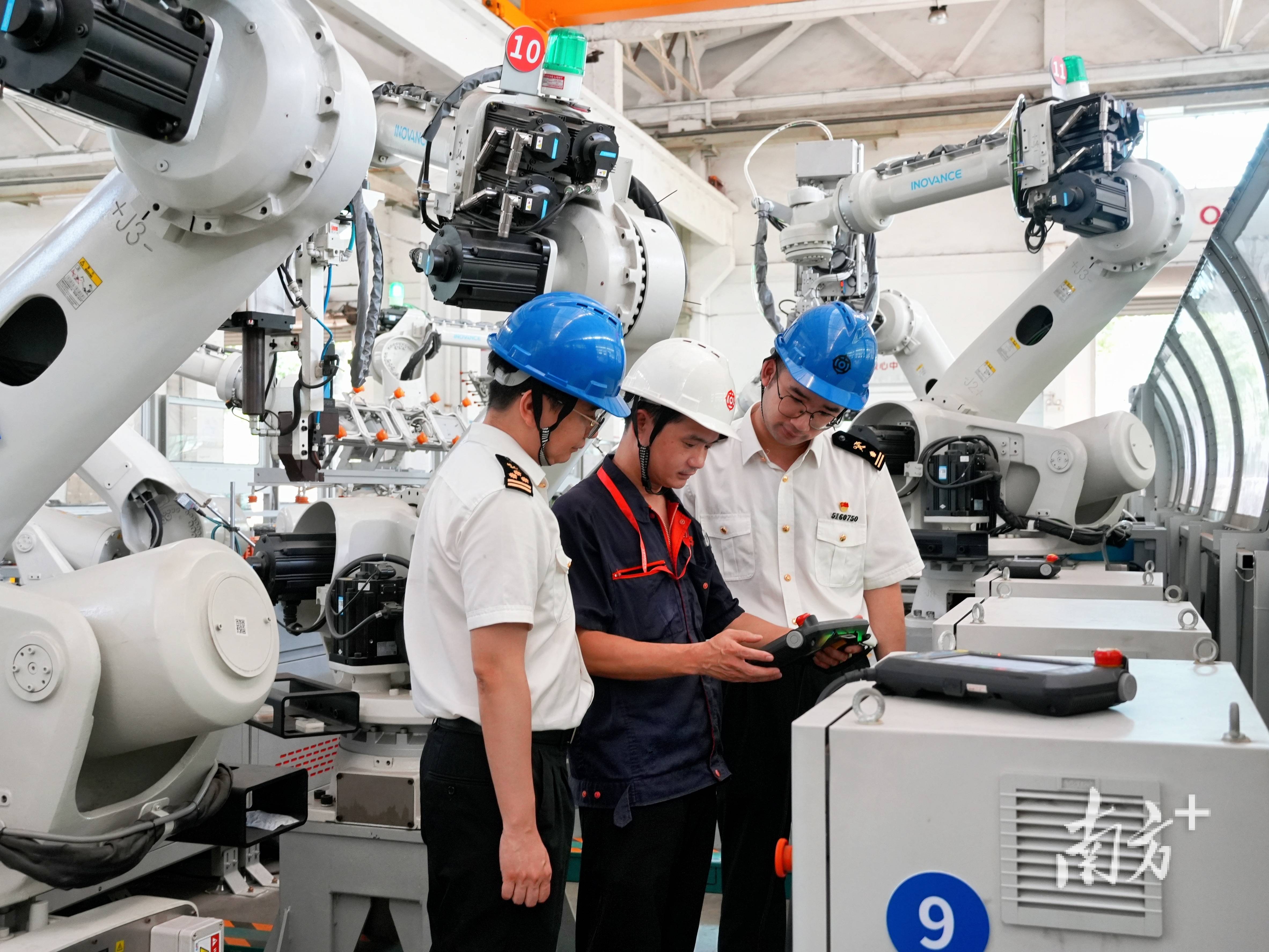
今年前9月广州海关关区企业超96亿元进出口货物享惠RCEP
Sou Hu Cai Jing· 2025-10-28 15:07
Group 1 - In the first nine months of this year, Guangzhou Customs issued a total of 17,000 RCEP certificates of origin, with export value benefiting from these certificates amounting to 4.63 billion yuan, representing year-on-year growth of 7.6% and 11.2% respectively [1] - Enterprises declared imports under RCEP amounting to 5.01 billion yuan, enjoying a tariff reduction of 110 million yuan, with year-on-year increases of 17.0% and 38.4% respectively [1] Group 2 - Guangzhou Oukatu International Trade Co., Ltd., a company specializing in the R&D and production of beauty products, reported that the implementation of RCEP allowed them to export eye makeup products to Indonesia with zero tariffs, enhancing their product competitiveness. Their export value exceeded 50 million yuan in the first nine months, a nearly 30% year-on-year increase [5] - Guangdong Weirong Electronic Technology Co., Ltd., a high-tech enterprise producing multilayer ceramic capacitors, benefited from RCEP by obtaining a tariff reduction of approximately 1.63 million yuan through 232 RCEP certificates of origin, which helped lower production costs [5] - The "Approved Exporter" system for self-declaration of origin has been widely implemented since RCEP took effect, with 114 companies recognized by Guangzhou Customs, the highest in the country. In the first nine months, these approved exporters issued 1,650 self-declared origin statements, involving a value of 210 million yuan, marking year-on-year growth of 50.3% and 22.9% respectively [6]
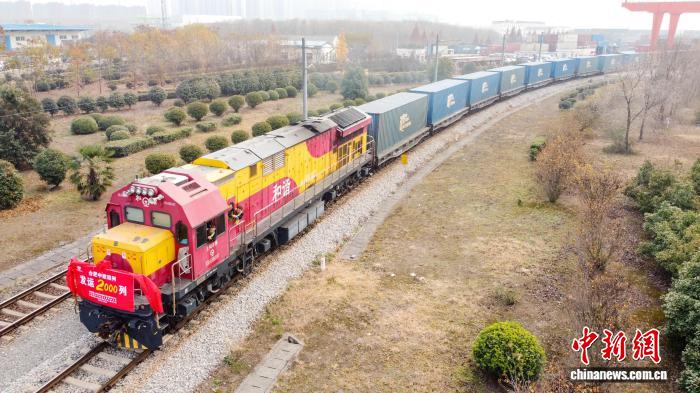
今年前三季度合肥对东盟进出口增长71%
Zhong Guo Xin Wen Wang· 2025-10-28 09:22
Core Insights - In the first three quarters of this year, Hefei's imports and exports to ASEAN increased by 71% [1] - The total import and export volume of Hefei reached nearly 329.6 billion yuan, a year-on-year increase of 21.8% [2] - The export of "new three items" (electric passenger vehicles, lithium batteries, solar cells) exceeded 31.7 billion yuan, growing by 20.2% [2] Group 1 - Hefei's trade with countries involved in the Belt and Road Initiative and other members of the Regional Comprehensive Economic Partnership (RCEP) saw increases of 29.6% and 45.1%, respectively [1] - Mechanical and electrical products accounted for nearly 80% of the city's total export volume, amounting to 179.3 billion yuan [2] - Over 570 enterprises participated in various domestic and international exhibitions, indicating Hefei's efforts to stabilize traditional markets while exploring emerging markets [2]
下一个五年 这两个字更重要
Zhong Guo Xin Wen Wang· 2025-10-28 00:14
Group 1 - The core viewpoint emphasizes that "expanding high-level opening-up" has been elevated in importance within China's 14th Five-Year Plan, reflecting a proactive choice amid geopolitical risks and trade protectionism [1][2] - The opening-up is primarily aimed at promoting China's own development, with a target of reaching a goods trade scale of $6.16 trillion and service trade exceeding $1 trillion by 2024 [2][3] - High-level opening-up has become a strong driving force for China's economic development [3] Group 2 - The nature of opening-up is undergoing a structural transformation, shifting from merely removing barriers to establishing rules [4][5] - China is transitioning from being a follower to a leader in global standards and rules, particularly in fields like artificial intelligence, quantum computing, and advanced manufacturing [5][6] - The next five years will see strategic deployments in three pillars of trade: goods, services, and digital trade [6][7] Group 3 - Emerging fields such as service trade and digital trade are becoming new frontiers for high-level opening-up [7][8] - Technologies like artificial intelligence and digital tools are reshaping traditional trade organization and resource allocation, enhancing certainty and resilience in opening-up [8] Group 4 - China's opening-up strategy is diversifying and is no longer reliant on a single market, with increasing trade with Belt and Road Initiative countries and significant growth in trade with ASEAN following the RCEP agreement [9] - The emphasis on "active" opening-up indicates a shift from compliance-based to a more proactive approach, enhancing foreign investment confidence [9][10] - The total foreign direct investment in China from 2021 to May 2025 is projected to reach 4.7 trillion yuan, surpassing the total during the previous five-year plan [9][10] Group 5 - Investment in China is becoming a necessity for multinational companies, with foreign firms expressing increased confidence in the Chinese market due to the emphasis on opening-up and innovation [10] - China's high-level opening-up not only drives its own development but also plays a stabilizing role in global connectivity, creating a mutually beneficial rule system for broader market access and investment opportunities [10]
前三季度新疆外贸创新高 加速开拓新兴市场
Zhong Guo Xin Wen Wang· 2025-10-24 16:16
Core Viewpoint - In the first three quarters of this year, Xinjiang's foreign trade import and export value reached 393.14 billion yuan, marking a year-on-year increase of 22.1%, setting a historical record for the same period [1] Group 1: Trade Performance - Xinjiang's import and export value with countries involved in the Belt and Road Initiative reached 341.49 billion yuan [1] - Trade with RCEP member countries and ASEAN saw significant growth, with import and export values of 57.41 billion yuan and 48.8 billion yuan, respectively, reflecting year-on-year increases of 98.5% and 99.2% [1] - The five Central Asian countries remain Xinjiang's largest trading partners, with a total import and export value of 215.73 billion yuan [1] Group 2: Trade Composition - General trade has been a key driver for Xinjiang's foreign trade growth, with an import and export value of 198.86 billion yuan, up 81.9% year-on-year [1] - Border trade experienced a "doubling" growth, with imports valued at 0.95 billion yuan, a year-on-year increase of 100.4% [1] Group 3: Role of Private Enterprises - Xinjiang's private enterprises accounted for 367.39 billion yuan in foreign trade import and export, a year-on-year increase of 23.4%, representing 93.5% of the total foreign trade value during the same period [1] - These enterprises achieved positive growth in trade with 173 countries and regions globally [1] Group 4: Market Expansion - Xinjiang is accelerating its efforts to explore emerging markets, with significant growth in trade with Africa, West Asia, and Latin America, showing year-on-year increases of 149.1%, 102.4%, and 107%, respectively [1]
持续布局新旧动能转换 上海给出亮眼数据
Sou Hu Cai Jing· 2025-10-22 16:36
Economic Growth and New Momentum - Shanghai's GDP for the first three quarters reached 40,721.17 billion yuan, with a year-on-year growth of 5.5%, surpassing the national growth rate of 5.2% [1][2] - The new momentum in Shanghai's economy is driven by the rapid growth of new industries, with manufacturing output increasing by 8.5% and high-tech manufacturing output growing by 10.3% [1][4] Industrial Performance - The three leading industries in Shanghai saw significant growth, with strategic emerging industries' output increasing by 7.3%, accounting for 44.1% of the city's total industrial output [4][5] - Notable growth was observed in artificial intelligence (12.8%), integrated circuits (11.3%), and biomedicine (3.6%) [4] Service Sector Growth - The tertiary sector, which accounts for nearly 80% of GDP, also showed resilience, with a year-on-year increase of 5.9% in value added [1] - The information transmission, software, and IT services sector grew by 15.5%, while the financial sector increased by 9.8% [1] Consumer Market Trends - Shanghai's total retail sales of consumer goods reached 12,302.77 billion yuan, with a year-on-year growth of 4.3% in the first three quarters [6] - The retail sales showed a quarterly growth trend, with significant increases in the third quarter [6] Investment and Future Prospects - Industrial investment in Shanghai grew by 20.3%, significantly outpacing the overall fixed asset investment growth of 6.0% [10] - The city is focusing on reducing costs for industrial enterprises, leading to a 16.3% increase in profits for industrial companies [10] Export Performance - The export value of the three leading industries reached 1,936.7 billion yuan, growing by 10.3% [11] - High-end manufacturing exports, including industrial robots and aerospace equipment, saw substantial growth, with some categories increasing by over 30% [11] Strategic Initiatives - Shanghai is actively developing its artificial intelligence sector, aiming to enhance its industrial chain and innovation ecosystem [9] - The city is also positioning itself as a global hub for biomedicine, with significant achievements in innovative drug approvals and a growing number of biomedicine enterprises [8]
西部外贸大省变局:渝桂陕前三季度跑出“加速度”
2 1 Shi Ji Jing Ji Bao Dao· 2025-10-22 12:56
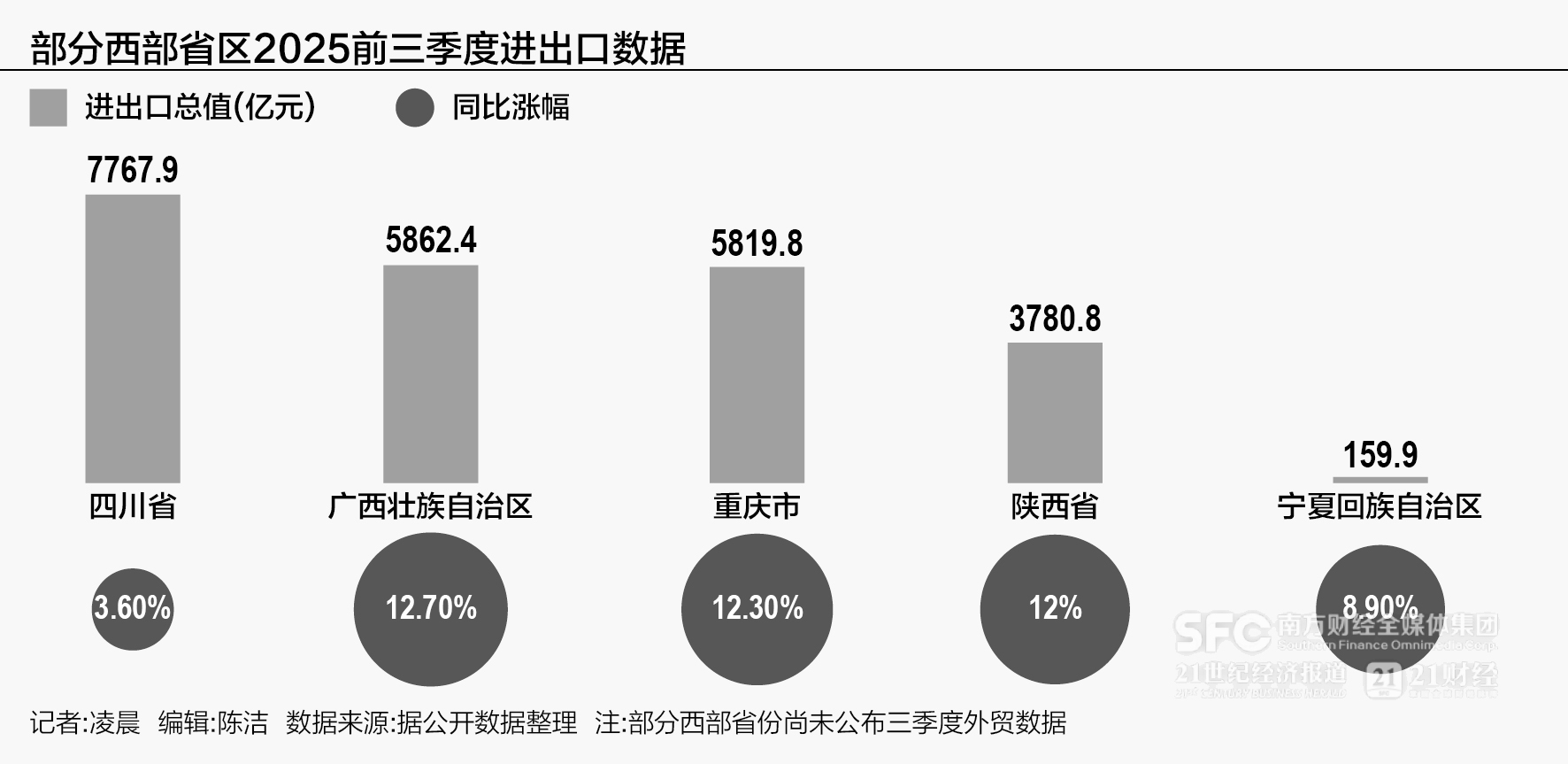
Core Insights - The western provinces of China have shown remarkable performance in foreign trade during the first three quarters of the year, with significant growth rates surpassing the national average [1][5][8] - Key drivers for this growth include deepening economic cooperation with ASEAN and the emergence of new industries [1][5][8] - The transformation from "channel economy" to "industrial economy" is evident in the high-growth provinces, indicating a shift towards more sustainable economic models [9][11] Summary by Category Trade Performance - Shaanxi's total import and export value reached 378.08 billion yuan, with a year-on-year growth rate of 12%, outperforming the national average by 8 percentage points [1][6] - Guangxi's foreign trade value was 586.24 billion yuan, with a growth rate of 12.7%, making it the fastest-growing province in the western region [5] - Chongqing's foreign trade totaled 581.98 billion yuan, achieving a growth rate of 12.3% [5] Key Drivers of Growth - The growth in these provinces is attributed to the continuous deepening of economic cooperation with ASEAN and the diversification of trade methods [5][11] - The "policy empowerment + channel optimization" model has effectively reduced logistics costs and improved customs efficiency [1][8] - The western region is actively undertaking industrial transfers from the eastern provinces and enhancing cooperation with countries along the Belt and Road Initiative [1][2] Industry and Export Trends - In Guangxi, exports of electronic components and computer accessories surged by 56.6% and 146.1%, respectively, indicating a strong integration into the China-ASEAN electronic information supply chain [5][11] - Chongqing's exports of mechanical and electrical products accounted for 90% of its total exports, with notable growth in electric vehicles and laptops [6][11] - Shaanxi's high-tech product exports grew by 11.4%, with "new three types" products (new energy vehicles, lithium-ion batteries, photovoltaic products) seeing a 32.6% increase [6][10] Future Outlook - The western region is expected to gradually form a new foreign trade pattern characterized by multi-point support and internal-external linkage [2][8] - The focus will be on enhancing quality and reducing risks while expanding into high-end equipment and new energy vehicle sectors [7][11] - The integration of policy, industry, and market will be crucial for the future competitiveness of western provinces in foreign trade [11]
第24届中国(阳江)国际五金刀剪博览会开幕
Nan Fang Ri Bao Wang Luo Ban· 2025-10-22 09:08
Core Insights - The 24th China (Yangjiang) International Hardware Knife and Scissors Expo aims to promote the global hardware knife and scissors industry through an innovative model of "exhibition + conference + competition + trade" [1] - The expo features an exhibition area of nearly 20,000 square meters, attracting over 210 quality manufacturers and nearly 10,000 buyers, showcasing a complete supply chain from raw materials to finished products [1][2] - The event has established five specialized exhibition areas to facilitate one-stop procurement and in-depth exchanges, enhancing the visibility of Yangjiang's hardware knife and scissors industry on a global scale [1][2] Industry Development - The expo has strengthened industrial collaboration across China by inviting brands from major production areas, fostering a collective effort for high-quality development in the hardware knife and scissors industry [2] - International participation has increased, with representatives from six countries attending the opening ceremony and agreements signed with four countries to enhance economic and trade cooperation [2] - The expo has become a significant platform for promoting the integration of domestic and foreign trade in Yangjiang, with projected export growth rates of 2.3% and 8.5% for the "Belt and Road" and RCEP regions, respectively, in 2024 [3] Economic Impact - The hardware knife and scissors industry in Yangjiang has a robust foundation, supported by over 8,500 industry entities and a total industry chain scale exceeding 55 billion yuan [2] - Domestic e-commerce sales are expected to reach 9.93 billion yuan, with cross-border e-commerce transactions projected at 2.93 billion yuan, both achieving double-digit growth [3]
广西前三季度进出口增长12.7%
Jing Ji Ri Bao· 2025-10-22 05:54
Core Insights - Guangxi's foreign trade imports and exports have maintained a rapid growth momentum in 2023, with a total of 586.24 billion yuan in the first three quarters, representing a year-on-year increase of 12.7% [1] - In September alone, the import and export volume reached 69.48 billion yuan, marking a significant growth of 20.4% and setting a historical record for the same period [1] Group 1: Trade Characteristics - The first three quarters showed high growth in processing trade, with an import and export volume of 68.01 billion yuan, increasing by 59.5% [1] - Private enterprises accounted for a significant portion of the trade, with exports reaching 398.43 billion yuan, up 11.6%, and making up 68% of the total [1] - Trade with other RCEP member countries was also notable, with imports and exports totaling 341.18 billion yuan, a growth of 10.6%, representing 58.2% of the total [1] Group 2: Infrastructure and Efficiency Improvements - The new western land-sea corridor has significantly enhanced the efficiency of port services, with freight volume through the new corridor increasing by 70.3% year-on-year [1] - Specific provinces such as Yunnan, Chongqing, Sichuan, and Guizhou saw substantial growth in trade through Guangxi ports, with increases of 56.4%, 168.2%, 11.2%, and 35.7% respectively [1] - The port has effectively facilitated the export of electronic information products from Chongqing and Sichuan, while ensuring smooth imports of essential raw materials for Yunnan and Guizhou [1] Group 3: Agricultural Trade Developments - Nanning Customs has actively developed a new ecosystem for port inspections, significantly reducing the inspection time for agricultural products, which has stimulated rapid growth in agricultural trade with ASEAN [2] - In the first three quarters, Guangxi imported agricultural products from ASEAN worth 17.36 billion yuan, an increase of 18%, with palm oil imports surging by 162.8% [2] - The establishment of a dedicated fresh produce passage at Aidian Port has improved customs efficiency, allowing trucks transporting fruits to clear customs approximately every five minutes [2]