
东数西算

Search documents
经济新方位丨这个“10万亿”,意味着什么
Ren Min Ri Bao· 2026-01-19 02:46
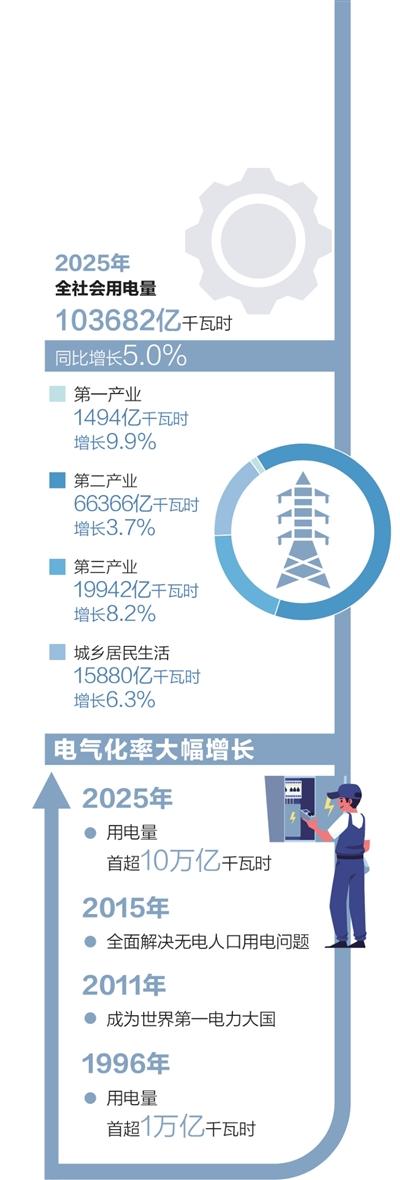
Core Insights - China's total electricity consumption is projected to exceed 10 trillion kilowatt-hours by 2025, marking a significant milestone as the first country to reach this level globally [1] - The growth in electricity consumption reflects China's status as a manufacturing powerhouse and indicates an enhancement in energy security capabilities [1] Group 1: Electricity Consumption Trends - By 2025, the secondary industry is expected to consume 66,366 billion kilowatt-hours, accounting for approximately 64% of total electricity consumption, maintaining its role as the primary sector [2] - The demand for electricity in the semiconductor industry is surging, with companies like Huahong Semiconductor reporting over a 43% year-on-year increase in electricity consumption due to heightened production [2] - The electricity consumption in the computer, communication, and other electronic equipment manufacturing sectors is projected to surpass 50 billion kilowatt-hours for the first time, outpacing traditional industries like steel and chemicals [2] Group 2: Industrial and Service Sector Developments - High-end manufacturing, including new energy vehicles and wind power equipment, is expected to see growth rates exceeding 20% and 30%, respectively, while traditional high-energy-consuming industries will experience slower growth at 1.8% [3] - The tertiary sector's electricity consumption is anticipated to reach nearly 2 trillion kilowatt-hours by 2025, with a year-on-year growth of 8.2%, driven by sectors like charging services and information technology [3] Group 3: Electrification and Rural Development - The electrification rate of end-use energy is around 30%, surpassing that of major developed economies, contributing to increased electricity consumption [4] - Investments in rural electrification projects are expected to narrow the gap in electricity consumption between urban and rural residents [5] Group 4: Power Supply and Infrastructure - China's power generation capacity accounts for one-third of the global total, with over 95% of coal-fired power plants achieving ultra-low emissions [6] - The construction of 46 ultra-high voltage projects will enhance the transmission of clean energy from western and northern regions to load centers in the east and central areas [7] - The national unified electricity market has seen a significant increase in traded electricity volume, growing from 10.7 trillion kilowatt-hours to 23.8 trillion kilowatt-hours, representing over 60% of total electricity consumption [8]
这个“10万亿” 意味着什么
Ren Min Ri Bao· 2026-01-19 01:37
Core Insights - In 2025, China's total electricity consumption is projected to exceed 10 trillion kilowatt-hours for the first time globally, reflecting significant economic growth and energy security improvements [2][10] Group 1: Electricity Consumption Growth - China's electricity consumption in 2025 is expected to reach 10,368.2 billion kilowatt-hours, more than double that of the United States and surpassing the total consumption of the EU, Russia, India, and Japan combined [2] - The electricity consumption in 2025 will be nearly double that of 2015, showcasing an unprecedented growth rate among major economies [2][3] Group 2: Industrial and Sectoral Changes - The secondary industry is projected to consume 66,366 billion kilowatt-hours, accounting for approximately 64% of total consumption, with significant contributions from high-value-added and technology-intensive sectors [3] - The electricity consumption in the computer, communication, and other electronic device manufacturing sectors is expected to exceed 50 billion kilowatt-hours, surpassing traditional industries like steel and chemicals [3][4] - The third industry is anticipated to consume nearly 2 trillion kilowatt-hours, with a year-on-year growth of 8.2%, driven by sectors such as electric vehicle charging and information technology services [4] Group 3: Electrification and Energy Efficiency - The electrification rate of end-use energy is around 30%, which is higher than that of major developed economies, contributing to increased electricity consumption [5] - Smart irrigation systems in agriculture have improved efficiency by approximately 65%, indicating advancements in energy use in traditional sectors [6] Group 4: Power Supply and Infrastructure - China has the world's largest power supply system, with renewable energy sources accounting for over one-third of total electricity generation, and wind and solar capacity surpassing thermal power for the first time [7][8] - The construction of ultra-high voltage transmission lines has strengthened the energy supply network, facilitating the transfer of clean energy from western regions to eastern load centers [8][9] - The national electricity market has seen a significant increase in transaction volume, doubling from 10.7 trillion kilowatt-hours to 23.8 trillion kilowatt-hours, now accounting for over 60% of total electricity consumption [9]
“人工智能+”与数字经济知名上市公司 企业家河南行活动在郑举行
Zheng Zhou Ri Bao· 2026-01-19 00:53
Group 1 - The event "Artificial Intelligence + Digital Economy" held in Zhengzhou gathered key figures from various sectors, including artificial intelligence, new materials, and finance, to explore new economic opportunities and collaborative efforts [1] - Zhengzhou is positioned as a central hub in the national "East Data West Computing" strategy, enhancing its role in the digital economy and infrastructure development [1] - The city has made significant progress in digital transformation and computing power infrastructure, laying a solid foundation for the integration of artificial intelligence and the digital economy [1] Group 2 - The Yangtze River Delta region is recognized as a highly active and innovative area in China's economic development, making it a crucial partner for Zhengzhou [2] - Recent collaborative activities between Zhengzhou and the Yangtze River Delta have yielded mutual benefits, enhancing economic exchanges [2] - The current event serves as a platform for deeper integration of industrial, innovation, and capital chains between Zhengzhou and the Yangtze River Delta, promoting high-quality regional development [2]
这个“10万亿”,意味着什么(经济新方位)
Ren Min Ri Bao· 2026-01-18 23:47
Core Insights - In 2025, China's total electricity consumption is projected to exceed 10 trillion kilowatt-hours for the first time, marking a significant milestone in global energy consumption [3][4] - This consumption level is more than double that of the United States and surpasses the total consumption of the European Union, Russia, India, and Japan combined [3] - The growth in electricity consumption reflects China's robust manufacturing capabilities and enhanced energy security [3] Electricity Consumption by Sector - The primary industry is expected to consume 149.4 billion kilowatt-hours, showing a growth of 9.9% [1] - The secondary industry will account for 66,366 billion kilowatt-hours, with a growth rate of 3.7%, maintaining its status as the main consumer [1][4] - The tertiary industry is projected to consume 19,942 billion kilowatt-hours, growing by 8.2% [1][5] - Urban and rural residential electricity consumption is expected to reach 15,880 billion kilowatt-hours, with a growth of 6.3% [1][6] Industrial and Technological Developments - The electricity consumption in the industrial sector is increasingly driven by high-value-added and technology-intensive industries [5] - In Jiangsu, the semiconductor industry is experiencing significant growth, with companies like Huahong Semiconductor reporting over 43% year-on-year increase in electricity consumption [4] - The computer and communication equipment manufacturing sector has surpassed traditional industries like steel and chemicals in electricity consumption, indicating a shift in industrial structure [4] Electrification and Energy Efficiency - The electrification rate of end-use energy is approximately 30%, which is higher than that of major developed economies [6] - Innovations in agriculture, such as smart irrigation systems, are contributing to increased electricity consumption in rural areas [6][7] - The "14th Five-Year Plan" includes significant investments in rural power grid improvements, enhancing electricity access and reducing consumption disparities between urban and rural areas [6] Power Supply and Infrastructure - China's power supply system is the largest globally, with renewable energy sources like wind and solar surpassing traditional coal power [8][9] - The country has built 46 ultra-high voltage transmission lines to efficiently transport clean energy from resource-rich regions to consumption centers [9] - The national grid's investment has reached historical highs, ensuring robust electricity supply and infrastructure development [9][10] Market Dynamics and Energy Transition - The establishment of a unified national electricity market has significantly increased market transaction volumes, doubling from the previous five-year period [11] - The energy sector is actively transitioning towards a new energy system, focusing on green and low-carbon development [11] - The growth in electricity consumption is indicative of China's economic transformation and improvement in living standards [11]

全球首次,2025年我国全社会用电量超10万亿千瓦时——这个“10万亿”,意味着什么
Xin Hua Wang· 2026-01-18 23:41
Core Insights - In 2025, China's total electricity consumption is projected to exceed 10 trillion kilowatt-hours for the first time, marking a significant milestone in global energy consumption [1] - This consumption level is more than double that of the United States and surpasses the combined total of the EU, Russia, India, and Japan [1] - The growth in electricity consumption reflects China's robust manufacturing capabilities and enhanced energy security [1] Group 1: Industrial Electricity Consumption - In 2025, the secondary industry is expected to consume 66,366 billion kilowatt-hours, accounting for approximately 64% of total electricity consumption [2] - The semiconductor industry, driven by AI applications, is experiencing a surge in demand, with companies like Huahong Semiconductor reporting over 43% year-on-year growth in electricity consumption [2] - The electricity consumption structure in Jiangsu is shifting, with the computer and communication equipment manufacturing sector surpassing traditional industries like steel and chemicals for the first time [2] Group 2: High-End and Green Development - The high-end manufacturing sector, including new energy vehicles and wind power equipment, is projected to grow electricity consumption by over 20% and 30% respectively [3] - The service sector is also becoming a significant driver of electricity consumption, with the data industry in Guizhou showing rapid growth [3] - By 2025, the tertiary sector's electricity consumption is expected to reach nearly 2 trillion kilowatt-hours, growing by 8.2% year-on-year [3] Group 3: Electrification Trends - The electrification rate of end-use energy is around 30%, surpassing that of major developed economies [4] - In Yunnan, smart irrigation systems have improved efficiency by approximately 65%, reflecting advancements in agricultural electricity consumption [5] - The gap in electricity consumption between urban and rural residents is gradually narrowing due to investments in rural power grid improvements [5] Group 4: Power Supply and Infrastructure - China's power generation capacity accounts for one-third of the global total, with over 50% of coal-fired power plants capable of deep peak regulation [6] - The country has built the world's largest power supply system and clean energy generation framework, with renewable energy sources surpassing thermal power for the first time [6] - The construction of ultra-high voltage transmission lines has strengthened the energy supply network, facilitating the transfer of clean energy from the west to the east [7] Group 5: Market Dynamics - The establishment of a unified national electricity market has significantly increased electricity trading volume, doubling from 10.7 trillion kilowatt-hours to 23.8 trillion kilowatt-hours [8] - The market's role as a regulator and price guide has become more pronounced, enhancing the efficiency of electricity resource allocation [8] - The ongoing transition towards a new energy system is expected to support high-quality development in renewable energy and contribute to China's modernization efforts [8]
2025年我国全社会用电量超10万亿千瓦时 意味着什么
Ren Min Ri Bao· 2026-01-18 23:32
Core Insights - China's total electricity consumption is projected to exceed 10 trillion kilowatt-hours by 2025, marking a significant milestone as the first country to reach this level globally [1] - This consumption level is more than double that of the United States and surpasses the combined total of the European Union, Russia, India, and Japan [1] - The growth in electricity consumption reflects China's robust manufacturing capabilities and enhanced energy security [1] Electricity Consumption Trends - By 2025, the secondary industry is expected to consume 66,366 billion kilowatt-hours, accounting for approximately 64% of total electricity consumption [2] - The semiconductor industry, driven by AI applications, is experiencing a surge in demand, with companies like Huahong Semiconductor reporting over 43% year-on-year growth in electricity consumption [2] - The electricity consumption structure is shifting, with the computer and communication equipment manufacturing sector surpassing traditional industries like steel and chemicals for the first time [2] Industrial and Service Sector Developments - High-end manufacturing and technology-intensive industries are becoming the primary contributors to electricity consumption growth, with new energy vehicles and wind power equipment manufacturing seeing growth rates exceeding 20% and 30%, respectively [3] - The service sector is also a significant driver of electricity consumption, with the third industry expected to consume nearly 2 trillion kilowatt-hours by 2025, reflecting an 8.2% year-on-year increase [3] Electrification and Rural Development - The electrification rate of end-use energy is around 30%, surpassing that of major developed economies, contributing to increased electricity consumption [4] - Rural electrification initiatives have led to significant investments, with over 800 billion yuan allocated to improve rural power grids, narrowing the electricity consumption gap between urban and rural residents [5] Power Supply and Infrastructure - China's power supply system is the largest globally, with renewable energy sources accounting for over one-third of total electricity generation [6] - The construction of high-voltage transmission lines has strengthened the electricity grid, facilitating the transfer of clean energy from western regions to eastern load centers [7] - The national electricity market has seen a significant increase in trading volume, doubling from 10.7 trillion kilowatt-hours to 23.8 trillion kilowatt-hours since the 13th Five-Year Plan [8] Conclusion - The anticipated electricity consumption of 10 trillion kilowatt-hours signifies an upgrade in power supply capabilities, reflecting China's economic transition towards higher quality and improved living standards [9]
全球首次,2025年我国全社会用电量超10万亿千瓦时—— 这个“10万亿”,意味着什么(经济新方位)
Ren Min Ri Bao· 2026-01-18 22:05
Group 1 - In 2025, China's total electricity consumption is projected to exceed 10 trillion kilowatt-hours for the first time, which is more than double the annual electricity consumption of the United States and higher than the combined total of the EU, Russia, India, and Japan [1] - The electricity consumption growth reflects China's status as a manufacturing powerhouse and indicates a significant improvement in energy security [1] - The electricity consumption in the secondary industry is expected to reach 66,366 billion kilowatt-hours, accounting for approximately 64% of total consumption, with a notable shift towards high-value-added and technology-intensive industries [2] Group 2 - The demand for electricity in the semiconductor industry is surging, with companies like Huahong Semiconductor reporting over 43% year-on-year growth in electricity consumption due to increased production [2] - The electricity consumption in the computer, communication, and other electronic equipment manufacturing sectors is projected to surpass 50 billion kilowatt-hours for the first time, overtaking traditional industries like steel and chemicals [2] - The third industry is also contributing significantly to electricity consumption, with a projected growth of 8.2% year-on-year, reaching nearly 2 trillion kilowatt-hours by 2025 [3] Group 3 - The electrification rate of end-use energy in China is around 30%, which is higher than that of major developed economies, contributing to increased electricity consumption [4] - The implementation of smart irrigation systems in agriculture has improved efficiency by approximately 65%, showcasing the impact of electrification on traditional sectors [5] - The gap in electricity consumption between urban and rural residents is gradually narrowing, supported by significant investments in rural power grid upgrades [5] Group 4 - China's power supply system is the largest globally, with renewable energy sources like wind and solar surpassing thermal power for the first time [6] - The country has built the world's largest clean coal power supply system, with over 95% of coal power units meeting ultra-low emissions standards [6] - The construction of high-voltage transmission lines has strengthened the electricity grid, facilitating the transfer of clean energy from resource-rich regions to consumption centers [7] Group 5 - The establishment of a unified national electricity market has significantly increased electricity trading volume, doubling from 10.7 trillion kilowatt-hours to 23.8 trillion kilowatt-hours since the 13th Five-Year Plan [8] - The electricity market's role as a regulator and price guide has been enhanced, contributing to the efficient allocation of resources [8] - The energy sector is actively promoting a new energy system and advancing green and low-carbon transitions, supporting high-quality development of renewable energy [8]
算力需求爆发,千亿龙头股价一个月内狂飙86%
21世纪经济报道· 2026-01-18 14:00
Core Viewpoint - The AIDC (Artificial Intelligence Data Center) sector is entering a critical transition period from "concept narrative" to "performance verification" driven by policies, technology, and global computing power demand by the end of 2025 to early 2026 [1] Group 1: Market Dynamics - The AIDC industry is entering a new phase of market differentiation due to the ongoing global AI competition, the implementation of domestic policies like "East Data West Computing," and accelerated technological iterations such as liquid cooling and high-speed interconnects [4] - The capital expenditure of major North American cloud providers reached $257.4 billion in the first three quarters of 2025, a 65% year-on-year increase, indicating a strong demand-side momentum [5] - Major domestic internet companies are expected to reach a peak capital expenditure of 77.2 billion yuan in Q4 2024, reflecting the urgency for cloud providers to layout the next round of intelligent computing centers [5] Group 2: Supply Chain Challenges - The effective supply of AIDC is constrained by multiple hard constraints, particularly in energy and equipment, with electricity demand for data centers expected to rise significantly [7] - By 2028, data center electricity demand in the U.S. is projected to account for 6.7%-12% of total electricity consumption, leading to an expanded supply-demand gap and rising electricity prices [7] - The global supply of gas turbines is highly concentrated, with three major companies holding 88% of the market share, creating an opportunity for Chinese manufacturers to enter the global supply chain [7] Group 3: Technological Innovations - Liquid cooling technology is becoming essential as AI chip power consumption increases, with a projected global penetration rate of 30% by 2026, representing a market space of approximately 68.8 billion yuan [8] - The shift to liquid cooling is expected to reshape the cooling equipment market and drive structural upgrades in data center power distribution systems [8] Group 4: Investment Opportunities - Companies with core customer resources, technological advantages, or the ability to solve key bottlenecks are becoming focal points for investment in the AIDC sector [10] - Key investment targets include IDC leaders with core internet clients, second-tier firms capable of absorbing overflow demand, and upstream suppliers of power distribution and cooling equipment [10] - Specific companies such as Shenghong Co. in power supply and cooling equipment are highlighted as key observation targets due to their potential to address bottlenecks in the industry [11]

年用电量首超10万亿度 展现中国经济发展活力
Xin Lang Cai Jing· 2026-01-18 13:17
Group 1 - The core point of the article is that China's total electricity consumption is projected to exceed 10 trillion kilowatt-hours by 2025, marking a significant milestone as the first country to reach this level, which is more than double the annual electricity consumption of the United States and surpasses the combined consumption of the EU, Russia, India, and Japan [1][3][4] - In 2025, China's total electricity consumption is expected to reach 10,368.2 billion kilowatt-hours, representing a year-on-year growth of 5.0% [1][3] - The primary sectors contributing to this growth include the first industry with a consumption of 149.4 billion kilowatt-hours (up 9.9%), the second industry with 6,636.6 billion kilowatt-hours (up 3.7%), and the third industry with 199.4 billion kilowatt-hours (up 8.2%) [1][3] Group 2 - The third industry and residential electricity consumption are the main drivers of overall electricity growth, contributing to 50% of the increase [3][6] - The rapid growth in the third industry is attributed to sectors such as electric vehicle charging services, which saw a consumption growth rate of 48.8%, and information transmission, software, and IT services, which grew by 17.0% [3][6] - The electricity consumption in high-end manufacturing has surpassed traditional high-energy-consuming industries, indicating a structural shift towards knowledge-intensive and innovation-driven sectors [4][8] Group 3 - The electricity supply system's resilience is being tested as the country aims to achieve this unprecedented level of consumption, with a focus on building a clean and low-carbon power generation system and an efficient interconnected transmission network [4][6] - The digital economy is experiencing rapid growth, with the data industry in Guizhou seeing a staggering 95.01% increase in electricity consumption, driven by the "East Data West Computing" initiative [8] - The transition towards a high-tech, high-value-added industrial structure is evident, with the increasing share of green electricity supply signaling a positive outlook for a new energy system dominated by renewables [8]
建筑行业周报:海外持续景气叠加国产替代提速,继续看多洁净室-20260118
GF SECURITIES· 2026-01-18 10:46
Core Viewpoints - The report maintains a bullish outlook on cleanroom segments due to ongoing overseas demand and accelerated domestic substitution in the construction and decoration industry [1][4]. Group 1: Semiconductor Capital Expenditure - TSMC and Micron are significantly increasing their capital expenditures in 2026, with TSMC's actual capital expenditure expected to reach $40.9 billion, a 37% increase from $29.8 billion in 2025, marking a historical high for the company [12][16]. - Micron has raised its capital expenditure forecast for the 2026 fiscal year to $20 billion, up from an initial estimate of $18 billion, indicating strong growth in the semiconductor sector [12][17]. - Domestic semiconductor companies, including Changxin Technology and SMIC, are also in critical phases of expansion and technological upgrades, with capital expenditures expected to grow significantly [12][18]. Group 2: IDC Construction and Internet Companies - The construction of domestic IDC projects is progressing, with major internet companies and operators accelerating their investments. For instance, China Mobile's data center project in Hohhot is valued at CNY 5.244 billion, while China Telecom's smart cloud base project is valued at CNY 880 million [22][23]. - Leading internet companies like Alibaba and ByteDance are planning substantial investments in AI-related infrastructure, with Alibaba set to invest CNY 380 billion over the next three years [22][24]. - The report suggests that construction companies can leverage their resources to participate in IDC operations and maintenance, enhancing their value-added services [22][24]. Group 3: Coal Chemical Projects and Steel Prices - Coal chemical projects are steadily advancing, with significant contracts being awarded, such as the CNY 1 billion contract for the Shenhua Yulin project [26][27]. - Steel prices have seen a slight decline, with the average price of medium and thick plates at CNY 3,359 per ton, down 0.6% week-on-week, indicating a stable but low pricing environment [28][29].

