空间计算

Search documents
WRC2025聚焦(4):多场景加速落地,EAI与空间计算引领机器人产业新周期
Haitong Securities International· 2025-08-13 04:04
Investment Rating - The report does not explicitly provide an investment rating for the robotics industry but indicates a significant growth potential, suggesting a favorable outlook for investments in this sector [5][21]. Core Insights - The global robotics industry is transitioning from single manufacturing scenarios to multi-sector applications, with a focus on ecosystem building and application deployment in the short term, while embodied intelligence and spatial computing are expected to become foundational technologies in the long term [19][21]. - Japan is advancing embodied intelligence with a focus on "human-machine symbiosis," aiming for full-spectrum intelligence in robots, particularly in healthcare, disaster rescue, and scientific collaboration [15][17]. - The UAE is leveraging its "2030 AI Strategy" and "Dubai 200,000 Robots Plan" to drive the robotics industry, targeting a 9% contribution to GDP by 2032, with strategic focuses on smart factories, medical robots, and space exploration [16][21]. - JD.com is investing over RMB 10 billion in the intelligent robotics sector, aiming to deploy robots across over one million end-user scenarios and support 100 brands to achieve over RMB 1 billion in sales [17][21]. - Spatial computing is identified as a core enabler for robotics, enhancing human-machine interaction and facilitating the transition from AI to AI+Robotics under China's national strategy [18][21]. Summary by Sections Embodied Intelligence - Japan's approach to embodied intelligence focuses on creating distributed intelligent systems capable of environmental awareness and autonomous decision-making, with applications in healthcare and scientific research [15][17]. National Strategies - The UAE's robotics strategy aims for a 9% GDP contribution by 2032, with a focus on integrating government, enterprise, and academic resources to overcome challenges like engineer shortages [16][21]. Corporate Initiatives - JD.com is establishing a comprehensive robotics ecosystem, with significant investments aimed at integrating robots into various industries and households [17][21]. Technological Integration - The integration of spatial computing with AI is seen as crucial for advancing robotics, enabling robots to interact with the physical world in a more sophisticated manner [18][21].

vivo Vision已在内测,但苹果MR头显却要凉透了
3 6 Ke· 2025-08-11 23:35
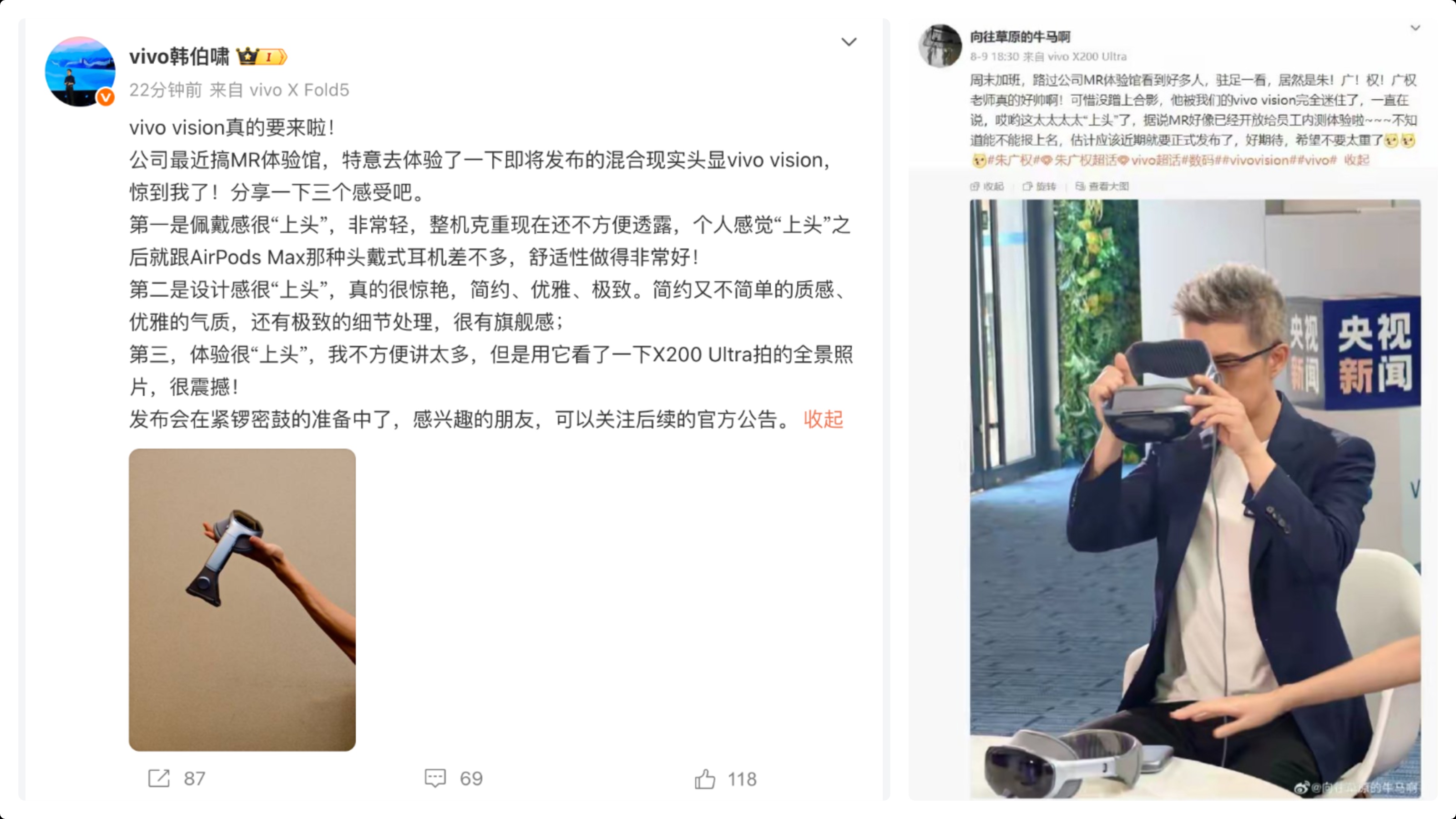
Core Insights - vivo is set to officially launch its mixed reality (MR) headset, vivo Vision, following a series of teasers and internal testing [1][4][5] - The product is positioned as a step towards a broader robotics strategy, aiming to integrate MR technology into everyday user scenarios such as entertainment and home robotics [8][19] - vivo Vision's design bears similarities to Apple's Vision Pro, but it aims to differentiate itself by focusing on practical applications and affordability [7][19] Product Development - vivo's mixed reality team has expanded to 500 members, with plans to launch high-fidelity prototype experiences in multiple cities by September 2025 [5][9] - The company has established a new robotics lab, indicating a strategic focus on integrating MR with robotics technology [11] Technical Specifications - vivo Vision features a design reminiscent of ski goggles, with multiple cameras for spatial video capture and gesture interaction [11][15] - The headset is expected to weigh less than Apple's Vision Pro, which ranges from 600-650g, potentially enhancing user comfort during extended use [17][22] - It will utilize an external battery, with expectations for higher energy density compared to Apple's 3166mAh battery [17] Market Positioning - vivo Vision aims to create a compelling use case for MR technology by linking it to family-oriented applications and home automation, contrasting with the more niche positioning of Apple Vision Pro [19][23] - The company plans to price vivo Vision competitively, targeting a broader audience by aligning its cost with high-end smartphones and lightweight laptops [23] Competitive Landscape - vivo Vision seeks to address the shortcomings of Apple Vision Pro, which has faced criticism for its high price and limited practical applications [20][22] - The success of vivo Vision will depend on its ability to deliver on key performance metrics such as visual clarity, interaction accuracy, and overall user experience [20][23]


影目科技智能眼镜亮相世界运动会
Zheng Quan Ri Bao Wang· 2025-08-08 11:20
Core Insights - The 12th World Games officially commenced on August 7, with Shenzhen Yingmu Technology Co., Ltd. being the only smart glasses brand participating in the event [1] - Yingmu Technology showcased its products INMO GO2 and INMO AIR3, highlighting the potential of smart glasses in enhancing event experiences and promoting cultural exchange [1] Product Highlights - The company deployed 20 units of INMO GO2 simultaneous translation glasses in the World Games Village, capable of translating over 40 languages and recognizing 90 accents, covering most countries and regions globally [1] - INMO AIR3 is noted as the world's first mass-produced 1080P wireless all-in-one AR smart glasses, featuring the IMOS 3.0 spatial operating system, high-definition full-color display, spatial computing capabilities, and AI semantic interaction [1] - INMO AIR3 supports various functionalities such as virtual large screens, multi-screen collaboration, and AUTO AI, catering to diverse usage needs during the World Games [1]
AR创业者亲述:在美国做中国的事情,成本将暴涨好几倍
Guan Cha Zhe Wang· 2025-08-08 06:52
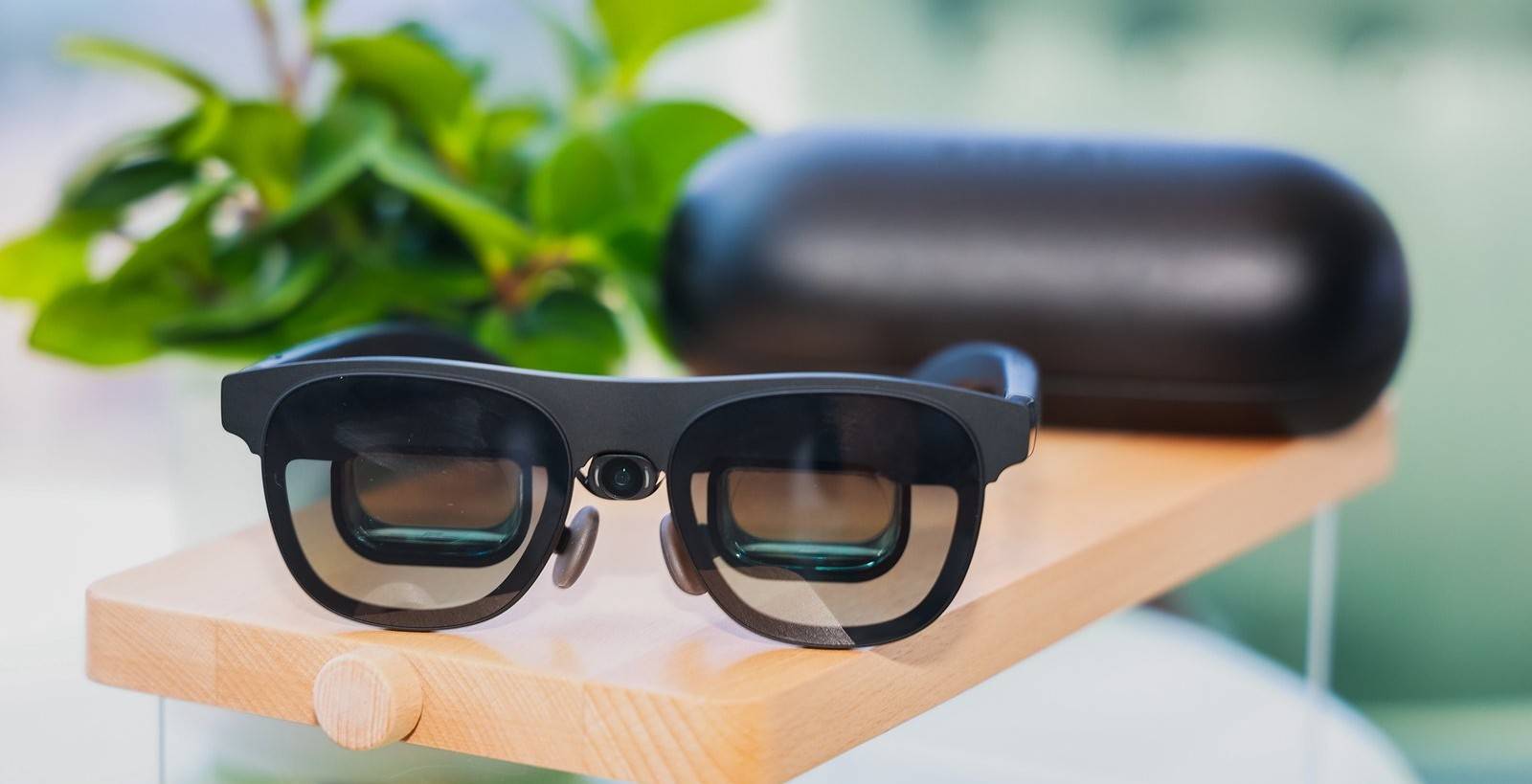
Core Viewpoint - The AI glasses market is currently booming, with major players like Xiaomi and Alibaba entering the space, while XREAL, a leading AR glasses company, has not yet released its AI glasses, focusing instead on core technological advancements and product differentiation [1][2]. Company Overview - XREAL was founded in 2017 by Xu Chi and Wu Kejian, with nearly 500 employees and over $300 million in funding from investors including Alibaba and Sequoia [2]. - The company has established two optical factories in Wuxi and Kunshan, producing 65% of its components in-house, leveraging China's manufacturing advantages [2]. Market Position - XREAL has been the global sales leader in the AR sector for three consecutive years and ranks second in the global AR/VR market, only behind Meta [1][2]. - The company believes that the hardware still faces challenges in optical display and battery life, predicting that achieving the ideal form will take five years or more [2]. Product Innovations - XREAL recently introduced two products: XREAL One Pro and Project Aura, focusing on spatial display and spatial computing capabilities [6][7]. - The XREAL One Pro features an upgraded optical system with a field of view of 57 degrees, providing an immersive viewing experience [6][7]. - The self-developed X1 chip in the XREAL One series reduces latency to an industry-leading 3 milliseconds, enhancing the user experience [7]. Strategic Partnerships - XREAL has partnered with Google on Project Aura, which aims to create a unified operating system for XR devices, similar to the Android system for smartphones [10]. - This collaboration is expected to address the fragmentation in the XR industry, allowing developers to create applications that can run across various hardware platforms [9][10].


创维数字跌1.38%,成交额2.19亿元,后市是否有机会?
Xin Lang Cai Jing· 2025-07-31 07:35
Core Viewpoint - The company, Skyworth Digital, is experiencing fluctuations in stock performance and is actively involved in the development of advanced technologies in the VR and smart home sectors [1][2][3]. Group 1: Company Performance - On July 31, Skyworth Digital's stock fell by 1.38%, with a trading volume of 219 million yuan and a market capitalization of 13.06 billion yuan [1]. - The company reported a revenue of 1.799 billion yuan for the first quarter of 2025, a year-on-year decrease of 21.24%, and a net profit attributable to shareholders of 5.3274 million yuan, down 94.98% year-on-year [8]. Group 2: Technology and Product Development - The company has developed self-researched software systems that include algorithms for six degrees of freedom positioning and gesture recognition, as well as VR live streaming solutions [2]. - Skyworth Digital's Pancake series VR/MR products utilize the Qualcomm XR2 chip, enabling the projection of large movie screens and interaction in three-dimensional virtual spaces [2]. - The company showcased its new generation XR products, including an 8K MR all-in-one machine and AI smart glasses, at the IFA 2024 in Berlin [3]. Group 3: Market Position and Shareholder Information - Skyworth Digital holds a 32.26% market share in the 10G PON dual-band WiFi 6 smart home gateway segment, as announced by China Mobile [2]. - The company has a diverse revenue structure, with 75.44% from smart terminals, 19.73% from professional displays, and 4.51% from operational services [7]. - As of July 20, the number of shareholders in Skyworth Digital was 86,700, with an average of 12,805 circulating shares per person [8].

XREAL创始人兼CEO徐驰:智能眼镜行业需去泡沫化 以长期主义打造下一代终端
Zheng Quan Shi Bao Wang· 2025-07-29 02:27
Core Viewpoint - The smart glasses industry is at a critical juncture, with the potential to replace smartphones as the next terminal for spatial computing, but it requires careful development and cannot take shortcuts [1][2]. Group 1: Company Insights - XREAL's latest product, XREAL One Pro, features a field of view of 57 degrees, an increase of 38% compared to its predecessor, XREAL One, which had a 50-degree field of view [1]. - XREAL has invested over $300 million in research and development, with 65% of the components in XREAL One Pro being self-developed, indicating a strong commitment to innovation across the entire supply chain [1][3]. - The company aims to create a million-level sales product before progressing to larger-scale targets, emphasizing the importance of a solid foundation in the AR market [2][3]. Group 2: Industry Trends - The AR and AI glasses market is currently characterized by a lack of clear consumer understanding, with many companies hoping for rapid success without adequate investment [2]. - The industry is still in its early stages, and the development of smart glasses requires a focus on spatial display and the establishment of a comprehensive spatial computing ecosystem [3]. - The current competition in the AI glasses market is seen as more of a speculative chase for concepts rather than a reflection of mature technology and user experience [2].
XREAL新品One Pro迎来中国首秀 打造“下一代计算平台”
Zheng Quan Shi Bao Wang· 2025-07-26 13:28
Group 1 - XREAL showcased its latest flagship product, XREAL One Pro, at the WAIC 2025, featuring the world's first self-developed X Prism optical engine and a wide field of view of 57° [1] - The XREAL One Pro is designed to be a versatile "all-ecosystem spatial screen," compatible across devices and suitable for various scenarios, driven by self-developed chips and optics [1] - The product has already gained popularity in major global markets and is set to launch in China, responding to local user demand after its overseas success [1] Group 2 - XREAL's founder and CEO, Xu Chi, believes XR devices could replace smartphones as the next-generation terminal, with Chinese companies positioned to lead this transition [2] - The newly established AI exhibition area at WAIC integrates AI with AR, utilizing XREAL's 6DoF spatial positioning technology to create seamless digital and real-world interactions [2] - Founded in 2017, XREAL has become a leading company in the AR glasses sector, focusing on mixed reality technology and production [2] Group 3 - Since its establishment, XREAL has completed 10 rounds of financing, raising over $300 million, with notable investors including Alibaba, Kuaishou, and Sequoia China [3] - In May, Pudong Venture Capital Group made a strategic investment of 200 million yuan in XREAL, prompting the company to relocate its headquarters to Pudong [4] - The integration of AI and spatial computing is emerging as a strategic focal point in the tech revolution, with AR and AI becoming key trends at WAIC 2025 [4] Group 4 - The global AR market is undergoing a deep evolution driven by AI and spatial understanding, with the Chinese supply chain maturing and costs decreasing, facilitating the transition from concept validation to consumer adoption [4]
XREAL亮相WAIC 2025:One Pro旗舰首秀,引领AR+AI融合新时代
IPO早知道· 2025-07-26 12:58
Core Viewpoint - The article emphasizes the emergence of AR+AI as a new interface for daily life, showcasing XREAL's innovations in smart glasses and immersive experiences that integrate these technologies into everyday activities [2][11]. Product Launch and Features - XREAL showcased its flagship product, the XREAL One Pro, at WAIC 2025, featuring the world's first self-developed X Prism optical engine, achieving a 57° ultra-wide field of view and 3 milliseconds ultra-low latency [6][10]. - The X Prism optical solution significantly enhances visual clarity and eliminates common issues like ghosting and reflections, providing a pure imaging experience regardless of lighting conditions [8][10]. Market Reception and Strategy - The XREAL One Pro has gained popularity in major global markets, including Europe, Japan, and the U.S., and is now being launched in China, responding to local consumer demand [10]. - XREAL aims to establish itself as a core player in the AR industry by leveraging its self-developed chips and optical technologies, positioning itself as a key technology enterprise in Shanghai [21]. Integration of AI and AR - XREAL's AI exhibition area demonstrates the practical applications of AI in enhancing AR experiences, allowing users to interact with their environment in meaningful ways [11][13]. - The "AR+AI 6DoF Interactive Experience House" at WAIC serves as a prototype for future living, showcasing seamless integration of digital content with real-world environments [15][16]. Industry Trends - The convergence of AI and spatial computing is identified as a strategic focal point for the next technological revolution, with a new trillion-dollar market emerging [21]. - The article highlights the maturation of China's AR supply chain and the decreasing costs of core components, facilitating the transition of AR hardware from concept to consumer adoption [21].
停牌前涨停 时空科技实控人或易主
Zhong Guo Jing Ying Bao· 2025-07-25 15:01
Group 1 - The core point of the article is that Beijing New Space Technology Co., Ltd. (605178.SH) is undergoing a significant matter that may lead to a change in control, resulting in a temporary suspension of its stock trading [1][2] - The stock price of New Space Technology reached a new high of 27.64 yuan on July 23, following a continuous increase over seven trading days, with a total rise of 42.11% during this period [2][4] - The company has reported a projected net loss of 75 million to 61 million yuan for the first half of 2025, marking its fourth consecutive year of losses, totaling nearly 700 million yuan since 2021 [4][5][6] Group 2 - The company has experienced a continuous decline in sales gross margin, which fell to 9.82% in 2024 from 41.17% in 2019, indicating a significant decrease in profitability [6] - The competitive landscape in the lighting engineering industry has intensified, leading to a decline in gross margins for many companies, while some have managed to maintain gross margins above 50% [6]

智能眼镜领头羊,道出行业泡沫
Hu Xiu· 2025-07-25 02:12
Core Insights - XREAL has launched its new product "XREAL One Pro" amidst a booming interest in AI glasses, raising questions about its decision to not enter this segment [1][2] - The company holds a dominant position in the AR glasses market, with IDC reporting it has a market share greater than the combined total of its closest competitors [3] - XREAL's founder, Xu Chi, remains cautious about the AI glasses trend, questioning the sustainability and logic behind the rapid growth in this sector [5][10] Company Positioning - XREAL has partnered with Google on the "Project Aura," enhancing its ecosystem support [4] - The company has a strong user base and is focusing on refining core technologies rather than rushing into the AI glasses market [5][14] - Xu Chi emphasizes the importance of developing core modules and believes the AI glasses industry is still in its early stages, predicting significant developments around 2027-2028 [11][18] Industry Analysis - The current AI glasses market is characterized by a lack of consensus on its future direction, with many players entering the space without a clear path to profitability [12][20] - Xu Chi describes the current state of the industry as a "bubble," suggesting that many companies are chasing trends rather than focusing on sustainable growth [20][21] - The technological maturity of components, such as chips and sensors, is still lacking, which hinders the development of viable AI glasses [22][24] Future Outlook - Xu Chi believes that the industry will see a true competitive landscape when major players like Xiaomi commit significant resources to the sector [18] - The company is focused on building a robust ecosystem rather than competing directly with established giants, recognizing the challenges of creating a new ecosystem from scratch [25]