
超级智能

Search documents
Meta (META.US)再次重组 AI 团队,千亿豪赌超级智能
贝塔投资智库· 2025-08-20 04:01
Core Viewpoint - Meta is restructuring its newly formed AI team into four independent groups to better utilize top talent acquired at a high cost, aiming to accelerate its pursuit of "superintelligence" technology [1][2]. Group 1: New AI Team Structure - The new AI team, named "Meta Superintelligence Lab" (MSL), consists of four parts: 1. TBD Lab, led by Alexandr Wang, will oversee Meta's large language models, including the Llama tools that support its AI assistant [1]. 2. FAIR, an internal AI research lab that has existed for over a decade, focuses on foundational AI research and long-term projects [2]. 3. A product and application research team led by former GitHub CEO Nat Friedman will apply these models and research to consumer products [2]. 4. MSL Infra will focus on the expensive infrastructure needed to support Meta's AI goals [2]. Group 2: Strategic Goals and Investments - Meta aims to achieve superintelligent technology that surpasses human capabilities, with plans to invest hundreds of billions in talent and infrastructure [2]. - The AI leadership at Meta has experienced multiple upheavals in recent years, with several adjustments made this year to keep pace with competitors like OpenAI and Google [2][3]. Group 3: Leadership Changes and Team Dynamics - The AGI foundational team has been disbanded, with its former leaders now focusing on MSL strategic projects [2]. - Aparna Ramani will lead the MSL infrastructure team, while Robert Fergus continues to lead the FAIR research lab [3]. - Loredana Crisan, previously leading the Messenger application, has left the company to join Figma Inc. [3].


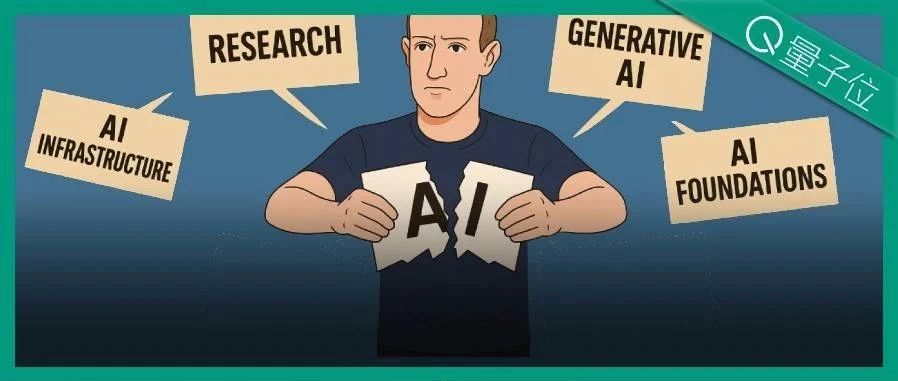
小扎“亿元俱乐部”刚组就被拆!千人AI团队面临裁员,高管也得走
量子位· 2025-08-20 01:13
Core Viewpoint - Meta is undergoing significant restructuring of its AI department, indicating a strong commitment to remain competitive in the AI race, despite market skepticism and stock price declines [3][4][6]. Group 1: Restructuring Details - The AI department has been reorganized into four main divisions: TBD Lab, Products and Applied Research, MSL Infra, and FAIR, each with distinct responsibilities [3][7]. - Alexandr Wang, the newly appointed Chief AI Officer, is leading the restructuring and will oversee TBD Lab, focusing on high-risk, high-reward innovations [8][20]. - The restructuring has led to a decline in Meta's stock price, with a drop of 4.29% over two days following the announcement [3]. Group 2: Leadership and Personnel Changes - Nat Friedman, former GitHub CEO, will head the Products and Applied Research division, aiming to translate advanced AI technologies into consumer products [14]. - Aparna Ramani is responsible for the MSL Infra division, which supports AI research infrastructure [16]. - Robert Fergus will lead the FAIR division, continuing its focus on foundational AI research [18]. Group 3: Implications and Future Directions - The restructuring may involve layoffs or reassignments within the AI department, as the company considers scaling down its workforce [25][24]. - There is a growing tension between new hires and long-term employees, highlighting internal conflicts within the company [28][29]. - Meta is exploring the use of third-party AI models to enhance its products, indicating a shift in strategy towards collaboration with external AI resources [29].
Meta考虑全面缩减AI部门规模,重组AI团队,寻求壮大超级智能部门
硬AI· 2025-08-20 01:08
Core Viewpoint - Meta is restructuring its AI department into four independent teams to accelerate its goal of achieving "superintelligence" under the leadership of new Chief AI Officer Alexandr Wang [2][3][4] Group 1: Restructuring Details - The AI department, previously known as Meta Superintelligence Labs (MSL), will be divided into four parts: TBD Lab, FAIR, Products and Applied Research, and MSL Infra [5][9] - The TBD Lab will focus on large language models, including the Llama tool that supports Meta's AI assistant, and will be directly led by Wang [5] - The restructuring aims to streamline the path to superintelligence and enhance product development speed amid fierce competition [5][8] Group 2: Talent and Leadership Changes - Meta has invested heavily in acquiring top AI talent, spending hundreds of millions on salaries, and is now looking to stabilize its AI team through this restructuring [8] - Several AI executives are expected to leave the company, and there are discussions about potential layoffs or reassignments due to the rapid growth of the AI team [6][8] - The leadership of the new teams includes notable figures such as Nat Friedman and Daniel Gross, with ongoing personnel changes as the company adapts to its new structure [10][15] Group 3: Internal Dynamics and Challenges - Tensions have arisen within the company since Wang's appointment, with some employees dissatisfied with the new direction and leadership [12][14] - The new team is developing a next-generation AI model, moving away from the previously planned "Behemoth" model due to poor testing performance [13] - The shift towards potentially closed-source models marks a departure from Meta's traditional open-source philosophy, causing further internal friction [13]

Meta (META.US)再次重组 AI 团队,千亿豪赌超级智能
智通财经网· 2025-08-20 00:15
Core Viewpoint - Meta is restructuring its newly formed AI team into four independent groups to better utilize top talent acquired at a high cost, aiming to accelerate its pursuit of "superintelligence" [1][2]. Group 1: New AI Team Structure - The new AI team, named "Meta Superintelligence Lab" (MSL), consists of four parts: TBD Lab led by Alexandr Wang focusing on large language models; FAIR, an existing AI research lab; a product and application research team led by Nat Friedman; and MSL Infra focusing on necessary infrastructure [2][3]. - The restructuring does not involve layoffs, despite the significant investment in acquiring top AI researchers from competitors [2]. Group 2: Leadership and Strategic Changes - Meta's AI leadership has experienced multiple changes in recent years, with the AGI foundational team being disbanded and its leaders reassigned to focus on MSL strategic projects [3]. - Aparna Ramani will lead the MSL infrastructure team, while Robert Fergus continues to lead the FAIR research lab [3]. - The previous head of the Messenger application, Loredana Crisan, has left the company to join Figma Inc. [3].
Meta超级智能实验室重组为四个部门,某些高管将离开
机器之心· 2025-08-20 00:15
Core Viewpoint - Meta is restructuring its Superintelligence Labs (MSL) and other AI departments into four new divisions focused on AI research, infrastructure, hardware, and product integration, aiming to enhance its long-term superintelligence goals [2][3][4]. Group 1: Organizational Changes - MSL and previous AI departments like FAIR will be divided into smaller units to better focus on key areas necessary for achieving superintelligence [3]. - Alexandr Wang, the new Chief AI Officer, emphasized the need for organizational restructuring to take superintelligence seriously [4]. - The restructuring is expected to cause some internal chaos, with reports indicating that some executives may leave the company following these changes [7]. Group 2: Talent Acquisition and Investment - Meta has been aggressively recruiting top talent from companies like OpenAI, Anthropic, GitHub, and Google DeepMind, with no signs of this trend slowing down [5]. - In June, Meta invested $14 billion in Scale AI and appointed Scale's CEO, Alexandr Wang, as the new Chief AI Officer [5]. - OpenAI's CEO, Sam Altman, accused Meta of offering $100 million salaries to poach its employees [5]. Group 3: Financial Commitment to AI - Meta's CEO, Mark Zuckerberg, has positioned AI and superintelligence as central to the company's long-term vision [9]. - The company's CFO, Susan Li, indicated that capital expenditures could reach $72 billion by the end of the year, primarily driven by AI-related infrastructure [9]. - Zuckerberg expressed optimism that superintelligence could accelerate human progress and empower individuals to improve the world [10].

Meta Platforms考虑全面缩减人工智能(AI)部门的规模。该公司重组AI团队,寻求壮大超级智能部门。(纽约时报)
Hua Er Jie Jian Wen· 2025-08-19 16:39
Core Viewpoint - Meta Platforms is considering a significant reduction in the scale of its artificial intelligence (AI) department while restructuring its AI team to strengthen its superintelligence division [1] Group 1 - Meta Platforms is undergoing a reorganization of its AI team [1] - The company aims to enhance its superintelligence division through this restructuring [1]
腾讯研究院AI速递 20250820
腾讯研究院· 2025-08-19 16:01
Core Insights - The article discusses advancements in generative AI models, highlighting new releases and updates from various companies, including Nvidia, OpenAI, and Tencent, among others. Group 1: Nvidia's Nemotron Nano 2 Model - Nvidia released the Nemotron Nano 2 model with 9 billion parameters, utilizing a Mamba-Transformer hybrid architecture, achieving inference throughput up to 6 times that of traditional models [1] - The model competes with Qwen3-8B, showing comparable or superior performance in mathematics, coding, reasoning, and long-context tasks, fully open-source and supporting a context length of 128K [1] - It was trained on 20 trillion tokens, compressing a 12 billion parameter model to 9 billion, and can be run on a single A10G GPU [1] Group 2: OpenAI's GPT Model Comparison - OpenAI's president Greg Brockman shared a comparison of responses from GPT-1 to GPT-5 using the same prompts, showcasing significant improvements in knowledge retention, logical structure, and language coherence [2] - The results indicated that earlier models like GPT-1 and GPT-2 often produced nonsensical answers, while GPT-5 provided more logical, rich, and emotionally valuable responses [2] - Interestingly, some users expressed a preference for the earlier models, finding them more "wild" and "unconventional," with GPT-1 being likened to "true AGI" [2] Group 3: DeepSeek Model Update - DeepSeek's latest online model has been upgraded to version 3.1, extending context length to 128K, available through official web, app, and mini-programs [3] - This update is a routine version iteration and is not related to the anticipated DeepSeek-R2, which is not expected to be released in August [3] - The expanded context capacity will enhance user experience in long document analysis, codebase understanding, and maintaining consistency in long conversations [3] Group 4: Nano Banana Model - The mysterious AI drawing model Nano Banana demonstrated exceptional character consistency in LMArena evaluations, accurately preserving facial features and expressions, outperforming competitors like GPT-4o and Flux [4] - Although not officially claimed, the model is said to originate from Google DeepMind and is currently only available in LMArena's battle mode without a public interface [4] - Besides character consistency, it excels in background replacement, style transfer, and text modification, effectively executing various complex image editing tasks [4] Group 5: Alibaba's Qwen-Image-Edit Model - Alibaba launched the Qwen-Image-Edit model, based on its 20 billion parameter Qwen-Image model, which supports both semantic and appearance editing capabilities [5][6] - The model can perform precise text editing while retaining the original font, size, and style, achieving state-of-the-art performance in multiple public benchmark tests [6] - It has shown excellent performance in tasks like adding signage, replacing backgrounds, and modifying clothing, though it still faces limitations in multi-round modifications and complex font generation [6] Group 6: Tencent's AutoCodeBench Dataset - Tencent's Mixyuan released the AutoCodeBench dataset to evaluate large model coding capabilities, featuring 3,920 high-difficulty problems across 20 programming languages [7] - The dataset is notable for its high difficulty, practicality, and diversity, with existing evaluations showing that leading industry models scored below 55, indicating its challenge [7] - A complete set of open-source tools is also available, including the data generation workflow AutoCodeGen and the evaluation tools AutoCodeBench-Lite and AutoCodeBench-Complete [7] Group 7: Higgsfield's Draw-to-Video Feature - AI startup Higgsfield introduced the Draw-to-Video feature, allowing users to draw arrows and shapes on images and input action commands to generate cinematic dynamic visuals [8] - This feature is complemented by the Product-to-Video function, supporting various video generation models, making it easier to create advertisement videos compared to text prompts [8] - Founded in October 2023, Higgsfield has garnered attention for its advanced cinematic control technology and user-friendly design [8] Group 8: Zhiyuan's A2 Humanoid Robot - Zhiyuan Robotics completed a 24-hour live broadcast of its humanoid robot A2 walking outdoors, achieving this feat in high temperatures of 37°C and ground temperatures of 61°C [9] - The A2 showcased strong environmental adaptability, autonomously navigating obstacles, planning paths, and adjusting gait without remote control, utilizing "hot-swappable" battery technology for quick recharging [9] - During the event, three industry dialogues were held to discuss the development path of humanoid robots, marking a significant milestone in transitioning from technology development to commercial production [9] Group 9: Richard Sutton's OaK Architecture - Richard Sutton, the father of reinforcement learning and 2024 ACM Turing Award winner, introduced the OaK architecture (Options and Knowledge), outlining a path to superintelligence through operational experience [10][11] - The OaK architecture consists of eight steps, including learning policies and value functions, generating state features, and maintaining metadata [11] - It emphasizes open-ended abstraction capabilities, enabling the active discovery of features and patterns during operation, though key technological prerequisites like continuous deep learning must be addressed to realize the superintelligence vision [11] Group 10: OpenAI's GPT-5 Release Review - OpenAI's VP and ChatGPT head Nick Turley acknowledged the failure to continue offering GPT-4o, underestimating user emotional attachment to models, and plans to provide clearer timelines for model discontinuation [12] - Turley noted a polarized user base, with casual users preferring simplicity while heavy users require complete model switching options, aiming to balance both needs through menu settings [12] - Regarding the business model, Turley mentioned strong growth in subscription services, with enterprise users increasing from 3 million to 5 million, and future exploration of transaction commissions while ensuring commercial interests do not interfere with content recommendations [12]
小扎“亿元俱乐部”开招白菜岗,年薪20-30万美元,网友:是时候招牛马干苦力了
量子位· 2025-08-19 03:13
Core Viewpoint - Meta is adjusting its hiring strategy for the Super Intelligence Lab, moving from high-salary offers to more standard compensation packages for product operations roles, indicating a shift in focus from attracting top-tier talent to filling essential positions [1][2][15]. Recruitment Strategy - The Super Intelligence Lab is now seeking product operations managers with a total annual compensation package of approximately $200,000 to $300,000, which is significantly lower than the previous high offers [2][4]. - The lab aims to recruit individuals who can coordinate between clients and partners, specifically focusing on AI models (GenAI) [6][10]. Job Responsibilities - Responsibilities include communicating product quality information to various teams, managing technical setups and processes for product launches, and collaborating with operational teams to improve efficiency and product quality [7][9][10]. - Candidates are expected to analyze data from various sources to inform business decisions and optimize workflows using AI and automation [11][20]. Candidate Qualifications - Required qualifications include a bachelor's degree and over six years of experience, with additional experience in global/remote team collaboration and leadership being advantageous [12][13]. - The job posting specifies a salary range of $122,000 to $177,000 per year, plus bonuses, stock options, and benefits [14]. Organizational Context - The overall size of the new AI department has reportedly reached over 2,500 employees, suggesting that the majority of the workforce does not consist of high-salary individuals [18]. - The shift in hiring strategy may reflect a broader organizational need to fill roles with less emphasis on high compensation, as the company has already secured many core positions [17].

GPT-5雷声大雨点小,AI赶超人类宣传过火了?
Feng Huang Wang· 2025-08-18 08:25
Core Viewpoint - The performance of the newly released GPT-5 model has not met the high expectations set by the tech community, leading to a reevaluation of the timeline for achieving "superintelligence" in AI [1][2][3] Group 1: Performance Evaluation - GPT-5 was released on August 7 and, while it shows improvements over GPT-4, it is not considered a significant leap forward [1][2] - Users have reported that GPT-5 performs better in tasks like coding and complex topic research but still makes common errors, such as being misled by puzzles or confidently stating false information as true [1][3] - Some industry insiders believe that the expectations for GPT-5 were overly optimistic, as it does not feel like a major technological breakthrough for ordinary users [4][5] Group 2: Industry Reactions - The release of GPT-5 has prompted some to question the claims made by industry leaders, including OpenAI CEO Sam Altman, about the rapid advancement of AI capabilities [2][3] - David Sacks, a prominent tech investor, stated that the performance of leading AI models remains similar, and they still require human guidance to be truly useful [3][4] - Concerns have been raised that the hype surrounding AI advancements may not align with the actual progress demonstrated by GPT-5 [5][6] Group 3: User Experience and Feedback - Some users have expressed disappointment, feeling that GPT-5 lacks warmth compared to previous versions, leading OpenAI to allow paid users to continue using GPT-4 [6][7] - OpenAI's CEO defended the model, stating that demand for GPT-5 has doubled within 48 hours of its release, indicating a strong interest from businesses [6][7] - The new model is designed to optimize resource usage based on the complexity of user queries, potentially improving efficiency and reducing costs [7]
马斯克痛失xAI大将,Grok 4缔造者突然离职,长文曝最燃创业内幕
3 6 Ke· 2025-08-15 02:26
Core Insights - Igor Babuschkin, co-founder of xAI, announced his departure to start a new venture, Babuschkin Ventures, after significant contributions to the company, including the development of the world's largest AI supercomputer, Colossus, and the multi-modal model Grok 4 [1][2][12][30]. Group 1: Company Achievements - In just 120 days, xAI successfully built the Colossus supercomputer, which supports large-scale training for AI models [2][12]. - Grok 4, developed under Babuschkin's leadership, is now a leading model capable of competing with Gemini 2.5 and GPT-5 [14][30]. - The team at xAI has been recognized for their dedication and rapid execution, achieving milestones that were deemed impossible by industry standards [20][27]. Group 2: Igor Babuschkin's Background - Before joining xAI, Babuschkin worked at Google DeepMind, where he led the AlphaStar project, an AI system that achieved Grandmaster-level play in StarCraft II [5][7]. - He also contributed to the development of the WaveNet speech synthesis system, enhancing the quality of voice generation [5]. - Babuschkin has a strong academic background in physics, having worked at CERN and holding a master's degree from the Technical University of Dortmund [9][11]. Group 3: Future Directions - Babuschkin Ventures will focus on supporting AI safety research and investing in startups that aim to advance human progress and explore the mysteries of the universe [30]. - The departure of Babuschkin marks a significant change for xAI, which has seen a reduction in its founding team from 12 to 9 members [38].

