
AGI(通用人工智能)

Search documents
大厂90%员工在做无用功?
Hu Xiu· 2025-09-01 00:57
Group 1 - The company Surge AI, founded by Edwin Chen, has achieved over $1 billion in revenue within four years without external financing, while its competitor Scale AI has raised over $1.3 billion but only generated $850 million in revenue [1] - Edwin Chen emphasizes that 90% of employees in large tech companies are engaged in unproductive work, suggesting that smaller teams can achieve tenfold efficiency with only 10% of the resources [8][9] - Surge AI focuses on quality control in data annotation, contrasting with many competitors that operate as "body shops" without proper technology to measure or improve data quality [32][39] Group 2 - The prevailing culture in Silicon Valley prioritizes fundraising over genuine problem-solving, with many entrepreneurs chasing capital rather than building meaningful products [20][23] - Surge AI's business model is profitable from the first month, negating the need for a sales team, as the company relies on the inherent value of its high-quality data to attract clients [20][21] - Edwin Chen rejects the notion that having a PhD guarantees coding ability, noting that many computer science PhDs struggle with practical coding skills [48][41] Group 3 - The concept of "100x engineers" exists, with some individuals demonstrating productivity levels significantly higher than their peers, especially when combined with AI tools [46][47] - Edwin Chen advocates for eliminating unnecessary meetings and prioritizing quality, embedding this principle deeply within the company culture [56][57] - Surge AI has gained traction among clients seeking high-quality data, especially after the acquisition of Scale AI, as many clients have experienced difficulties with data quality from other providers [64][67] Group 4 - Edwin Chen has firmly rejected a $100 billion acquisition offer, stating that the company is already successful and has the resources to pursue its mission independently [5][72][74] - The company aims to contribute significantly to the development of Artificial General Intelligence (AGI), viewing its role as crucial in the broader AI landscape [78][80] - Edwin Chen believes that AGI could automate many engineering tasks by 2028, but emphasizes that current models are not yet capable of addressing the most meaningful problems [85][86] Group 5 - The industry faces challenges with synthetic data, which is often overestimated in its effectiveness compared to high-quality human-annotated data [93][96] - AI safety is a critical concern, with many underestimating the potential risks associated with misaligned AI objectives [97][99] - Edwin Chen foresees a future with multiple leading AI companies, each pursuing different paths and solutions, reflecting the diversity of human intelligence [100][104]

刚刚,Ilya一个神秘动作,OpenAI全员狂欢:AGI来了
3 6 Ke· 2025-08-30 17:45
Core Insights - The recent actions of Ilya Sutskever, including changing his profile picture and background, have sparked speculation about the potential achievement of "superintelligence" within the company [1][3][5] - OpenAI researchers are expressing excitement about the possibility of having achieved Artificial General Intelligence (AGI), with multiple team members publicly stating their feelings of having reached this milestone [17][18][22] Group 1: Ilya Sutskever's Profile Change - Ilya Sutskever has changed his profile picture to a formal image, moving away from a more casual look, which has led to widespread speculation [5][10] - The new background image features Saturn, which has been interpreted in various ways, including themes of emergent order, alignment, and efficiency [10][8] - The company’s homepage has also undergone a visual change, shifting from a white background to a black one, which coincides with significant funding despite having no products [13] Group 2: OpenAI's AGI Claims - OpenAI researchers are collectively expressing that they "feel AGI," indicating a significant internal development [17][18] - A breakthrough has been suggested involving training AI agents in video games to achieve superhuman performance, which could then be generalized to other fields like mathematics [23] - Speculation exists that the recent excitement may be a response to competitive pressures, particularly from Google's advancements, indicating a strategic move to maintain visibility in the AI landscape [24]

Z Event|¥1万奖金,我们决定用一场黑客松来验证 Vibe Coding 是自嗨还是真有用?
Z Potentials· 2025-08-30 04:18
Group 1 - The event is a 24-hour hackathon called Vibe Coding, co-hosted by VibeFriends and SegmentFault, aimed at optimizing Vibe Coding through user-driven product development [1][3]. - A total of 33 teams will participate, with over 20 industry experts and 200 target users involved in the voting process to ensure the products developed are genuinely useful [4][6]. - Participants will receive various supports, including model tokens valued at hundreds of yuan, exposure on Xiaohongshu, mentorship from AI entrepreneurs and experts, and continuous supply of food and drinks [7][8]. Group 2 - Awards include a first prize of ¥10,000, a second prize of ¥5,000, and a community popularity award of ¥3,000 for the third place, along with smaller prizes for other participants [8]. - The event is scheduled for September 13, 2025, in Beijing, with a call for teams of 1-3 members and 200 special observers [13]. - The event is supported by strategic partners such as Xiaohongshu and various technology partners, indicating a strong collaborative effort within the tech community [15][16].

消失一年,Kimi杨植麟最新对话:“站在无限的开端”
创业邦· 2025-08-30 03:19
Core Viewpoint - The article discusses the evolution and advancements in AI, particularly focusing on the Kimi K2 model developed by DeepSeek, highlighting the ongoing challenges and the philosophical implications of problem-solving in AI development [4][5][12]. Group 1: Kimi K2 Model Development - The Kimi K2 model, based on the MoE architecture, represents a significant advancement in AI, allowing for open-source programming and interaction with the digital world [4][5]. - The model's release in July 2025 marked a return to public attention for DeepSeek after a period of relative silence from its founder, Yang Zhilin [4][5]. - The development process involved a shift from pre-training and supervised fine-tuning to a focus on pre-training and reinforcement learning, which significantly impacted the company's operational methods [27][28]. Group 2: Philosophical Insights - Yang Zhilin emphasizes that human civilization is a continuous process of conquering problems and expanding knowledge boundaries, drawing inspiration from David Deutsch's book "The Beginning of Infinity" [5][12]. - The notion that every solved problem leads to new questions is central to the ongoing development of AI, suggesting an infinite journey of exploration and innovation [5][12]. Group 3: Technical Innovations - The K2 model aims to maximize token efficiency, allowing the model to learn more effectively from the same amount of data, which is crucial given the slow growth of high-quality data [29][30]. - The introduction of the Muon optimizer significantly enhances token efficiency, enabling the model to learn from data more effectively than traditional optimizers like Adam [30][31]. - The model's ability to perform complex tasks over extended periods without human intervention is a notable advancement, showcasing the potential for end-to-end automation in AI applications [17][44]. Group 4: Agentic Capabilities - The K2 model is characterized as an Agentic model, capable of multi-turn interactions and utilizing various tools to connect with the external world, which enhances its problem-solving capabilities [43][44]. - The development of multi-agent systems is highlighted as a way to improve task execution and collaboration among different agents, allowing for more complex problem-solving [22][44]. - The challenge of generalization in agent models is acknowledged, with ongoing efforts to improve their adaptability to various tasks and environments [34][46].

OpenAI/微软争夺AGI控制权,重组谈判激烈,年底谈不成软银700亿或撤
3 6 Ke· 2025-08-28 07:02
Group 1 - OpenAI's restructuring negotiations with Microsoft are ongoing, focusing on control, certainty, and the future of AGI, which will impact Microsoft's stake value and SoftBank's $10 billion investment timeline [1][2][5] - OpenAI operates under a capped-profit structure, which has become a financing obstacle, limiting investor returns and hindering the potential for an IPO [2][3] - Microsoft has invested over $13 billion in OpenAI, securing exclusive technology collaboration and priority usage rights, but this has led to conflicts regarding profit distribution as key milestones approach [5][11] Group 2 - The current exclusive hosting of OpenAI's models on Microsoft Azure limits OpenAI's API expansion and compliance capabilities, leading to negotiations for potential multi-cloud arrangements [6][17] - Microsoft seeks access to OpenAI's core intellectual property, particularly the training methodologies behind its advanced models, which OpenAI aims to protect as trade secrets [8][10] - The existing contract allows OpenAI to cut off Microsoft's access to its IP upon achieving AGI, creating significant risk for Microsoft and uncertainty regarding its investment [11][13] Group 3 - A potential compromise may involve transitioning from a binary AGI cutoff to a tiered mechanism based on significant capability milestones, enhancing investment certainty for both parties [13][15] - Multi-cloud capabilities could provide OpenAI with greater bargaining power, especially with large clients, while also increasing competition among cloud providers [17][19] - Specific industries may prioritize compliance and deployment flexibility over Azure's integration, indicating a shift in market dynamics [16][18]

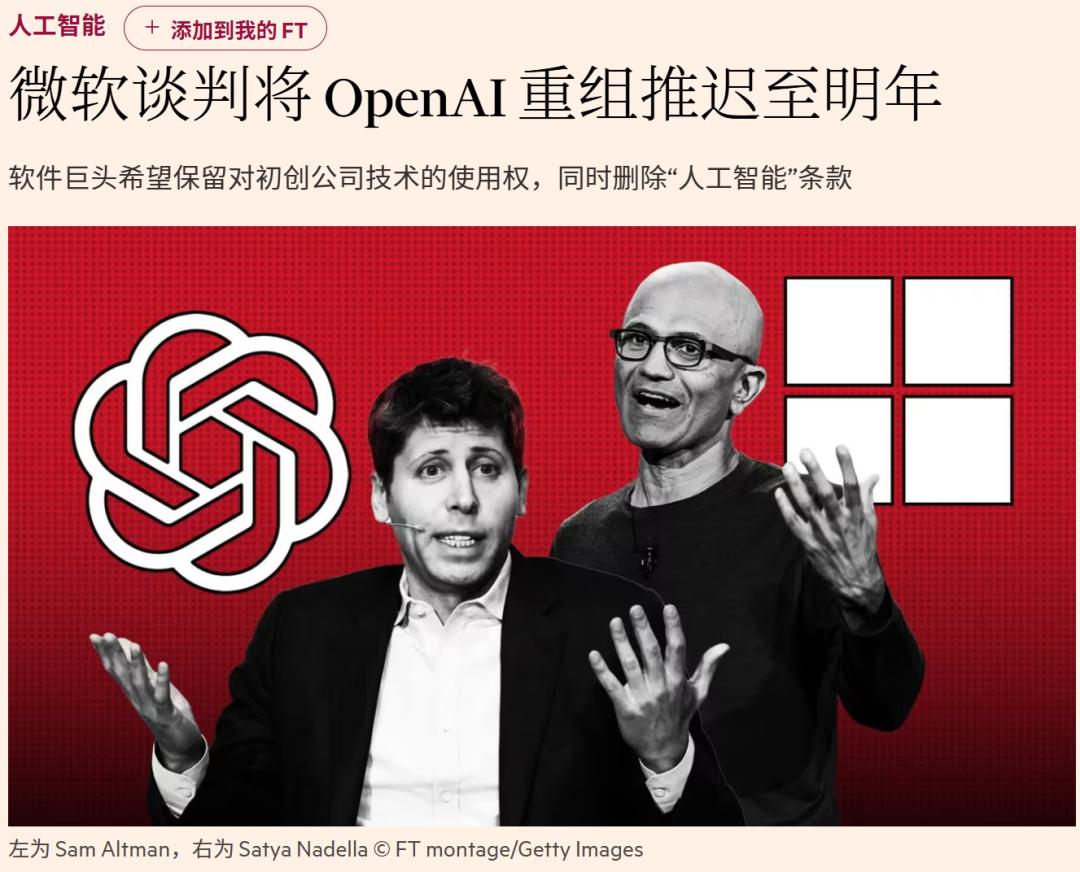
AI浪潮录|周志峰:北京AI优势根植于顶尖学府汇聚的科研沃土
Bei Ke Cai Jing· 2025-08-26 08:58
Core Insights - Beijing is emerging as a strategic hub in the AI large model sector, driven by technological innovation and a supportive ecosystem for startups and research institutions [1] - The AI industry is transitioning from a "technology acceleration phase" to an "application acceleration phase," with foundational capabilities remaining crucial [7] - Investment strategies in the AI sector emphasize the importance of independent thinking and the ability to recognize opportunities amidst market hype [12][13] Group 1: Industry Development - The rise of AI unicorns like Zhiyuan AI and the establishment of the "Global Open Source Capital" initiative highlight Beijing's commitment to fostering AI innovation [1] - The emergence of DeepSeek as a significant player illustrates the practical growth of China's innovative capabilities in AI [6] - The AI landscape is characterized by a dynamic competition between established giants and agile startups, with the latter having unique opportunities to thrive [23][24] Group 2: Investment Strategies - Investors are encouraged to be "super users" of AI technologies, gaining firsthand experience to inform their investment decisions [10] - The fear of missing out (FOMO) is identified as a major challenge in investment, necessitating a careful analysis of market signals and trends [13][14] - Successful investment in AI requires a balance of intellectual rigor and emotional resilience, enabling investors to navigate uncertainty and make informed predictions [11] Group 3: Market Trends - The concept of "基模五强" (Five Strong Foundational Models) reflects the evolving competitive landscape, with companies like DeepSeek and Zhiyuan AI leading the charge [19] - The increasing focus on application-driven models indicates a shift in how AI companies are categorized and valued [20] - The rapid development of general agents (AGI) and their implications for various industries signal a significant transformation in AI capabilities [25][27] Group 4: Talent and Research - Beijing's AI advantage is rooted in its concentration of top-tier research institutions and talent, with leading universities contributing significantly to the global AI workforce [29] - The collaboration between academia and industry is essential for translating research strengths into practical applications [29]

3年前投中Claude的人,今年又赚了7亿美金
Hu Xiu· 2025-08-21 08:34
Core Insights - Leopold Aschenbrenner predicts that AGI (Artificial General Intelligence) will reach a critical point around 2027, followed by the rise of superintelligence shortly thereafter [2][8] - Aschenbrenner's hedge fund, Situational Awareness LP (SALP), has achieved a net return of 47% in just six months, showcasing a sharp investment strategy amidst skepticism in the capital markets [4][51] - The technological explosion in AI is characterized as an exponential leap rather than a linear progression, with trillions of dollars expected to flow into industries such as GPU, data centers, and energy infrastructure [3][16] Investment Strategy - SALP's initial capital reached $1.5 billion, reflecting significant confidence from prominent Silicon Valley figures [42] - The fund focuses on the AGI supply chain rather than consumer-level AI, with major holdings in companies like Broadcom, Intel, and energy suppliers [44][46] - SALP's performance has been bolstered by strategic options trading, particularly benefiting from Intel's stock surge due to acquisition rumors [45][51] Industry Dynamics - The demand for energy and infrastructure to support AGI is immense, with a single training cluster consuming as much electricity as a medium-sized city [11][12] - Major investments in AI infrastructure are projected to exceed $1.5 trillion by 2027, surpassing investments in 5G and renewable energy [16] - The emergence of AGI is framed as a national industrial deployment issue rather than merely a scientific breakthrough [17] Regulatory and Ethical Considerations - Aschenbrenner emphasizes the urgency of AGI regulation, particularly in light of lessons learned from the FTX collapse and the need for transparent governance in capital markets [30][34] - His experiences have led to a more cautious investment approach, integrating a delta-neutral strategy to mitigate risks associated with market volatility [30][52] Future Outlook - Aschenbrenner's transition from an AGI whistleblower to a capital market operator reflects a shift in focus towards practical investment strategies while maintaining engagement with ethical discussions in the EA community [65][67] - The ongoing developments in AGI and its implications for energy and technology distribution suggest that SALP may represent a significant and thoughtful investment in the future of AI [69][70]
喝点VC|a16z对话OpenAI研究员:GPT-5的官方解析,高质量使用场景将取代基准测试成为AGI真正衡量标准
Z Potentials· 2025-08-21 03:09
Core Viewpoint - The release of ChatGPT-5 marks a significant advancement in AI capabilities, particularly in reasoning, programming, and creative writing, with notable improvements in reliability and behavior design [3][4][6]. Group 1: Model Improvements - ChatGPT-5 has shown a substantial reduction in issues related to flattery and hallucination, indicating a more reliable interaction model [4][14]. - The model's programming capabilities have seen a qualitative leap, allowing users to create applications with minimal coding knowledge, which is expected to foster the emergence of many small businesses [6][17]. - The team emphasizes the importance of user experience and practical applications as key metrics for evaluating model performance, rather than just benchmark scores [20][21]. Group 2: Training and Development - The development process for ChatGPT-5 involved a focus on desired capabilities, with the team designing assessments to reflect real user value [22][23]. - The integration of deep research capabilities into the model has enhanced its ability to perform complex tasks efficiently, leveraging high-quality data and reinforcement learning [16][26]. - Mid-training techniques have been introduced to update the model's knowledge and improve its performance without the need for extensive retraining [45]. Group 3: Future Implications - The advancements in ChatGPT-5 are expected to unlock new use cases and increase daily usage among a broader audience, which is seen as a critical indicator of progress towards AGI [21][15]. - The model's ability to assist in creative writing has been highlighted, showcasing its potential to help users with complex writing tasks [29][31]. - The future of AI is anticipated to be characterized by the rise of autonomous agents capable of performing real-world tasks, with ongoing research focused on enhancing their capabilities [36][41].

Manus对话实录:探索AI Agent支付新领域,年度化收入逼近1亿美元
Sou Hu Cai Jing· 2025-08-21 00:54
Core Insights - Manus AI's annual recurring revenue (RRR) has reached $90 million and is expected to surpass $100 million soon, with clarification that this figure is based on monthly revenue multiplied by 12 and does not equate to cash revenue [1] - The distinction between AI Agents and AGI (Artificial General Intelligence) is emphasized, with AI Agents being a subset of applied AI that interacts with the environment, while AGI possesses general capabilities to perform various tasks without specific design [3][4] Company Developments - Manus AI's team member highlighted that many AI products offer annual payment options, which can inflate revenue figures as they may represent prepayments rather than actual operating income [1] - The company aims to empower non-programmers by generalizing the use of AI tools like Cursor, which has gained traction among both engineers and non-engineers for tasks such as data visualization and writing [4] Industry Trends - The conversation addressed the challenges AI faces in interacting with the real world, such as the lack of APIs or standard interfaces and the prevalence of CAPTCHAs, which hinder AI's capabilities [4] - Despite current limitations, there is optimism about AI's future, with expectations for significant breakthroughs as the ecosystem evolves and infrastructure companies like Stripe contribute to advancements [4]

首个国产“手机智能体”问世,智谱补位Manus
Guan Cha Zhe Wang· 2025-08-21 00:51
Core Viewpoint - The launch of AutoGLM 2.0 marks a significant advancement in AI technology, transitioning from mere conversational capabilities to practical task execution, providing a user-friendly experience for a broader audience, especially in the mobile domain [3][4][5]. Group 1: Product Features and Innovations - AutoGLM 2.0 is the world's first mobile universal agent, designed as an "executive assistant" that can perform tasks asynchronously without competing for screen time with users [3][4][5]. - The new version allows users to engage in other activities while the AI executes tasks such as shopping, ordering food, and writing content, addressing previous limitations where users had to watch the AI work [3][4][5]. - The technology behind AutoGLM includes an end-to-end operation capability, enabling it to autonomously interact with various applications and complete complex tasks without human intervention [7][9][20]. Group 2: Market Context and Strategic Positioning - The release of AutoGLM comes at a time when traditional agent models are struggling in the Chinese market due to regulatory challenges and the exit of competitors like Manus [5][6]. - The focus on mobile-first design aligns with the preferences of Chinese users, contrasting with the PC-centric approach of many existing AI products [5][6]. - The strategic decision to utilize cloud-based execution allows AutoGLM to operate independently of local device constraints, enhancing its usability and efficiency [23][24]. Group 3: Cost Efficiency and Performance - AutoGLM significantly reduces operational costs, with single task execution costs dropping to approximately $0.2, compared to $3-5 for traditional models, making it accessible to a wider consumer base [27]. - The model has demonstrated superior performance in benchmark tests, achieving a score of 48.1 in the OSWorld Benchmark, surpassing competitors like ChatGPT [26]. Group 4: Future Developments and Ecosystem Integration - Future updates for AutoGLM will include features for scheduled tasks, allowing the AI to proactively manage user needs, such as ordering coffee based on preferences [29]. - The integration of AutoGLM with smart devices aims to create a seamless ecosystem where AI can manage physical tasks, enhancing user convenience and operational efficiency [30][34]. - The vision for AutoGLM extends towards achieving a form of general artificial intelligence (AGI), where the agent can autonomously manage daily tasks, significantly improving user productivity [34][35].
