数字化转型

Search documents
数启新程向未来 ——写在2025天府数字经济大会开幕之际
Si Chuan Ri Bao· 2025-11-18 00:09
Core Insights - The digital economy is a strategic focus for the "14th Five-Year Plan" and is a key driver for high-quality development in Sichuan, with the core industry value expected to exceed 530 billion yuan in 2024, accounting for 16.7% of revenue from large-scale enterprises, ranking among the top in the country [1][11] - The establishment of digital economy innovation development pilot zones, including Sichuan, has created new opportunities for deepening reforms and innovations in the digital economy [1][11] Infrastructure Development - Sichuan has achieved full 5G coverage in all 26,000 administrative villages, with a total of 207,000 5G base stations built, ranking 6th in the country [3] - The province's total optical cable length has reached 5.869 million kilometers, equivalent to 15 times the distance from Earth to the Moon, with industrial parks achieving 10G optical network coverage [3] - The total computing power in Sichuan has reached 16.8 exaFLOPS, with plans to double this to 40 exaFLOPS by 2027 [4] Industrial Transformation - The digital transformation coverage rate among large-scale industrial enterprises in Sichuan has increased to 45.5%, with over 800 smart factories cultivated [6][7] - Sichuan has established 47 cross-industry industrial internet platforms, ranking 8th in the national development index, with a digital transformation action plan aiming for full coverage by 2027 [7][8] - The province is addressing the challenges faced by small and medium-sized enterprises in digital transformation by providing support and establishing digital transformation promotion centers [7][8] Economic Impact - The digital economy is driving modernization in agriculture, with new business models like smart agriculture emerging, leading to significant growth in rural e-commerce [9][10] - The online transaction volume in Sichuan exceeded 3 trillion yuan in the first seven months of the year, with over 5.5 million people employed in the sector [10] - Sichuan has built 437 internet hospitals, serving over 23.46 million patients, and achieved 100% internet access in primary and secondary schools [10]
国内冷链智能装备“小巨人”今日申购
2 1 Shi Ji Jing Ji Bao Dao· 2025-11-17 23:25
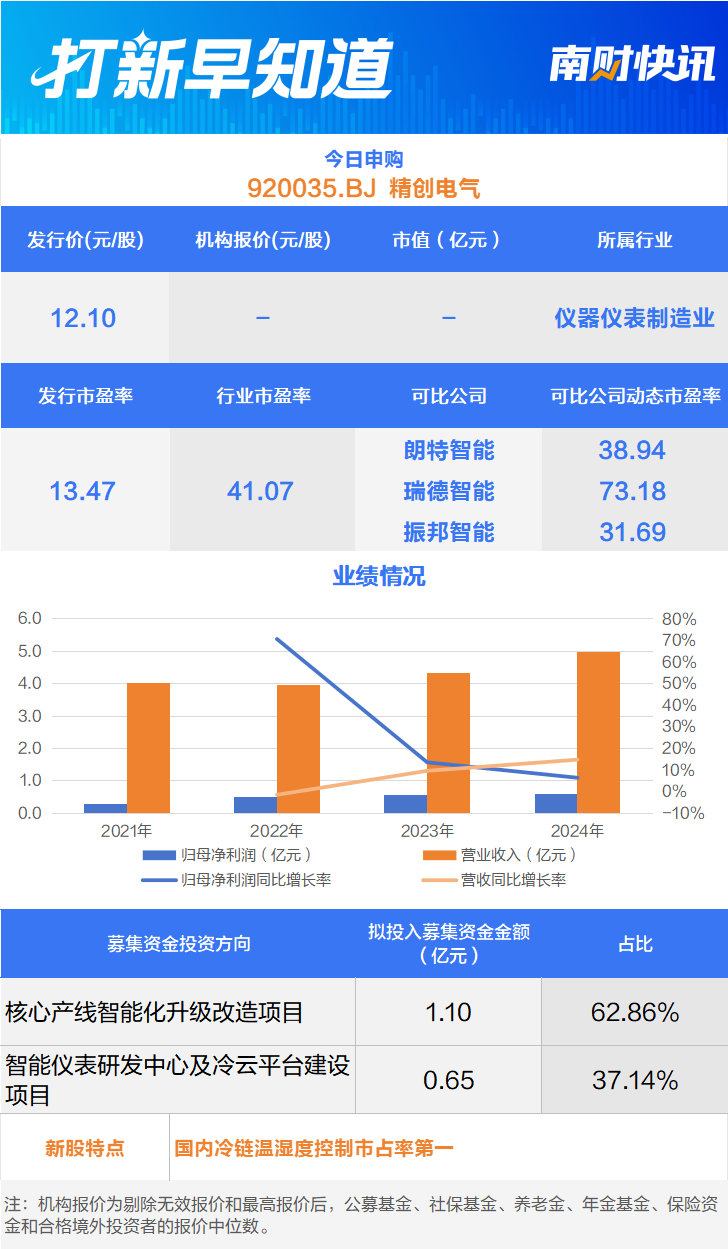
Group 1: New Stock Subscription and Listings - A new stock subscription for Jingchuang Electric (920035.BJ) is available, while three new stocks are listed: Nanfang Digital (301638.SZ), Hengkong New Materials (688727.SH), and Beikang Testing (920160.BJ) [1] Group 2: Jingchuang Electric Overview - Jingchuang Electric specializes in the R&D, production, and sales of cold chain equipment smart controllers, monitoring recorders, and environmental detection instruments, and is recognized as a national high-tech enterprise [2] - The company has established subsidiaries in the USA, UK, and Brazil, and has entered the supply chains of major refrigeration equipment manufacturers like Panasonic and Haier [2] - As of November 17, Jingchuang Electric holds a market share of 13.13% in China's cold chain temperature and humidity control market, ranking first domestically, and 4.64% globally [3] Group 3: Nanfang Digital Overview - Nanfang Digital provides comprehensive digital construction solutions for the power energy sector, focusing on digital transformation and maintaining grid safety [4] - The company has developed key technologies, including the "Dihong" IoT operating system and the "Fuxi" power-specific main control chip, contributing to the domestic energy control field [4] Group 4: Hengkong New Materials Overview - Hengkong New Materials focuses on the R&D and industrial application of key materials for integrated circuits, particularly in photolithography materials [6] - The company's self-produced product sales revenue has increased from 12,357.89 million in 2022 to 34,418.93 million in 2024, with a rising proportion of total revenue [6][7] Group 5: Beikang Testing Overview - Beikang Testing, established in 2016, is a leading institution in the R&D and service of non-ferrous metal inspection and testing technology [9] - The company is involved in the formulation of numerous national and international standards in the field of mineral and metal testing [9][10]
国内冷链智能装备“小巨人”申购 3只新股上市丨打新早知道
2 1 Shi Ji Jing Ji Bao Dao· 2025-11-17 23:10
New IPOs and Market Overview - A new IPO for Jingchuang Electric (920035.BJ) is available for subscription, while three new stocks are listed: Nanfang Digital (301638.SZ), Hengkang New Materials (688727.SH), and Beikang Testing (920160.BJ) [1] - Jingchuang Electric specializes in the R&D, production, and sales of cold chain equipment and monitoring instruments, recognized as a national high-tech enterprise and a "little giant" [1] Jingchuang Electric's Financials and Market Position - The company plans to invest 1.10 billion CNY (62.86%) in core production line upgrades and 0.65 billion CNY (37.14%) in the development of smart instruments and cloud platforms [3] - As of November 17, Jingchuang Electric holds a 13.13% market share in China's cold chain temperature and humidity control market, ranking first domestically and fourth globally [4] Nanfang Digital's Business Model and Financials - Nanfang Digital provides comprehensive digital solutions for the power and energy sectors, focusing on digital transformation [5] - The company has a market capitalization of 18.09 billion CNY, with an issue price of 5.69 CNY per share and a P/E ratio of 71.22 [6][10] Hengkang New Materials' Market Strategy - Hengkang New Materials focuses on R&D and industrial application of key materials for integrated circuits, with a significant increase in sales revenue from 123.58 million CNY in 2022 to 344.19 million CNY in 2024 [16][17] - The company aims to meet domestic demand for integrated circuit materials, achieving over 10% market share in 2024 [17] Beikang Testing's Industry Position - Beikang Testing is a leading institution in the field of non-ferrous metal inspection and testing, with a comprehensive service offering and a top market share in China [18][23] - The company plans to allocate 1.44 billion CNY (71.89%) for advanced testing instrument development and 0.56 billion CNY (28.11%) for working capital [22]

国内冷链智能装备“小巨人”申购,3只新股上市丨打新早知道
2 1 Shi Ji Jing Ji Bao Dao· 2025-11-17 23:08
Group 1: New Stock Subscription and Listings - A new stock subscription for Jingchuang Electric (920035.BJ) is available, with three new stocks listed: Nanfang Digital (301638.SZ), Hengkang New Materials (688727.SH), and Beikang Testing (920160.BJ) [1] Group 2: Jingchuang Electric - Jingchuang Electric specializes in the R&D, production, and sales of cold chain equipment and is recognized as a national high-tech enterprise and a "little giant" enterprise [2] - The company has established a significant position in technology standards related to cold chain control and monitoring, participating in 38 national and industry standards [2] - Jingchuang Electric has a market share of 13.13% in China's cold chain temperature and humidity control market and 4.64% globally, ranking first domestically and among the top globally [3] Group 3: Nanfang Digital - Nanfang Digital provides comprehensive digital construction solutions for the power energy sector, focusing on digital transformation [4] - The company generated revenue of 75,514.01 million yuan from digital grid services in the first half of 2025, accounting for 48.64% of total revenue [5] Group 4: Hengkang New Materials - Hengkang New Materials is involved in the R&D and production of key materials for integrated circuits, with a focus on photolithography materials [7] - The company's sales revenue from self-produced products increased from 12,357.89 million yuan in 2022 to 34,418.93 million yuan in 2024, with a rising proportion of total revenue [7] - Hengkang New Materials has become a major supplier of photolithography materials in China, with an estimated market share exceeding 10% [8] Group 5: Beikang Testing - Beikang Testing is a leading institution in the field of non-ferrous metal inspection and testing, with a comprehensive range of services and a strong market position [9] - The company is involved in the development and revision of numerous national and international standards in the non-ferrous metal sector [9] - Despite its leading market position, Beikang Testing faces risks related to market space limitations and a single-source revenue model [10][11]
云上水电:打造水电一体化专业数据服务新范式
Si Chuan Ri Bao· 2025-11-17 22:42
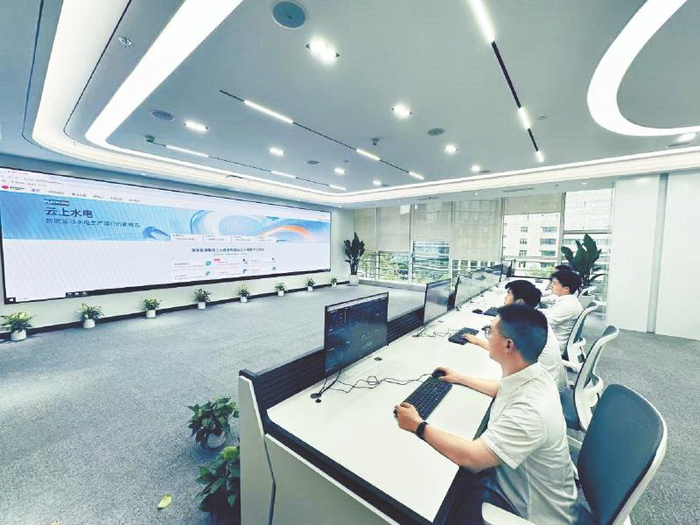
Core Viewpoint - The integration of digital technology into the hydropower industry is essential for driving industrial upgrades and achieving high-quality development in the context of China's digital economy strategy [2][12]. Industry Challenges - The hydropower sector, particularly in Sichuan, faces significant challenges in digital transformation, including uneven development, high costs, and a lack of standardized data systems leading to "data silos" [4][5]. - Over 99% of hydropower stations in China are small to medium-sized, which struggle with low operational efficiency and high reliance on manual processes [4][5]. - Safety monitoring is outdated, relying on traditional methods without real-time, intelligent risk assessment capabilities [5]. Solutions - The "Cloud Hydropower" platform has been developed to address the digital transformation challenges faced by small to medium-sized hydropower stations, promoting an integrated data service model [6][9]. - This platform utilizes a unified cloud-native architecture to facilitate data integration and sharing, significantly reducing data aggregation time from weeks to three days [6][8]. - The platform enhances operational efficiency and safety by integrating artificial intelligence, allowing for predictive maintenance and improved decision-making in flood management [8][11]. Achievements - "Cloud Hydropower" has connected 132 hydropower stations, with over 500,000 real-time data points and a daily data increment of 2.4 billion records, demonstrating its significant impact on the industry [9][10]. - The platform has reduced information technology investment by two-thirds and decreased data management costs by 30%, while improving business response efficiency by 40% [10]. - Operational metrics have improved, with water situation forecasting accuracy increasing by 5% and equipment availability rising by 5% [11]. Future Outlook - The platform aims to deepen the value extraction of data elements and enhance integration with new technologies like artificial intelligence, while transitioning to a more open industry cloud [12]. - "Cloud Hydropower" is positioned as a key driver for the digital transformation of the hydropower sector, contributing to the construction of a modern industrial system and promoting sustainable energy practices [12].
河北推进新型工业化走深走实 工业经济压舱石作用更加凸显
Jing Ji Ri Bao· 2025-11-17 22:03
Core Viewpoint - The article highlights the significant progress and achievements of Hebei Province in promoting new industrialization since the start of the 14th Five-Year Plan, emphasizing the importance of industrial development as a foundation for modernization. Group 1: Industrial Economic Growth - Hebei's total industrial added value increased from 11,813.5 billion to 14,908.5 billion from 2020 to 2024, with the manufacturing added value accounting for 26.3% of GDP in 2024, surpassing the national average by 1.4 percentage points [1] - The annual growth rate of industrial added value for large-scale industries is 6.2%, with operating income rising from 4.21 trillion to 5.17 trillion [1] - The province has developed advanced steel and high-end equipment industries, with several industry-leading companies emerging [1] Group 2: Quality Upgrade of Leading Industries - Hebei has implemented 10,552 key industrial and technological transformation projects, enhancing the competitiveness of steel products and transitioning companies from manufacturers to comprehensive service providers [2] - The production of new energy vehicles in Hebei increased by 5.3 times from 2020 to 2024, while the robot industry saw revenue growth exceeding 40% for two consecutive years [2] - The proportion of high-tech industry added value in large-scale industrial added value rose from 19.4% in 2020 to 22.3% in 2024 [2] Group 3: Development of Characteristic Industries - Hebei is focusing on building 107 provincial-level key characteristic industrial clusters, promoting shared manufacturing to enhance efficiency and reduce costs [3] - A total of 90 clusters have established 166 shared factories and over 10,000 shared devices, involving more than 13,000 enterprises [3] - The province has nurtured 589 "leader" enterprises within these clusters, driving collaborative development among over 3,200 cluster enterprises [3] Group 4: Enhancement of Quality Enterprises - By the end of 2024, the number of large-scale industrial enterprises in Hebei increased by 4,286 compared to the end of 2020, totaling 18,525 [4] - Hebei ranks fifth nationally in the number of companies included in the 2025 China Top 500 Private Enterprises and China Top 500 Manufacturing Enterprises [4] - The province has established a nurturing mechanism for high-quality small and medium-sized enterprises, with 15,500 high-tech enterprises and 7,014 specialized and innovative small and medium-sized enterprises cultivated [4] Group 5: Integration of Technological Innovation - Hebei has recognized over 10,000 industrial enterprise R&D institutions and established several manufacturing innovation centers [5] - The province has made significant breakthroughs in key technologies, with R&D intensity in large-scale manufacturing enterprises reaching 1.6%, an increase of 0.35 percentage points since 2020 [5] Group 6: Digital Transformation and Empowerment - Hebei has implemented 3,939 provincial-level digital transformation projects, creating 155 5G factories and 14 national exemplary smart factories [6] - The province's integration level of information technology and industrialization reached 63.8 in 2024, ranking ninth nationally [6] - A total of 371 industrial internet platforms have been cultivated, connecting 15.58 million industrial devices [6] Group 7: Green Transformation Progress - Hebei has achieved a 26.9% reduction in energy consumption and a 27.6% reduction in water consumption per unit of industrial added value since the start of the 14th Five-Year Plan [7] - The province has implemented over 2,000 green technology transformation projects, promoting the widespread adoption of green products [7] - Hebei has established 1,107 provincial-level green factories and 309 national green factories, leading the nation in green manufacturing initiatives [7]
元器件分销商并购运作频频 半导体产业链整合大势已来
Zheng Quan Shi Bao· 2025-11-17 16:57
Core Insights - The electronic components distribution sector is experiencing significant capital activity, with multiple acquisitions announced by major players in 2023, indicating a trend towards market consolidation and increased competition [1][5][6]. Industry Trends - The electronic components market includes a wide range of products such as ICs, resistors, capacitors, inductors, connectors, and diodes. Approximately 44% of electronic components are procured directly by downstream manufacturers from original manufacturers, while 56% rely on distributors [2][3]. - The global distribution landscape is dominated by major companies like Arrow, Avnet, WPG, and Winbond, with the top four distributors projected to generate revenues close to or exceeding $100 billion annually from 2022 to 2024 [3]. Market Concentration - The concentration of the electronic components distribution market is increasing, with the top four distributors expected to account for 53.91% of the total revenue of the top 50 distributors in 2024, down from 56.72% in 2023 [3]. - Chinese distributors are rapidly emerging, with companies like Zhongdian Port and Yachuang Electronics seeing significant revenue growth, driven by sectors such as computing and AI [3]. Performance Disparities - There is a performance divergence among global distributors, with regions like Greater China experiencing recovery due to AI and memory components, while North American and Japanese distributors face negative growth due to inventory destocking [4]. Diversification Strategies - The semiconductor industry has a history of mergers and acquisitions, and this trend is evident in the distribution sector as well. Companies like Arrow and Winbond have made strategic acquisitions to enhance their market position [5][6]. - Distributors are expanding their services beyond traditional distribution to include semiconductor design, PCBA manufacturing, and technical support, adapting to market changes [6][8]. Digital Transformation - The rise of digitalization and e-commerce is reshaping the distribution landscape, with semiconductor manufacturers increasing direct sales and optimizing distribution channels. This shift requires distributors to enhance their supply chain management and technical support capabilities [8]. Future Outlook - The rapid development of the domestic electronic industry presents vast market opportunities for distributors, particularly with the rise of technologies like 5G, AI, and IoT. Distributors are encouraged to strengthen collaborations with suppliers and customers to expand their market share [9]. - Chinese distributors are expected to innovate continuously to adapt to market changes, focusing on enhancing service capabilities and exploring international markets through acquisitions [9].


百万级项目频现!银行业密集启动科技招标,数字化转型驶入深水区
Xin Lang Cai Jing· 2025-11-17 12:24
Core Insights - Recent trends show multiple banks accelerating their technology procurement efforts, with significant budgets allocated for projects in areas such as large model development, computing infrastructure, and intelligent risk control [1][3][6] - The banking industry's IT investment is projected to reach 169.315 billion yuan in 2024, marking a 3.6% increase from 2023, and is expected to exceed 266.227 billion yuan by 2028 [7] Group 1: Technology Procurement Trends - Major banks are shifting from fragmented IT equipment purchases to systematic and ecological strategic layouts, with policy banks leading through large-scale tenders and framework agreements [3][4] - State-owned banks and national joint-stock banks dominate the technology procurement market, focusing on high-budget, long-cycle projects [3][4] - Smaller banks are adopting a more targeted approach, focusing on regional needs and core requirements with flexible budget scales [4] Group 2: Drivers of Technology Investment - The narrowing net interest margin and pressure on traditional lending businesses are pushing banks to leverage technology for competitive differentiation and cost control [6] - Regulatory policies are also driving technology projects, with over 30 "one-table" related projects initiated or completed across the industry since October [6][9] - External competition from fintech companies and internet platforms is compelling banks to accelerate their transformation efforts [6][9] Group 3: Challenges and Risks - The rapid pace of technology procurement presents challenges such as unclear risk responsibilities in outsourcing partnerships and compliance with regulatory requirements [9][10] - A notable case involving Guizhou Bank highlights issues with contract clarity and risk assessment in technology procurement [9] - The fast iteration of technology poses adaptation risks, as banks may face additional costs for upgrades if algorithms become outdated [10] Group 4: Future Considerations - The banking industry needs to establish a more systematic technology governance framework, including lifecycle management of suppliers and risk assessment mechanisms [10] - Balancing technological innovation with risk management will be crucial for banks to transform technology investments into core competitive advantages [10]




“港版携程”冲刺美股IPO!成立10年未盈利!
Zheng Quan Shi Bao Wang· 2025-11-17 11:55
Core Insights - Klook, known as the "Hong Kong version of Ctrip," has filed for an IPO with the SEC, marking a significant moment for its investors after years of participation [1] - The company has yet to achieve profitability since its establishment in 2014, and faces challenges in competing with industry giants during its global expansion [1] Company Overview - Founded in 2014, Klook is one of the few unicorns to emerge from Hong Kong, focusing on non-standard travel products, unlike major OTAs like Ctrip and Booking that offer standardized services [2] - Klook supports 14 languages, 40 currencies, and over 40 payment methods, providing 310,000 travel booking services across approximately 4,200 destinations [2] - The platform is projected to achieve 54.5 million bookings in 2024 and over 65 million bookings in the year ending September 30, 2025 [2] Financial Performance - Klook has not been profitable in its 10 years of operation, with revenues of $129 million, $335 million, $417 million, and $407 million for the years 2022, 2023, 2024, and the first three months of 2025, respectively [3] - Corresponding net losses were $123 million, $142 million, $99 million, and $141 million for the same periods [3] - However, the company showed signs of improvement in 2025, with adjusted EBITDA turning positive in the second and third quarters, reaching approximately $5 million per quarter [3] Investment and Funding - Klook's three co-founders control approximately 20.5% of the company through various investment vehicles, with EEB Capital Limited holding 15.3% [4] - Since its inception, Klook has completed nine funding rounds, raising over $1 billion, with Sequoia China participating in six rounds [4][5] - Recent funding includes $210 million from Asian financial institutions in December 2023, aimed at accelerating international expansion, and a $100 million round led by Veen Capital in February 2025 for AI and digital transformation initiatives [5]
“云药之乡”玉龙县探索中药材产业绿色发展模式
Zhong Guo Jin Rong Xin Xi Wang· 2025-11-17 11:47
Core Viewpoint - Yulong County is leveraging its rich ecological resources to develop a unique traditional Chinese medicine (TCM) industry, focusing on sustainable practices and innovative models to enhance both economic and ecological benefits [1][3]. Group 1: Ecological and Economic Synergy - Yulong County is transforming its limited arable land into new opportunities for TCM by utilizing its abundant forest resources, with a forest coverage rate exceeding 68.24% [1][3]. - The county is implementing a "forest + organization + cooperative + company + farmer" model to promote the cultivation of high-quality TCM, effectively utilizing idle forest land while minimizing chemical fertilizer and pesticide use [3]. - The introduction of the "National Reserve Forest + N" project aims to innovate the development model of national reserve forests, enhancing TCM quality and establishing Yulong as a comprehensive industrial demonstration zone [3]. Group 2: Initial Processing and Economic Stability - Yulong County is addressing land use constraints by establishing "field-side" initial processing sites, which allow for local processing of TCM while protecting the ecological environment [4][7]. - Currently, Yulong County has built 10 initial processing sites, processing 52,100 tons of TCM annually, generating a processing output value of 2.16 billion yuan [7]. Group 3: Digital Transformation in the TCM Industry - The "Smart Cloud Medicine" industrial park was inaugurated to create a digital platform that integrates various stages of the TCM supply chain, from seedling breeding to market sales [10]. - The platform provides precise services across the supply chain, attracting investments from external enterprises and enhancing the local TCM industry [10]. - Yunnan Baiyao Group is advancing its digital transformation by establishing comprehensive management systems for various TCM plants, supporting breeding improvements and precise raw material matching for different medicinal needs [10][11].