
电子及通信设备制造业

Search documents
辽宁省化工相关行业稳步增长
Zhong Guo Hua Gong Bao· 2026-01-28 02:45
Economic Overview - The total GDP of Liaoning Province reached 33,182.9 billion yuan in 2025, reflecting a growth of 3.7% compared to the previous year, indicating overall economic stability [1] Industrial Performance - The added value of industrial enterprises above designated size increased by 0.6% year-on-year, with notable growth in certain chemical and related industries [1] - Out of 40 major industrial categories, 19 reported an increase in added value compared to the previous year [1] Chemical Industry Highlights - The chemical fiber manufacturing sector exhibited exceptional growth, with an increase in added value by 7.0 times [1] - The petroleum, coal, and other fuel processing industries saw an added value growth of 3.2% [1] - Key chemical product outputs included a growth of 18.6% in synthetic ammonia production, a 12.7% increase in agricultural nitrogen, phosphorus, and potassium fertilizers, and a 5.4% rise in crude oil processing volume [1] High-Tech Manufacturing Investment - Investment in high-tech manufacturing rose by 1.6% year-on-year, with significant increases in specific sectors: aerospace and equipment manufacturing up by 61.2%, computer and office equipment manufacturing up by 26.7%, and electronic and communication equipment manufacturing up by 15.5% [1] Price Trends - The industrial producer price index decreased by 4.1% year-on-year, while the purchasing price index for industrial producers fell by 4.9% [1]
【省统计局】2025年陕西重点领域投资亮点纷呈
Shan Xi Ri Bao· 2026-01-28 01:04
Core Insights - In 2025, Shaanxi province is set to accelerate investment in key areas, focusing on effective investment expansion and optimizing fixed asset investment structure, with industrial investment expected to grow by 9.4% year-on-year, significantly outpacing overall investment growth by 12.2 percentage points [1] Group 1: Investment Growth - Industrial investment in Shaanxi is projected to increase by 9.4%, contributing 3.1 percentage points to overall investment growth [1] - Mining industry investment is expected to grow by 3.6%, contributing 0.3 percentage points to total investment [1] - Manufacturing investment is anticipated to rise by 13.3%, contributing 2.3 percentage points to total investment [1] - Investment in electricity, heat, gas, and water production and supply is forecasted to grow by 6.2%, contributing 0.5 percentage points to total investment [1] - Industrial technological transformation investment is expected to maintain a robust growth rate of 6.1% year-on-year [1] Group 2: Private Investment - Private investment in Shaanxi is projected to grow by 4.6%, contributing 1.8 percentage points to total investment [1] - Industrial private investment is expected to increase by 11.3%, contributing 4.3 percentage points to total private investment [1] - Manufacturing private investment is anticipated to grow by 10.3%, contributing 2.8 percentage points to total private investment [1] - Infrastructure private investment is forecasted to rise by 5.5%, contributing 0.3 percentage points to total private investment [1] Group 3: Equipment and High-tech Investment - Equipment and tool purchase investment is expected to grow by 16.4%, exceeding overall investment growth by 19.2 percentage points, contributing 1.8 percentage points to total investment [2] - High-tech industry investment is projected to grow by 4.4%, surpassing overall investment growth by 7.2 percentage points [2] - High-tech manufacturing investment is expected to increase by 18.1%, exceeding overall investment growth by 20.9 percentage points, with electronic and communication equipment manufacturing investment growing by 40.3% [2] Group 4: Livelihood Investment - Investment in wholesale and retail is projected to grow by 58.9% [2] - Investment in the agricultural and food processing industry is expected to increase by 26.5% [2] - Investment in accommodation and catering is anticipated to rise by 20.9% [2] - Forestry investment is expected to grow by 17.4% [2] - Investment in electricity and heat production and supply is projected to increase by 5.7% [2] - Investment in the education sector is expected to grow by 4.7% [2]
绵阳:2025年GDP超4600亿元 同比增长6.5%
Zheng Quan Shi Bao Wang· 2026-01-26 10:18
Core Viewpoint - In 2025, Mianyang's GDP reached 460.66 billion yuan, reflecting a year-on-year growth of 6.5% at constant prices [1] Economic Performance - The primary industry added value was 35.74 billion yuan, growing by 3.9% compared to the previous year [1] - The secondary industry added value was 183.81 billion yuan, with a growth rate of 5.6% [1] - The tertiary industry added value was 240.51 billion yuan, showing a growth of 7.8% [1] High-tech Manufacturing Sector - The output value of Mianyang's high-tech manufacturing industry increased by 10.4% year-on-year [1] - The computer and office equipment manufacturing sector experienced significant growth of 68.2% [1] - The medical instruments and equipment manufacturing sector grew by 14.0% [1] - The electronic and communication equipment manufacturing sector saw a growth of 10.9% [1]
成色更足步伐更稳韧性更强
Xin Lang Cai Jing· 2026-01-21 21:34
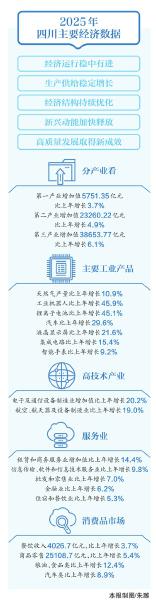
Economic Performance - In 2025, Sichuan's GDP reached 67,665.34 billion yuan, reflecting a 5.5% growth compared to the previous year at constant prices [2] - Sichuan's economic growth rates for the first quarter, first half, first three quarters, and the entire year were 5.5%, 5.6%, 5.5%, and 5.5% respectively, indicating a stable economic trajectory [3] Comparative Analysis - Sichuan's economic growth of 5.5% surpassed the national average by 0.5 percentage points, with industrial added value growth at 6.5% and service sector growth at 6.1%, both exceeding national rates [3] - Retail sales of consumer goods in Sichuan grew by 5.1%, outpacing the national growth rate by 1.4 percentage points [3] Industrial Structure - Over 80% of the 41 major industrial categories in Sichuan saw an increase in added value, with six key advantageous industries consistently outperforming the overall industrial growth [4] - The service sector contributed significantly to the economy, accounting for 57.1% of GDP and over 60% of economic growth, particularly in modern service industries like leasing and business services [4] Innovation and Technology - High-tech manufacturing led growth, with a 12.3% increase in added value, particularly in electronics and communication equipment, which grew by 20.2% [5] - The green and low-carbon transition is evident, with significant growth in industries such as power batteries and lithium-ion batteries, which saw increases of 28.4% and 45.1% respectively [5] Investment Trends - Investment in clean energy and industrial upgrades showed significant growth, with electricity and natural gas investments increasing by 10.7% and 32.4% respectively [6] - High-tech manufacturing investment rose by 5.3%, with notable growth in electronics and communication equipment investment at 10.5% [6] Policy Impact - The provincial government implemented targeted policies to stimulate economic recovery, including measures that led to a 50.8% increase in retail sales of communication equipment and an 8.9% increase in automobile sales [7] - Private investment in Sichuan rebounded, growing by 2.1% in 2025, reversing a two-year decline [7] Future Outlook - The construction of the He Tian Chuang headquarters and optical display manufacturing base in Chengdu is expected to be completed by November 2026, reflecting a positive investment climate [8] - Despite ongoing challenges, Sichuan's economic resilience and potential remain strong, supported by strategic initiatives like the Chengdu-Chongqing economic circle [8]

成渝地区高校科技成果转化发布281项成果
Si Chuan Ri Bao· 2025-12-25 00:23
Group 1 - The Chengdu-Chongqing region has gathered 27,000 high-tech enterprises, with a regional collaborative innovation index growth of 82.5% [1] - The region has jointly reorganized 25 national key laboratories and approved the establishment of one new laboratory, with 11 large scientific devices accelerating construction [1] - The conference released 281 technology achievements related to 14 key industrial sectors, including pharmaceuticals, artificial intelligence, advanced materials, and new energy vehicles [1] Group 2 - The "Sichuan Province High-Tech Industry Development Report (2025)" indicates that by 2024, there will be 4,912 large-scale high-tech enterprises in the province, with high-tech manufacturing enterprises at 2,183, a year-on-year growth of 9.92% [2] - High-tech industries achieved operating income of 1,752.23 billion yuan, reflecting a year-on-year growth of 5.70%, indicating a steady progress in overall development [2] - The Chengdu Plain Economic Zone is a core growth driver, with high-tech manufacturing and service industries accounting for over 80% and 90% of their respective revenues [2]
湖南前11个月规模以上工业增加值同比增长6.1%
Xin Lang Cai Jing· 2025-12-21 01:11
Core Viewpoint - Hunan Province's industrial economy demonstrates resilience and vitality with a 6.1% year-on-year growth in industrial added value from January to November [1] Group 1: Industrial Performance - The added value of the equipment manufacturing industry increased by 9.3% year-on-year, contributing 3.1 percentage points to the growth of the industrial sector [1] - The aerospace and equipment manufacturing industry grew by 18%, while the electronic and communication equipment manufacturing industry saw a growth of 16.8% [1] Group 2: Market Activity - The market for smart products is active, with the production of new energy vehicles and optoelectronic devices from large-scale industrial enterprises both achieving approximately 40% growth [1] - The production of service robots and sensors increased by 33.4% and 21.8%, respectively [1]
湖南:前11个月规模以上工业增加值同比增长6.1%
Xin Lang Cai Jing· 2025-12-21 01:09
Core Viewpoint - Hunan Province's industrial economy shows resilience and vitality with a year-on-year growth of 6.1% in industrial added value from January to November [1] Group 1: Industrial Performance - The equipment manufacturing sector stands out with a year-on-year growth of 9.3%, contributing 3.1 percentage points to the overall industrial growth [1] - The aerospace and equipment manufacturing industry grew by 18%, while the electronic and communication equipment manufacturing sector increased by 16.8% [1] Group 2: Market Activity - The market for smart products is active, with the production of new energy vehicles and optoelectronic devices in large-scale industrial enterprises achieving approximately 40% growth [1] - Production of service robots and sensors increased by 33.4% and 21.8%, respectively [1]
湖南:前11个月,规模以上工业增加值同比增长6.1%
Xin Lang Cai Jing· 2025-12-21 00:53
Group 1 - The core viewpoint of the article highlights the robust growth of the industrial economy in the province, with a year-on-year increase of 6.1% in the added value of large-scale industries from January to November [1] - The equipment manufacturing sector has shown remarkable performance, with a year-on-year increase of 9.3% in added value, contributing 3.1 percentage points to the growth of large-scale industries [1] - Specific industries such as aerospace and equipment manufacturing, as well as electronic and communication equipment manufacturing, experienced significant growth rates of 18% and 16.8% respectively [1] Group 2 - The smart product market is thriving, with large-scale industrial enterprises reporting approximately 40% growth in the production of new energy vehicles and optoelectronic devices [1] - The production of service robots and sensors also saw substantial increases, with growth rates of 33.4% and 21.8% respectively [1]
国家统计局:11月航空航天器及设备制造业、电子及通信设备制造业增加值分别增长9.1%、11.7%
Ge Long Hui· 2025-12-15 04:26
Core Insights - In November, the added value of large-scale equipment manufacturing and high-tech manufacturing industries grew by 7.7% and 8.4% year-on-year, significantly outpacing the overall industrial added value growth rate [1] - The cumulative added value of these sectors accounted for 36.4% and 16.9% of the total industrial added value, respectively [1] Equipment Manufacturing Sector - In November, the automotive manufacturing, railway, shipbuilding, aerospace, and other transportation equipment manufacturing industries saw an added value growth of 11.9% [1] - The production of high-speed trains and civil steel ships increased by 24.1% and 18.4%, respectively [1] High-Tech Manufacturing Sector - High-tech industries such as aerospace and electronic communication experienced rapid growth, with the added value of aerospace equipment manufacturing and electronic and communication equipment manufacturing increasing by 9.1% and 11.7%, respectively [1]
国家统计局:11月份工业生产总体平稳,产业优化升级持续
Zhong Guo Xin Wen Wang· 2025-12-15 04:20
Group 1 - The core viewpoint of the news is that China's industrial production has shown stable growth in November, contributing significantly to the overall economic stability and development [1] - In November, the industrial added value of large-scale enterprises increased by 4.8% year-on-year, maintaining a steady growth rate compared to the previous month [1] - The month-on-month growth of industrial added value was 0.44%, which is an acceleration of 0.27 percentage points from the previous month [1] Group 2 - The structure of the industrial sector continues to optimize and upgrade, with significant growth in high-end manufacturing, particularly in equipment manufacturing and high-tech manufacturing, which grew by 7.7% and 8.4% year-on-year, respectively [2] - The cumulative added value of equipment manufacturing and high-tech manufacturing accounted for 36.4% and 16.9% of the total industrial added value, respectively [2] - Notable growth was observed in the automotive manufacturing sector, with an increase of 11.9% in added value, and production of high-speed trains and civil steel ships grew by 24.1% and 18.4%, respectively [2] Group 3 - Emerging industries are growing rapidly, with significant increases in the added value of electronic special materials and integrated circuit manufacturing, which rose by 30.9% and 32.4%, respectively [3] - The production of smart products is also increasing, with smart vehicle equipment and unmanned aerial vehicle manufacturing seeing growth rates of 30% and 49.3%, respectively [3] - The new energy vehicle and lithium-ion battery production also showed strong growth, with increases of 17% and 32.7%, respectively, driven by green transformation [3]