
研发投入

Search documents
透景生命(300642)2025年三季报点评:逐步走出集采影响 业务外延加速推进
Xin Lang Cai Jing· 2025-11-24 06:42
Core Viewpoint - The company reported a significant decline in revenue and net profit for the first three quarters of 2025, but the revenue decline in Q3 showed notable improvement compared to earlier quarters, indicating a gradual recovery from the impact of centralized procurement [1][2]. Financial Performance - For the first three quarters of 2025, the company achieved a revenue of 258 million yuan, down 19.73% year-on-year, with a net profit attributable to shareholders of 6 million yuan, down 76.33% [1]. - In Q3 2025, the company reported a revenue of 99 million yuan, a decrease of 6.36% year-on-year, and a net profit of 3 million yuan, down 83.02% [1]. Impact of Centralized Procurement - The revenue decline is primarily attributed to the impact of centralized procurement and market conditions, but the decline rate in Q3 has significantly narrowed to -6.36% from -26.25% in the first half of the year [2]. - The company expects the negative effects of centralized procurement to gradually diminish within 2025, as revenues from key products like tumor markers and HPV testing are showing signs of recovery [2]. Business Expansion - The company has accelerated its business expansion, completing the integration of its subsidiary Hebei Toukang, which allows entry into the invasive fungal disease testing market [3]. - The company announced plans to acquire Kanglu Bio, a leader in the pathology diagnosis sector, which will enhance its capabilities in molecular pathology technologies [3]. - A strategic investment in Huihe Bio is aimed at strengthening the company's position in the autoimmune disease diagnosis and treatment sector, creating a comprehensive "diagnosis-treatment-monitoring" chain [3]. Research and Development - The company maintains a high R&D expense ratio of 15.52% for the first three quarters of 2025, increasing to 17.16% in Q3, indicating a strong commitment to R&D [4]. - Several new reagent products have received medical device registration certificates, enhancing the company's product offerings in various fields, including autoimmune and coagulation testing [4].
诺瓦星云:一直以来公司高度重视研发与技术
Zheng Quan Ri Bao Wang· 2025-11-21 09:43
Core Viewpoint - Nova Star Cloud (301589) emphasizes its commitment to research and development, maintaining high levels of investment in R&D and actively collaborating with industry giants and research institutions to explore cutting-edge technologies and make forward-looking arrangements [1] Group 1 - The company places a high priority on R&D and technology [1] - The company maintains a strong investment in R&D [1] - The company actively collaborates with upstream and downstream industry leaders and research institutions [1]
电连技术:积极通过优化全球供应链布局、深化与核心客户的战略合作等方式应对行业发展机遇与挑战
Zheng Quan Ri Bao Wang· 2025-11-20 13:13
Core Viewpoint - The company is actively responding to industry trends and customer demand changes by optimizing its global supply chain, deepening strategic cooperation with core customers, increasing R&D investment to enhance product competitiveness, and expanding into emerging markets and application fields [1] Group 1 - The company is closely monitoring industry trends and changes in customer demands [1] - The company is optimizing its global supply chain layout [1] - The company is deepening strategic cooperation with core customers [1] Group 2 - The company is increasing R&D investment to enhance product competitiveness [1] - The company is expanding into emerging markets and application fields [1]

黄山谷捷:公司将继续加大研发投入,努力提高主导产品的工艺技术及质量水平
Zheng Quan Ri Bao Wang· 2025-11-20 10:52
Core Viewpoint - Huangshan Gujie (301581) emphasizes its commitment to increasing R&D investment to enhance the technology and quality of its leading products while actively developing new products to expand its market share [1] Group 1 - The company encourages investors to monitor its regular reports for detailed market share information [1] - The company plans to strengthen research on new technologies, materials, and processes [1] - The company aims to diversify its product range to improve market presence [1]
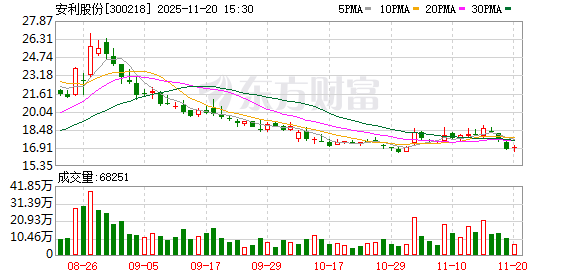
安利股份:公司保持高强度研发投入,近两年研发费用占营收比重均超过5%
Zheng Quan Ri Bao· 2025-11-20 10:44
Core Insights - Amway Co., Ltd. announced on November 20 that it is participating in the Anhui Top 100 Enterprises ranking activity, which is based on voluntary applications from companies and confirmed by relevant institutions, using 2024 revenue as the entry standard [2] Group 1 - The ranking will identify the comprehensive top 100 enterprises in Anhui, as well as the top 100 in manufacturing and services, and the top 30 in emerging industries [2] - The company maintains a high level of R&D investment, with R&D expenses accounting for over 5% of revenue in the past two years [2] - The focus of R&D is primarily on ecological and functional areas, with an emphasis on developing high-performance and multifunctional materials [2] Group 2 - Currently, the company is actively developing new materials and processes, including high-performance, water-based, solvent-free, silicon-based, bio-based, and recycled materials [2]


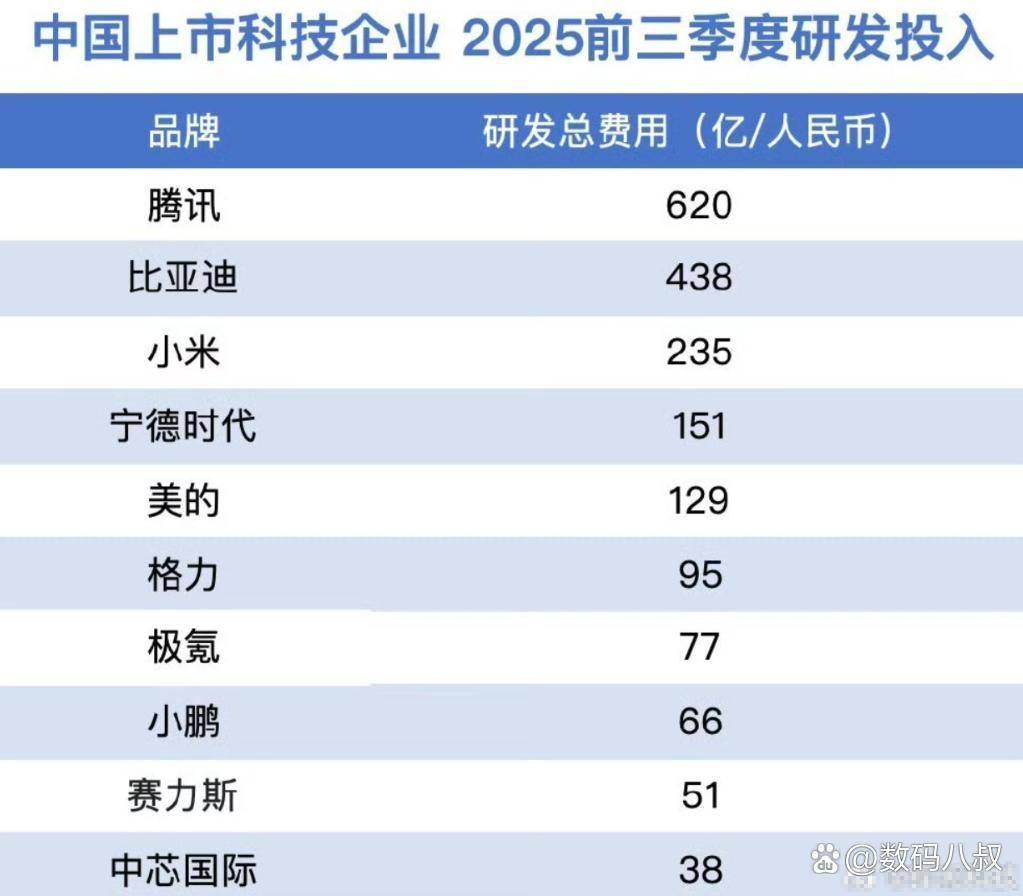
中国上市科技企业 2025前三季度研发投入前十的公司出炉,分别是:腾讯、比亚迪、小米、宁德时代、美的、格力、极氪、小鹏、赛力斯、中芯国际。所以,本人投资得多,收获就多,这个眼红不了的。
Sou Hu Cai Jing· 2025-11-20 04:31
Core Insights - The top ten Chinese listed technology companies in terms of R&D investment for the first three quarters of 2025 have been identified, highlighting significant players in the industry [1] Group 1: R&D Investment Rankings - Tencent leads the list with a total R&D expenditure of 62 billion RMB [2] - BYD follows with 43.8 billion RMB in R&D spending [2] - Xiaomi ranks third with 23.5 billion RMB allocated for R&D [2] - CATL (宁德时代) is fourth with 15.1 billion RMB in R&D investment [2] - Midea (美的) and Gree (格力) have R&D expenditures of 12.9 billion RMB and 9.5 billion RMB, respectively [2] - Zeekr (极氪) invests 7.7 billion RMB in R&D [2] - XPeng (小鹏) has an R&D budget of 6.6 billion RMB [2] - Seres (赛力斯) spends 5.1 billion RMB on R&D [2] - Semiconductor Manufacturing International Corporation (中芯国际) rounds out the list with 3.8 billion RMB in R&D investment [2]





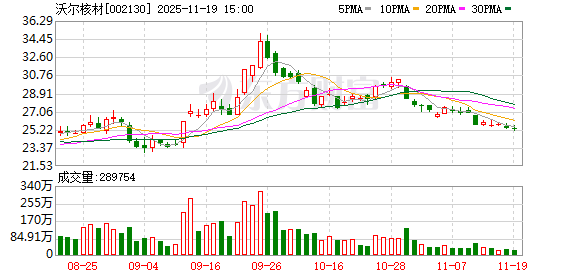
沃尔核材:公司暂无回购计划
Zheng Quan Ri Bao· 2025-11-19 14:09
Core Viewpoint - The company is actively exploring merger and acquisition opportunities within its industry, emphasizing a cautious approach to decision-making based on various strategic factors [2] Group 1: Mergers and Acquisitions - The company is paying close attention to beneficial merger and acquisition opportunities that align with its development goals, but acknowledges the complexity and need for suitable timing in such processes [2] - Decisions regarding mergers and acquisitions will be made after a comprehensive evaluation of strategic planning, industry prospects, business synergies, and acquisition costs [2] Group 2: Production Capacity and Market Demand - By mid-next year, the company will have over 30 imported foam core line extruders to match market demand [2] - The company’s power products, including cable accessories and various insulation protection products across voltage levels of 1-500kV, hold a leading position in the industry, serving major clients such as State Grid, Southern Power Grid, and local power bureaus [2] Group 3: Nuclear Power Products - The company’s nuclear-grade cable accessory products have been successfully applied in multiple domestic and international nuclear power projects, achieving a leading bid rate in the industry [2] - Collaborations exist with major nuclear power companies, including China National Nuclear Corporation, China General Nuclear Power Group, and State Power Investment Corporation [2] Group 4: Research and Development Investment - To align with the development needs of its various business segments and seize industry opportunities, the company is increasing its investment in research and development and capacity layout [2] - Currently, there are no plans for share buybacks, but the company will adhere to legal disclosure requirements if such plans arise in the future [2]

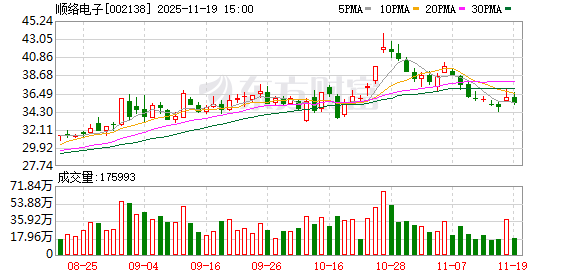
顺络电子:公司近年来投入的基建项目包括三个工业园和公司研发中心
Zheng Quan Ri Bao· 2025-11-19 13:38
Core Viewpoint - The company has made significant investments in infrastructure projects, including three industrial parks and a research center, and plans to slow down future investments in this area while maintaining high levels of R&D spending [2] Group 1: Infrastructure Development - The Dongguan Phoenix Industrial Park's smart park has completed its third phase, with some production lines already operational [2] - The Xiangtan ceramic powder industrial park has been completed and is now in production [2] - The Shanghai Songjiang Industrial Park has been completed, with some production lines gradually starting operations [2] - The Shenzhen research center has also been completed [2] Group 2: Future Investment Strategy - The company plans to significantly reduce its capital expenditures compared to the previous phase of infrastructure development [2] - Future investments will focus on emerging markets and new product capacity, which will continue to be supported [2] - R&D investments will remain at a high level, with specific capital allocation to be adjusted according to market demand [2]

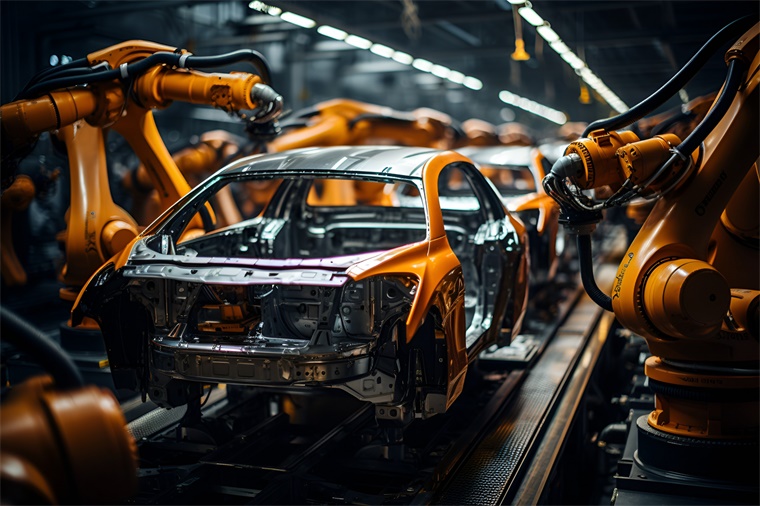
打破欧美垄断!中国车型成印度汽车研发新标杆,就连商用车制造商也开始关注中国技术【附新能源汽车行业市场分析】
Qian Zhan Wang· 2025-11-19 03:31
Core Insights - Chinese vehicles are becoming the benchmark for automotive R&D in India, surpassing European, Japanese, and American models in terms of disassembly and analysis [2] - The rapid development of Chinese automotive technology, particularly in electric vehicles, is establishing a new standard for the global automotive industry [2][5] Group 1: Market Position and Trends - China has become the largest producer and market for new energy vehicles (NEVs), with a market share of 24.4% in 2022, expected to grow further by 2025 [3] - Indian automotive companies are increasingly using Chinese models for benchmarking, indicating a shift in competitive standards [2] Group 2: Technological Advancements - Chinese automakers have made significant advancements in core technologies such as batteries, electric drive, and electric control, establishing a complete automotive supply chain [5][10] - The focus on consumer-centric design and user experience is a key factor in the success of Chinese vehicles [2] Group 3: Investment in R&D - Chinese NEV companies are investing unprecedented amounts in R&D, with total investments reaching 312.2 billion yuan in 2024, led by BYD with 54.2 billion yuan [8] - Xiaomi plans to invest 100 billion yuan over five years, with 30 billion yuan allocated for 2024 alone [9] Group 4: Industry Dependency - Indian electric vehicle manufacturers, despite promoting local production, still rely on Chinese suppliers for critical components such as batteries and electric motors [7]
天德钰:将根据市场需求变化与技术趋势,精准投入研发
Zheng Quan Ri Bao Wang· 2025-11-18 13:41
Core Viewpoint - The company has developed a display driver product applicable to VR products and plans to invest in R&D based on market demand and technological trends [1] Group 1 - The company has previously created a display driver product suitable for VR applications [1] - The company will adjust its R&D investments in response to market changes and technological trends [1]
