AI智能体

Search documents
【公告全知道】商业航天+卫星导航+AI营销+机器人!公司深耕互联网数字营销生态圈并得到小红书等行业头部客户认可
财联社· 2026-01-12 15:43
Group 1 - The article highlights the importance of weekly announcements from Sunday to Thursday at 22:00, which include significant stock market updates such as suspensions, investments, acquisitions, and performance reports, helping investors identify potential opportunities and risks [1] - A company specializing in internet digital marketing has gained recognition from leading clients like Xiaohongshu, launching multiple AI application robots [1] - Another company has set a target for AI revenue between 500 million to 600 million yuan by 2026, focusing on AI, cloud computing, and low-altitude economy [1] - A company involved in brain-computer interfaces and AI pharmaceuticals aims to achieve revenue exceeding 110,000 yuan from its brain-computer interface products by 2025 [1]


天赢居:春季行情遥遥领先
Jin Rong Jie· 2026-01-12 15:09
Group 1 - The market has shown a strong upward trend, achieving a seventeen-day consecutive rise, which is more robust than the historical eighteen-day rise, and is currently approaching a dense trend line zone between 4156 and 4193 [1][2] - After stabilizing above 4018, the market experienced rapid growth in a "vacuum zone" until reaching 4156, where the upward momentum is expected to slow down as it enters a trend line dense area [2] - The current market structure indicates a transition from a focus on technology hardware and non-ferrous metals to a stronger emphasis on software and application sectors, with significant gains in AI marketing, software services, and related concepts [4] Group 2 - The use of moving averages is crucial in managing volatility during strong market conditions, with specific focus on the 5-day and 8-day moving averages as key support levels [3] - The strategy emphasizes maintaining discipline in trading, suggesting that investors should hold positions until a significant trend reversal occurs, while being cautious of making emotional decisions [5] - The entrepreneurial board signals indicate a pattern of "air refueling" after breaking previous highs, suggesting a need for confirmation through oscillation and pullbacks to align moving averages and positions [4]
手机厂商、应用方如何看AI手机争议?A2A协作有望破局
第一财经· 2026-01-12 13:37
Core Viewpoint - The development of intelligent agents should focus on both "wisdom" and "execution," ensuring they understand user intent and act accordingly while maintaining safety and control in existing governance and commercial order [3][4]. Group 1: Current Trends in AI Agents - Various exploration paths have emerged in the past year regarding whether AI can effectively handle tasks traditionally performed by humans, with products like GUI Agents attempting to automate tasks such as video editing and ticket booking by simulating human operations [3][4]. - Experts suggest that while the current GUI-based approach allows for quicker integration into real-world applications, it has inherent limitations in stability, efficiency, and governance, making it more of a temporary solution [4][5]. Group 2: Industry Perspectives - Mobile manufacturers are exploring the implementation of intelligent agents, with OPPO highlighting that the current GUI-based solutions are not the final form of AI phones but rather a method to operate existing interfaces [5]. - The core value for mobile manufacturers lies not in the model parameters but in their long-term understanding of users, emphasizing that "memory" is the true essence of a smartphone [5][6]. Group 3: Challenges and Future Directions - The real challenge for intelligent agents is not just task completion but also defining operational boundaries and management challenges [5][6]. - Current GUI models can stimulate the industry, but the Chinese AI sector should not be limited to this route; it should explore safer and more advanced evolutionary paths, taking cues from Apple's collaborative mechanisms between intelligent agents and applications [6][7]. - The introduction of A2A (AI-to-AI) mechanisms is suggested to improve governance and market competition, addressing potential risks associated with disruptive innovation [6][7].

手机厂商、应用方如何看AI手机争议?A2A协作有望破局
Di Yi Cai Jing· 2026-01-12 12:24
Core Insights - The true challenge of intelligent agents is not just their ability to perform tasks but also their wisdom and execution capabilities, which require a deep understanding of user intent and actions [1] - The development of intelligent agents should not disrupt existing governance frameworks and commercial orders but should promote industry evolution through deep collaboration while ensuring safety and control [1] Group 1: Current Developments in AI Agents - Various exploration paths have emerged in the past year regarding whether AI can replace human tasks, with products attempting to operate through screen understanding and simulated actions, categorized as GUI Agents [3] - These products face significant challenges, including permission granting, accountability for errors, service invocation, and regulatory constraints [3] - Experts suggest that the authorization of intelligent agents should be scene-specific, with critical operations requiring secondary confirmation, and that not all scenarios should be authorized by third-party platforms [3] Group 2: Industry Perspectives on AI Implementation - OPPO's perspective indicates that while products like the Doubao phone positively impact the industry, they are not the final form of AI phones but rather a method to operate existing GUI interfaces [4] - The focus for phone manufacturers is on engineering and scalability, as any instability in system capabilities can lead to significant quality issues [4] - The future of intelligent agents is expected to shift towards A2A (Agent-to-Agent) collaboration models, with the core value for manufacturers lying in their long-term understanding of users rather than just model parameters [4] Group 3: Regulatory and Safety Considerations - The current GUI approach can activate the industry but should not be the sole focus; a more optimal evolution path that balances safety and development should be explored [5] - Apple's model is highlighted as a reference, establishing a collaborative mechanism between intelligent agents and apps through open APIs while ensuring safety boundaries [5] - The introduction of A2A mechanisms and market-based credit systems is suggested to improve authorization processes and manage potential risks associated with disruptive innovations [5]

2025,AI行业发生了什么?
经济观察报· 2026-01-12 11:48
Core Viewpoint - The AI industry has reached a significant milestone in 2025, marked by technological innovations, business model transformations, and global regulatory dynamics [5]. Group 1: Multi-Modal Integration - AI models have rapidly advanced in text and reasoning but have lagged in multi-modal capabilities, limiting their effectiveness [8]. - By 2025, developers shifted from "assembly-style" models to designing "native multi-modal" models that can process text, images, audio, and video simultaneously [9]. - The development of multi-modal models is becoming a primary battleground for leading AI companies, enhancing the practical application and popularization of AI technology [10]. Group 2: Embodied Intelligence - The focus of embodied AI has shifted from experimental demonstrations to market-ready solutions, with companies announcing mass production of robots [12]. - The cost of humanoid robots has significantly decreased, making them more accessible for commercial use [13]. - The rise of embodied intelligence is driven by advancements in multi-modal AI and increasing labor costs, leading to a growing demand for robotic solutions in various sectors [14]. Group 3: Computing Power Competition - The competition for computing power has evolved from a focus on acquiring GPUs to a more complex, efficiency-driven battle [16]. - Companies are beginning to develop their own chips to reduce reliance on dominant suppliers like NVIDIA [16]. - AI infrastructure is being designed specifically for AI workloads, indicating a shift towards a more integrated approach to computing resources [17]. Group 4: Paradigm Controversy - There is a growing debate in the theoretical community regarding the validity of the "scale law" that has dominated AI development, with some experts suggesting that simply increasing model size may not lead to better outcomes [19]. - Opposing views exist, with some researchers arguing that larger models still play a crucial role in advancing AI capabilities [20]. Group 5: Rise of Agents - The emergence of AI agents, capable of understanding tasks and executing operations autonomously, signifies a shift in human-computer interaction [22]. - This new model allows users to focus on goals rather than navigating complex interfaces, reducing the learning curve [22]. - The rise of agents is facilitated by advancements in large models and standardized protocols for tool integration [23]. Group 6: Open Source Renaissance - Open-source models have become a foundational infrastructure for global innovation, increasingly rivaling closed-source systems in performance and adoption [26]. - The rise of open-source is attributed to the need for rapid customization and community collaboration, making it a practical choice for many developers [27]. Group 7: Business Innovation - The AI industry is transitioning from a focus on technology competition to a clearer division of labor within the ecosystem, with companies finding monetization strategies that align with their capabilities [29]. - The commercialization of AI capabilities is evolving, with a shift towards "Outcome-as-a-Service" models that prioritize task completion over mere functionality [30]. Group 8: Regulatory Dynamics - AI governance has become a critical area of focus, balancing innovation with the need for regulatory frameworks that adapt to evolving technologies [33]. - Different regions are adopting varied approaches to governance, reflecting their unique priorities and regulatory philosophies [34]. Group 9: Great Power Competition - The international competition in AI has escalated to a national level, with countries vying for leadership in defining technological paths and standards [36]. - The competition is characterized by interdependence, as nations rely on each other's capabilities while competing for dominance in AI technology and supply chains [37]. Group 10: Youth Leadership - A trend of young scientists taking on leadership roles in major companies is emerging, reflecting a shift in the industry towards innovative thinking and agile decision-making [39]. - This generational change is crucial as the industry navigates the complexities of AI development and seeks to redefine its future [40].
今天,A股破历史纪录
Nan Fang Du Shi Bao· 2026-01-12 09:52
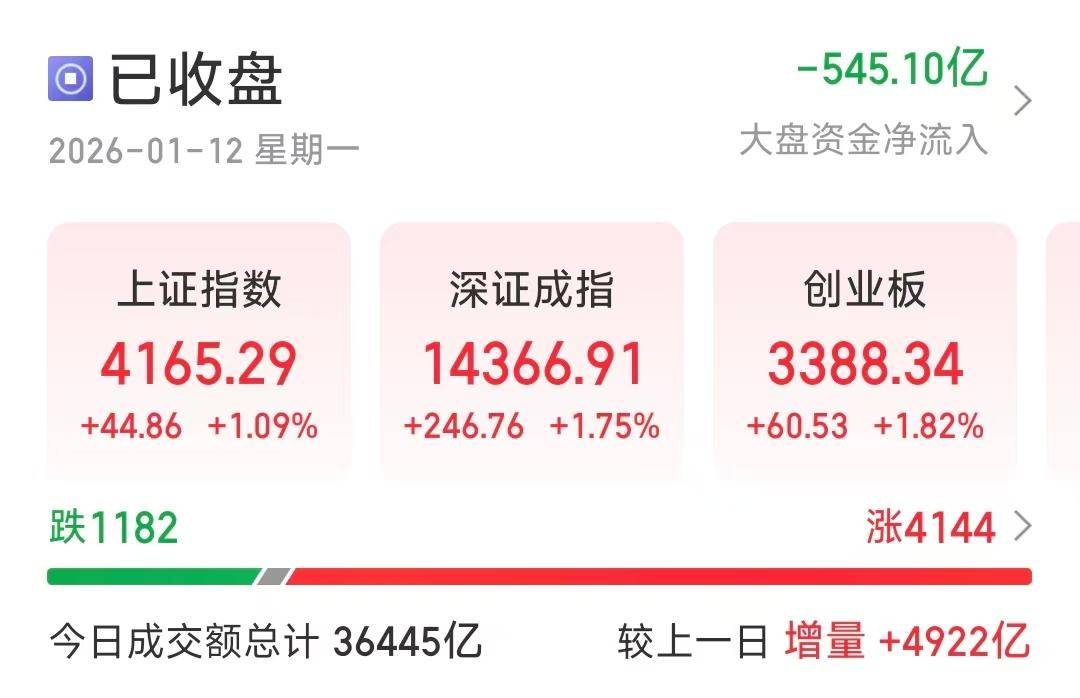
Market Overview - The Shanghai Composite Index has achieved a 17-day consecutive rise, closing at 4165.29 points, up 1.09% [1] - The total trading volume in the Shanghai and Shenzhen markets reached 3.6 trillion yuan, an increase of 478.7 billion yuan from the previous trading day, setting a historical record [1][3] - Experts indicate that the market has entered a phase of simultaneous increase in volume and price, marking the beginning of a spring rally [1][3] Sector Performance - The commercial aerospace, Sora concept, and AI intelligent agent sectors showed significant gains, with multiple stocks hitting the daily limit of 30% [3] - Notable performers in the commercial aerospace sector included Tianrun Technology and Xingtu Mapping, while in the AI sector, stocks like Zhongcheng Technology and Liujin Technology also reached the daily limit [3] Future Market Outlook - Yang Delong, Chief Economist at Qianhai Kaiyuan Fund, believes that the bull market logic for 2026 remains unchanged, with expectations for a transition from a cross-year market to a spring offensive [3][4] - January is typically a month with the highest credit issuance, estimated between 3 trillion to 5 trillion yuan, which may lead to increased capital inflow into the stock market [3] - The current strong market performance is expected to suppress bearish sentiment and enhance investor confidence [3] Long-term Projections - Yang Delong anticipates a slow bull market lasting 3 to 5 years, with the 2026 market expected to expand beyond technology and banking stocks to include consumer blue chips, new energy leaders, and military industries [4] - Industry analysts from Industrial Bank predict a continued positive outlook for the A-share market in 2026, with technology remaining a core focus [4] - Global economic conditions are favorable, with major economies showing steady growth and a low-risk macroeconomic environment, which supports the capital market [4] Valuation Insights - According to a report from GF Securities, the valuation of the A-share market has seen restrained growth over the past two years, with the changing competitive landscape between China and the U.S. providing a safety margin for valuations [5] - There is an expectation that A-share valuations may break historical patterns and continue to rise for three consecutive years [5]

美股异动丨利好叠加,沃尔玛盘前涨2.6%,开盘或创新高
Ge Long Hui· 2026-01-12 09:22
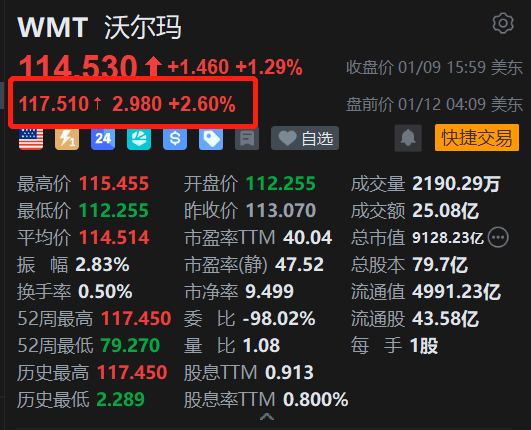
Core Viewpoint - Walmart is experiencing a pre-market increase of 2.6%, reaching $117.5, potentially setting a new historical high, driven by the announcement of AI shopping assistants in collaboration with major retailers like Google, Shopify, and Wayfair [1] Group 1: AI Integration in Retail - Google has announced partnerships with Walmart and other large retailers to transition from traditional search methods to AI-driven shopping experiences, marking a significant transformation in the retail industry [1] - The collaboration signifies a shift towards AI agents dominating the commercial landscape, indicating the next major change in retail [1] Group 2: Market Position and Index Changes - Walmart will replace AstraZeneca in the Nasdaq 100 index, with the adjustment set to take effect on January 20, 2026 [1]

量价齐升!沪指17连阳,A股成交额3.6万亿元破历史纪录
Sou Hu Cai Jing· 2026-01-12 08:07
Market Overview - The Shanghai Composite Index has achieved a 17-day consecutive rise, with the total trading volume in the Shanghai and Shenzhen markets reaching 3.6 trillion yuan, marking a record high [1] - The Shanghai Composite Index closed at 4165.29 points, up 1.09%, while the Shenzhen Component Index and the ChiNext Index rose by 1.75% and 1.82%, respectively [1] Sector Performance - The commercial aerospace, Sora concept, and AI intelligent agent sectors have shown significant gains, with multiple stocks in these sectors hitting their daily price limits [2] - Notable performers include Tianrun Technology, Xingtum Mapping, and Liujin Technology in the commercial aerospace sector, all achieving 30% price limits [2] Economic Outlook - The chief economist of Qianhai Kaiyuan Fund, Yang Delong, indicates that the current bull market is gaining strength, with a transition from a cross-year market to a spring offensive [2] - January is typically a month with the highest credit issuance, estimated between 3 to 5 trillion yuan, which is expected to channel into the capital markets, enhancing investor confidence [2] Long-term Market Projections - The market outlook for 2026 is optimistic, with expectations of a slow bull market lasting 3 to 5 years, expanding into various sectors including consumer staples, new energy leaders, and military industry stocks [3] - The global macroeconomic environment remains favorable, with major economies showing steady growth and low overall risk, which is beneficial for capital markets [3] - The valuation of A-shares is expected to break historical patterns, with a potential continuous increase over three years, particularly if adjustments occur in late January [3]
企业IT预算回暖信号浮现 属于Figma(FIG.US)的“AI设计工作流增长时代”到来
Zhi Tong Cai Jing· 2026-01-12 07:28
Core Viewpoint - RBC Capital has downgraded the target price for Figma from $65 to $38 while maintaining a neutral rating, citing the company's potential in the AI-driven design software sector as a key growth area [1][2] Group 1: Company Performance and Projections - Figma achieved a significant milestone with an annual revenue run rate exceeding $1 billion, driven by a 38% year-over-year revenue increase to $274.2 million, surpassing Wall Street expectations [2] - The company anticipates Q4 revenue between $292 million and $294 million, with a projected annual revenue for FY2026 of $1.044 billion to $1.046 billion, indicating a potential 40% year-over-year growth [3] - Figma's management has provided conservative guidance for early 2026, but the AI design software spending is stabilizing and improving in certain sectors [2] Group 2: Product and Market Position - Figma is a collaborative design software company focused on product design and development teams, offering an integrated workflow from interface design to development handoff [4] - The platform's core advantages include end-to-end workflow capabilities, strong cross-role collaboration, and a unique design and development ecosystem [5] - Figma is embedding generative AI technology into its business model, promoting tools like "Figma Make" for design automation and integrating AI credits into its pricing structure [5][6] Group 3: Industry Trends and Future Outlook - The AI application sector is experiencing a bullish narrative, with RBC Capital's positive outlook for companies like Figma indicating a potential acceleration in growth post-2026 [7] - The demand for AI applications is robust, with companies like Google launching new AI ecosystems that drive significant computational needs, reflecting a strong market for AI software [7][8] - The market for AI agents is projected to reach $53 billion by 2030, with a compound annual growth rate (CAGR) of 46%, highlighting the increasing importance of AI in enhancing operational efficiency [9]

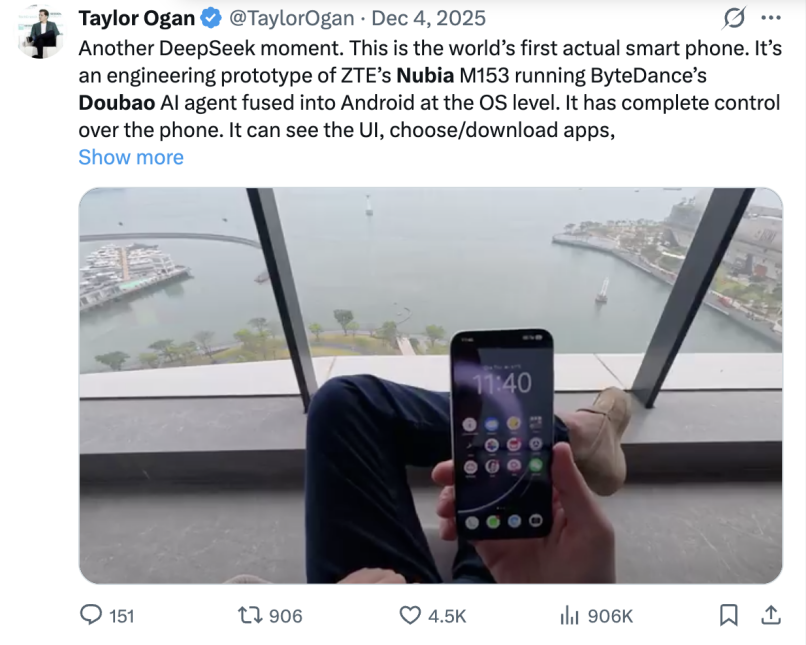
美国知名智库:豆包AI手机是引领全球的“游戏变革者”
Jin Rong Jie Zi Xun· 2026-01-12 03:50
Core Insights - Doubao AI phone has emerged as a significant technological innovation, capturing attention both domestically and internationally, and is viewed as a "game changer" in the AI agent development landscape [1][2] - The phone represents a shift in user interaction with AI, moving from text-based commands to a more integrated, multi-agent collaboration at the operating system level [2][5] - The fragmentation of China's mobile ecosystem poses challenges for the deployment of AI agents, as major platforms operate in closed environments, limiting interoperability [5][6] Group 1: Technological Innovation - Doubao AI phone allows users to issue voice commands that the device interprets to understand true intent, autonomously completing complex tasks without manual input [2][5] - The phone has been praised by early adopters, including U.S. investor Taylor Ogan, who described it as the "world's first true smart phone" [2] Group 2: Market Challenges - China's mobile ecosystem is characterized by "walled garden" models established by companies like Alibaba and Tencent, which complicate the integration of AI agents [5][6] - The fragmentation is exacerbated by smartphone manufacturers having their own operating systems, making cross-application collaboration difficult [6] Group 3: Competitive Landscape - Major internet companies have quickly restricted access to their apps for Doubao AI phone users, indicating a struggle for user attention and control over data [6][7] - The competition is not solely about security or privacy but fundamentally about maintaining control over user engagement and advertising revenue [6][7] Group 4: Standardization and Future Directions - The emergence of Doubao AI phone highlights the need for standardized protocols in AI agent technology, which is currently lacking [9][10] - The establishment of global standards is crucial for the interoperability of AI agents, with potential implications for international collaboration and market dynamics [9][10]