绿色化转型

Search documents
透过港口码头看中国外贸“含新量”(经济新方位)
Ren Min Ri Bao· 2025-07-30 22:06
Core Insights - The meeting of the Central Political Bureau emphasized the need to expand high-level opening-up and stabilize the fundamentals of foreign trade and foreign investment [1] - China's foreign trade maintained strong resilience, achieving a record high of 21.79 trillion yuan in imports and exports in the first half of the year, with exports reaching 13 trillion yuan, a year-on-year increase of 7.2% [1] - The increase in the "new content" of foreign trade is attributed to the continuous improvement of China's manufacturing "hard power" [1] Group 1: Trade Performance - In the first half of the year, the export of electromechanical products grew by 9.5%, accounting for 60% of total exports [2] - High-end equipment related to new productive forces saw growth exceeding 20%, while "new three samples" products representing green and low-carbon initiatives grew by 12.7% [2] Group 2: Expansion of Trade Networks - The addition of 11 new international routes from Shenzhen Port has created a global network, with over 40,000 standard containers shipped daily [3] - The opening of the "Tianjin Port—Qian Kai Port" international roll-on/roll-off route marks a new channel for vehicle exports from the Beijing-Tianjin-Hebei region [3] - China is a major trading partner for over 150 countries and regions, with imports and exports to Belt and Road Initiative countries reaching 11.29 trillion yuan, a year-on-year increase of 4.7% [3] Group 3: Innovation and New Business Models - The "new content" of foreign trade is reflected not only in product and market structure optimization but also in the vigorous development of new business formats and models [3] - E-commerce has become a significant driver of global cooperation, with 35 countries partnering in the Silk Road e-commerce initiative, establishing 120 online and offline national pavilions [3] Group 4: Future Outlook - The Ministry of Commerce stated the importance of continuously shaping new dynamics and advantages in foreign trade, maintaining global trade order, and collaborating with more trade partners for mutual benefit [4]
深耕技术优势,临清智卓纺织双轮驱动迎战行业智能化浪潮
Qi Lu Wan Bao Wang· 2025-07-30 11:07
临清市智卓纺织有限公司成立于2016年6月,是一家集棉花收购加工、棉纺织于一体的综合性民营企 业。公司固定资产9000余万元,棉纱年产能达7000吨,年销售收入约1.5亿元。 深化智能融合:投入建设"数字化纺纱云平台",整合生产全流程数据(设备、质量、能源、订单),实 现可视化、智能决策与远程诊断,提升管理效率与敏捷性。 强化绿色生产:推进节能改造(变频、余热回收);扩大再生棉/BCI棉应用。 拓展高端市场:利用云平台大数据指导研发,缩短新品周期,提升成功率,并依托智能化保障的稳定高 品质,深化南方高端面料市场的渗透,提升"智卓"品牌价值。 "总结来说,智卓的目标清晰:立足临清棉花资源,通过持续的智能化和绿色化转型,从优质纱厂升级 为华北智能化棉纺标杆,探索传统产业升级路径,不断优化提升精梳紧密赛络纺等产品品牌影响 力。"刘欢说。 7月29日,聊城市政府新闻办策划举办"产业链上的山东好品牌"企业家系列现场记者见面会,临清市智 卓纺织有限公司总经理刘欢介绍,面对行业智能化浪潮,智卓的核心策略是"智能装备+精益管理"双轮 驱动,这已转化为实实在在的竞争力和产品优势。 首先,智能化装备筑牢质量根基。率先应用了德国特 ...
热点追踪|上半年工业经济发展向稳、向新、向优
Ke Ji Ri Bao· 2025-07-28 05:38
Group 1 - The industrial and information technology sectors in China showed a positive development trend in the first half of 2025, characterized by stability, innovation, and quality improvement [1][2] - The total industrial added value increased by 6.4% year-on-year, with the manufacturing added value accounting for 25.7% of GDP, indicating strong resilience [1] - The number of large-scale industrial enterprises reached 520,000, an increase of over 8,000 compared to the end of last year, and profits in the manufacturing sector grew by 5.4% year-on-year [1] Group 2 - The integration of technological and industrial innovation accelerated, with industrial robot production increasing by 35.6% and service robot production by 25.5% year-on-year [1] - Nearly 410,000 technology contracts were registered nationwide, with a transaction value exceeding 3 trillion yuan, reflecting a 14.2% year-on-year growth [1] - The construction of industrial innovation platforms continued, with 33 national manufacturing innovation centers established by the end of June [1] Group 3 - The pace of industrial transformation and upgrading accelerated, with the added value of large-scale equipment manufacturing contributing 3.4 percentage points to overall industrial growth, accounting for 35.5% of total industrial output [2] - The added value of high-tech manufacturing increased by 9.5% year-on-year, contributing 23.3% to overall industrial growth [2] - Green factories accounted for over 20% of total manufacturing output, and energy consumption per unit of industrial added value continued to decline [2] Group 4 - Digital transformation efforts were enhanced, with 26 pilot cities identified for new manufacturing technology upgrades and support for 35 additional cities for small and medium-sized enterprise digital transformation [2] - The penetration rate of digital R&D tools in large-scale light industry enterprises reached 86.2%, while the digital management penetration rate was 82.3% [2]
金财互联:中航证券投资者于7月27日调研我司
Zheng Quan Zhi Xing· 2025-07-28 01:10
Industry Overview - The heat treatment industry is experiencing new development opportunities driven by national strategies for manufacturing, transportation, and aerospace [2] - The industry is focusing on "green, intelligent, precise, and high-end" directions, integrating new information technology and artificial intelligence with heat treatment technology [2] - There is a continuous growth in demand for heat treatment of key basic components in sectors such as aerospace, defense, new energy equipment, automotive, and robotics, with a trend towards high-end development [2] Company Performance - In the first half of 2025, the company maintained stable overall operations, actively responding to national strategies and focusing on heat treatment business through industry chain integration [3] - The company has invested in Wuxi Fuaier to enhance its precision high-temperature alloy component supporting capabilities, thereby improving its core competitiveness [3] Application Areas - The company's heat treatment business is primarily applied in various sectors including automotive (both traditional and new energy vehicles), wind power, photovoltaics, robotics components, engineering machinery, aerospace, nuclear power, military, shipping, precision machinery, and agricultural machinery [4] Market Position - As of the end of 2024, the company has established 6 heat treatment equipment manufacturing enterprises and 16 commercial heat treatment processing service enterprises, leading the domestic mid-to-high-end heat treatment equipment market [5] - The company has the largest number of commercial heat treatment processing service outlets nationwide and participates in the formulation of multiple national and industry standards, ranking among the top in comprehensive strength in the domestic market [5] - Major clients include Schaeffler, NSK, SKF, THK, and several others across various industries [5] Robotics Sector - The company's heat treatment equipment and commercial processing services are applied in the production of core components for robots, such as guide rails, screws, bearings, RV reducers, and planetary reducers [6] - The investment in Wuxi Fuaier is a strategic move to consolidate heat treatment business and explore upstream and downstream integration within the industry chain [6] Financial Performance - In Q1 2025, the company reported a main revenue of 206 million yuan, a year-on-year decrease of 33.0%, while the net profit attributable to shareholders increased by 466.95% to approximately 13.65 million yuan [7] - The net profit after deducting non-recurring gains and losses rose significantly by 5522.47% to approximately 12.16 million yuan, with a debt ratio of 32.59% and a gross margin of 33.49% [7]

新华时评·年中经济观察丨让外贸发展韧性更强活力更足
Xin Hua She· 2025-07-25 10:52
Core Insights - China's foreign trade report for the first half of the year shows a total import and export value of 21.79 trillion yuan, a year-on-year increase of 2.9% [1] - Exports of high-end equipment grew by over 20%, and the export of "new three types" products accelerated [1] - The report highlights the need for innovation and market vitality to enhance the resilience of foreign trade amid a challenging global environment [1] Group 1 - The total import and export value of China's goods trade reached 21.79 trillion yuan, with growth in trade with over 190 countries and regions [1] - The focus is on transforming price and cost advantages into technological comparative advantages, emphasizing the value of "Made in China" [1] - There is a call to enhance the independent controllability of strategic emerging industries and to strengthen core technologies [1] Group 2 - The strategy includes diversifying trade markets to mitigate risks associated with reliance on single markets [2] - The importance of responding to diverse consumer demands with customized products is emphasized to maintain competitiveness [2] - China's deep integration into global supply chains is highlighted, showcasing mutual benefits in various sectors such as textiles and agriculture [2]
2025年中国海上浮式基础平台行业产业链全景、发展现状、竞争格局及发展趋势研判:深远海资源开发提速,海上浮式基础平台迈向规模化商业应用[图]
Chan Ye Xin Xi Wang· 2025-07-25 01:11
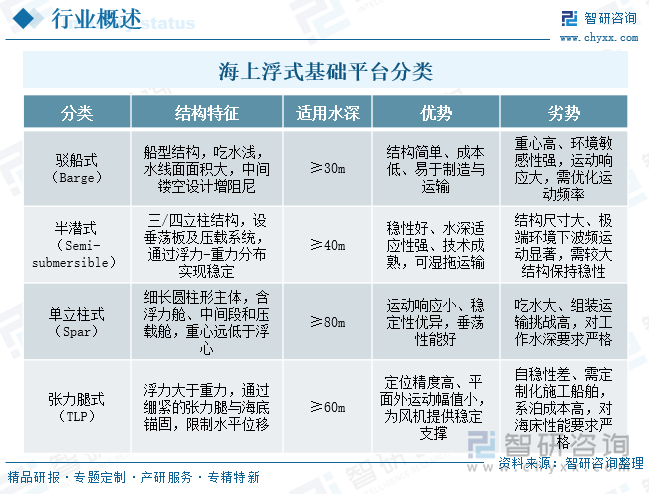
Core Viewpoint - The Chinese floating foundation platform industry is experiencing a dual opportunity period driven by policy dividends and industrial transformation, with a market scale projected to grow from 12 billion yuan in 2020 to 30 billion yuan in 2024, reflecting a compound annual growth rate of 26.3% [1][14][22] Industry Overview - The floating foundation platform is a marine engineering structure supported by buoyancy, primarily used for deep-sea oil and gas extraction, wind power generation, and ocean observation [2] - The main technical types include semi-submersible, barge-type, spar-type, and tension leg platforms, with semi-submersible platforms dominating the market due to their superior motion performance [2][16] Policy Environment - The "14th Five-Year Plan" for renewable energy development emphasizes the promotion of floating wind turbine foundations and aims to start construction on China's first commercial floating wind power project during this period [5][7] - A series of policies have been introduced to support the development of offshore wind power projects, marking a transition from technical demonstration to commercialization [5][7] Market Dynamics - The market size of the floating foundation platform industry is expected to reach 38 billion yuan by 2025, indicating a shift towards large-scale development [1][14] - The cumulative installed capacity of China's offshore wind power leads globally, accounting for 49.6% of the total, with significant projects like the "Haiyou Guanjing" platform further solidifying this position [1][10] Industry Chain - The industry chain features high collaboration and specialization, with upstream focusing on key materials and equipment supply, midstream on platform design and manufacturing, and downstream on project development and operation services [9][10] - The integration of technology, finance, and resources is crucial for the successful implementation of demonstration projects and the operation phase [9][10] Competitive Landscape - The industry is characterized by a competitive landscape where state-owned enterprises lead, while private enterprises specialize in specific technologies [18][20] - Semi-submersible technology accounts for over 60% of the market, with significant innovations in tension leg and concrete floating body designs [18][20] Future Trends - The industry is expected to evolve towards deep-sea development, intelligent operations, green transformation, and global collaboration, with a projected domestic production rate of 75% by 2030 [22][23] - Technological advancements will focus on extending operations to depths exceeding 300 meters and increasing the capacity of floating wind turbines to over 20 MW [22][23]

高质量完成“十四五”规划|“十四五”交通运输领域成绩单发布 “人享其行、物畅其流”美好愿景加快实现
Xin Hua She· 2025-07-21 12:14
Core Viewpoint - The Chinese government has made significant progress in enhancing the transportation sector's comprehensive capabilities, service quality, and operational efficiency since the start of the 14th Five-Year Plan, aiming to realize the vision of "smooth travel for people and goods" [1] Group 1: Infrastructure Development - By the end of 2024, China's railway operating mileage is expected to reach 162,000 kilometers, an increase of approximately 16,000 kilometers compared to the end of the 13th Five-Year Plan [1] - The total length of highways will reach 5.49 million kilometers, an increase of about 290,000 kilometers [1] - The navigable length of high-grade waterways will reach 17,600 kilometers, an increase of 1,600 kilometers [1] - The number of port berths for vessels over 10,000 tons will reach 2,971, an increase of 379 [1] - The number of certified civil aviation transport airports will reach 263, an increase of 22 [1] Group 2: Transportation Services - On average, approximately 180 million people travel across regions daily, with 160 million tons of goods transported and 478 million express deliveries collected [2] - Urban rail transit operating mileage is about 11,000 kilometers, and the total length of urban bus routes has reached 1.75 million kilometers, representing increases of 48.5% and 18.3% respectively compared to the end of the 13th Five-Year Plan [2] - The freight turnover for railways and waterways has increased by 17.5% and 33.6% respectively compared to the end of the 13th Five-Year Plan [2] - The annual growth rate of port container rail-water intermodal transport is approximately 15% [2] Group 3: Technological Advancements - Major projects such as the Shenzhen-Zhongshan Link have set multiple world records, and significant engineering achievements like the Pinglu Canal and Xiaoyangshan North Container Terminal have emerged [2] - The CR450 high-speed train set has been launched, the first domestically produced large cruise ship has commenced operations, and the C919 large passenger aircraft is now in regular commercial operation [2] - Automation in terminal construction, operational efficiency, and technological standards are among the best in the world, with advancements in autonomous driving, smart shipping, and intelligent logistics flourishing [2] Group 4: International Cooperation - The construction of the Shanghai International Shipping Center is progressing, with innovative breakthroughs in aviation and shipping policies at the Hainan Free Trade Port [3] - Major projects such as the China-Laos Railway, the China-Russia Heihe Highway Bridge, and the Peru Chancay Port have been completed and are operational [3] - The cumulative number of China-Europe freight trains has exceeded 110,000, with nearly 10,000 annual operations of the Western Land-Sea New Corridor's sea-rail intermodal trains [3] Group 5: Future Plans - The transportation sector aims to accelerate the construction of a strong transportation nation, focusing on the completion of the 14th Five-Year Plan and the preparation of the 15th Five-Year Plan [3] - Efforts will be made to promote the integration of transportation, enhance safety, upgrade intelligence, and transition to green practices, providing robust transportation support for national modernization and rejuvenation [3]
2025智慧物业软件TOP10榜单与行业变革趋势深度解析
Sou Hu Cai Jing· 2025-07-21 11:01
Core Insights - The article emphasizes that smart property management is a key driver for enhancing community governance efficiency and optimizing resident living experiences amid the global digital transformation wave [1] Group 1: Market Trends and Predictions - The global smart property market is expected to expand at a compound annual growth rate (CAGR) of 7.3% from 2025 to 2031, with China's market share continuing to grow [4] - Smart property management is not just a tool but a cornerstone for reconstructing community governance models and defining future lifestyles [4] Group 2: Technology and Innovation - AIoT is driving full-scene intelligence in property management, integrating management tools into community service platforms [4] - The article highlights the importance of green transformation, energy conservation, and sustainable development in property management [4] Group 3: Software Solutions and Case Studies - Mingyuan Cloud Property Management System is noted for its comprehensive coverage capabilities [4] - Tencent Cloud Smart Property is recognized as a leader in ecological integration [4] - You Ni Smart Home Property System is highlighted as an innovator in three-end collaboration [4] - Property通 Management System is identified as an expert in group data control [4] Group 4: Key Features and Benefits - New Window Property Management System offers integrated management across finance, taxation, and banking, enhancing operational efficiency [5] - AI-driven features such as intelligent order dispatch improve response times by 65%, while automated payment reminders increase payment rates to over 82% [5] - The system supports various scenarios including residential complexes, commercial complexes, and industrial parks [5] Group 5: Strategic Opportunities - Property companies are encouraged to prioritize technology investment in AIoT and blockchain to build technological barriers [5] - Collaborating with tech giants and vertical service providers is essential for building community ecosystems [5] - Transitioning from "managing properties" to "operating communities" is crucial for unlocking commercial value from data and scenarios [5]

研判2025!中国铜板带行业产业链、发展现状、进出口情况及发展趋势分析:高端转型加速推进,新能源汽车等新兴领域需求爆发[图]
Chan Ye Xin Xi Wang· 2025-07-19 02:29
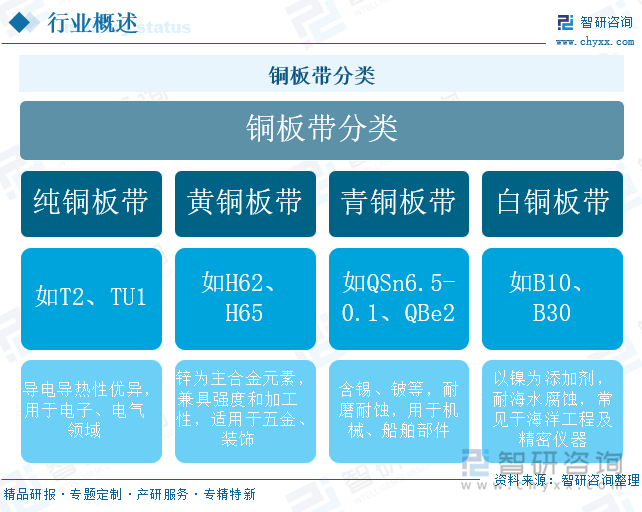
Industry Overview - Copper strip is a key material in modern industry, known for its excellent electrical and thermal conductivity, processing performance, and corrosion resistance, widely used in new energy and electronic electrical fields [1][4] - The industry is experiencing a "quantity and quality rise" trend, with total production capacity expected to reach 4.179 million tons and output exceeding 3 million tons by 2024, while the proportion of high-end products is projected to increase to 35% [1][10] - The new energy vehicle sector has become a core growth driver, with production and sales in the first five months of 2025 increasing by over 44% year-on-year, significantly boosting demand for high-conductivity copper strips [1][22] Import and Export Dynamics - The import and export landscape is characterized by accelerated import substitution and steady export growth, with exports expected to increase by 20.61% year-on-year in 2024 [1][12] - In 2024, the total import volume of copper strips is projected to be approximately 88,800 tons, a year-on-year increase of 14.28%, while exports are expected to reach 124,200 tons [12][14] - The import structure is shifting towards high-value-added products, while exports are primarily focused on general-purpose products, indicating a trend towards higher technical content and added value in trade [14][21] Competitive Landscape - The competitive landscape of the copper strip industry is evolving into a gradient structure, with leading companies like Jiangxi Copper and Tongling Nonferrous Metals dominating over 60% of the high-end market through technological innovation and cost reduction [16][18] - Medium-sized enterprises are focusing on niche markets, while smaller firms are facing pressure due to environmental standards and market saturation, leading to accelerated exits from the market [16][18] - The industry is expected to consolidate further, with a focus on technological leadership and high-end production capabilities [18][21] Future Trends - The copper strip industry is witnessing three core trends: high-end breakthrough, structural differentiation, and green transformation, driven by technological advancements and market demands [21][22] - The demand for copper strips in the new energy vehicle sector is expected to exceed 2 million tons by 2025, accounting for over 40% of global copper consumption growth [22][23] - Companies are increasingly investing in green technologies and innovations to enhance competitiveness, with significant potential for import substitution in high-end markets [23]


五大造船央企上半年净利润预计超50亿元!中国船舶、中国重工贡献超八成
Hua Xia Shi Bao· 2025-07-15 12:58
Core Viewpoint - The five major state-owned shipbuilding enterprises in China are expected to report a combined net profit of 50.2 billion to 60.5 billion yuan for the first half of 2025, showcasing the robust strength of China's shipbuilding industry and boosting confidence in the global shipbuilding market [2][3]. Group 1: Company Performance - China Shipbuilding and China Heavy Industry are projected to achieve a combined net profit of 43 billion to 49 billion yuan in the first half of 2025, reflecting a year-on-year growth of approximately 121% to 152% [3]. - China Heavy Industry anticipates a net profit of 15 billion to 18 billion yuan, representing a year-on-year increase of 181.73% to 238.08% due to a significant rise in the number of civil ship deliveries [3]. - China Shipbuilding expects a net profit of 28 billion to 31 billion yuan, with a year-on-year increase of 98.25% to 119.49%, attributed to higher prices for civil ship products and effective cost control [3]. - China Shipbuilding Industry Corporation and China Power are also expected to report substantial profit increases, with China Power projecting a net profit of 8 billion to 11.5 billion yuan, a year-on-year growth of 68.28% to 141.9% [6]. Group 2: Market Trends - The global shipbuilding market is experiencing a downturn, with new ship orders in the first half of 2025 declining by 54% year-on-year, totaling 647 ships and approximately 19.38 million compensated gross tonnage (CGT) [8][9]. - Despite the drop in new orders, Chinese shipyards maintain a strong delivery performance, accounting for 48% of global deliveries, while South Korea and Japan hold 31% and 13%, respectively [9]. - The shipbuilding industry in China is expected to continue benefiting from cost advantages, resilient supply chains, and technological innovations, solidifying its position as the world's largest shipbuilding nation [9]. Group 3: Future Outlook - The Chinese shipbuilding industry aims to enhance its core competitiveness through increased technological innovation, talent development, and collaborative industrial chain growth, while actively participating in international market competition [10].