
能源绿色低碳转型

Search documents
陕西榆林:煤化工产业与科技深度融合加速推进
Shan Xi Ri Bao· 2025-09-26 06:22
Core Insights - Yulin, an important energy base in China, is focusing on clean and efficient coal utilization, positioning itself as a key player in modern coal chemical industry development [1][3] - The 1 million tons/year high-end chemical new materials project is a significant initiative under Yulin's "14th Five-Year Plan," aimed at enhancing the coal chemical industry chain [1][2] - The project will require approximately 900,000 tons of methanol annually, primarily sourced from internal group companies, with plans to expand downstream partnerships [2] Industry Development - Yulin is developing six industrial chains, including coal-based high-end chemicals and coal-to-oil, to promote industrial clustering in designated industrial zones [2][3] - The city is transforming coal into various products, including construction materials and biodegradable items, showcasing a shift from traditional coal usage to innovative applications [2][3] Technological Innovation - Yulin is investing over 2.5 billion yuan in clean energy research and innovation, establishing platforms for technology integration and development [3] - The Yulin Zhongke Clean Energy Innovation Research Institute is facilitating a full-chain innovation path, leading to significant advancements in hydrogen energy storage and coal chemical research [3] Environmental Initiatives - The Yulin City Investment Baisheng CO2 comprehensive utilization project aims to reduce CO2 emissions by 1.01 million tons annually, contributing to environmental sustainability [4] - The project will convert CO2 into useful products for various applications, including oil recovery and agricultural fertilizers [4] Industry Collaboration - China National Offshore Oil Corporation's subsidiary showcased advanced technologies for efficient coalbed methane development at the Yulin International Coal and High-end Energy Chemical Industry Expo [5] - The company emphasizes green and low-carbon energy development, aligning with Yulin's goals for sustainable industrial transformation [5]
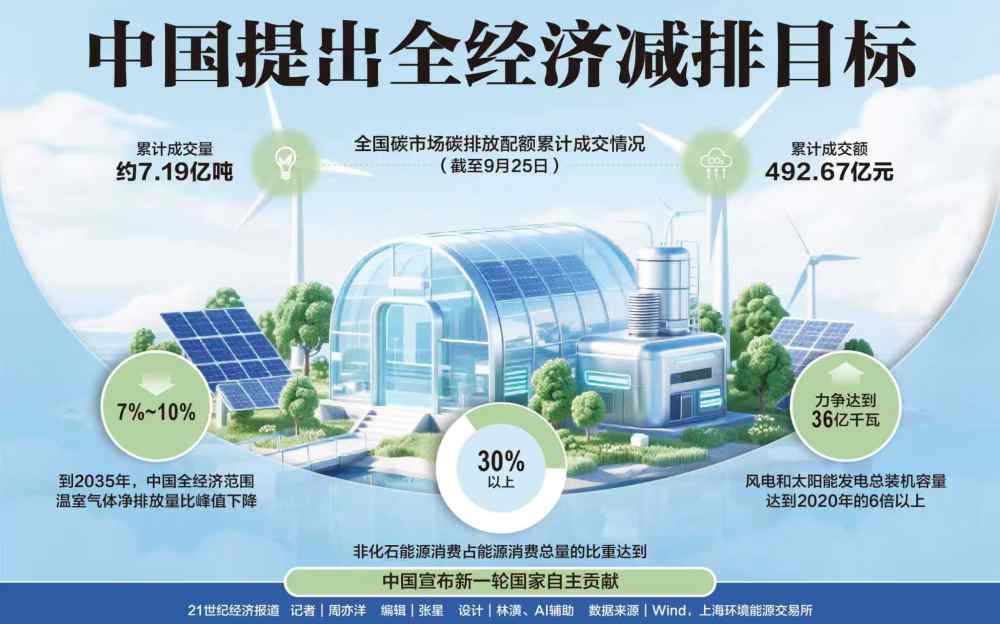
新一轮国家自主贡献落地:2035年风光装机36亿千瓦
2 1 Shi Ji Jing Ji Bao Dao· 2025-09-25 14:34
Core Viewpoint - China has announced a new round of Nationally Determined Contributions (NDC), aiming for non-fossil energy consumption to exceed 30% of total energy consumption by 2035, with wind and solar power installed capacity reaching over six times that of 2020, targeting 360 million kilowatts [2][4][8]. Group 1: NDC and Energy Transition Goals - The NDC is part of China's commitment under the Paris Agreement, with previous targets set in 2015 and 2020 focusing on carbon intensity and non-fossil energy share [3]. - The new NDC emphasizes the need for a new power system dominated by renewable energy, requiring coordinated development of energy sources, networks, loads, and storage [2][4][5]. Group 2: Energy Structure and Consumption - The transition to a green energy structure is accelerating, with non-fossil energy consumption expected to exceed the 20% target set for the 14th Five-Year Plan [4]. - Achieving the 30% target will involve a diversified approach to clean energy, including nuclear, hydropower, and biomass, alongside significant growth in renewable energy projects [6][7]. Group 3: Installed Capacity and Market Dynamics - The total installed capacity for wind and solar power has increased from 530 million kilowatts in 2020 to 1.68 billion kilowatts by July this year, with an annual growth rate of 28% [8][9]. - The ambitious target of 360 million kilowatts will require sustained high levels of new installations, supported by a robust supply chain and technological advancements [9][10]. Group 4: Technological and Policy Innovations - To support the integration of large-scale renewable energy, advancements in energy storage, grid flexibility, and smart grid technologies are essential [9][10]. - The development of a carbon market and electricity market synergy is crucial for enhancing the competitiveness of renewable energy [10].

氢能应用现代产业链高质量发展推进会在南京举行
Sou Hu Cai Jing· 2025-09-25 14:18
Group 1 - The conference on high-quality development of the hydrogen energy industry was held in Nanjing, focusing on key issues for the industry's advancement under the theme "Hydrogen Creates the Future, Green Chain Wins Together" [1] - The conference featured a special report by Gu Shengzu, a prominent economist, discussing global energy transition and the high-quality development of China's new energy industry [1] - Key figures from China Petrochemical Corporation (Sinopec), including General Manager Zhao Dong, emphasized the company's goal to become "China's leading hydrogen energy company" and the importance of collaboration within the hydrogen energy ecosystem [3] Group 2 - Nanjing is positioned as a significant base for hydrogen energy development in the Yangtze River Delta, with plans to enhance industrial planning and innovation ecosystems to support green and low-carbon energy transitions [5] - Sinopec released a hydrogen supply-demand matching list and a "Hydrogen Chain" data platform to facilitate industry data integration and promote collaboration across the hydrogen energy supply chain [5] - The conference included presentations from various experts and leaders in the hydrogen energy sector, highlighting the importance of cooperation and shared goals in advancing the industry [5]

专家解读丨2035年国家自主贡献目标:我国能源转型持续发力 彰显应对气候变化责任担当
国家能源局· 2025-09-25 04:43
Core Viewpoint - The article emphasizes the significance of green and low-carbon energy transition in achieving China's carbon peak and carbon neutrality goals, highlighting the country's commitment to sustainable development and international cooperation in addressing climate change [2][6][8]. Group 1: Achievements in Energy Transition - China's energy consumption reached 5.96 billion tons of standard coal in 2024, maintaining its position as the world's largest energy consumer. The country has made remarkable progress in energy green and low-carbon transition under strong leadership [3]. - Energy efficiency and cleanliness have improved, with energy consumption per unit of GDP decreasing by 11.6% compared to the end of the 13th Five-Year Plan. The share of non-fossil energy consumption reached 19.8%, an increase of 7.8 percentage points since 2015, with expectations to exceed the 20% target by 2025 [3]. - The electrification rate of end-use energy has reached around 30%, with over one-third of electricity being green energy, reflecting a significant shift in energy consumption structure [3]. Group 2: Strengthening Non-Fossil Energy Supply - China has the world's largest and fastest-growing renewable energy system, with installed capacities for hydropower, wind, solar, and biomass power leading globally. By July 2025, the total installed capacity for wind and solar power reached 1.68 billion kilowatts, accounting for nearly half of the global total [4]. - The country has consistently approved over 10 nuclear power units annually, leading the world in operational and under-construction nuclear power capacity. The average power supply reliability reached 99.924% in 2024 [4]. Group 3: Growth of Clean Energy Industry - Since 2015, China's share of global clean energy investment has increased from 26% to around 34%, making it the largest investor in energy transition. The country leads in the production of photovoltaic products, lithium batteries, and new energy vehicles, contributing over 80% of global photovoltaic modules and 70% of lithium batteries [5]. - China's exports of wind and solar products have significantly supported global climate change efforts, reducing carbon emissions by approximately 4.1 billion tons since 2020 [5]. Group 4: National Contribution Goals for 2035 - China's 2035 national contribution goals reflect its commitment to addressing climate change and establishing a fair global energy governance system. The country aims to achieve a non-fossil energy consumption share of over 30% by 2035, demonstrating its responsibility as a major power [6][7]. - The country acknowledges the challenges of achieving significant reductions in carbon intensity while facing rising energy demand, emphasizing its commitment to the principle of "common but differentiated responsibilities" in global climate governance [6][8]. Group 5: Strategies for Achieving Goals - The strategy for achieving carbon peak and carbon neutrality includes constructing a green and resilient energy consumption system, promoting structural changes in energy consumption, and implementing dual control over total carbon emissions and intensity [9]. - The focus on non-fossil energy development will be intensified, with plans to expand the multi-source supply system for non-fossil energy and develop a new power system that integrates various energy forms [9][10]. - Emphasis will be placed on technological innovation in energy, market reforms, and international cooperation to enhance the effectiveness of energy transition efforts [10].

我国电气化率已超28% 高于欧美主要发达经济体
Yang Shi Xin Wen· 2025-09-25 00:41
Core Insights - The report from the China Electricity Council indicates that China's electrification rate has surpassed 28%, exceeding that of major developed economies in Europe and the United States [1] Electrification Rate Overview - As of 2024, China's electrification rate is projected to be approximately 28.8%, an increase of 0.9 percentage points from the previous year [1] - The electrification rates in different regions are as follows: Eastern region at about 31.6%, Central region at 27.5%, Western region at 29.3%, and Northeastern region at 16.8% [1] - Fourteen provinces (regions, municipalities) have electrification rates above the national average [1] Sector-Specific Electrification - The industrial sector shows a steady increase in electrification, with the high-tech and equipment manufacturing industries achieving a combined electrification rate of 64.7% [1] - Other sectors such as consumer goods manufacturing, wholesale and retail, accommodation and catering, as well as agriculture and rural residents' living conditions are also experiencing rising electrification rates [1] Future Projections - By 2030, the national electrification rate is expected to reach around 35%, exceeding the average of OECD countries by 8 to 10 percentage points [1] - The electrification rate reflects both the strengthening of China's power supply capacity and the acceleration of the country's green and low-carbon energy transition [1]
【榆林】煤化工产业与科技深度融合加速推进
Shan Xi Ri Bao· 2025-09-24 22:58
Core Insights - Yulin is a significant energy base in China and one of the four modern coal chemical industry demonstration zones, focusing on clean and efficient coal utilization [1][4] - The 1 million tons/year high-end chemical new materials project is a key initiative under Yulin's "14th Five-Year Plan," aimed at enhancing the coal chemical industry chain [1][2] - The project includes various production facilities, such as a 400,000 tons/year DMTA unit and a 200,000 tons/year ethylene oxide unit, which will produce refined chemical products for downstream markets [1][2] Industry Development - Yulin is developing six industrial chains, including coal-based high-end chemicals and coal-to-oil, to promote industrial clustering in designated industrial zones [2][4] - The transformation of coal into various products, including construction materials and biodegradable medical supplies, signifies a shift towards sustainable practices in the coal industry [2][4] - The establishment of the Yulin Zhongke Clean Energy Innovation Research Institute aims to integrate technology and industry, focusing on hydrogen energy storage and downstream coal chemical research [3][4] Environmental Initiatives - Yulin is actively pursuing carbon reduction strategies, including the largest carbon capture and utilization project in Shaanxi, which aims to reduce CO2 emissions by 1.01 million tons annually [4] - The project converts CO2 into useful products for oil recovery, underground storage, and agricultural fertilizers, aligning with global green energy trends [4] - The introduction of innovative technologies in coalbed methane extraction and low-carbon fracturing techniques reflects the industry's commitment to reducing carbon emissions [5]
中国能建连续22年参加中国—东盟博览会
Xin Hua Wang· 2025-09-19 01:29
Group 1 - The 22nd China-ASEAN Expo and China-ASEAN Business and Investment Summit was held in Nanning, Guangxi, with China Energy Construction participating for the 22nd consecutive year [1] - China Energy Construction's exhibition theme was "Green Energy Chain World, Intelligent Creation of the Future," showcasing advanced technologies in large hydropower, clean coal power, compressed air energy storage, and green hydrogen ammonia [1] - The company is implementing the "Four Revolutions, One Cooperation" energy security strategy, focusing on a "30·60" system solution and promoting green low-carbon energy transformation [1] Group 2 - In the energy storage sector, China Energy Construction is a key player in new energy storage engineering and has been recognized as an original technology source by the State-owned Assets Supervision and Administration Commission [1] - The company has completed the world's first 300 MW compressed air energy storage demonstration project, achieving full capacity grid connection and setting multiple world records in power output and efficiency [1] - In the hydrogen energy sector, China Energy Construction has built an integrated industrial ecosystem covering green hydrogen, ammonia, and alcohol, and is involved in the largest green hydrogen ammonia project globally in Jilin [2] Group 3 - China Energy Construction has participated in major national projects such as the Three Gorges Project and the South-to-North Water Diversion Project, completing over 90% of China's power planning consulting and industry standards [3] - The company has achieved significant contributions in various energy sectors, including hydropower, thermal power, and nuclear power, holding multiple world-leading technologies and receiving six national science and technology progress awards [3] - It has established 77 institutions in ASEAN countries, with ongoing project contracts amounting to approximately 90 billion yuan, demonstrating its commitment to international cooperation and sustainable development [2]

远达环保272亿重组过会推进转型 “蛇吞象”式并购完成总资产或增6倍
Chang Jiang Shang Bao· 2025-09-18 23:45
Core Viewpoint - The asset restructuring of Yuanda Environmental Protection, led by State Power Investment Corporation, has successfully passed the Shanghai Stock Exchange review, aiming to enhance its business scale and profitability through the acquisition of hydropower and wind power assets [1][2][6]. Group 1: Restructuring Details - Yuanda Environmental Protection plans to acquire 100% equity of Wuling Power and 64.93% equity of Changzhou Hydropower for a total consideration of 271.8 billion yuan, funded through share issuance and cash payments [1][2][4]. - The restructuring has been in progress for nearly a year, with the initial proposal released in October 2024 and the formal application accepted by the Shanghai Stock Exchange in June 2025 [2][3]. - The restructuring will allow Yuanda Environmental Protection to integrate hydropower and wind power operations, enhancing its core competitiveness in the context of China's green energy transition [2][3]. Group 2: Financial Impact - Post-restructuring, Yuanda Environmental Protection's total assets and equity attributable to shareholders are projected to reach 682.55 billion yuan and 159.23 billion yuan, representing increases of 618.23% and 209.02% respectively compared to pre-restructuring figures [1][6]. - The acquisition price represents 527.48% of Yuanda Environmental Protection's net assets as of the end of 2024, with the total assets of the acquired companies accounting for 618.23% of Yuanda's assets [5][6]. - The projected increase in operating revenue and net profit post-restructuring is expected to be 146.61% and 2361.37% respectively, significantly enhancing the company's financial performance [6][5]. Group 3: Shareholding Changes - Following the restructuring, State Power Investment Corporation's shareholding in Yuanda Environmental Protection will decrease from 43.74% to 7.8%, while China Power will become the controlling shareholder with a 46.04% stake [3][4]. - Despite the change in shareholding structure, the ultimate controlling entity remains State Power Investment Corporation, ensuring continuity in strategic direction [3][4].

国网天津电力AI赋能配网运行智能化转型
Zhong Guo Dian Li Bao· 2025-09-18 02:46
"10千伏某配电线路开关分闸。"9月11日,国网天津蓟州供电公司新型电力系统中心源网荷储协同管控 平台发出语音告警提示。"以前,我们平均每天要查看5000余条配网告警信息。现在有了AI研判和语音 提示,任何重要信息都不会漏掉,我们可以更精准地分析电网运行态势。"蓟州供电调度员王成帅介 绍。 近年来,天津市能源绿色低碳转型持续推进,新能源占比不断提升。随着分布式光伏、电动汽车等新型 负荷大量接入,电网从单向辐射网络转型为多源随机交互的新型电力系统,配电网的运行方式也越来越 复杂。为有效开展新形势下的电网数据智能分析,积极推进配电网智能化转型,国网天津市电力公司加 快建设"电力+算力"深度融合的新型智能运维模式。 提效率 发现即处理 智能化 解放劳动力 为了增强配电网对分布式光伏的承载能力,天津电力首次采用"大模型+工作流"技术,自主研发了"告警 智能研判""线路态势感知"等AI应用,替代人工对负载率、电压平衡等关键指标进行实时监测和风险预 警,实现精准定位潜在问题区域,为制定运维策略提供有力支持。 "随着大模型技术的持续突破,我们在能源管理、智能电网、智能调度等方面进行了更多尝试,向着打 造更稳定、更安全、更智 ...
输配电价形成机制迎重要变革
Zhong Guo Dian Li Bao· 2025-09-17 06:20
Core Viewpoint - The recent issuance of four revised pricing methods for transmission and distribution by the National Development and Reform Commission marks a new phase in China's transmission and distribution pricing reform, aimed at establishing a scientific pricing mechanism to support the construction of a unified national electricity market and promote green and low-carbon energy transformation [1] Group 1: Enhancing Grid Infrastructure - The revised methods introduce an innovative capacity mechanism that allows for the exploration of two-part or single capacity pricing for cross-provincial and cross-regional projects primarily transmitting clean energy, ensuring fixed cost recovery and improving channel utilization efficiency [2] - The methods clarify the cost boundaries for pricing, excluding costs from pumped storage and new energy storage stations, while including environmental protection and water resource taxes, thereby optimizing the cost structure and highlighting the ecological value of the grid [2] Group 2: Incentivizing Grid Efficiency - The methods continue the incentive mechanism where 30% of the revenue from actual utilization hours exceeding the approved hours is shared with grid companies, promoting efficiency and supporting key areas like peak-shaving capacity and transmission channel optimization [3] Group 3: Supporting National Electricity Market Development - The methods establish a unified pricing system that ensures transparency and rationality from the cost source, clarifies the functions and pricing of various grid levels, and synchronizes adjustments over time, which is crucial for advancing the national unified electricity market [4] - The methods address rigid pricing mechanisms for cross-provincial transmission by enhancing flexibility in pricing for clean energy projects, thereby improving regional power regulation and resource allocation [4] Group 4: Promoting Clean Energy Utilization - The proposed two-part or single capacity pricing for clean energy transmission aims to reduce costs and enhance competitiveness in the unified electricity market, supporting large-scale renewable energy base power delivery [5] - The methods encourage the establishment of a nearby consumption mechanism and explore single capacity pricing for new energy consumption scenarios, fostering innovation in service models and promoting the maturity of distributed energy markets [6] - The continuation and enhancement of the excess revenue sharing mechanism, where 70% of excess revenue from cross-provincial transmission is allocated to support clean energy delivery, incentivizes renewable energy companies to improve efficiency and mitigate curtailment issues [6]