GEO

Search documents
三七互娱领投智推时代种子轮融资,抢占AI搜索红利
Huan Qiu Wang· 2025-10-30 05:13
Core Insights - The article discusses the recent investment by 37 Interactive Entertainment in Shanghai Zhitui Shidai Technology Co., a service provider for AI search ecosystem optimization, highlighting the growth potential of the GEO sector and the strategic importance of this investment in intelligent marketing [1][4]. Company Overview - Zhitui Shidai, founded in 2025, focuses on providing GEO solutions centered around AI visibility enhancement and content optimization for leading global brands across various sectors including education, gaming, health, retail, enterprise services, and finance [3]. - The company has developed China's first open-source GEO service system, the GENO system, which includes four engines: Star Hub (monitoring and early warning), Star Map (user analysis), Star Core (content generation), and Star Dome (knowledge graph), covering the entire intelligent marketing chain [3][5]. Market Trends - The article notes a significant shift in search behavior from traditional keyword searches to a new model of "zero-click direct answers," with a forecasted 25% decline in search engine traffic by 2026, as per Gartner [4]. - The GEO market in China is projected to exceed 20 billion yuan by 2025, with a compound annual growth rate of 67%, indicating that over 78% of enterprises have integrated GEO into their core strategies for brand growth and intelligent marketing [4]. Competitive Advantage - Zhitui Shidai has established a competitive barrier through a systematic product approach, offering a full-service capability via its SaaS platform and four engine product matrix, which optimizes service efficiency, accuracy, and cost control [5]. - The company's solutions have demonstrated significant results, such as a 70% increase in recruitment conversion rates for a top university and a reduction in customer acquisition costs from 300 yuan to 70 yuan for a well-known training institution [8]. Strategic Investment - 37 Interactive Entertainment's investment in Zhitui Shidai reflects confidence in the future of the GEO sector and recognition of the company's unique systematic product capabilities and global vision [8]. - The company aims to leverage AI and big data technologies to explore opportunities in the industry, focusing on the integration of AI-driven marketing innovations and enhancing its competitive edge in the AI search era [9].


ChatGPT要做广告和电商了,AI将重塑营销业
3 6 Ke· 2025-10-28 10:39
Core Insights - OpenAI is transitioning from being solely a chat tool to building a transaction ecosystem, indicating a significant shift in the marketing and e-commerce landscape [2][18] - The CEO of OpenAI, Sam Altman, has changed his stance on advertising, now viewing it as a potential value-add for users, which signals a new direction for the company [1][18] - OpenAI has introduced the "Instant Checkout" feature, allowing users to purchase products directly through ChatGPT, streamlining the e-commerce process [1][9] Group 1: New Advertising and E-commerce Scenarios - AI can provide personalized travel itineraries and seamlessly integrate commercial recommendations, enhancing user experience [3][4] - The AI acts as a personal shopping assistant, efficiently managing the entire purchasing process without requiring users to leave the chat interface [6][9] Group 2: Transformation of Marketing Logic - The flow of consumer information and product access is shifting from multiple platforms to a single AI assistant, making AI the new entry point for marketing [12] - Advertising is evolving from disruptive formats to service-oriented recommendations that are contextually relevant to users [13][5] - The decision-making process is being compressed from a lengthy funnel to an immediate action facilitated by AI [14] Group 3: Strategies for Embracing AI Marketing - Brands need to shift from traditional SEO to GEO, focusing on being the preferred answer for AI queries [19] - Marketing should transition from product promotion to problem-solving, aligning with user needs [20] - Maintaining brand recognition outside AI platforms is crucial for ensuring visibility within AI recommendations [22] - Establishing symbiotic relationships with AI platforms is essential for brands to integrate their services directly into AI interactions [24] - Marketing teams must adapt their skill sets to meet the demands of AI-driven marketing strategies [25] Group 4: Future of Brand Competition - The competition will focus on who can gain AI's trust and understand human needs better, rather than just budget or traffic [28][29] - The essence of marketing is returning to understanding and solving user problems, rather than merely capturing attention [26][27]

江西geo营销策略,如何高效实施与优化?
Sou Hu Cai Jing· 2025-10-17 17:09
Core Insights - The article emphasizes the necessity for Jiangxi enterprises to adopt and optimize GEO marketing strategies in the era of AI search to stand out in a competitive market [1][16]. GEO Definition and Mechanism - GEO, or Generative Engine Optimization, is a new marketing strategy designed for generative AI search engines, focusing on content quality, contextual relevance, and AI model training needs [2]. - GEO operates through data training and natural language processing, ensuring content aligns with AI preferences and meets EEAT (Expertise, Experience, Authority, Trustworthiness) standards [3]. Importance and Necessity of GEO - GEO represents a significant transformation in digital marketing, changing how users access information and positioning AI tools as new search engine entry points [5]. - Traditional SEO is insufficient in the AI search era; GEO helps brands optimize content to fit AI model training needs, securing advantageous positions in AI search results [5]. - GEO is particularly crucial for companies in competitive industries that rely heavily on generative AI for decision-making and those looking to expand from SEO to AI-driven platforms [5]. - GEO enhances brand visibility in AI searches and strengthens brand authority and credibility through the frequency and quality of brand mentions, which are becoming key indicators of brand authority in AI evaluations [5]. GEO Implementation Strategies and Optimization Suggestions - Implementing GEO requires efforts in keyword segmentation, content depth enhancement, and leveraging AI citation advantages [7]. - Companies should segment target keywords to cover conversational queries and long-tail phrases, making content more aligned with user needs while deepening content to reinforce topic authority [8]. - Content optimization strategies should include clear semantics and structured design, using Q&A formats to directly address user questions and integrating multimedia and unique insights to enhance GEO effectiveness [9]. - Technical SEO support is essential, including structured data markup (Schema) for FAQs, products, and articles, ensuring AI can efficiently understand and extract information [10]. - Utilizing professional tools and services, such as those offered by BatMan IT, can help companies efficiently implement GEO strategies and adapt to changes in AI search algorithms [11]. - Continuous tracking and optimization are vital due to the evolving demands of AI search engines, requiring ongoing analysis of competitor content and long-tail natural language queries [12]. Integration and Innovation of GEO with Traditional SEO - GEO complements SEO rather than replacing it, working together to advance brand development in digital marketing [12]. - Understanding the commonalities and differences between GEO and SEO can help maximize marketing effectiveness [13]. - Practical integration of GEO and SEO involves unified content strategies, comprehensive keyword research, and technical optimization [14]. - Continuous learning and adaptability are crucial in the rapidly changing digital marketing landscape, necessitating participation in industry seminars and staying updated on trends [14]. Success Standards and Performance Evaluation of GEO - Key indicators for measuring GEO success include the frequency and quality of brand mentions, AI citation frequency, and presence in zero-click results [15]. - Evaluating GEO performance should also incorporate traditional SEO metrics such as organic traffic, click-through rates, and rankings [15]. - Data-driven decision-making is essential for assessing GEO and SEO performance, utilizing tools like Google Analytics and Google Search Console to monitor traffic peaks and brand search volumes [15].
Google 搜索产品副总裁:AI 搜索的尽头是清晰
3 6 Ke· 2025-10-14 07:56
Core Insights - The podcast features Robbie Stein, Vice President of Google Search Products, discussing the evolution of search in the context of AI advancements [2][3] - The conversation highlights how AI has not changed fundamental human needs but has expanded the ways in which questions can be asked [4][6] - Google is transitioning from traditional search to an AI-driven model that understands context and semantics, allowing for more complex queries [7][8] Group 1: AI and Search Evolution - AI has increased the complexity and variety of questions users can ask, with Google Lens search volume growing by 70% over the past year [5] - The AI model enables Google to understand the intent behind questions, effectively rephrasing them for better search results [6][7] - Google aims to make searching easier and more natural, positioning AI as an expansion of search capabilities rather than a replacement [9][10] Group 2: AI Mode and Information Retrieval - The introduction of "AI Mode" allows Google to provide comprehensive answers by breaking down questions into sub-queries and conducting parallel searches [11][15] - Google differentiates itself from general chat-based AIs by focusing on information retrieval, ensuring answers are traceable and reliable [13][14] - The shift from traditional SEO to AI Engine Optimization (AEO) emphasizes semantic relevance and context over mere keyword optimization [24] Group 3: User Interaction and Experience - AI search is evolving to remember user context, preferences, and intent, making interactions more conversational and intuitive [25][27] - The goal is to create a seamless experience where users can ask questions in various formats—text, voice, or image—without needing to adjust their approach [19][21] - Robbie emphasizes the importance of clarity and speed in product design, aiming to simplify user interactions with technology [29]

案例| 从 SEO 到 GEO: Profound 的 AI 搜索“权游”
未可知人工智能研究院· 2025-09-03 03:03
Core Insights - The article discusses the significant shift in search behavior due to AI-driven chat search tools, which have captured 5% of desktop search traffic in the U.S. as of early 2024, up from 1.3% earlier in the year, indicating a critical turning point in user habits [2] - The traditional SEO model is being replaced by a new paradigm termed "GEO + AI ecosystem cultivation," emphasizing the need for brands to adapt to this change [2] Group 1: Foundational Changes in Search - The rise of AI search tools marks a departure from the conventional "keyword + click" model to a direct answer retrieval approach, disrupting established SEO practices [2] - Historical data suggests that surpassing a 3% user habit threshold indicates a significant shift, which has now been achieved by AI search tools [2] Group 2: Company Background and Development - Profound was founded by James Cadwallader and Dylan Babbs, who recognized the need for brands to maintain visibility in AI-generated answers [5] - The company completed its angel funding round in spring 2024 and launched its MVP in summer 2024, quickly attracting major clients and securing a total funding of $58.5 million by August 2025 [7] Group 3: Founders' Profiles - James Cadwallader is noted for his marketing acumen and ability to drive brand growth through content, while Dylan Babbs brings technical expertise from his experience at Uber [9][10] Group 4: Product Overview - Profound's platform serves as a comprehensive tool for tracking AI visibility, optimizing content for AI answers, and generating new content based on AI preferences [12] - The platform includes modules for AI visibility tracking, Answer Engine Optimization (AEO), and content creation with gap analysis [13][14][15] Group 5: Case Study - Lake.com utilized Profound's services to enhance its visibility in AI platforms, resulting in a fivefold increase in organic traffic and a 50% visibility rate in AI-generated answers for non-branded keywords [16][18] Group 6: Implications for the Chinese Market - The article highlights a similar trend in China, where AI search products are gaining traction, and emphasizes the importance for brands to establish an AI answer optimization system early on [22] Group 7: Future Outlook - The article posits that brand operations will increasingly involve long-term collaboration with AI models, suggesting that neglecting this aspect could lead to brand invisibility in the consumer landscape [25]

AI搜索时代:当机器成为“首席导购”,品牌如何守住话语权?
Jing Ji Guan Cha Bao· 2025-08-19 09:57
Core Insights - The article discusses the transformative impact of AI on consumer behavior and brand visibility, emphasizing the shift from traditional SEO to a new paradigm where AI acts as a direct recommendation source for consumers [5][9][11]. Group 1: AI's Role in Consumer Decision-Making - Consumers are increasingly relying on AI tools like ChatGPT for hotel recommendations, reducing the need for traditional comparison methods [3][4]. - AI's ability to provide quick, confident recommendations positions it as a powerful influencer in consumer choices, creating a "reputation battle" among brands [3][4]. Group 2: Shift from SEO to GEO - The traditional SEO market, valued at over $80 billion, is facing disruption as search behavior shifts towards large language models (LLMs) [6]. - Brands must adapt to a new landscape where visibility is determined by how often they are mentioned in AI-generated responses, rather than traditional search rankings [9][10]. Group 3: Brand Management in the AI Era - Brands need to actively manage their online presence to ensure they are positively represented in AI outputs, as over 40% of users may not click on original sources [7][10]. - Companies are leveraging AI monitoring tools to understand how their brand is perceived in AI-generated content, allowing for proactive reputation management [10][11]. Group 4: Strategies for Brands - Brands should create a "brand recognition map" using AI tools to identify how they are described in AI responses, enabling them to address potential biases or misinformation [13]. - Developing clear, structured content that is easily digestible by AI is crucial for brands to be favorably mentioned in AI outputs [14]. - Establishing a cross-departmental response mechanism is essential for brands to maintain visibility and trust in the AI-driven landscape [15][17].
每 2 周新增 100 万美金 ARR GEO 已来,实时 AI 2 年 31 亿美金估值
投资实习所· 2025-08-12 05:42
Core Insights - Decart, led by former Benchmark partner Victor Lazarte, recently completed a $100 million Series B funding round, raising its valuation to $3.1 billion in less than two years [1] - The company has seen a sixfold increase in valuation from $500 million to $3.1 billion in just over six months [1] - Decart's core products, Oasis and Mirage, are pioneering real-time generative AI technologies that enhance user interaction and experience [3][4] Product Development - Oasis is a real-time generative AI open-world model that allows users to interactively shape their virtual environment, achieving over 1 million users within three days of launch [4] - Mirage, described as a "world transformation model," enables real-time video-to-video conversion with a response time of under 40 milliseconds, eliminating delays common in previous AI video models [3][4] - Both products represent a shift from static visual content to dynamic, interactive experiences, expanding the potential applications in gaming, virtual reality, and the metaverse [5] Market Position and Strategy - Decart aims to create a consumer application with a user base of one billion, aspiring to reach a market valuation of $1 trillion [8] - The company is preparing to launch an API for Mirage, which will allow developers and businesses to leverage its core technology, fostering an open ecosystem [9] - Decart currently generates revenue from GPU acceleration and anticipates that the Mirage model will become a significant revenue source as costs for content generation are drastically reduced [10] Financial Performance - The company has achieved significant revenue from GPU acceleration, amounting to tens of millions of dollars [9] - The proprietary optimization technology has reduced the cost of content generation from $10 to $1,000 per hour to less than $0.25, positioning Decart competitively in the market [10] - The rapid increase in valuation reflects strong investor confidence driven by broad market demand and Decart's technological advantages [11]

SEO 已死?GEO 崛起:当流量入口从“蓝色链接”变成“AI 一句话”
3 6 Ke· 2025-08-05 10:26
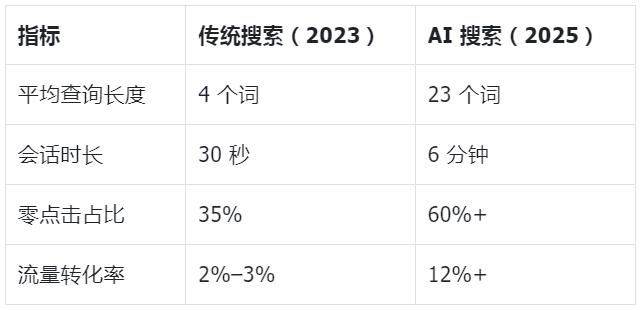
Core Insights - The article discusses the significant impact of AI technologies, particularly ChatGPT, on the traditional SEO industry, which is valued at $75 billion, and how it is transitioning towards a new paradigm known as GEO (Generated Engine Optimization) [1][7][16] Group 1: SEO Industry Overview - SEO has evolved into a multi-billion dollar industry focused on improving natural search results and ensuring visibility on search engines like Google [1][2] - The traditional SEO practices are being challenged by AI-driven search engines that provide direct answers to users, reducing the need for users to click through to websites [2][5] - The average query length is expected to increase from 4 words in traditional search to 23 words in AI search by 2025, indicating a shift in user behavior [3] Group 2: Impact of AI on Search Behavior - AI search engines are changing user interaction, with session durations increasing from 30 seconds to 6 minutes, and zero-click results expected to rise from 35% to over 60% [3] - The conversion rate is projected to improve from 2%-3% in traditional search to over 12% in AI search, highlighting the effectiveness of AI in delivering relevant information [3] Group 3: Transition from SEO to GEO - The shift from SEO to GEO emphasizes the need for content to be structured in a way that is easily digestible by AI, focusing on semantic blocks rather than traditional keyword stuffing [7][8] - Companies are encouraged to create content that is easily quotable and structured to improve chances of being referenced by AI models [9][10] - The new metrics for success are shifting from click-through rates (CTR) to reference rates, which track how often a brand is mentioned in AI-generated responses [8][9] Group 4: Industry Response and Future Outlook - The SEO industry is experiencing turmoil, with many professionals facing layoffs as they adapt to the new landscape dominated by AI [6][16] - New startups are emerging, focusing on AI optimization and marketing, raising significant funding to help brands navigate this transition [10][11] - The future of marketing will focus on how well brands can be integrated into AI responses, rather than traditional search rankings [16]
当用户“对话”AI,品牌如何主动被cue? | 红杉爱生活
红杉汇· 2025-07-10 12:42
Core Viewpoint - The article discusses the shift from traditional search engines to AI-driven search methods, emphasizing the importance of Generative Engine Optimization (GEO) for brands to enhance their visibility and credibility in the AI search era [1][3][4]. Group 1: Transition from Traditional Search to AI - The traditional search model required users to sift through numerous links, while AI provides direct, integrated answers, reducing consumer decision-making touchpoints [3][4]. - Gartner predicts a 25% decline in traditional search volume by 2026, with natural search traffic potentially decreasing by over 50% [3]. - A survey by Accenture indicates that 72% of consumers frequently use generative AI tools, with half relying on AI recommendations for purchases [3]. Group 2: Emergence of GEO - GEO represents a new marketing direction where brands must focus on being mentioned by AI rather than just being searchable [4][5]. - Companies need to adopt new optimization strategies to ensure their content is recognized as a credible source by AI engines [4][5]. Group 3: Creating AI-Friendly Content - Brands should create high-quality, structured content that is authoritative and comprehensive to increase the likelihood of being referenced by AI [8][9]. - The process of generating AI responses involves data collection, processing, and optimization, where content quality and relevance are crucial [9][12]. - Key factors influencing content citation by AI include quality, credibility, timeliness, and readability [9][12]. Group 4: Strategies for Enhancing Content Credibility - Incorporating authoritative quotes, industry reports, and expert opinions can enhance content credibility [11]. - Engaging with users through social media and encouraging user-generated content can provide additional references for AI [11][10]. Group 5: The Relationship Between GEO and SEO - Despite the rise of GEO, traditional SEO remains relevant, as both can coexist and complement each other [15][16]. - SEO can enhance the overall quality of a brand's website, making it more likely to be referenced by AI, while also providing insights into user behavior that can inform GEO strategies [15][16].

AI搜索的“回答位”,正被广告涌入
21世纪经济报道· 2025-07-10 07:10
Core Viewpoint - The article discusses the emergence and rapid growth of Generative Engine Optimization (GEO) as a new marketing strategy in the advertising industry, driven by the increasing influence of AI in consumer decision-making and the need for brands to be recognized by AI systems [1][5][26]. Group 1: Market Demand and Growth - The GEO market in China is estimated to be around 2.1 billion yuan this year, which is only one-tenth of the SEO market, but it is projected to grow to 24.2 billion yuan by 2027, surpassing SEO by double [1]. - Many brands are now actively seeking GEO services, asking agencies how they can outperform other GEO service providers and how quickly they can see results [1][2]. Group 2: Current State of GEO - GEO is still in its developmental stage, likened to the early chaotic days of internet marketing, with some companies generating low-quality content in bulk and others making unmeasurable promises of effectiveness [2][14]. - The operational mechanics of GEO involve embedding brand information into AI responses, contrasting with traditional SEO which focused on improving webpage rankings [5][6]. Group 3: Service Providers and Offerings - The GEO service market is divided into two main types: one offers customized services based on analyzing a company's presence on AI platforms, while the other follows a traditional SEO model charging per keyword [6][7]. - Pricing for GEO services varies significantly, with some companies charging from several thousand to tens of thousands of yuan depending on the service package [17]. Group 4: Content Optimization Strategies - Effective GEO strategies include three main content optimization tactics: semantic depth, data support, and authoritative sources [10]. - GEO service providers also focus on correcting AI-generated inaccuracies, which is becoming an essential part of their offerings [12]. Group 5: Challenges and Risks - The current GEO landscape is characterized by a lack of clear rules and standards, leading to potential "black hat" practices where low-quality content is produced to manipulate AI responses [14][18]. - The effectiveness of GEO is difficult to measure, as traditional metrics used in SEO do not apply, and many service providers rely on vague performance guarantees [15][19]. Group 6: Future Outlook - There is optimism that as AI platforms evolve, clearer regulations and standards for GEO will emerge, similar to those seen in the SEO industry [27]. - The integration of advertising into AI responses is anticipated, which could lead to a more structured commercial environment for GEO, enhancing its value and effectiveness [26][27].