中证1000

Search documents
大类资产周报:资产配置与金融工程美元弱势,降息在即,全球风险资产上行-20250915
Guoyuan Securities· 2025-09-15 15:17
Group 1 - The macro growth factor continues to rise, while inflation indicators show a weakening rebound, with domestic CPI turning negative at -0.4% and PPI's decline narrowing to -2.9%, indicating persistent internal demand issues [4] - The Federal Reserve's interest rate cut expectations are driving upward global liquidity expectations, benefiting Asian equity markets, with the Korean Composite Index rising by 5.94% and the Hang Seng Tech Index by 5.31% [4][9] - The A-share market shows a preference for growth styles, with the Sci-Tech 50 Index increasing by 5.48%, while small-cap indices outperform large-cap blue chips [4] Group 2 - Recommendations for asset allocation include favoring high-grade credit bonds in the bond market, adjusting duration flexibly, and focusing on bank and insurance sector movements [5] - In the overseas equity market, the report suggests monitoring interest rate-sensitive sectors due to limited short-term rebound potential for the dollar and significantly raised interest rate cut expectations [5] - For gold, it is recommended to increase allocations to gold and silver as they are core assets during the interest rate cut cycle, with expectations for Shanghai gold to break previous highs [5] Group 3 - The report indicates that the overall liquidity environment remains supportive for market valuation recovery and structural trends, with a significant decrease in average daily trading volume in the A-share market [56] - The A-share valuation levels have increased, with the price-to-earnings ratio rising to 50.38 times and the price-to-book ratio reaching 5.60 times, suggesting that market expectations for future corporate earnings may be overly optimistic [60] - The report highlights that the earnings expectations for A-shares are weaker than historical averages, with a projected rolling one-year earnings growth rate of 10.3% and revenue growth rate of 5.9% [61]
交易型指数基金资金流向周报-20250904
Great Wall Securities· 2025-09-04 07:27
Group 1: Core Insights - The report highlights the capital flow trends in exchange-traded funds (ETFs) during the specified period, indicating a mixed performance across different categories of funds [2][4]. - The total fund sizes and weekly net inflows show significant variations, with the CSI 300 experiencing a net inflow of 9.34 billion yuan, while the STAR 50 saw a net outflow of 135.45 billion yuan [6][7]. Group 2: Fund Performance by Category - The report categorizes funds into major themes, with large technology funds showing a fund size of 216.69 billion yuan and a weekly net inflow of 261.95 million yuan, while large financial funds had a size of 128.48 billion yuan with a slight decline of 1% [7]. - In the health sector, large health funds reported a fund size of 100.16 billion yuan with negligible weekly change, while large consumer funds had a net inflow of 55.83 million yuan [7]. Group 3: Sector and Style Analysis - The report provides insights into style strategies, indicating that growth funds had a size of 73.06 billion yuan with a weekly increase of 6.34%, while value funds reported a size of 33.08 billion yuan with a slight increase of 0.26% [9]. - The report also notes that the dividend strategy funds had a size of 598.77 billion yuan but experienced a weekly decline of 0.78% [9]. Group 4: International Fund Performance - Internationally, the Nasdaq 100 had a fund size of 784.21 billion yuan with a weekly increase of 1.44%, while the S&P 500 reported a size of 208.37 billion yuan with a modest increase of 0.72% [11]. - The report indicates that the Hang Seng Index had a fund size of 191.74 billion yuan with a slight decline of 0.29% [11].
A股牛市是结构性牛市么?|投资小知识
银行螺丝钉· 2025-08-30 13:56
Group 1 - The core viewpoint of the article highlights the cyclical nature of stock market trends, particularly the performance of value and growth stocks over different periods [2][3][4]. - From 2016 to 2017, there was a bull market for large-cap value stocks, with significant increases in indices related to real estate, value, and dividends, leading to value style fund managers achieving top returns in 2017 [2]. - In contrast, from 2019 to 2021, large-cap growth stocks dominated the market, with sectors like consumption, pharmaceuticals, and new energy driving the growth, while value styles remained relatively subdued during this period [3][4]. Group 2 - The article predicts that by 2025, small-cap and growth stocks will experience a resurgence, with indices like CSI 1000 and CSI 2000 leading the market for the first time in a decade [5][6]. - The performance of growth styles is expected to be strong, while the sectors that led the market in 2020-2021, such as consumption, may remain relatively weak in 2025 [6]. - The article emphasizes the benefits of having a mix of undervalued and overvalued stocks, allowing for strategic investment opportunities such as "buy low, sell high" as different stocks reach their valuation peaks at different times [7].


交易型指数基金资金流向周报-20250828
Great Wall Securities· 2025-08-28 03:37
Report Information - Report Title: Weekly Report on Capital Flows of Exchange-Traded Index Funds [1] - Data Date: August 18 - 22, 2025 [1] - Analyst: Jin Ling [1] - Report Date: August 28, 2025 [1] Core Findings Domestic Passive Equity Funds - Different index funds showed varying performance in terms of fund size, weekly returns, and net weekly capital inflows. For example, the Shanghai - Shenzhen 300 index fund had a size of 983.449 billion yuan, a weekly return of 4.27%, and a net weekly capital outflow of 34.74 billion yuan; while the ChiNext Index fund had a size of 126.448 billion yuan, a weekly return of 5.81%, and a net weekly capital inflow of 22.61 billion yuan [4]. Overseas Index Funds - International index funds also had diverse performance. The Nasdaq 100 index fund had a size of 78.421 billion yuan, a weekly return of -3.08%, and a net weekly capital inflow of 7.78 billion yuan; the S&P 500 index fund had a size of 20.837 billion yuan, a weekly return of -1.63%, and a net weekly capital outflow of 1.44 billion yuan [5]. Bond Funds - Bond funds had different performance based on factors such as maturity and credit rating. The 30 - year bond fund had a size of 8.969 billion yuan, a weekly return of -1.25%, and a net weekly capital inflow of 59.60 billion yuan; the short - term financing bond fund had a size of 29.341 billion yuan, a weekly return of 0.01%, and a net weekly capital outflow of 28.50 billion yuan [6]. Commodity Funds - Commodity funds, including gold, soybean meal, and others, also had distinct performance. The gold fund had a size of 70.887 billion yuan, a weekly return of -0.29%, and a net weekly capital outflow of 0.94 billion yuan; the energy and chemical fund had a size of 2.93 billion yuan, a weekly return of 0.76%, and a net weekly capital inflow of 0.88 billion yuan [6]. Index - Enhanced Funds - Index - enhanced funds based on different indices had different performance. The CSI 500 index - enhanced fund had a size of 1.978 billion yuan, a weekly return of 3.76%, and a net weekly capital inflow of 0.12 billion yuan; the ChiNext Index - enhanced fund had a size of 0.469 billion yuan, a weekly return of 5.46%, and a net weekly capital outflow of 0.04 billion yuan [6].
交易型指数基金资金流向周报-20250820
Great Wall Securities· 2025-08-20 12:19
1. Report Information - Report Title: Weekly Report on the Fund Flow of Exchange-Traded Index Funds [1] - Data Date: August 11 - August 15, 2025 [1] - Report Release Date: August 20, 2025 [1] - Analyst: Jin Ling [1] - Analyst's License Number: S1070521040001 [1] 2. Domestic Passive Stock Funds 2.1 Composite - **Fund Scale, Weekly Return, and Net Weekly Inflow**: For example, the Shanghai Stock Exchange 50 has a fund scale of 159.456 billion yuan, a weekly return of 1.86%, and a net weekly inflow of 4.352 billion yuan; the CSI 300 has a scale of 983.449 billion yuan, a return of 2.52%, and an inflow of 2.643 billion yuan; the CSI 500 has a scale of 140.12 billion yuan, a return of 4.08%, and an inflow of 1.117 billion yuan; the CSI 1000 has a scale of 116.917 billion yuan, a return of 4.20%, and an inflow of 3.272 billion yuan; the ChiNext Index has a scale of 126.448 billion yuan, a return of 8.69%, and an outflow of 3.136 billion yuan; the STAR Market and ChiNext 50 has a scale of 32.965 billion yuan, a return of 8.77%, and an outflow of 1.461 billion yuan; the STAR 50 has a scale of 181.221 billion yuan, a return of 5.58%, and an outflow of 10.456 billion yuan; the STAR 100 has a scale of 25.701 billion yuan, a return of 7.46%, and an inflow of 0.478 billion yuan; the STAR 200 has a scale of 0.547 billion yuan, a return of 5.06%, and an inflow of 0.138 billion yuan; the A50 has a scale of 36.101 billion yuan, a return of 2.05%, and an outflow of 1.399 billion yuan; the A500 has a scale of 198.099 billion yuan, a return of 2.90%, and an outflow of 1.155 billion yuan; the Hang Seng Index has a scale of 6.723 billion yuan, a return of 2.26%, and an inflow of 0.459 billion yuan; the Hang Seng China Enterprises Index has a scale of 0.915 billion yuan, a return of 2.09%, and no inflow; other funds have a scale of 129.449 billion yuan, a return of 3.36%, and an outflow of 0.765 billion yuan [4]. 2.2 Industry and Theme - **Fund Scale, Weekly Return, and Net Weekly Inflow**: Big technology funds have a scale of 216.688 billion yuan, a return of 5.87%, and an outflow of 9.937 billion yuan; big finance funds have a scale of 128.483 billion yuan, a return of 4.44%, and an inflow of 1.291 billion yuan; big health funds have a scale of 100.161 billion yuan, a return of 3.63%, and an inflow of 3.754 billion yuan; big manufacturing funds have a scale of 72.818 billion yuan, a return of 4.44%, and an outflow of 0.736 billion yuan; big consumption funds have a scale of 56.089 billion yuan, a return of 1.28%, and an inflow of 1.695 billion yuan; big cycle funds have a scale of 21.416 billion yuan, a return of 2.30%, and an inflow of 1.834 billion yuan; public utilities funds have a scale of 6.614 billion yuan, a return of -0.51%, and an outflow of 0.189 billion yuan; carbon neutrality funds have a scale of 13.051 billion yuan, a return of 2.26%, and an outflow of 0.125 billion yuan; state - owned enterprise reform funds have a scale of 0.0061 billion yuan, a return of 1.17%, and an outflow of 0.0002 billion yuan; other funds have a scale of 0.0742 billion yuan, a return of 2.75%, and an outflow of 0.0005 billion yuan [4]. 2.3 Style Strategy - **Fund Scale, Weekly Return, and Net Weekly Inflow**: Dividend funds have a scale of 59.877 billion yuan, a return of 0.19%, and an outflow of 0.203 billion yuan; growth funds have a scale of 7.306 billion yuan, a return of 7.20%, and an outflow of 0.189 billion yuan; value funds have a scale of 3.308 billion yuan, a return of 1.28%, and an outflow of 0.031 billion yuan; dividend low - volatility funds have a scale of 43.535 billion yuan, a return of -0.59%, and an outflow of 0.836 billion yuan; quality funds have a scale of 1.332 billion yuan, a return of 3.67%, and an outflow of 0.0004 billion yuan; low - volatility funds have a scale of 0.255 billion yuan, a return of 1.00%, and an outflow of 0.0001 billion yuan; other funds have a scale of 0.0111 billion yuan, a return of -0.59%, and no inflow [4]. 2.4 Enterprise Nature - **Fund Scale, Weekly Return, and Net Weekly Inflow**: China Special - Valuation Concept funds have a scale of 51.633 billion yuan, a return of 0.57%, and an inflow of 0.643 billion yuan [4]. 2.5 Region - **Fund Scale, Weekly Return, and Net Weekly Inflow**: Regional funds have a scale of 4.342 billion yuan, a return of 3.25%, and an outflow of 0.071 billion yuan [4]. 3. Overseas - Related Funds 3.1 Composite - **Fund Scale, Weekly Return, and Net Weekly Inflow**: The Nasdaq 100 has a fund scale of 78.421 billion yuan, a weekly return of 2.18%, and a net weekly inflow of 0.362 billion yuan; the S&P 500 has a scale of 20.837 billion yuan, a return of 1.99%, and an inflow of 0.023 billion yuan; the Dow Jones has a scale of 1.708 billion yuan, a return of 2.62%, and an inflow of 0.006 billion yuan; the German DAX has a scale of 0.975 billion yuan, a return of 1.33%, and an outflow of 0.053 billion yuan; the French CAC40 has a scale of 0.601 billion yuan, a return of 2.46%, and an outflow of 0.007 billion yuan; the Nikkei 225 has a scale of 3.611 billion yuan, a return of 4.00%, and an outflow of 0.200 billion yuan; the Tokyo Stock Price Index has a scale of 0.771 billion yuan, a return of 3.12%, and no inflow; Saudi Arabian funds have a scale of 0.540 billion yuan, a return of -0.53%, and an inflow of 0.152 billion yuan; the Hang Seng Index has a scale of 19.174 billion yuan, a return of 2.15%, and no inflow; the Hang Seng China Enterprises Index has a scale of 12.002 billion yuan, a return of 1.98%, and no inflow; other funds have a scale of 3.713 billion yuan, a return of 2.29%, and an outflow of 0.055 billion yuan [5]. 3.2 Industry and Theme - **Fund Scale, Weekly Return, and Net Weekly Inflow**: Hong Kong technology funds have a scale of 92.609 billion yuan, a return of 1.91%, and an inflow of 4.025 billion yuan; Chinese Internet funds have a scale of 45.350 billion yuan, a return of 2.98%, and an outflow of 0.450 billion yuan; Hong Kong medical funds have a scale of 27.231 billion yuan, a return of 6.47%, and an inflow of 1.194 billion yuan; Hong Kong consumption funds have a scale of 0.968 billion yuan, a return of 1.65%, and an inflow of 0.003 billion yuan; other funds have a scale of 16.931 billion yuan, a return of 2.98%, and an outflow of 0.034 billion yuan [5]. 3.3 Style Strategy - **Fund Scale, Weekly Return, and Net Weekly Inflow**: Dividend funds have a scale of 1.269 billion yuan, a return of 0.81%, and an outflow of 0.246 billion yuan; dividend low - volatility funds have a scale of 0.777 billion yuan, a return of 0.13%, and an inflow of 0.012 billion yuan [5]. 4. Bond and Commodity Funds 4.1 Bond Funds - **Interest - Rate Bonds**: 30 - year bonds have a scale of 8.969 billion yuan, a return of -1.53%, and an inflow of 4.046 billion yuan; 10 - year bonds have a scale of 4.090 billion yuan, a return of -0.31%, and an inflow of 0.024 billion yuan; 5 - 10 - year bonds have a scale of 38.952 billion yuan, a return of -0.33%, and an outflow of 0.986 billion yuan; 5 - year bonds have a scale of 6.948 billion yuan, a return of -0.12%, and an outflow of 0.192 billion yuan; bonds with a term of less than 5 years have a scale of 22.725 billion yuan, a return of -0.01%, and an outflow of 0.304 billion yuan; other bonds have a scale of 0.0371 billion yuan, a return of -0.53%, and an inflow of 0.0598 billion yuan [6]. - **Credit Bonds**: Medium - and high - grade bonds have a scale of 10.916 billion yuan, a return of -0.13%, and no inflow; urban investment bonds have a scale of 13.817 billion yuan, a return of -0.14%, and an inflow of 0.260 billion yuan; short - term financing bonds have a scale of 29.341 billion yuan, a return of 0.02%, and an inflow of 1.747 billion yuan [6]. - **Convertible Bonds**: Convertible bond funds have a scale of 43.859 billion yuan, a return of 1.44%, and an inflow of 3.181 billion yuan [6]. 4.2 Commodity Funds - **Fund Scale, Weekly Return, and Net Weekly Inflow**: Gold funds have a scale of 70.887 billion yuan, a return of -1.42%, and an outflow of 1.912 billion yuan; soybean meal funds have a scale of 4.193 billion yuan, a return of 1.36%, and an outflow of 0.053 billion yuan; non - ferrous metal funds have a scale of 0.745 billion yuan, a return of 0.35%, and an outflow of 0.032 billion yuan; energy and chemical funds have a scale of 0.293 billion yuan, a return of -0.83%, and an inflow of 0.0232 billion yuan [6]. 5. Index - Enhanced Funds - **Fund Scale, Weekly Return, and Net Weekly Inflow**: For example, the Shanghai Stock Exchange 50 has a scale of 0.076 billion yuan, a return of 2.82%, and an outflow of 0.0001 billion yuan; the CSI 300 has a scale of 3.209 billion yuan, a return of 2.34%, and an inflow of 0.0034 billion yuan; the CSI 500 has a scale of 1.978 billion yuan, a return of 3.68%, and an outflow of 0.0004 billion yuan; the CSI 1000 has a scale of 0.656 billion yuan, a return of 3.77%, and an inflow of 0.0086 billion yuan; the ChiNext Index has a scale of 0.469 billion yuan, a return of 8.38%, and an outflow of 0.0025 billion yuan; the STAR Market and ChiNext 50 has a scale of 0.062 billion yuan, a return of 8.63%, and no inflow; the STAR 50 has a scale of 0.935 billion yuan, a return of 5.52%, and an outflow of 0.0077 billion yuan; the STAR 100 has a scale of 0.317 billion yuan, a return of 6.74%, and an outflow of 0.0003 billion yuan; other funds have a scale of 0.194 billion yuan, a return of 2.68%, and an inflow of 0.031 billion yuan [6].
中证500与中证1000:沪深京成交放量2700亿,股市向好
Sou Hu Cai Jing· 2025-08-13 13:10
Group 1 - The core viewpoint of the article indicates that the stock market is experiencing a trend of oscillating upward movement, with significant gains in the CSI 500 and CSI 1000 indices [1] - The total trading volume in the Shanghai, Shenzhen, and Beijing markets reached 21,752 billion yuan, an increase of 2,700 billion yuan compared to the previous day, reflecting a rising risk appetite among investors [1] - The People's Bank of China and the Ministry of Finance have jointly introduced two loan interest subsidy policies aimed at boosting consumption, which is expected to promote a positive cycle in the "household consumption - corporate profits - employee salaries" chain [1] Group 2 - The article notes that the continuous rise in the stock market may lead to profit-taking demands, suggesting the possibility of short-term technical consolidation [1] - Overall, the short-term domestic policy outlook is strong, external risk factors are easing, and the stock market's risk appetite is recovering, indicating a bullish trend for the indices in the near term [1] - The implied volatility of options is currently within a normal range, and given the medium to long-term upward trend of the indices, it is suggested to maintain a bullish outlook through bull spreads or ratio spreads [1]
交易型指数基金资金流向周报-20250812
Great Wall Securities· 2025-08-12 11:44
Report Information - Data Date: 2025/8/4 - 2025/8/8 [1] - Report Date: August 12, 2025 [1] - Analyst: Jin Ling [1] - Report Title: Weekly Report on Fund Flows of Exchange-Traded Index Funds [1] Investment Ratings - Not provided in the given content Core Views - Not provided in the given content Summary by Categories Domestic Passive Stock Funds - Different concepts have varying fund scales, weekly price changes, and net weekly fund purchases. For example, the Shanghai Composite 50 has a fund scale of 159.456 billion yuan, a weekly increase of 1.15%, and a net weekly fund outflow of 2.506 billion yuan; while the CSI 1000 has a scale of 116.917 billion yuan, a weekly increase of 2.62%, and a net weekly fund inflow of 469 million yuan [4]. Overseas Index Funds - Overseas index funds also show diverse performance. The Nasdaq 100 has a fund scale of 78.421 billion yuan, a weekly increase of 0.83%, and a net weekly fund inflow of 391 million yuan; the S&P 500 has a scale of 20.837 billion yuan, a weekly decrease of 0.04%, and a net weekly fund outflow of 18 million yuan [5]. Bond Funds - Bond funds are divided into different types such as interest rate bonds, credit bonds, and convertible bonds. For instance, 30 - year interest rate bonds have a fund scale of 8.969 billion yuan, a weekly increase of 0.13%, and a net weekly fund outflow of 749 million yuan; short - term financing bonds in credit bonds have a scale of 29.341 billion yuan, a weekly increase of 0.04%, and a net weekly fund inflow of 4.023 billion yuan [6]. Commodity Funds - Commodity funds include gold, soybean meal, non - ferrous metals, and energy and chemical products. Gold funds have a scale of 70.887 billion yuan, a weekly increase of 2.11%, and a net weekly fund outflow of 3.123 billion yuan [6]. Index - Enhanced Funds - Index - enhanced funds cover various indices. For example, the Shanghai Composite 50 index - enhanced fund has a scale of 76 million yuan, a weekly increase of 0.35%, and a net weekly fund outflow of 1 million yuan [6].
基差方向周度预测-20250808
Guo Tai Jun An Qi Huo· 2025-08-08 12:11
Group 1: Core Views - Recent leveraged funds continue to flow in, with the total margin trading balance exceeding 2 trillion this week. The market sentiment remains optimistic, but the increase in the ratio of margin trading to market capitalization is limited. The 2 trillion mark has stronger signaling meaning than practical meaning and may trigger reverse trading, weakening risk appetite [2]. - Seven departments including the central bank jointly issued the "Guiding Opinions on Financial Support for New - type Industrialization", creating credit demand for banks through monetary structured tools, supporting the manufacturing industry, and stimulating a rapid rebound in the banking sector [2]. - US employment data released last week plunged, increasing market bets on interest rate cuts. The US dollar index has continued to decline to around 98, and foreign capital has replenished A - share positions, supporting the sentiment in the mainland market after the A - share index correction [2]. - This week's total A - share trading volume slightly decreased compared to last week, with daily trading around 1.6 trillion. Most broad - based indices recovered last week's losses, with small - and medium - cap stocks remaining strong. The CSI 1000 rose more than 2%, and together with the CSI 2000 and micro - cap stock indices, reached new highs for the year. Large - cap broad - based indices rose slightly more than 1% this week [2]. - The downward support for basis has weakened, and the intraday structured divergence in trends among varieties has increased. The risk appetite shown in the futures market has declined, and there is a need to guard against the risk of a slowdown in the index's upward rate or even a continuous adjustment [2]. - As of Friday, the annualized basis of each variety was basically the same as last week, with the annualized discounts of IC and IM still around 10% and 11% respectively [2]. Group 2: Weekly Forecast - The model's judgment on the movement direction of the basis of IH, IF, IC, and IM next week is: strengthening, weakening, strengthening, and weakening respectively [4].
上证指数收报3583.31点,涨0.66%。深证成指收报11041.56点,涨0.46%。创业板指收报2334.32点,涨0.50%。沪深300收报4070.70点,涨0.39%。科创50收报1049.41点,涨1.22%。中证500收报6261.73点,涨0.78%。中证1000收报6739.69点,涨1.04%。
news flash· 2025-08-04 07:11
Core Viewpoint - The stock market indices in China showed positive performance with notable increases across various indices, indicating a bullish sentiment in the market [1] Group 1: Index Performance - The Shanghai Composite Index closed at 3583.31 points, up by 0.66% [1] - The Shenzhen Component Index closed at 11041.56 points, up by 0.46% [1] - The ChiNext Index closed at 2334.32 points, up by 0.50% [1] - The CSI 300 Index closed at 4070.70 points, up by 0.39% [1] - The STAR 50 Index closed at 1049.41 points, up by 1.22% [1] - The CSI 500 Index closed at 6261.73 points, up by 0.78% [1] - The CSI 1000 Index closed at 6739.69 points, up by 1.04% [1]

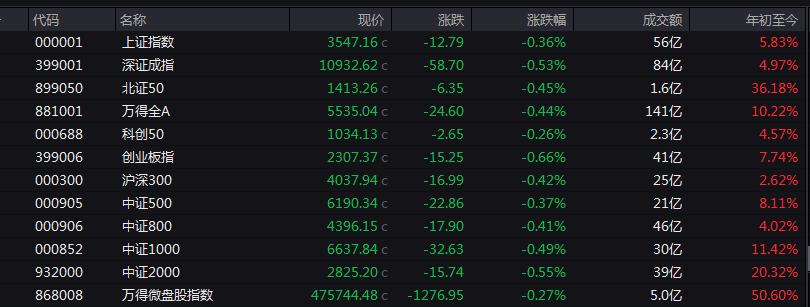
上证指数开盘报3547.16点,跌0.36%。深证成指开盘报10932.62点,跌0.53%。创业板指开盘报2307.37点,跌0.66%。沪深300开盘报4037.94点,跌0.42%。科创50开盘报1034.13点,跌0.26%。中证500开盘报6190.34点,跌0.37%。中证1000开盘报6637.84点,跌0.49%。
news flash· 2025-08-04 01:35
Market Overview - The Shanghai Composite Index opened at 3547.16 points, down 0.36% [1] - The Shenzhen Component Index opened at 10932.62 points, down 0.53% [1] - The ChiNext Index opened at 2307.37 points, down 0.66% [1] - The CSI 300 opened at 4037.94 points, down 0.42% [1] - The STAR 50 opened at 1034.13 points, down 0.26% [1] - The CSI 500 opened at 6190.34 points, down 0.37% [1] - The CSI 1000 opened at 6637.84 points, down 0.49% [1] Index Performance - The Shanghai Composite Index recorded a trading volume of 5.6 billion with a year-to-date increase of 5.83% [2] - The Shenzhen Component Index had a trading volume of 8.4 billion with a year-to-date increase of 4.97% [2] - The North Star 50 Index had a trading volume of 160 million with a year-to-date increase of 36.18% [2] - The Wind All A Index had a trading volume of 14.1 billion with a year-to-date increase of 10.22% [2] - The STAR 50 Index had a trading volume of 23 million with a year-to-date increase of 4.57% [2] - The ChiNext Index had a trading volume of 4.1 billion with a year-to-date increase of 7.74% [2] - The CSI 300 had a trading volume of 2.5 billion with a year-to-date increase of 2.62% [2] - The CSI 500 had a trading volume of 2.1 billion with a year-to-date increase of 8.11% [2] - The CSI 800 had a trading volume of 4.6 billion with a year-to-date increase of 4.02% [2] - The CSI 1000 had a trading volume of 3 billion with a year-to-date increase of 11.42% [2] - The CSI 2000 had a trading volume of 3.9 billion with a year-to-date increase of 20.32% [2] - The Wind Micro-Stock Index had a trading volume of 5.01 trillion with a year-to-date increase of 50.60% [2]