互联网

Search documents
生成式人工智能用户规模超6亿人
Sou Hu Cai Jing· 2026-02-06 00:07
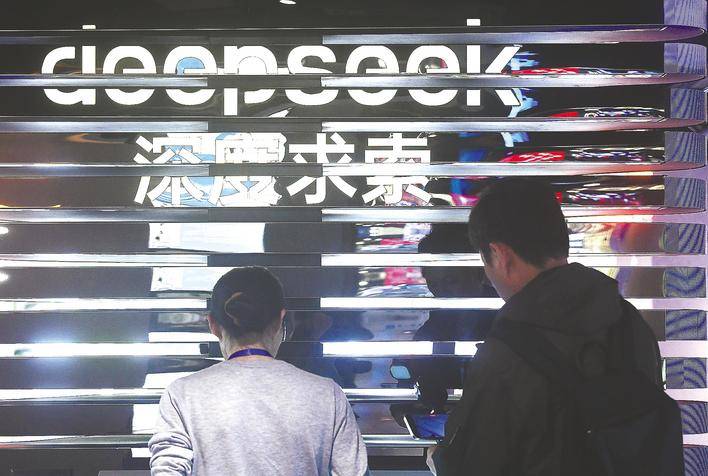
我国互联网普及率逾80% 生成式人工智能用户规模超6亿人 2025年5月4日,人们在浙江省杭州市文三数字生活街区的AI黑科技市集上体验DeepSeek的人工智能大 模型。(新华社发) 截至2025年12月,我国网民规模达11.25亿人,互联网普及率达80.1%;生成式人工智能用户规模达6.02 亿人,普及率达42.8%。 AI加速应用,发展动能更强—— AI旅行助手完成个性化行程定制、农业机器人广泛渗透"耕、种、管、收、运"全场景作业、机器人交警 高效实现交通动态分流…… 从"技术积淀"到"场景深耕",人工智能正加速融入日常生活与生产领域,成为推动社会数字化、智能化 转型的重要引擎。 报告显示,截至2025年12月,我国生成式人工智能用户规模达6.02亿人,较2024年底增长141.7%。 2月5日,中国互联网络信息中心政策与国际合作所发布第57次《中国互联网络发展状况统计报告》。一 系列亮眼的数据,勾勒出我国互联网发展持续向"新"而行、朝"好"迈进的生动图景。 夯实数字基座,互联网普及更广—— 报告显示,我国已建成全球技术领先、规模最大的信息通信网络,打通了经济社会发展的信息"大动 脉"。 我国已累计建成5 ...

11.25亿网民背后,中国互联网量变与质变
Xin Lang Cai Jing· 2026-02-05 20:15
人工智能作为一项革命性技术,将对经济社会长期运行逻辑带来重要影响,涉及经济、社会、治理等多 方面。从"互联网+"到"人工智能+",是信息技术革命的进一步延续和深化。对于11.25亿网民来讲,这 是享受中国创新成果、重塑网络生活生态的很好机会。当人工智能在创造新岗位和赋能传统岗位方面的 作用更加凸显,当智能消费基础设施持续提升家政、物业、出行、养老、托育等生活服务品质,当面向 自然人、数字人、智能机器人等多元一体的公共安全治理体系加快形成,数字发展成果也必将更好惠及 每一个人。 索乙 除了宏观意义上的数字,互联网带给每一个普通人的获得感,让我们更为感同身受。如今,"互联网 +"智能家居进入千家万户,在手机上即可看到家电的各项信息,预约、启动等操作变得更加方便智 能;智能穿戴设备可以随时监测身体情况,让运动健康变得可视化;新能源汽车凭借强大的互联交互功 能成为人们购车的优先之选……互联网推动科技发展带来的改变,正在潜移默化地影响着每个人。面对 新一代人工智能技术快速演进的新形势,让11.25亿网民更好共享数字发展成果的背后,是向"新"以强 技术、向"好"以惠民生,加速推动数字经济向智能经济和智能社会演进的不断进步 ...
【最新】我国网民规模,达11.25亿人!
Xin Lang Cai Jing· 2026-02-05 11:01
今天(2月5日),第57次《中国互联网络发展状况统计报告》发布。报告显示,截至2025年12月,我国 网民规模达11.25亿人,互联网普及率突破80%。来看央视新闻报道↓ 编辑:蒋燕楠 截至2025年12月,生成式人工智能用户规模达6.02亿人,较2024年底增长141.7%;普及率达 42.8%,同比大幅提高25.2个百分点。生成式人工智能正加速融入日常生活与生产领域,成为推动 社会数字化、智能化转型的重要引擎。 在移动网络方面,已建成5G基站483.8万座,全国所有乡镇以及95%的行政村已通5G,5G演进网 络已覆盖超330个城市。 在固定网络方面,全国2/3的地市达到千兆城市标准。 在算力设施方面,建成万卡智算集群42个,位居全球前列,有力支撑我国人工智能产业快速发 展。 全国一体化政务服务平台用户达9.4亿,"高效办成一件事"成为常态,彰显了互联网发展服务于 民、暖心为民的价值导向。 资料:央视新闻 ...
我国网民规模,达11.25亿人!
Sou Hu Cai Jing· 2026-02-05 05:16
编辑 王熙宁 责编 吴翔 审核 徐铁 第57次《中国互联网络发展状况统计报告》2月5日在京发布。报告显示,截至2025年12月,我国网民规 模达11.25亿人,互联网普及率达80.1%,数字发展成果惠及更广泛群体。生成式人工智能用户规模达 6.02亿人,应用场景向生活、生产领域深度渗透。 根据报告,"十四五"期间,我国互联网在覆盖广度与应用深度上取得显著进展,在技术能力与创新水平 上实现稳步提升。 来源:新华社 新华社权威快报|我国网民规模达11.25亿人 ...
新华社权威快报丨我国网民规模达11.25亿人
Xin Hua She· 2026-02-05 03:05
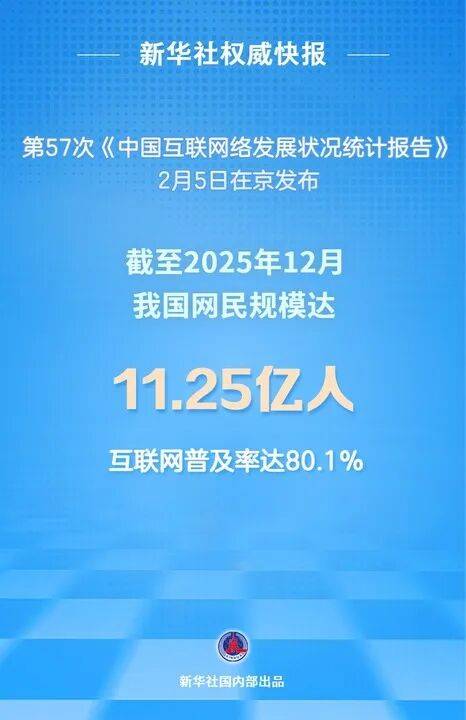
新华社权威快报 第57次《中国互联网络发展状况统计报告》 2月5日在京发布 新华社国内部出品 第57次《中国互联网络发展状况统计报告》2月5日在京发布。报告显示,截至2025年12月,我国网民规 模达11.25亿人,互联网普及率达80.1%,数字发展成果惠及更广泛群体。生成式人工智能用户规模达 6.02亿人,应用场景向生活、生产领域深度渗透。 根据报告,"十四五"期间,我国互联网在覆盖广度与应用深度上取得显著进展,在技术能力与创新水平 上实现稳步提升。 记者:王思北 海报制作:王思北 新华社国内部出品 截至2025年12月 我国网民规模达 11.25亿人 互联网普及率达80.1% ...
写好“义乌+互联网”的下半篇文章(新媒视点)
Ren Min Ri Bao· 2026-01-25 21:25
Core Insights - The article highlights the rise of Yiwu, a small county in Zhejiang, China, which has transformed into a global trading hub known as the "world supermarket" through the integration of the internet and e-commerce [1][2]. Group 1: Yiwu's Transformation - Yiwu's growth is characterized as a grassroots entrepreneurial legend, with the internet serving as a crucial variable for its leap into the digital age [1]. - Before the internet, Yiwu merchants faced limitations in information flow, but the internet has enabled them to connect with global buyers instantly, transforming their business model from traditional face-to-face negotiations to online transactions [2]. - Yiwu's export volume surpasses that of 25 provinces in China, engaging in trade with over 230 countries and regions, with 156 of these having trade volumes exceeding 100 million RMB [2]. Group 2: Future Prospects - The future vision for Yiwu includes becoming not only a global commodity distribution center but also a source of innovation and a benchmark for global trade, focusing on digital integration and the use of big data and AI [2]. - Yiwu is home to over 10,000 foreign-funded enterprises from more than 160 countries, with nearly 650,000 international visitors annually, fostering a multicultural business environment [3]. - The deep integration of Yiwu with the internet is expected to contribute to the development of an open world economy and enhance cultural exchanges, positioning Yiwu as a showcase for Chinese civilization and governance [3].
AI 产品是一间办公室,互联网产品是报纸
投资实习所· 2026-01-25 10:21
Core Insights - The article emphasizes the shift in product design focus from information presentation in the internet era to productivity organization in the AI era [4][51] - It highlights the need for a new design framework that accommodates AI's embedded productivity within products, moving away from traditional information containers [4][51] Group 1: Internet Product Design - Internet products are designed around information, addressing how it is produced, organized, distributed, and consumed [3][5] - The evolution of information containers can be categorized into three stages: physical (newspapers), digital (web pages), and algorithmic (recommendation systems) [8] - The design paradigm for internet products has consistently revolved around creating effective information containers [8] Group 2: AI Product Design - AI products are fundamentally different as they embed productivity directly, requiring a new approach to design that focuses on how to organize and utilize this productivity [9][10] - The evolution of work containers for AI can also be divided into three stages: physical (offices), digital (tools like Notion), and AI-native (products like Kuse) [10] - The design of AI products must consider how to effectively harness AI's productivity within a structured work environment [10] Group 3: Work State Management - Human work is a continuous process of moving from historical states to target states, necessitating stable expression, acquisition, and manipulation of work states [11][15] - Files serve as the minimal expression of state, allowing visibility and operability of work states [16][17] - Folders manage the context of work, defining the scope and continuity of tasks [19][20] Group 4: AI Work Context - AI operates by predicting and generating tokens based on given context, making the structure of context crucial for effective output [25][26] - Context is limited to a one-time window, requiring reconstruction for each computation, which adds complexity to AI product design [27][28] - The cost of context is significant, as each token contributes to computational expenses, necessitating efficient context management [29] Group 5: File Systems and AI Collaboration - File systems provide an external state space that allows for efficient context management, enabling AI to work without needing to load all information at once [30][32] - The structure of file systems has been validated in coding products, where continuous development relies on a well-maintained file system [34][36] - File systems enhance AI productivity by ensuring outputs meet expectations and allowing for continuous work progression [38][40] Group 6: Human and AI Collaboration - Collaboration shifts from instruction-based interactions to state-based teamwork, with files becoming the shared objects of work [42][43] - Outputs from AI become reusable work states rather than one-time results, creating a continuous trajectory of work [46][49] - The system's potential is realized as work progresses without constant human intervention, allowing for a collaborative environment between humans and AI [50]

南向资金再现单日百亿流入!恒生科技ETF(513130)连续11个交易日吸金、份额连创历史新高!
Jin Rong Jie· 2026-01-22 03:43
Core Viewpoint - The Hong Kong stock market is experiencing significant inflows, particularly in the technology sector, indicating a potential new wave of support for tech stocks [1][2]. Group 1: Market Trends - On January 26, 2021, net inflows from southbound funds reached HKD 13.93 billion, marking the second instance this year of daily net inflows exceeding HKD 10 billion, with a focus on the information technology sector [1]. - The Hang Seng Technology ETF (513130) has seen continuous net inflows for 11 trading days, totaling HKD 3.597 billion, pushing its total shares to 63.3 billion, a historical high, reflecting increased confidence in the long-term allocation to Hong Kong tech stocks [2]. Group 2: Industry Developments - The commercialization of AI is gaining momentum, with a notable Hong Kong internet giant's Qianwen series model surpassing 1 billion downloads, becoming the most popular open-source AI model globally, solidifying the leading position of Hong Kong internet companies in the AI sector [2]. - The current price-to-earnings (P/E) ratio of the Hang Seng Technology Index stands at 23.73, which is significantly lower than the NASDAQ's 40.98 and the STAR Market's 179.45, suggesting a favorable valuation for potential investment [3]. Group 3: Investment Opportunities - The Hang Seng Technology ETF (513130) allows for T+0 trading and provides a low-cost entry point into core Chinese tech assets, tracking a range of leading companies in internet, cloud computing, and AI sectors [4]. - The management fee for the Hang Seng Technology ETF is only 0.2% per year, making it an attractive option for investors looking to gain exposure to the Hong Kong tech sector [4].
开评:三大指数集体低开 黄金概念涨幅居前
Zheng Quan Shi Bao Wang· 2026-01-21 01:30
Core Viewpoint - The three major indices opened lower on January 21, with the Shanghai Composite Index down by 0.25%, the Shenzhen Component down by 0.38%, and the ChiNext Index down by 0.24% [1] Sector Performance - The polyurethane, gold concept, and non-ferrous metal sectors showed the highest gains [1] - The AI marketing, internet, communication equipment, and Zhipu AI sectors experienced the largest declines [1]
近3400只个股下跌
第一财经· 2026-01-20 04:08
Market Overview - The A-share market showed a decline with the ChiNext index dropping by 1.83% to 3276.64, while the Shanghai Composite Index fell by 0.3% and the Shenzhen Component Index decreased by 1.22% [4][5] - The total trading volume in the Shanghai and Shenzhen markets reached 1.85 trillion yuan, an increase of 568 billion yuan compared to the previous trading day, with nearly 3400 stocks declining [5][6] Sector Performance - The satellite internet, commercial aerospace, and 6G concept sectors experienced significant declines, while the real estate, advanced packaging, cultural media, and retail sectors saw gains [4][5] - The retail sector showed strength with stocks like Xinhua Department Store and Shanghai Jiubai hitting the daily limit, following news from the National Development and Reform Commission about plans for a demand expansion strategy from 2026 to 2030 [5] Individual Stock Movements - Pop Mart saw a rise of over 10% after announcing a share buyback of 2.51 billion Hong Kong dollars, marking its first buyback since early 2024 [8][18] - Hualing Cable opened down over 9% and approached the daily limit down after announcing the termination of its acquisition of Hunan Xingxin Aerospace New Materials Co., Ltd [14] - Yidian Tianxia faced a limit down upon resuming trading [16] Economic Indicators - The People's Bank of China conducted a reverse repurchase operation of 324 billion yuan for 7-day terms at an interest rate of 1.40%, with 358.6 billion yuan of reverse repos maturing today [19]