
卫星互联

Search documents
亚太主要股指集体飘绿,A股化工股爆发,泡泡玛特涨超8%,黄金涨白银跌
2 1 Shi Ji Jing Ji Bao Dao· 2026-01-20 07:23
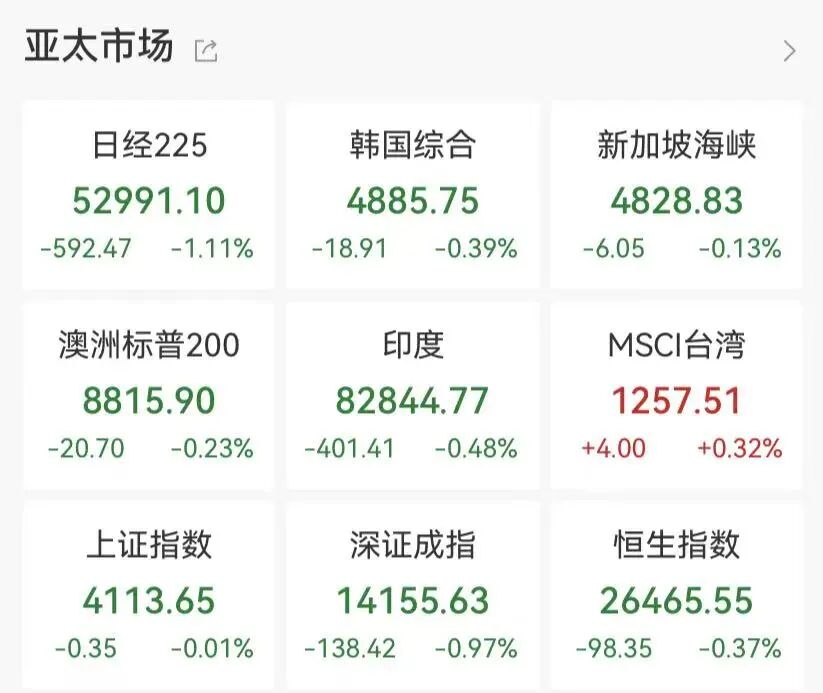
Market Overview - Major Asia-Pacific stock indices collectively declined on January 20, with the Nikkei 225 down by 592.47 points or 1.11%, the KOSPI down by 18.91 points or 0.39%, and the Straits Times Index down by 6.05 points or 0.13% [2] - The A-share market experienced fluctuations, with the Shanghai Composite Index down by 0.01%, the Shenzhen Component down by 0.97%, and the ChiNext Index down by 1.79%. Over 3,100 stocks in the market fell [2] Sector Performance - The satellite internet, CPO, commercial aerospace, and telecommunications sectors led the declines, with commercial aerospace stocks experiencing significant drops, including Shenjian Co. (002361) facing four consecutive trading halts and Aerospace Power (600343) facing two consecutive halts [3] - The chemical sector showed resilience, with over ten constituent stocks hitting the daily limit up, including Hongbaoli (002165), Shandong Heda (002810), Weiyuan Co. (600955), and Hongqiang Co. (002809) [3] - The real estate sector was active, with Dayuecheng (000031) and City Investment Holdings (600649) hitting the daily limit up [3] Hong Kong Market - In the Hong Kong market, the Hang Seng Technology Index fell over 1%, while the Hang Seng Index and Hang Seng China Enterprises Index saw slight declines. Most tech stocks were in the red, with SMIC, Sunny Optical Technology, and BYD (002594) down over 3%, while Xiaomi Group fell over 2%. Ctrip Group rose over 2.5%, and Midea Group (000333) and Baidu Group increased by over 1% [3] Gold and Silver Market - Gold prices rose, with spot gold surpassing $4,700, increasing by nearly 1% and up over 9% year-to-date. In contrast, spot silver fell nearly 0.5%, fluctuating around $94 per ounce [5] - Current prices for gold and silver include: - London Gold: $4,714.235, up by $45.051 or 0.96%, with a year-to-date increase of 9.17% - London Silver: $93.954, down by $0.444 or -0.47%, with a year-to-date increase of 31.26% - COMEX Gold: $4,712.5, up by $35.8 or 0.77%, with a year-to-date increase of 8.78% - COMEX Silver: $93.380, down by $0.900 or -0.95%, with a year-to-date increase of 31.58% [6]


亚太主要股指集体飘绿,A股化工股爆发,泡泡玛特涨超8%,黄金涨白银跌
21世纪经济报道· 2026-01-20 07:18
Market Overview - Major Asia-Pacific stock indices collectively declined, with the Nikkei 225 down by 1.11% and the Hang Seng Index down by 0.37% [2] - A-shares experienced volatility, with the Shanghai Composite Index closing down 0.01%, the Shenzhen Component down 0.97%, and the ChiNext Index down 1.79% [2] - Over 3,100 stocks in the market fell, indicating a broad market downturn [2] Sector Performance - The satellite internet, CPO, commercial aerospace, and communications sectors led the decline, with significant drops in commercial aerospace stocks [3] - The chemical sector showed resilience, with over ten stocks hitting the daily limit up, including Hongbaoli and Shandong Heda [3] - The real estate sector was active, with stocks like Diyi City and Urban Investment Holdings reaching the daily limit up [3] Stock Highlights - In Hong Kong, the Hang Seng Technology Index fell over 1%, while the overall Hang Seng Index saw a slight decline [3] - Notable declines were observed in tech stocks such as SMIC and BYD, both dropping over 3%, while Ctrip Group rose over 2.5% [3] - Pop Mart showed strong performance, initially rising over 10% after announcing a share buyback of 140,000 shares for HKD 251 million [3] Gold and Silver Market - Gold prices rose, surpassing USD 4,700, marking a year-to-date increase of over 9% [5] - In contrast, silver prices fell nearly 0.5%, fluctuating around USD 94 per ounce [5]

收盘丨创业板指高开低走跌1.79%,化工、贵金属板块逆势爆发
Di Yi Cai Jing· 2026-01-20 07:13
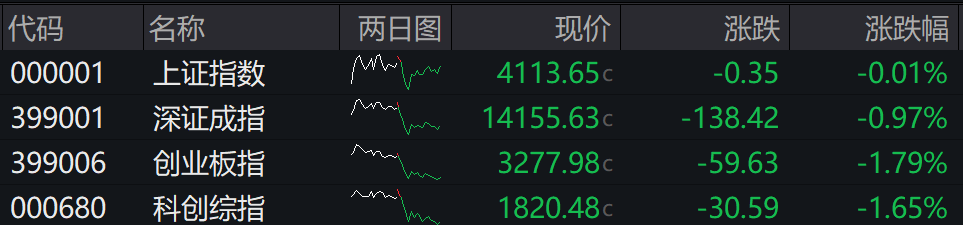
Market Overview - The total trading volume in the Shanghai and Shenzhen markets reached 2.78 trillion yuan, an increase of 69.4 billion yuan compared to the previous trading day [1][6] - The three major A-share indices opened high but closed lower, with the Shanghai Composite Index down 0.01%, the Shenzhen Component Index down 0.97%, and the ChiNext Index down 1.79% [1][2] Sector Performance - The satellite internet, CPO, commercial aerospace, and communication sectors led the decline, while cultivated diamonds, real estate, petrochemicals, and infrastructure sectors showed the most significant gains [2] - The chemical sector experienced a notable surge, with stocks such as Hongbaoli, Shandong Heda, Subote, and Hongqiang shares hitting the daily limit [2] Notable Stocks - The top gainers included Meibang Technology (+29.94%), Yida Co. (+11.96%), and Qicai Chemical (+10.71%) [3] - In the precious metals sector, Hunan Silver and Zhaojin Gold both reached the daily limit, with gains of 10.03% and 10.02% respectively [4][5] Capital Flow - Main capital inflows were observed in the real estate, banking, and cement materials sectors, while there were outflows from power equipment, communication, and aerospace sectors [9] - Specific stocks with significant net inflows included Shanghai Electric and China Power Construction, with inflows of 795 million yuan and 708 million yuan respectively [9] Institutional Insights - Guotai Junan expressed that the index is expected to experience strong range-bound fluctuations, recommending a focus on technology and cyclical sectors during pullbacks [9] - Flash Gold Asset Management noted that the fundamental logic for hard technology development remains unchanged [9] - Huaxin Securities projected that the potential incremental capital scale for A-shares could reach approximately 3 trillion yuan by 2026, with public funds, insurance funds, and bank wealth management being the main contributors [9]

创业板指半日跌近2%,商业航天、光模块重挫,芯片股走强,分析:高波题材或将降温
21世纪经济报道· 2026-01-20 04:11
Market Overview - On January 20, A-shares experienced a significant drop, with the ChiNext Index falling over 2% at one point, ultimately closing down 1.8% [1] - The Shanghai Composite Index closed down 0.3%, while the Shenzhen Component Index fell by 1.2%, with nearly 3,400 stocks declining [1] Index Performance - The Shanghai Composite Index closed at 4101.62, down 0.30% - The Shenzhen Component Index closed at 14119.95, down 1.22% - The ChiNext Index closed at 1824.62, down 1.43% - The total A-share market index (Wande All A) was at 6743.51, down 0.81% [2] Sector Performance - The chemical sector showed resilience, with stocks like Hongbaoli and Shandong Heda hitting the daily limit [2] - AI application stocks rose, with companies like Jiayun Technology and Yue Media also hitting the daily limit [2] - The storage chip sector remained active, with stocks like Baiwei Storage and Puran Shares reaching new highs, and Baiwei Storage increasing nearly 200% over the last 120 trading days [3] - Retail stocks strengthened, with Shanghai Jiubai and Xinhua Department Store hitting the daily limit, following the National Development and Reform Commission's announcement to develop a strategy for expanding domestic demand from 2026 to 2030 [3] Financing and Market Trends - A-shares' financing balance decreased for the first time in two weeks, with a reported balance of 27,059 billion yuan, down 8.5 billion yuan from the previous day [6][7] - The new financing regulations implemented on January 19 led to a significant drop in margin trading, with the trading volume on that day being the lowest of the year [6] - Key sectors experiencing net selling in financing included electronics, communications, defense, computers, and basic chemicals, each with net selling exceeding 1 billion yuan [7][8] - Analysts suggest that the increase in margin requirements is aimed at cooling down overheated speculative trends, particularly affecting high-volatility sectors [8] Broker Insights - Some brokers reported a shortage of available margin trading quotas due to high market demand [9]

近3400只个股下跌
Di Yi Cai Jing Zi Xun· 2026-01-20 04:09
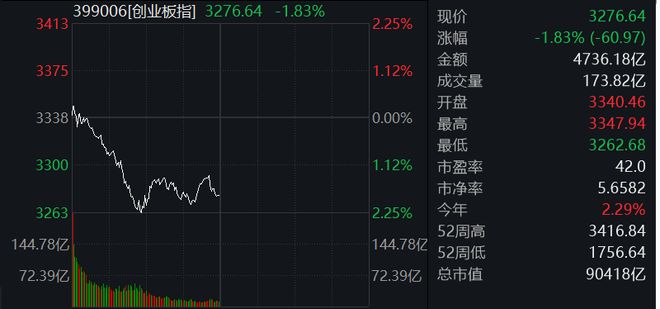
Market Overview - The A-share market showed a decline at midday, with the Shanghai Composite Index down 0.3%, the Shenzhen Component down 1.22%, and the ChiNext Index down 1.83% [1][4] - The total trading volume in the Shanghai and Shenzhen markets reached 1.85 trillion yuan, an increase of 568 billion yuan compared to the previous trading day [3] Sector Performance - The ChiNext Index fell by 1.83%, closing at 3276.64, with a trading volume of 473.618 billion yuan [2] - Sectors such as satellite internet, commercial aerospace, and 6G concepts experienced significant declines, while real estate, advanced packaging, cultural media, and retail sectors saw gains [2][4] Notable Stocks - Pop Mart International Holdings saw a rise of over 10% after announcing a share buyback of 2.51 billion Hong Kong dollars, marking its first buyback since early 2024 [5][13] - The coal sector showed some upward movement, with companies like Dayou Energy hitting the daily limit up, influenced by cold weather forecasts affecting several regions [3][4] Economic Indicators - The National Development and Reform Commission announced plans to formulate a strategy for expanding domestic demand from 2026 to 2030, which may impact retail and consumer sectors positively [3] - The People's Bank of China conducted a reverse repurchase operation of 324 billion yuan with a rate of 1.40%, with 358 billion yuan maturing today [12]





近3400只个股下跌
第一财经· 2026-01-20 04:08
Market Overview - The A-share market showed a decline with the ChiNext index dropping by 1.83% to 3276.64, while the Shanghai Composite Index fell by 0.3% and the Shenzhen Component Index decreased by 1.22% [4][5] - The total trading volume in the Shanghai and Shenzhen markets reached 1.85 trillion yuan, an increase of 568 billion yuan compared to the previous trading day, with nearly 3400 stocks declining [5][6] Sector Performance - The satellite internet, commercial aerospace, and 6G concept sectors experienced significant declines, while the real estate, advanced packaging, cultural media, and retail sectors saw gains [4][5] - The retail sector showed strength with stocks like Xinhua Department Store and Shanghai Jiubai hitting the daily limit, following news from the National Development and Reform Commission about plans for a demand expansion strategy from 2026 to 2030 [5] Individual Stock Movements - Pop Mart saw a rise of over 10% after announcing a share buyback of 2.51 billion Hong Kong dollars, marking its first buyback since early 2024 [8][18] - Hualing Cable opened down over 9% and approached the daily limit down after announcing the termination of its acquisition of Hunan Xingxin Aerospace New Materials Co., Ltd [14] - Yidian Tianxia faced a limit down upon resuming trading [16] Economic Indicators - The People's Bank of China conducted a reverse repurchase operation of 324 billion yuan for 7-day terms at an interest rate of 1.40%, with 358.6 billion yuan of reverse repos maturing today [19]

左手半导体光刻右手商业航天卫星,苏大维格产业布局加速
Zheng Quan Shi Bao Wang· 2026-01-11 04:40
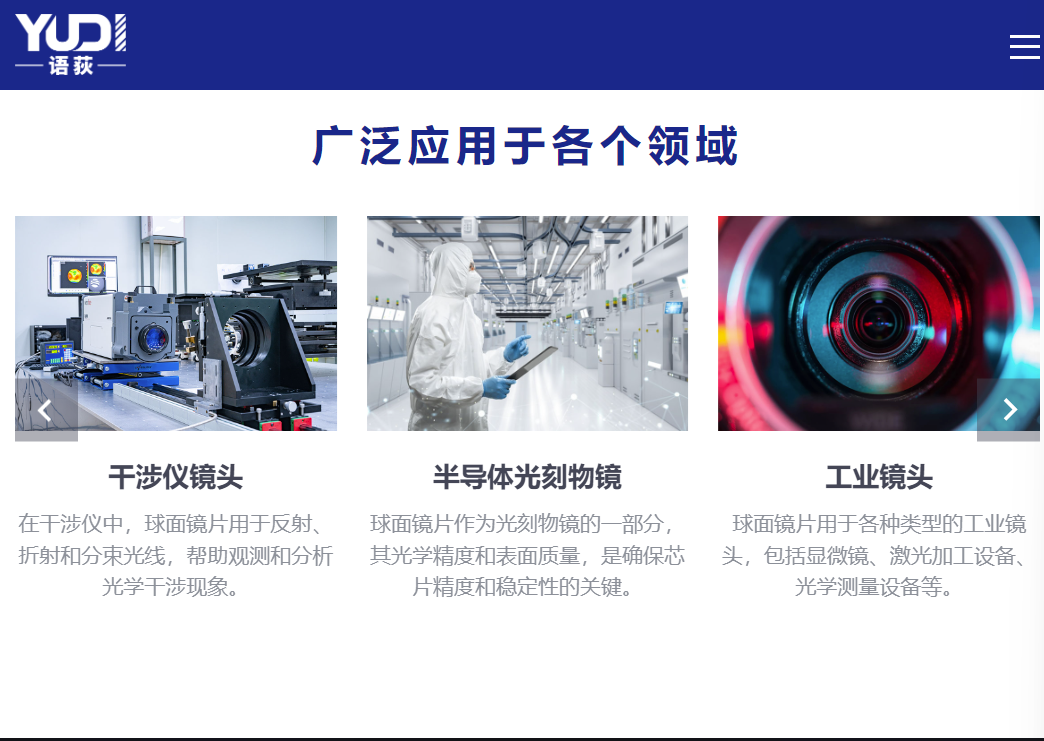
Group 1 - The core viewpoint is that Su Dawei Ge is accelerating its layout in the semiconductor and commercial aerospace sectors through strategic investments and acquisitions [1][8] - The company has entered into a strategic partnership with Shanghai Yu Di Optoelectronics, a leading domestic manufacturer in precision optical lenses and systems, focusing on semiconductor and satellite laser communication optics [2][3] - Shanghai Yu Di has experienced rapid growth in order and sales due to the trend of semiconductor localization and the development of commercial aerospace and low-orbit communication satellite industries [3][6] Group 2 - The recent acquisition of Changzhou Weipu Semiconductor has been completed, with the new generation STORM5000 mask defect detection equipment passing commercial acceptance tests, which is expected to significantly enhance Su Dawei Ge's future performance [8] - The company’s core business now covers the research and manufacturing of high-end laser direct-write lithography machines and nano-imprint lithography machines, greatly expanding its business boundaries [8] - The space laser communication technology has become a standard in the industry, with significant market potential, as evidenced by China's application for 200,000 low-orbit satellites, which is expected to drive faster growth for Shanghai Yu Di in the commercial aerospace sector [6]

2026年通信行业年度投资策略:AI基建与应用加速,卫星互联趋势明显
HUAXI Securities· 2026-01-06 15:36
Group 1 - The communication industry is transitioning from a traditional pipeline support role to becoming a core engine that empowers new productive forces [3][13] - Global ICT investment has shown a compound annual growth rate (CAGR) of 4.3% from 2010 to 2020, and despite the pandemic, it maintained a CAGR of 6.7% in 2020 [5] - By 2023, the global ICT market investment is expected to reach approximately $4.9 trillion, with projections to grow to $6.6 trillion by 2028, reflecting a CAGR of 6.3% [5] Group 2 - The transition from 5G to 5G-A/6G is characterized by a shift from bandwidth growth to capability integration, emphasizing the importance of integrated sensing and computing [11][13] - The "14th Five-Year Plan" focuses on the large-scale deployment of 5G and the integration of computing networks, while the "15th Five-Year Plan" anticipates the emergence of AI-driven intelligent computing capabilities [14] - The deployment of low-orbit satellite internet constellations is breaking geographical limitations, enhancing communication capacity and reducing latency [18] Group 3 - The demand for computing power is becoming the main driver of growth in the ICT market, with the Chinese enterprise-level ICT market expected to reach approximately $751.76 billion by 2028, with a CAGR of 6.5% [26] - The investment in enterprise-level servers and storage in China is projected to grow at a CAGR of 24.3% from 2023 to 2028 [26] - AI model training is driving a significant increase in computing power demand, with the computational equivalent for training AI models increasing dramatically [30] Group 4 - The capital expenditure of major Chinese telecom operators is expected to continue increasing, with China Mobile, China Telecom, and China Unicom projected to spend approximately ¥1,640 billion, ¥935.1 billion, and ¥613.7 billion respectively in 2024 [35] - The capital expenditure of these operators is shifting towards intelligent computing, with significant increases in their self-owned computing power [36] - The overseas cloud service providers are also increasing their capital expenditure, with a total of approximately $111.9 billion in Q3 2025, reflecting a year-on-year increase of 78.8% [36] Group 5 - The AI applications are expected to penetrate various sectors, with the emergence of AI-native applications and embodied intelligence reshaping interaction paradigms [65][67] - The market for humanoid robots is anticipated to grow significantly, with commercial applications expected to accelerate in both industrial and service sectors [73][76] - The integration of AI in industrial applications is addressing labor shortages and enhancing operational efficiency, with robots capable of replacing multiple skilled workers [81]
陕西华达(301517)深度报告:连接器需求稳步增长筑牢基本盘 积极拓展卫星市场
Xin Lang Cai Jing· 2025-12-30 10:59
Core Viewpoint - The company, Shaanxi Huada Technology Co., Ltd., has a strong position in the domestic connector market, particularly in military applications, and is poised for growth due to increasing demand and new market opportunities from its fundraising projects [1][2]. Group 1: Company Background - The company originated from the state-owned No. 853 Factory and has over 50 years of experience in research and production, specializing in RF coaxial connectors, low-frequency connectors, and RF coaxial cable components [1]. - It ranks among the top manufacturers of military connectors in China and is controlled by the Shaanxi Provincial State-owned Assets Supervision and Administration Commission [1]. Group 2: Market Outlook - The overall connector market in China is on an upward trend, with a projected market size of 205.8 billion yuan in 2023, reflecting a 9.1% increase from the previous year, and expected to reach approximately 218.1 billion yuan in 2024 [2]. - The military connector market is anticipated to grow due to increased defense spending and the trend towards domestic substitution, which will likely boost the company's product sales [2]. Group 3: Investment Projects - The company plans to invest 339 million yuan in a satellite interconnection high-reliability connector system project, which is expected to expand its business into satellite communications and phased array antennas [2]. Group 4: Customer Base and Profitability - The company has established a stable and high-quality customer base, including major entities like China Electronics Technology Group, Aerospace Science and Technology Corporation, and Huawei, maintaining long-term cooperative relationships [2]. - The company's products are primarily customized in small batches, which enhances their competitiveness and results in a gross margin that is significantly higher than the industry average [2]. Group 5: Profit Forecast - The company forecasts net profits attributable to shareholders of 63 million yuan, 93 million yuan, and 120 million yuan for the years 2025 to 2027, with corresponding valuations of 161.1, 108.2, and 83.8 times [3].
四中全会中报正式发布,航空航天ETF(159227)强势上涨,中国卫星涨停
Mei Ri Jing Ji Xin Wen· 2025-10-24 06:03
Core Insights - A-shares indices opened higher on October 24, driven by policy catalysts, with significant gains in sectors such as commercial aerospace, satellite connectivity, satellite navigation, military information, and large aircraft [1] - The Fourth Plenary Session of the Central Committee emphasized achieving the centenary goal of military development and advancing the modernization of national defense and military [1] - The report from AVIC Securities indicates that in 2024, China is expected to implement more policies supporting the aerospace industry, particularly in missile and intelligent ammunition, as well as space infrastructure and applications [1] Group 1 - The Aerospace ETF (159227) opened strongly, rising by 2.77% with a trading volume of 59.78 million yuan, leading the market [1] - Key stocks such as China Satellite and Shanghai Hanxun saw significant gains, with China Satellite hitting the daily limit and Shanghai Hanxun rising over 7% [1] - The military industry sector, represented by the Aerospace ETF, has a high purity of 98.2% in the Shenwan first-level military industry, covering critical areas such as aerospace equipment and satellite navigation [2] Group 2 - The Fourth Plenary Session's focus includes political, reform, technological, talent, and legal advancements in military construction, aiming to enhance national strategic capabilities [1] - The report highlights that the aerospace industry is entering a phase of resource allocation and policy support, particularly in defense and space infrastructure [1] - The Aerospace ETF includes leading companies in military and aerospace sectors, covering emerging fields like large aircraft development and commercial aerospace [2]
