产业链现代化

Search documents
奋进的河南——决胜“十四五”·产业加速键丨“链群”跑出新气象
He Nan Ri Bao· 2025-09-21 23:42
Group 1: Diamond Industry Development - The 2025 Diamond Industry Conference opened in Zhengzhou, highlighting the significance of the diamond industry as a key sector in Henan, evolving from abrasives to high-end products like single crystals and synthetic diamonds [1] - Henan has initiated a three-year action plan to enhance the superhard materials industry chain, establishing research institutes and associations to strengthen the industry ecosystem [1] - The province's focus on modernizing industrial chains has led to the creation of seven advanced manufacturing clusters and 28 key industry chains, enhancing Henan's competitive advantage [1] Group 2: New Energy Vehicle Sector - The rise of the new energy vehicle sector in Henan has been marked by the introduction of major manufacturers like BYD and CATL, leading to a significant increase in production from 6.6 million units in 2021 to 681,000 units in 2024 [2] - Exports of new energy vehicles from Henan have surged, with notable deliveries to international markets such as Norway and the UK [2] Group 3: Electronics and Advanced Equipment Industries - The electronics industry in Henan is focusing on specialized chips, high-end displays, and new computing power, with mobile phone production expected to reach 130 million units in 2024, ranking second in the country [2] - The advanced equipment sector is transitioning towards high-quality and intelligent products, with over 30% of the equipment industry now classified as advanced [2] Group 4: Innovation and Economic Growth - Henan is integrating innovation into its industrial chain, with the establishment of numerous research institutes and innovation centers, leading to significant technological advancements [3] - In the first half of the year, the added value of key industry chains in Henan grew by 9.5%, contributing 67.9% to industrial growth [3] - The "7+28+N" industry chain model has become a crucial support for high-quality development in Henan's manufacturing sector, accounting for over 80% of the province's total import and export value [3]
创新变革促进动能转换
Jing Ji Ri Bao· 2025-08-24 22:08
Group 1 - The core viewpoint emphasizes that local state-owned enterprises (SOEs) in Guangxi are leading high-quality development through technological innovation and modernization of the industrial chain, focusing on quality, efficiency, and energy transformation [1] - Guangxi SOEs leverage a dual endowment of "large industry + large channel," with traditional industries like machinery, metallurgy, and electricity having significant scale and potential for technological iteration, while also benefiting from open platforms such as the Western Land-Sea New Corridor and the China-ASEAN Expo [1] - The SOEs are implementing targeted reforms to convert comparative advantages into growth momentum, supported by a "policy toolbox" and "scenario testing ground" that facilitate project-driven technological and industrial development [2] Group 2 - The establishment of a "new project library" for SOEs aims to drive technological and industrial advancements, while encouraging traditional enterprises to enhance technology and product innovation [2] - Challenges remain in the high-quality development of SOEs, such as barriers in technology transfer, lack of brand valuation systems for traditional enterprises, and high costs in multimodal transport [2] - Recommendations include integrating AI development paths and establishing specialized evaluation guidelines for the four categories of enterprises, as well as building cross-border pilot bases and brand experience centers [2]
中钢协:下半年钢铁行业将继续推动产业基础能力稳步提升 增强产业链现代化水平
Xin Hua Cai Jing· 2025-07-30 03:19
Core Viewpoint - The steel industry aims to enhance self-discipline, prevent internal competition, optimize structure, improve efficiency, mitigate risks, and address shortcomings to ensure economic growth and high-quality development in response to external uncertainties [1] Group 1: Industry Development Strategies - The industry will focus on comprehensive internal adjustments to improve quality and efficiency, emphasizing the need for production control in response to declining domestic demand and shrinking international trade [1] - Continuous investment in technological innovation will be prioritized to support high-end, intelligent, and green development, including collaborative research and the establishment of digital transformation benchmarks [2] - Active participation in carbon markets and acceleration of green transformation will be pursued, with recommendations for policy support for high-efficiency, low-carbon enterprises [2] Group 2: Export and Market Strategies - The industry will promote high-end exports while stabilizing surrounding markets and enforcing strict regulations, advocating for policy support for high-end steel product exports and limiting primary steel product exports [3] - Development of steel structures and materials for emerging industries will be encouraged through exhibitions and research, focusing on specialized steel production [3] - An international exchange platform will be established to advance the globalization of the steel industry, facilitating dialogue and cooperation with foreign associations and enterprises [3]
明确产业定位合理分工协作有序
Jing Ji Ri Bao· 2025-07-18 22:03
Core Insights - The Yangtze River Delta integration strategy addresses regional development imbalances and emphasizes industrial positioning and collaboration among localities [1][2] - The focus is on leveraging advanced technologies to enhance traditional industries and promote the integration of digital and manufacturing sectors [1][2] - There is a strong push for the development of emerging industries, particularly in digitalization and intelligent manufacturing, to improve responsiveness and adaptability [2][3] Group 1 - The Yangtze River Delta integration strategy serves as a crucial tool for addressing regional development disparities [1] - Jiangsu and surrounding areas are clarifying their industrial positioning and fostering a collaborative development model [1] - The strategy emphasizes the importance of refining traditional industries through advanced technologies and industrial integration [1][2] Group 2 - There is a significant focus on seizing opportunities from the new technological and industrial revolution, particularly in digital and intelligent transformations [2] - The development of "new infrastructure" such as 5G networks and data centers is prioritized to support emerging manufacturing industries [2] - The strategy aims to build a self-controlled industrial system while recognizing the importance of global value chains [2][3] Group 3 - The Yangtze River Delta aims to enhance supply-side structural reforms through better resource utilization and regional cooperation [3] - There is a need for improved communication and coordination among regions to address planning bottlenecks [3] - The strategy seeks to achieve breakthroughs in transportation connectivity, energy cooperation, industrial innovation, and information networks [3]
山东药玻再叩央企大门
Qi Lu Wan Bao Wang· 2025-06-23 13:01
Core Viewpoint - The recent investment cooperation agreement between China National Pharmaceutical Group (国药集团) and Shandong Pharmaceutical Glass Co., Ltd. (山东药玻) marks a significant shift in the company's ownership structure, potentially enhancing its operational capabilities and market position in the pharmaceutical packaging industry [1][3]. Company Overview - Shandong Pharmaceutical Glass, established in 1970 and listed in June 2002, has developed a comprehensive range of pharmaceutical packaging products, including bottles, stoppers, and caps, becoming a leading manufacturer in the industry [5]. - In Q1 2025, the company reported revenues of 1.242 billion yuan and a net profit attributable to shareholders of 224 million yuan [5]. Investment Details - On June 20, 2023, an investment cooperation agreement was signed, where China National Pharmaceutical Group and its subsidiaries will inject 2.449 billion yuan into Shandong Pharmaceutical Glass's indirect controlling shareholder, Shandong Luzhong Investment Co., Ltd. (鲁中投资), acquiring a 51% stake [1]. - This transaction will change the indirect controlling shareholder from Luzhong Holdings to China National Pharmaceutical Group, with the actual controller shifting from the Yiyuan County Finance Bureau to China National Pharmaceutical Group [1]. Strategic Implications - The partnership aims to enhance the modernization of the industrial system and improve the competitiveness of the pharmaceutical and health industry in Yiyuan County and Zibo City [3]. - The acquisition is seen as a strategic move for China National Pharmaceutical Group to expand its presence in the upstream pharmaceutical supply chain, particularly in the pharmaceutical packaging materials sector [3][5]. Challenges and Opportunities - Despite steady growth, Shandong Pharmaceutical Glass faces challenges such as the need for capital, technology, and management upgrades to further its development [4]. - The collaboration with China National Pharmaceutical Group is expected to provide substantial financial support, access to global marketing networks, and technological advancements, which could significantly enhance the company's competitive edge and contribute to the growth of the local pharmaceutical industry [5].

以人才驱动提升产业链现代化水平
Jing Ji Ri Bao· 2025-06-16 22:25
Core Viewpoint - The modernization of the industrial chain is crucial for enhancing its position and competitiveness in the global value chain, with talent being the primary resource for innovation and optimization of resource allocation [1][4]. Group 1: Key Aspects of Industrial Chain Modernization - Strengthening the industrial chain relies on innovation, which includes enhancing self-control, promoting digital transformation, and advancing towards high-end development [2][3][4]. - Enhancing self-control involves utilizing technology innovation, brand building, and market expansion to improve overall competitiveness while focusing on developing proprietary technologies [2]. - Digital transformation is essential for breaking down information silos and improving collaboration across the industrial chain, leading to the emergence of new forms such as smart supply chains and industrial internet platforms [3]. - Advancing towards high-end development requires overcoming low-value and low-technology limitations, focusing on high-value segments like R&D, design, and brand marketing [3]. Group 2: Role of Talent in Innovation - Innovation is fundamentally driven by talent, which plays a critical role in the innovation ecosystem by integrating resources and facilitating collaboration [5][6]. - The relationship between industrial chain modernization and talent development is mutually reinforcing, where the demand for talent drives innovation and the aggregation of talent enhances modernization [6][7]. Group 3: Integration of Industrial and Talent Chains - Deep integration of the industrial chain and talent chain is necessary for enhancing modernization levels and maximizing talent value [8]. - Establishing a collaborative system across various fields and disciplines is essential for addressing key technological challenges and optimizing resource allocation [8][9]. - A seamless connection between talent demand, training, and utilization is crucial for fostering innovation and ensuring the effective application of new technologies [9][10]. Group 4: Building a Talent Ecosystem - Creating a sustainable talent supply ecosystem around key industrial chains involves attracting high-end talent and nurturing local talent [10]. - The process of extending, supplementing, solidifying, and strengthening the industrial chain requires a diverse talent pool, including strategic scientists and skilled professionals [10].
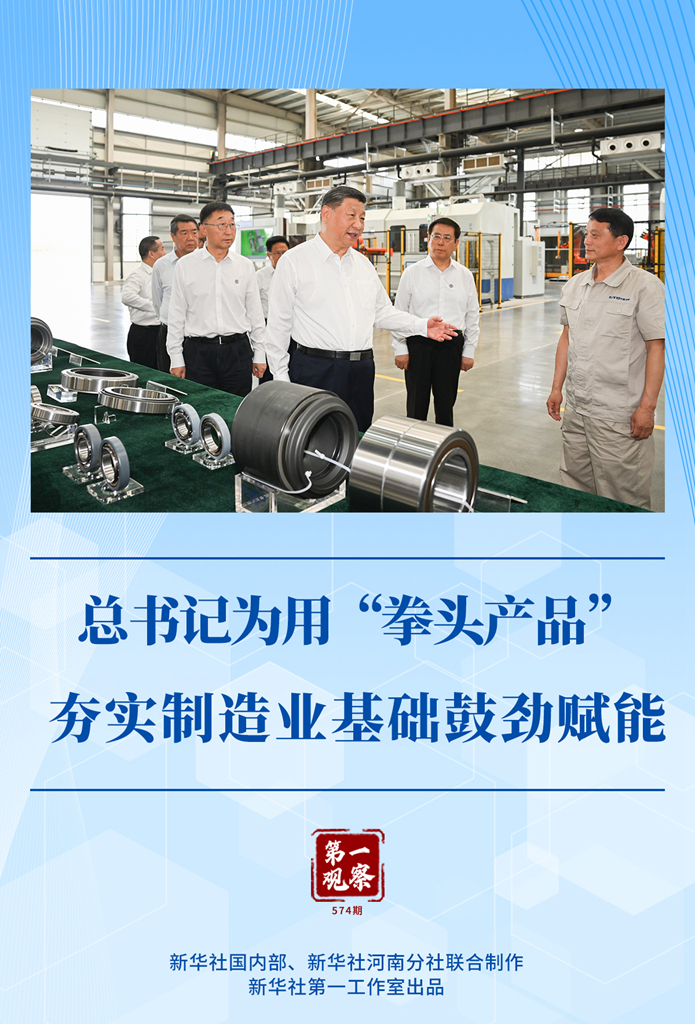
第一观察 | 总书记为用“拳头产品”夯实制造业基础鼓劲赋能
Xin Hua She· 2025-05-20 11:25
Core Viewpoint - The article emphasizes the critical importance of manufacturing, particularly in the context of China's industrial development and the need to strengthen the foundational capabilities of the manufacturing sector [2][4][5]. Group 1: Importance of Manufacturing - Manufacturing is described as the foundation of the nation and a key driver for national strength, with a focus on basic components, materials, and processes being essential for maintaining supply chain stability and promoting transformation [2][4]. - The significance of bearings, as a core component in various machinery, is highlighted, indicating their role in enhancing competitiveness in emerging industries like robotics and electric vehicles [2][4]. Group 2: Strategic Emphasis on Innovation - The article outlines the necessity for China to focus on high-quality development in manufacturing, with a call for innovation and mastery of key technologies [5][9]. - The importance of digital transformation and the integration of advanced technologies in manufacturing processes is underscored, with examples from the Luoyang Bearing Group showcasing their advancements in smart manufacturing [10][12]. Group 3: Policy and Planning - A series of strategic initiatives and policies have been introduced to bolster the manufacturing sector, including the emphasis on upgrading industrial foundations and modernizing supply chains [6][7][8]. - The "14th Five-Year Plan" outlines specific goals to address bottlenecks in foundational components and technologies, aiming to cultivate specialized and innovative enterprises [8][12]. Group 4: Future Directions - The article concludes with a forward-looking perspective, stressing the need for continuous innovation and structural adjustments in the manufacturing base to achieve sustainable economic and ecological benefits [12][13]. - The call for a collaborative approach to enhance overall efficiency and leverage China's vast market advantages is also emphasized [12].