低轨卫星组网

Search documents
钧达股份入局太空光伏!
Zhong Guo Zheng Quan Bao· 2026-01-15 01:43
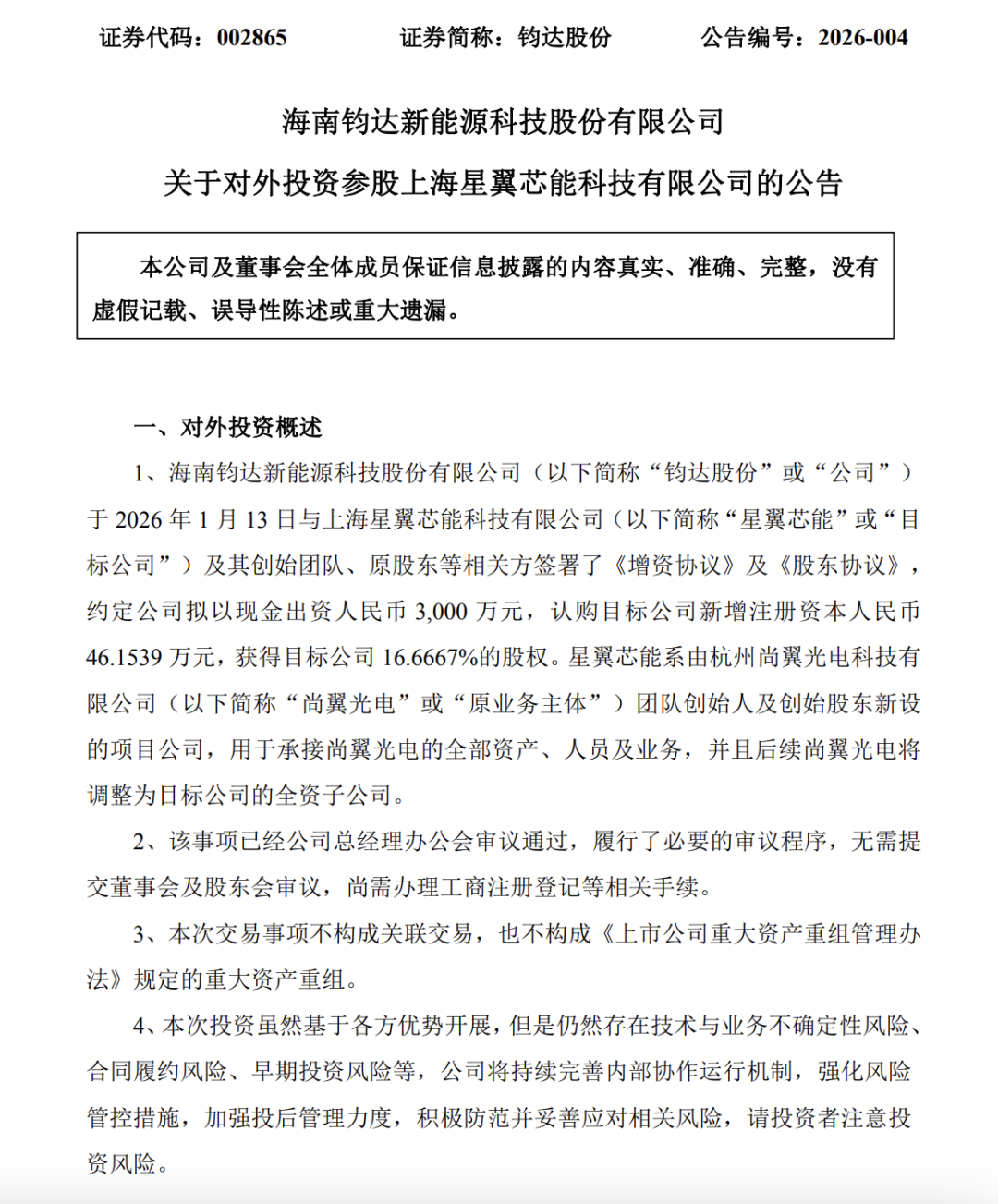
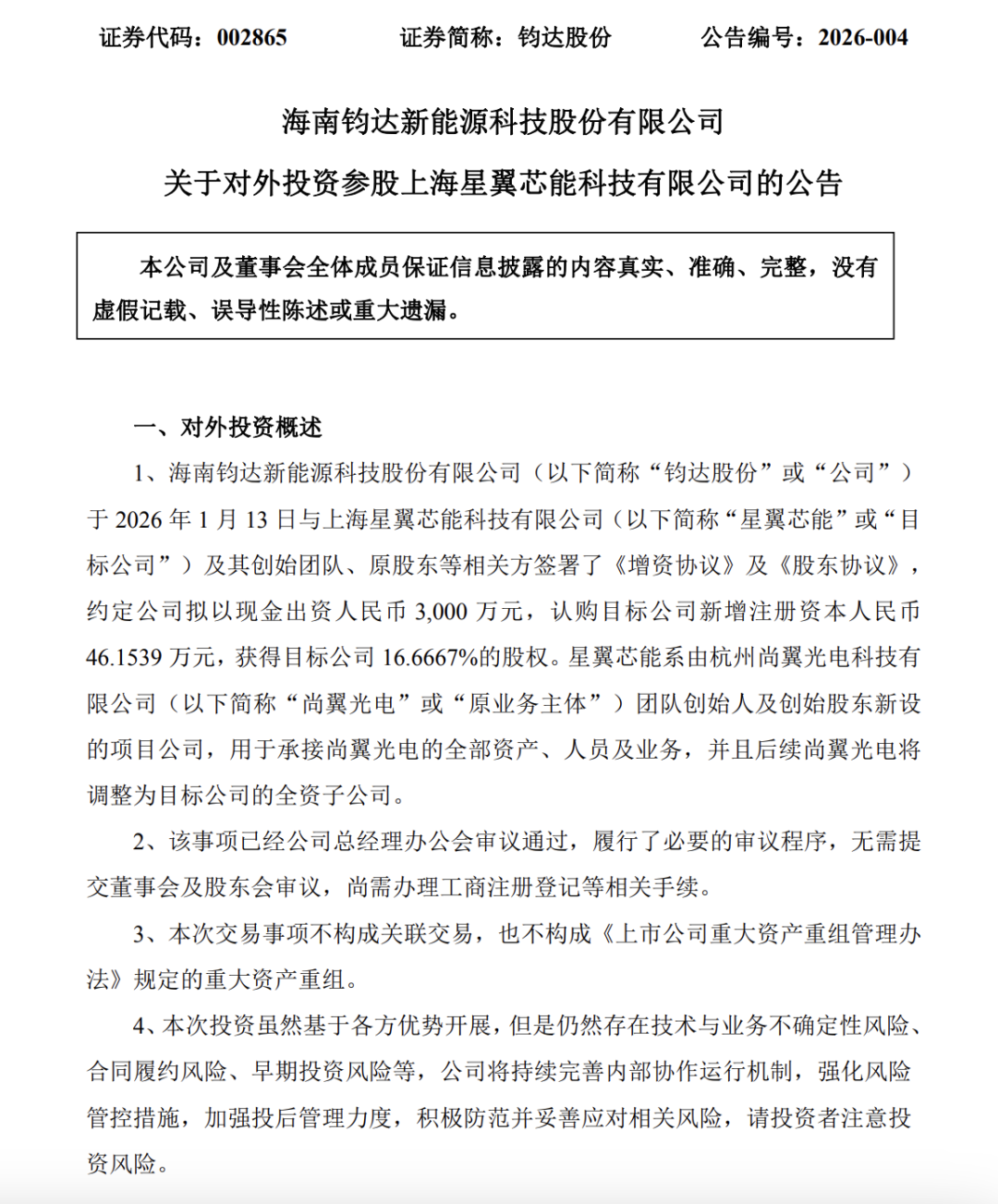
Core Viewpoint - JunDa Co., Ltd. plans to invest 30 million yuan in Shanghai Xingyi Chip Energy Technology Co., Ltd., acquiring a 16.67% stake to extend its strategy from terrestrial photovoltaic to space photovoltaic [1][5]. Group 1: Investment Details - JunDa will subscribe to 461,539 yuan of the newly registered capital of Xingyi Chip Energy, which is based on a pre-investment valuation of 150 million yuan for the target company [5]. - The investment has been approved by the company's management and does not require further board or shareholder approval, pending necessary registration procedures [5]. Group 2: Strategic Collaboration - A joint venture will be established focusing on the research and production of CPI films and related products, leveraging both companies' technological and resource advantages [1][7]. - The collaboration aims to capture opportunities in the trillion-dollar market for low Earth orbit satellite networking and space computing [1][7]. Group 3: Market Potential - The global space photovoltaic market is expected to grow to a trillion yuan scale, with optimistic forecasts from various institutions [7]. - CPI films are identified as a core component for space photovoltaic applications, characterized by high transparency and lightweight properties, suitable for low Earth orbit satellites [8]. Group 4: Risk Factors - The company acknowledges potential risks including technological and business uncertainties, contract performance risks, and early investment risks due to the nascent stage of Xingyi Chip Energy [8]. - JunDa plans to enhance internal collaboration, risk management, and post-investment management to mitigate these risks [8].


入局太空光伏,200亿A股公司,进军万亿市场
Zhong Guo Zheng Quan Bao· 2026-01-14 23:20
Core Viewpoint - JunDa Co., Ltd. plans to invest 30 million yuan in Shanghai Xingyi Xinneng Technology Co., Ltd. to acquire a 16.67% stake, marking a strategic shift from terrestrial photovoltaic to space photovoltaic [1][5] Group 1: Investment Details - The investment involves subscribing to 461,539 yuan of newly registered capital in Xingyi Xinneng, which is based on a pre-investment valuation of 150 million yuan [5] - The partnership will focus on the research and production of CPI films and related products, leveraging each company's technological and resource advantages [1][7] Group 2: Market Opportunity - The collaboration aims to capture opportunities in the trillion-yuan market for low Earth orbit satellite networking and space computing [1][7] - Multiple institutions, including Dongwu Securities and Guojin Securities, predict that the global space photovoltaic market will grow to a scale of trillions [7][8] Group 3: Technical Aspects - CPI films are considered the "core foundation" of space photovoltaics, featuring high transparency and lightweight properties, making them suitable for deployable solar wings [8] - The global supply of high-end CPI is currently tight, with space-grade CPI being even scarcer due to higher purity and stability requirements [8] Group 4: Strategic Synergy - The partnership is expected to create synergies with the existing photovoltaic business, broadening the application scenarios of the company's products [7] - The joint venture will be exclusive, with a board consisting of five directors, one of whom will be appointed by JunDa [7]
海南钧达新能源科技股份有限公司关于对外投资参股上海星翼芯能科技有限公司的公告
Shang Hai Zheng Quan Bao· 2026-01-14 17:49
Group 1 - The company, Hainan Junda New Energy Technology Co., Ltd., has signed an investment agreement to acquire a 16.6667% stake in Shanghai Xingyi Chip Energy Technology Co., Ltd. for RMB 30 million, which corresponds to a capital increase of RMB 46.1539 million [2][5] - The investment aims to leverage the global low-orbit satellite networking and space computing industry opportunities, enhancing the company's capabilities in photovoltaic industrialization and space scenario adaptation [25] - The target company, Shanghai Xingyi Chip Energy, was established on January 6, 2026, with a registered capital of RMB 1.5 million, focusing on technology services and photovoltaic equipment sales [3][4] Group 2 - The investment does not constitute a related party transaction or a major asset restructuring as defined by relevant regulations [2] - The investment is expected to have a positive long-term impact on the company's development without significantly affecting its current operating performance [29] - The company will utilize its own or raised funds for this investment, ensuring no adverse effects on its financial status or operating results [29]

瞄上卫星电池赛道 钧达股份拟入股星翼芯能
Zheng Quan Shi Bao· 2026-01-14 17:32
Core Viewpoint - The company, Junda Co., Ltd., has signed an investment agreement to acquire a 16.67% stake in Shanghai Xingyi Chip Energy Technology Co., Ltd. for 30 million yuan, aiming to leverage opportunities in the low-orbit satellite networking and space computing industry [1][2]. Group 1: Investment Details - Junda Co. plans to invest 30 million yuan to subscribe for an increase in registered capital of 46.1539 thousand yuan in Xingyi Chip Energy, acquiring a 16.67% equity stake [1]. - Xingyi Chip Energy was established on January 6, 2026, with a registered capital of 1.5 million yuan, and is set to take over all assets, personnel, and business from Hangzhou Shangyi Optoelectronics Technology Co., Ltd. [1]. Group 2: Strategic Collaboration - The partnership between Junda Co. and Hangzhou Shangyi Optoelectronics aims to explore flexible perovskite technology for space energy applications, enhancing China's capabilities in aerospace energy components [2]. - The collaboration is expected to create synergies with Junda Co.'s existing photovoltaic business, expanding product application scenarios from terrestrial to space photovoltaic fields [2].
钧达股份:拟3000万元参股星翼芯能 成立CPI膜、CPI膜与晶硅电池结合产品的生产制造合资企业
Mei Ri Jing Ji Xin Wen· 2026-01-14 12:16
Group 1 - The company JunDa Co., Ltd. plans to invest 30 million yuan in Shanghai Xingyi Chip Energy Technology Co., Ltd. to acquire a 16.6667% stake by subscribing to the new registered capital of 46153.9 yuan [1] - The partnership aims to establish a joint venture for the production of CPI membranes and products combining CPI membranes with crystalline silicon batteries [1] - This collaboration is intended to seize opportunities in the global low-orbit satellite networking and space computing power industries, leveraging both companies' strengths in photovoltaic industrialization, perovskite technology, space scenario adaptation, and aerospace resource integration [1]
钧达股份:拟参股星翼芯能 成立CPI膜、CPI膜与晶硅电池结合产品的生产制造合资企业
Ge Long Hui· 2026-01-14 12:13
Group 1 - The company, Junda Co., Ltd. (002865.SZ), announced a cash investment of 30 million yuan to acquire 16.6667% equity in Shanghai Xingyi Chip Energy Technology Co., Ltd. through a capital increase of 46153.9 yuan [1] - The partnership aims to establish a joint venture for the production of CPI membranes and products combining CPI membranes with crystalline silicon batteries, leveraging both parties' strengths in the photovoltaic industry and space-related technologies [1] - This collaboration is positioned to capitalize on the global opportunities in low-orbit satellite networking and space computing industries, promoting mutual benefits and resource integration [1]
20万颗卫星申报,开启中国商业航天总动员
Jiang Nan Shi Bao· 2026-01-14 09:55
Core Viewpoint - China's submission of 203,000 low Earth orbit satellite frequency resource applications to the International Telecommunication Union (ITU) marks a significant strategic move to secure space resources and establish a dominant position in the global digital infrastructure competition [1][3]. Group 1: Near-Earth Orbit Resource Competition - The competition for near-Earth orbit and frequency resources is intense, with a safe deployment limit of approximately 100,000 satellites based on current technology and safety requirements [2]. - The ITU has established strict rules for frequency resource applications, requiring the first satellite to be operational within 7 years and 10% of the total deployment within 9 years, or rights will be proportionally reclaimed [2]. - SpaceX's rapid deployment of satellites, with over 3,000 new satellites launched in a year, creates a pressing external pressure for China to take extraordinary actions to compete effectively [2]. Group 2: Industrial Capability and Compliance - The ambitious space strategy relies on robust industrial capabilities, particularly in satellite manufacturing and rocket launching, to meet ITU compliance deadlines [4]. - The shift from customized satellite production to industrial mass production is evident, with significant improvements in manufacturing efficiency, such as producing one satellite every 1.5 days and aiming for an annual capacity of 300 satellites by 2026 [4]. - The cost of satellite production has significantly decreased, with unit costs dropping from "hundreds of millions" to "tens of millions or even millions" [4]. Group 3: Launch Capacity Challenges - In 2025, China is projected to conduct only 92 launches, with fewer than 500 low Earth orbit commercial satellites deployed, highlighting a significant gap in launch capacity to meet the demand for thousands of satellites [5]. - The need for "high frequency, low cost, and large capacity" launches is critical, with SpaceX's Falcon 9 serving as a model for achieving efficient satellite deployment [5]. - The development of large-capacity rockets is essential for addressing the current imbalance of "many satellites, few rockets" [5]. Group 4: Key Developments in Launch Vehicles - The establishment of the Commercial Spaceflight Division by the National Space Administration is expected to increase commercial launch activities in 2026, with several rockets already planning launches [6]. - The Tianlong-3 rocket, designed to directly compete with the Falcon 9, features a high thrust-to-weight ratio and is capable of launching over 20 tons into low Earth orbit, marking a significant advancement in China's commercial space capabilities [8]. - The Tianlong-3 has successfully completed ground tests for launching multiple satellites in a single mission, which could alleviate the current launch capacity constraints [8]. Group 5: Infrastructure and Future Prospects - Tianbing Technology has established multiple R&D and manufacturing centers, with a design capacity to support 50 launches and 500 engines annually [12]. - The development of dedicated launch facilities is underway, which could support at least 60 launches per year, paving the way for operational efficiency in rocket launches [12]. - The interplay between manufacturing capacity, launch demand, and technological advancements in large-capacity rockets is crucial for realizing China's ambitious goal of deploying 203,000 satellites and securing a competitive edge in global low Earth orbit resource contention [12].

上海港湾20260109
2026-01-12 01:41
Summary of Shanghai Port Bay Conference Call Industry and Company Overview - **Company**: Shanghai Port Bay - **Industry**: Satellite Energy Management and Soft Soil Foundation Treatment - **Key Focus**: Development of satellite energy management systems, particularly gallium-based batteries and emerging perovskite battery technology [2][5][6] Core Points and Arguments - **Low Earth Orbit Satellite Network**: China is systematically advancing its low Earth orbit satellite network, with over 100 satellite constellation plans expected by 2025, aiming for more than 60,000 satellites in orbit [4] - **Recyclable Rocket Development**: More than 10 recyclable rockets are under development, including vertical recovery and sea landing methods, with recent experiments on the Zhuque 3 and Long March 12 rockets [4] - **Foundation Treatment Technology**: Shanghai Port Bay specializes in soft soil foundation treatment, which is crucial for high-water-content and easily settling foundations, with applications in notable projects like Dubai Palm Island and Shanghai Airport [7] - **Market Expansion Opportunities**: The company sees significant growth potential in coastal and riverine areas, particularly in Southeast Asia and the Middle East, with projects like the relocation of Indonesia's capital and Saudi Arabia's The Line [7] Additional Important Insights - **Battery Technology Development**: The company is transitioning from high-cost gallium-based batteries to more cost-effective perovskite batteries, which are currently in testing and validation stages [5][6] - **Strategic Shift**: Shanghai Port Bay aims to leverage its commercial space business to offset pressures on its core operations, focusing on innovative energy management systems to enhance market competitiveness and achieve growth [8]

华西证券:低轨卫星拐点已至 国内组网加速
智通财经网· 2025-11-07 08:39
Core Insights - The low Earth orbit (LEO) satellite market is becoming a strategic focus in the US-China competition, with the principle of "first come, first served" governing orbital and frequency resources [1][2] - SpaceX has launched over 10,000 satellites, with more than 8,600 currently operational, while China has only about 300 LEO satellites in orbit, indicating a significant gap that necessitates accelerated deployment [1][2] Group 1: Market Dynamics - The LEO orbit can accommodate approximately 60,000 satellites, and strict international regulations require timely launches to retain frequency and orbital rights [2] - SpaceX has applied for resources for 42,000 satellites, while Amazon's Kuiper plans to deploy 3,236 satellites; China's China Star Network and Shanghai Yuanxin plans to deploy around 13,000 and 15,000 satellites, respectively [2] Group 2: Launch Capacity and Technology - Rocket launch capacity is a critical metric, with SpaceX's Falcon 9 capable of 22.8 tons to LEO, while China's Long March 8 has a capacity of only 7 tons, highlighting a significant disparity [3] - The development of commercial rockets and reusable technology is progressing rapidly in China, with several private companies achieving successful launches and narrowing the gap with international standards [3] Group 3: Cost Reduction Strategies - SpaceX has reduced the cost of individual satellites to below $500,000 through mass production, while China's satellite manufacturing is also lowering costs via modular design and batch production [4] Group 4: Market Opportunities - LEO satellites are expected to integrate deeply with terrestrial 5G networks, enabling global seamless coverage, with significant advancements anticipated by 2025 [5] - The combination of artificial intelligence (AI) and LEO satellites is leading to the development of next-generation intelligent satellite systems, with major tech companies like NVIDIA and Google planning to deploy AI-capable satellites [5] Group 5: Future Developments - China's LEO satellite deployment is entering a rapid networking phase, with recent successful launches indicating an acceleration in the pace of deployment [6][7] - The domestic market is moving towards a "constellation deployment" phase, transitioning from "single satellite customization" [7] Group 6: Investment Opportunities - Companies to watch include Fudan Microelectronics (688385.SH) and Unisoc (002249.SZ) as potential investment targets in the LEO satellite sector [8]

*ST铖昌(001270):ST铖昌(001270):下游市场需求向好,业绩持续增长
CMS· 2025-10-28 10:33
Investment Rating - The investment rating for the company is "Add" [3] Core Views - The company reported a significant increase in revenue and profitability, with a 204.78% year-on-year increase in revenue to 306 million yuan for the first three quarters of 2025, and a net profit of 90.36 million yuan, reversing losses from the previous year [1] - The company is experiencing strong demand in downstream markets, leading to continuous growth in performance [1] - The company has successfully entered a phase of normalized bulk delivery for remote sensing satellite projects, which is expected to drive future growth [7] - The company is optimizing its cost structure through refined management and economies of scale, resulting in improved gross and net profit margins [7] Financial Data and Valuation - Total revenue is projected to reach 413 million yuan in 2025, with a year-on-year growth of 95% [2] - The company is expected to achieve a net profit of 120 million yuan in 2025, a significant recovery from a loss of 31 million yuan in 2024 [2] - The earnings per share (EPS) is forecasted to be 0.58 yuan in 2025, compared to -0.15 yuan in 2024 [2] - The price-to-earnings (PE) ratio is expected to be 79.3 in 2025, indicating a recovery in valuation metrics [2] Stock Performance - The company's stock has shown a 12% absolute performance over the past month and a 40% increase over the past six months [5] Key Financial Ratios - The gross profit margin for the first three quarters of 2025 was 69.72%, an increase of 17.68 percentage points year-on-year [7] - The return on equity (ROE) is projected to improve to 8.4% in 2025, up from -2.2% in 2024 [13] - The asset-liability ratio is expected to rise to 17.0% in 2025, indicating a gradual increase in leverage [13]