债转股

Search documents
港股异动 | 粤港湾控股(01396)涨超9% 公司此前实现化债破局 加速布局AI赛道
智通财经网· 2026-01-29 02:46
Core Viewpoint - Yuegangwan Holdings (01396) has seen a significant stock increase of over 9%, attributed to its strategic financing and operational developments in AI cloud services [1] Group 1: Financial Performance - In the first half of 2025, Yuegangwan Holdings reported a net profit of 970 million HKD, a turnaround from a loss of 1.028 billion HKD in the same period of 2024 [1] - The company successfully completed a debt-to-equity conversion plan worth 440 million USD with a high approval rate of 98.33%, becoming the first domestic property stock to clear its offshore USD debt [1] Group 2: Strategic Developments - Yuegangwan Holdings announced a share placement financing of 108 million HKD, with approximately 70% allocated for the delivery of AI computing cloud services [1] - The company completed the acquisition of Tiandun Data for 977 million HKD in October last year, positioning itself as a leading player in intelligent computing operations with nearly 200 enterprise clients, including major cloud service providers and top AI companies [1] - Yuegangwan Holdings (Tiandun Data) has been designated as the official strategic partner for the AI Agent 2025 Global Intelligent Agent Ecosystem Summit [1]
粤港湾控股涨超9% 公司此前实现化债破局 加速布局AI赛道
Zhi Tong Cai Jing· 2026-01-29 02:45
Core Viewpoint - Yuegang Bay Holdings (01396) has seen a significant stock increase of over 9%, attributed to its strategic financing and operational developments in the AI sector [1] Group 1: Financial Performance - As of the latest report, Yuegang Bay Holdings' stock rose by 9.39%, reaching HKD 6.29, with a trading volume of HKD 19.07 million [1] - The company reported a turnaround in its financial performance, achieving a net profit of HKD 970 million in the first half of 2025, compared to a loss of HKD 1.028 billion in the same period of 2024 [1] Group 2: Strategic Initiatives - In December 2025, Yuegang Bay Holdings announced a placement financing of HKD 1.08 billion, with approximately 70% allocated for the delivery of AI computing cloud services [1] - The company completed the acquisition of Tiandun Data for HKD 977 million in October of the previous year, positioning itself as a leading operator in intelligent computing with nearly 200 enterprise clients, including major cloud service providers and top AI companies [1] - Yuegang Bay Holdings (Tiandun Data) has been designated as the official strategic partner for the AI Agent 2025 Global Intelligent Agent Ecosystem Summit [1] Group 3: Debt Management - On May 7, 2025, the company successfully passed a debt-to-equity conversion plan with a high approval rate of 98.33%, becoming the first domestic property company to nearly clear all of its offshore US dollar debt [1]
晶澳无锡对鸿新新能源债转股增资2亿元
Xin Lang Cai Jing· 2026-01-27 14:44
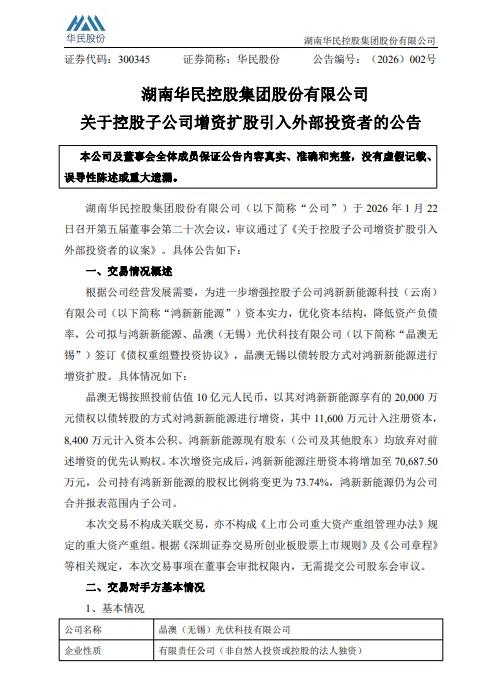
润阳股份之后,光伏又现又"债转股"案例。1月22日,华民股份(300345)召开第五届董事会第二十次 会议,审议通过了《关于控股子公司增资扩股引入外部投资者的议案》。 | 公司名称 | 晶澳(无锡)光伏科技有限公司 | | --- | --- | | | | | 企业性质 | 有限责任公司(非自然人投资或控股的法人独资) | 根据公司经营发展需要,为进一步增强控股子公司鸿新新能源科技(云南)有限公司(简称"鸿新新能 源")资本实力,优化资本结构,降低资产负债率,公司拟与鸿新新能源、晶澳(无锡)光伏科技有限 公司(简称"晶澳无锡")签订《债权重组暨投资协议》,晶澳无锡以债转股方式对鸿新新能源进行增资 扩股。 晶澳无锡按照投前估值10亿元人民币,以其对鸿新新能源享有的20,000万元债权以债转股的方式对鸿新 新能源进行增资,其中11,600万元计入注册资本,8,400万元计入资本公积。鸿新新能源现有股东(公司 及其他股东)均放弃对前述增资的优先认购权。本次增资完成后,鸿新新能源注册资本将增加至 70,687.50万元,公司持有鸿新新能源的股权比例将变更为73.74%,鸿新新能源仍为公司合并报表范围 内子公司。 截 ...


上能电气部分董事、高管计划减持;野马电池2025年净利同比预降|新能源早参
Mei Ri Jing Ji Xin Wen· 2026-01-22 23:11
Group 1 - The core point of the news is that several key stakeholders and management personnel of companies are planning to reduce their holdings, which may exert pressure on market sentiment and stock prices in the short term [1] Group 2 - Huamin Co. plans to introduce external investors through a capital increase in its subsidiary, which will help reduce debt risk and enhance operational stability [2] - The capital increase involves a debt-to-equity swap with a pre-investment valuation of 1 billion yuan, resulting in a change in ownership structure [2] Group 3 - Yema Battery expects a significant decline in net profit for 2025, projecting a decrease of 58% to 70% year-on-year due to increased market competition and rising commodity prices [3] - The company faces pressure on both revenue and cost sides, leading to a substantial compression of profit margins [3]


海航控股:债转股股票的定价系根据公司2021年12月31日已经执行完成的《重整计划》执行
Zheng Quan Ri Bao Wang· 2026-01-22 12:13
证券日报网讯1月22日,海航控股(600221)在互动平台回答投资者提问时表示,债转股股票的定价系 根据公司2021年12月31日已经执行完成的《重整计划》执行。 ...

华民股份:晶澳无锡拟债转股方式对鸿新新能源增资2亿元
Zhi Tong Cai Jing· 2026-01-22 11:11
Core Viewpoint - The company Huamin Co., Ltd. plans to sign a debt restructuring and investment agreement with Hongxin New Energy and JA Solar (Wuxi) Technology Co., Ltd., where JA Solar Wuxi will increase its capital in Hongxin New Energy through a debt-to-equity swap, enhancing the latter's financial strength and optimizing its capital structure [1] Group 1: Investment Agreement Details - JA Solar Wuxi will convert its 200 million RMB debt into equity at a pre-investment valuation of 1 billion RMB, with 116 million RMB allocated to registered capital and 84 million RMB to capital reserves [1] - Existing shareholders of Hongxin New Energy will waive their preemptive rights regarding this capital increase [1] - After the capital increase, the registered capital of Hongxin New Energy will rise to 707 million RMB, with the company's ownership stake increasing to 73.74% [1] Group 2: Strategic Implications - The introduction of a strong investor in the photovoltaic sector is expected to facilitate deep cooperation between Hongxin New Energy and JA Solar, creating synergies across the industry chain [1] - This capital injection will enhance Hongxin New Energy's capital strength, further optimize its capital structure, reduce its debt-to-asset ratio, and promote sustainable operations [1]
华民股份(300345.SZ):晶澳无锡拟债转股方式对鸿新新能源增资2亿元
智通财经网· 2026-01-22 11:10
Core Viewpoint - Huamin Co., Ltd. plans to sign a debt restructuring and investment agreement with Hongxin New Energy and JA Solar (Wuxi) Technology Co., Ltd., where JA Solar Wuxi will increase capital in Hongxin New Energy through a debt-to-equity swap, enhancing the latter's financial strength and operational sustainability [1] Group 1: Investment Details - JA Solar Wuxi will convert its 200 million RMB debt into equity at a pre-investment valuation of 1 billion RMB, with 116 million RMB allocated to registered capital and 84 million RMB to capital reserves [1] - After the capital increase, Hongxin New Energy's registered capital will rise to 707 million RMB, and Huamin Co., Ltd.'s ownership in Hongxin New Energy will change to 73.74% [1] Group 2: Strategic Implications - The introduction of a strong investor in the photovoltaic sector is expected to facilitate deep cooperation between Hongxin New Energy and JA Solar, creating synergies across the industry chain [1] - This capital increase will enhance Hongxin New Energy's capital structure, lower its debt-to-asset ratio, and promote sustainable operations [1]
上海剑桥科技股份有限公司关于向参股公司提供财务资助的公告
Shang Hai Zheng Quan Bao· 2026-01-20 18:37
● 上海剑桥科技股份有限公司(以下简称"公司"或"剑桥科技")合并报表范围内的扬中幸福家园创业投 资合伙企业(有限合伙)(以下简称"扬中基金")拟与其参股公司南京镭芯光电有限公司(以下简 称"镭芯光电")签订《可转换借款协议》(以下简称"协议"),扬中基金将向镭芯光电提供可转换借款 人民币8,000万元,期限自协议生效之日起至2027年2月1日,年固定利率3%。根据协议约定,若镭芯光 电在2026年任意季度满足债转股条件,则当期债转股额度内的借款本金及对应利息予以豁免,并按照协 议约定转换为扬中基金对镭芯光电的股权投资。对于未能转换为股权投资的任何借款本金及相应利息, 镭芯光电最晚应于2027年2月1日一次性向扬中基金清偿。 证券代码:603083 证券简称:剑桥科技 公告编号:临2026-007 上海剑桥科技股份有限公司关于向参股公司提供财务资助的公告 特别提示 本公司董事会及全体董事保证本公告内容不存在任何虚假记载、误导性陈述或者重大遗漏,并对其内容 的真实性、准确性和完整性承担法律责任。 重要内容提示: ● 本次财务资助事项已经公司第五届董事会第二十六次会议审议通过,无需提交公司股东会审议,不构 成关联 ...

中船防务跌2.01%,成交额3.12亿元,主力资金净流出2408.51万元
Xin Lang Zheng Quan· 2026-01-16 03:29
Core Viewpoint - China Shipbuilding Defense has experienced a stock price increase of 9.46% since the beginning of the year, but has seen a slight decline of 0.48% over the last five trading days, indicating volatility in its recent performance [2]. Financial Performance - For the period from January to September 2025, China Shipbuilding Defense reported a revenue of 14.315 billion yuan, representing a year-on-year growth of 12.83%. The net profit attributable to shareholders reached 655 million yuan, showing a significant increase of 249.84% [2]. - The company has distributed a total of 1.763 billion yuan in dividends since its A-share listing, with 259 million yuan distributed over the last three years [3]. Stock Market Activity - As of January 16, the stock price of China Shipbuilding Defense was 31.14 yuan per share, with a market capitalization of 44.017 billion yuan. The trading volume was 312 million yuan, with a turnover rate of 1.21% [1]. - The net outflow of main funds was 24.085 million yuan, with large orders showing a buy of 597.756 million yuan and a sell of 728.192 million yuan, indicating a mixed sentiment among investors [1]. Shareholder Structure - As of September 30, 2025, the number of shareholders for China Shipbuilding Defense was 75,900, a decrease of 3.14% from the previous period. The average circulating shares per person remained at 0 shares [2]. - The top ten circulating shareholders include notable funds such as the Fortune CSI Military Industry Leader ETF and Changxin National Defense Military Industry Quantitative Mixed A, which have increased their holdings [3].

9亿债权损失过半!债转股3年,广州农商行清仓中捷资源股权
Nan Fang Du Shi Bao· 2026-01-14 13:40
Core Viewpoint - Guangzhou Rural Commercial Bank has transferred its 1.06 billion shares of Zhongjie Resources, accounting for 8.84% of the total share capital, to Qianrun Investment for a total price of 287 million yuan, marking a significant loss on its previous debt holdings of 951 million yuan [2][3][4]. Group 1: Share Transfer Details - The share transfer price was set at 2.7167 yuan per share, totaling 287 million yuan [3]. - Following this transfer, Guangzhou Rural Commercial Bank no longer holds any shares in Zhongjie Resources, with Qianrun Investment becoming the second-largest shareholder [3][4]. - The transfer is part of Guangzhou Rural Commercial Bank's strategy to address its operational needs [3]. Group 2: Debt and Financial Impact - Guangzhou Rural Commercial Bank's debt to Zhongjie Resources was originally 951 million yuan, but after the transfer and previous cash repayments, the recovery was only about 33.63% of the total debt [4]. - The bank's losses from this transaction represent a 61.4% reduction compared to its original debt holdings [4]. - The bank's financial performance has been declining, with a net profit of only 17.22 billion yuan in the first three quarters of 2025, down 18.73% year-on-year [7]. Group 3: Broader Financial Context - The bank's credit impairment losses reached 38.1 billion yuan in the first half of 2025, accounting for 47.4% of its revenue, indicating severe pressure from non-performing assets [8]. - The bank's total assets were reported at 1.42 trillion yuan, making it the largest rural commercial bank in Guangdong, yet its profitability is significantly lower than its peers [7][8]. - The bank has been actively selling off assets, with over 100 billion yuan in asset disposals in recent years as part of its strategy to manage non-performing loans [8].