
偿二代二期规则

Search documents
未雨绸缪还是生存刚需?解码险企年度“战略蓄水”
Sou Hu Cai Jing· 2025-12-08 23:36
Core Viewpoint - The insurance industry is actively increasing capital through various means, including equity financing and bond issuance, to enhance their financial strength and meet regulatory requirements [2][3][10]. Group 1: Capital Increase Activities - Multiple insurance companies have received approval for capital increases or announced plans, with total amounts reaching hundreds of billions [3][10]. - Life insurance companies are leading in capital increases compared to property insurance and reinsurance companies [1][3]. - Ping An Life announced a capital increase of approximately 20 billion yuan, aimed at accelerating business development and enhancing solvency [3][10]. - Other notable capital increases include China Postal Life's increase from 28.663 billion yuan to 32.643 billion yuan and CITIC Prudential Life's increase from 4.86 billion yuan to 7.36 billion yuan [3]. Group 2: Bond Issuance - Issuing perpetual bonds has become a mainstream option for insurance companies to enhance their core solvency ratio [4]. - Companies such as Xinhua Insurance, Taikang Life, and Ping An Life have announced bond issuance plans to support their capital needs [4]. - In June, Ping An announced a plan to issue zero-coupon convertible bonds worth 11.765 billion HKD, aimed at supporting its future business development [4]. Group 3: Regulatory Environment and Strategic Responses - The "Solvency II Phase II" rules have heightened the demand for capital supplementation among insurance companies, necessitating proactive measures to maintain solvency [10][11]. - The regulatory framework requires insurance companies to meet specific solvency ratios, with a comprehensive solvency ratio of at least 150% for personal pension business [10]. - The transition period for the new solvency rules has been extended to the end of 2025, prompting companies to strengthen their capital management [10]. Group 4: Focus on Pension Insurance - Taikang Life has positioned itself as a leader in the pension insurance sector, with a pension fund management scale of 670 billion yuan as of November 2025 [6][7]. - The company aims to leverage its experience in managing pension funds to enhance its offerings in the second and third pillars of pension insurance [8]. - Taikang Life's solvency ratios remain robust, with a comprehensive solvency ratio of 222.42% and a core solvency ratio of 131.41% [7].
未雨绸缪还是生存刚需 解码险企年度“战略蓄水”
Zhong Guo Zheng Quan Bao· 2025-12-08 20:53
Core Viewpoint - Insurance companies are actively increasing their capital through various means, including equity financing and bond issuance, to strengthen their financial stability and meet regulatory requirements in a challenging economic environment [1][2][3]. Group 1: Capital Increase Activities - Multiple insurance companies have completed or announced capital increases this year, totaling hundreds of billions, with life insurance companies leading the way [2][3]. - Ping An Life announced a capital increase of approximately 20 billion yuan, aimed at accelerating business development and enhancing solvency [2]. - Other notable capital increases include China Postal Life's increase from 28.663 billion yuan to 32.643 billion yuan and CITIC Prudential Life's increase from 4.86 billion yuan to 7.36 billion yuan [2]. Group 2: Bond Issuance - Issuing perpetual bonds has become a mainstream method for insurance companies to enhance their core solvency ratios [3]. - Companies such as New China Life, Taikang Life, and Ping An Life have announced bond issuance plans to support their capital needs [3]. - China Ping An also issued zero-coupon convertible bonds worth 11.765 billion Hong Kong dollars to fund its future business development [3]. Group 3: Strategic Focus on Pension Finance - Taikang Life's capital increase and bond issuance reflect its commitment to the pension finance sector, aligning with national policies promoting the development of commercial insurance annuities [4][5]. - The company has managed pension assets totaling 670 billion yuan, with a strong market presence in enterprise annuities and personal pensions [5]. - Taikang Life maintains a robust solvency position, with a comprehensive solvency ratio of 222.42% and a core solvency ratio of 131.41% as of the end of the third quarter [5]. Group 4: Regulatory Environment - The "Solvency II Phase II" rules have heightened the demand for capital replenishment among insurance companies, necessitating proactive measures to ensure compliance by the 2025 deadline [7][8]. - Regulatory requirements stipulate that companies must maintain a comprehensive solvency ratio of at least 150% and a core solvency ratio of at least 75% to engage in personal pension business [7]. - The transition period for these regulations has been extended to the end of 2025 to allow companies to adjust to the new requirements [8].

【非银】股票风险因子差异化下调,推动险资进一步发挥耐心资本优势——《关于调整保险公司相关业务风险因子的通知》点评(王一峰等)
光大证券研究· 2025-12-07 23:03
Core Viewpoint - The article discusses the adjustments made by the National Financial Regulatory Administration to the risk factors related to insurance companies' investment activities, aimed at enhancing their solvency and encouraging long-term investments in the stock market [7][9]. Group 1: Event Summary - On December 5, the National Financial Regulatory Administration issued a notice to adjust the risk factors for insurance companies' related business, focusing on enhancing the role of insurance funds as patient capital [7]. - The adjustments include lowering the risk factors for stocks held for over three years and two years, specifically for the CSI 300 Index and the STAR Market stocks, to encourage long-term investments [10]. - The risk factors for export credit insurance and overseas investment insurance have also been reduced to support foreign trade enterprises [10]. Group 2: Background and Context - The solvency of insurance companies has been under pressure due to stricter capital recognition requirements and increased risk factors since the implementation of the second phase of the solvency regime [8]. - Despite regulatory optimizations in September 2023, the overall solvency adequacy ratio remains below levels seen before the new rules were implemented [8]. - The proportion of stocks held by insurance companies has increased significantly, with a 1.2 percentage point rise in stock allocation to 10% by the end of Q3 2025 compared to the previous quarter [8]. Group 3: Impact Analysis - The adjustments are expected to promote long-term investments by insurance funds, alleviating solvency pressures and enhancing investment flexibility [11]. - The changes are likely to improve the long-term return levels for insurance companies, helping to mitigate risks associated with low interest rates and enhancing market resilience [12]. - By increasing the allocation to high-return, high-dividend stocks, insurance companies can secure more stable income and improve their net investment returns [12].


偿付能力“大考”在即 险企多渠道补充资本金
Zheng Quan Ri Bao· 2025-12-04 16:37
Core Insights - Hengqin Life Insurance Co., Ltd. plans to increase its registered capital by approximately 1.852 billion yuan, raising its total registered capital to about 4.989 billion yuan, as part of a broader trend among insurance companies to enhance capital strength in light of upcoming regulatory changes [1][4] Group 1: Capital Increase Initiatives - Hengqin Life is not alone; Deutsche Bank AnGu Life Insurance Co. has approved a capital increase of 1.545 billion yuan, bringing its registered capital to 3.785 billion yuan [2] - Taiping Pension Insurance Co. has received approval to increase its registered capital by approximately 330 million yuan, changing its total from 3 billion yuan to about 3.333 billion yuan [2] - Huazhong Property Insurance Co. is initiating a capital increase project aiming to raise no less than 1 billion yuan [2] Group 2: Bond Issuance for Capital Supplementation - Several insurance companies have recently issued capital supplement bonds, including China Ping An Property Insurance Co. with 6 billion yuan at a coupon rate of 2.15%, and China Property Reinsurance Co. with 4 billion yuan at 2.20% [2] - Other notable issuances include 1.3 billion yuan from China Merchants Renhe Life Insurance Co. at 2.40% and 500 million yuan from Zijin Property Insurance Co. at 2.20% [2] Group 3: Regulatory Context and Market Conditions - The transition period for the insurance company's solvency regulatory rules (known as "Solvency II") is set to end, prompting companies to bolster their capital to meet stricter requirements [4] - As of the end of Q3 this year, the overall solvency adequacy ratio for the insurance industry was 186.3%, a decline of 11.1 percentage points year-on-year, with life insurance companies seeing a more significant drop of 13.4 percentage points [5] Group 4: Future Outlook and Strategic Focus - Industry experts anticipate continued high demand for capital supplementation among insurance companies, emphasizing the need for firms to enhance their internal capital generation capabilities [6] - Improving internal capital generation is seen as a critical challenge, requiring optimization of both liability structures and asset allocations to enhance overall profitability [6]
年内险企发债超700亿元,永续债占比接近七成
Huan Qiu Wang· 2025-11-22 01:28
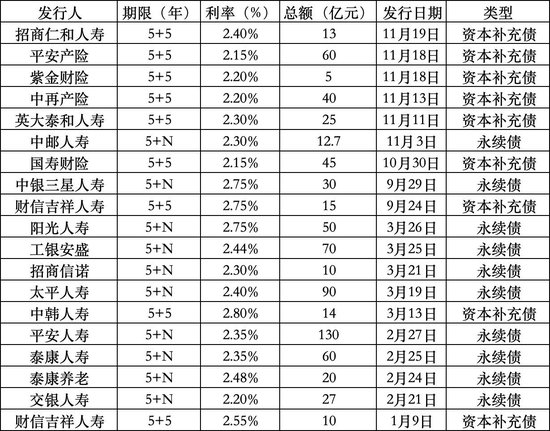
Core Insights - Insurance companies are accelerating capital replenishment as the transition period for the second phase of the solvency regulation approaches its end [1][4] - A total of 19 insurance companies have issued capital replenishment bonds or perpetual bonds this year, with a combined issuance scale of 74.17 billion yuan, maintaining a high level despite a slight decrease compared to the same period last year [1][4] Group 1: Issuance Details - Among the 19 insurance companies that issued bonds, half opted for perpetual bonds, with a total issuance close to 50 billion yuan, accounting for nearly 70% of the total [3] - Ping An Life issued the largest perpetual bond this year at 13 billion yuan, followed by Taiping Life, ICBC-AXA Life, Taikang Life, and Sunshine Life with issuance sizes of 9 billion yuan, 7 billion yuan, 6 billion yuan, and 5 billion yuan respectively [3] Group 2: Financial Implications - Perpetual bonds are favored by insurance companies as they directly supplement core tier 2 capital and enhance core solvency, with lower coupon rates making them an attractive option [3] - The coupon rates for the bonds issued this year are all below 3%, with the highest at 2.8% and the lowest at 2.15% [3] Group 3: Regulatory Context - The surge in bond issuance is primarily driven by the need to enhance solvency to meet stricter regulatory requirements established in the first quarter of 2022 [4] - The transition period for the second phase of solvency regulations has been extended to the end of 2025, prompting insurance companies to expedite their capital replenishment efforts as the deadline approaches [4]

险企今年以来发债超700亿元 永续债成资本补充主力
Zhong Guo Zheng Quan Bao· 2025-11-20 20:09
Core Viewpoint - Insurance companies are accelerating capital replenishment as the transition period for the second phase of the solvency regulation approaches its end, with 19 companies issuing capital supplementary bonds or perpetual bonds totaling over 70 billion yuan this year, with nearly 70% being perpetual bonds [1][2] Group 1: Capital Supplementation Trends - As of November 20, 2023, 19 insurance companies have issued capital supplementary bonds or perpetual bonds, with a total issuance scale of 741.7 billion yuan, slightly down from the previous year but still at a high level [1][2] - Half of the issuing companies opted for perpetual bonds, with a total issuance close to 500 billion yuan, representing nearly 70% of the total [2] - Major issuers of perpetual bonds include Ping An Life (13 billion yuan), Taiping Life (9 billion yuan), ICBC-AXA Life (7 billion yuan), Taikang Life (6 billion yuan), and Sunshine Life (5 billion yuan) [2] Group 2: Cost of Issuance and Debt Management - The average coupon rate for the bonds issued this year is below 3%, with the highest at 2.8% and the lowest at 2.15% [2][3] - Some insurance companies are redeeming old bonds while issuing new ones to lower financing costs, as seen with China Merchants Jinhe Life redeeming an 8 billion yuan bond with a higher interest rate [3] Group 3: Regulatory Context and Future Outlook - The issuance of bonds is primarily driven by the need to enhance solvency and meet stricter regulatory requirements under the second phase of solvency regulations, which has seen a decline in solvency ratios [3] - The transition period for these regulations has been extended to the end of 2025, prompting insurance companies to expedite capital replenishment efforts [3] - Industry experts suggest that insurance companies should diversify their capital replenishment channels and improve their profitability and capital management efficiency for sustainable development [3]

2025年险企发债观察:发行规模仍处历史高位,永续债占比近七成
Mei Ri Jing Ji Xin Wen· 2025-11-20 12:04
Core Viewpoint - The issuance of bonds by insurance companies remains at historically high levels, with perpetual bonds accounting for nearly 70% of the total issuance in 2025, driven by the need for capital supplementation to meet regulatory requirements and enhance risk resilience [1][2][6]. Group 1: Bond Issuance Trends - As of November 2025, 19 insurance companies have successfully issued capital supplementary bonds or perpetual bonds, totaling 741.7 billion yuan, which is a decrease compared to the previous two years but still at a historical high [1][6]. - The trend shows a preference for perpetual bonds, with 10 issued totaling approximately 500 billion yuan, representing nearly 70% of the total issuance [1][3]. - Major issuers of perpetual bonds include large life insurance companies and bank-affiliated insurers, as these bonds are more favorable for long-term capital needs [4][5]. Group 2: Capital Supplementation Needs - The need for continuous capital supplementation is a common requirement in the industry, as increasing shareholder contributions is challenging, leading to a reliance on various channels for capital [2][6]. - The overall trend in bond issuance is characterized by a decrease in total volume but a high level of issuance, with a structural shift towards perpetual bonds [2][6]. Group 3: Financial Performance and Regulatory Compliance - The solvency pressure has eased in 2025, resulting in a decrease in large bond issuances compared to 2024, where several companies issued bonds exceeding 100 billion yuan [6][7]. - As of the end of Q3 2025, the comprehensive solvency adequacy ratio for the insurance industry was 186.3%, with a core solvency adequacy ratio of 134.3%, indicating a decline from the end of 2024 [7]. - The issuance of bonds has been beneficial in alleviating short-term capital pressures and providing necessary financial buffers for strategic adjustments and business upgrades [5][6]. Group 4: Financing Costs and Market Conditions - The current relatively loose interest rate environment has led to a decrease in financing costs for insurance companies, with bond issuance rates ranging from 2.15% to 2.8% [8][9]. - The trend of declining issuance rates indicates a favorable market liquidity and high investor confidence in the credit quality of insurance companies, facilitating low-cost financing [8][9]. - Companies are adopting a strategy of issuing low-cost new bonds to replace or repay existing higher-rate debts, thereby optimizing their financial structure [8][9].
“十四五”保险业实现规模质量双提升 减震器稳定器功能凸显
Zhong Guo Zheng Quan Bao· 2025-10-21 01:12
Core Insights - The insurance industry in China has shown significant growth during the "14th Five-Year Plan" period, with a focus on enhancing social welfare and supporting the real economy [1][2][4] Group 1: Industry Growth and Performance - The insurance sector has achieved a dual increase in scale and quality, with total insurance premium income reaching 5.70 trillion yuan in 2024, a 26% increase from 2020 [2] - By mid-2025, the total assets of the insurance industry are expected to exceed 40 trillion yuan, marking a 72% increase from the end of 2020 [2] - The insurance industry has accumulated reserves of 11 trillion yuan for commercial pension and health insurance [1][4] Group 2: Regulatory Reforms and Innovations - Various reforms have been implemented to address deep-seated issues in the industry, including comprehensive reforms in auto insurance and personal marketing systems [3] - The introduction of the second phase of the solvency regime has improved risk management capabilities among insurance companies, with a solvency adequacy ratio of 204.5% reported by mid-2025 [2] Group 3: Social and Economic Contributions - The insurance industry has paid out 9 trillion yuan in claims during the "14th Five-Year Plan," a 61.7% increase compared to the previous five-year period [4] - Agricultural insurance has provided risk coverage for 800 million households, significantly enhancing social security [4] - The industry has expanded its coverage in export credit insurance, providing risk protection of 4.4 trillion USD, a 52% increase from the previous period [4] Group 4: Investment Strategies - Insurance funds have invested over 5.4 trillion yuan in stocks and equity funds, an 85% increase from the end of the "13th Five-Year Plan" [7] - The industry is focusing on directing substantial investment towards national strategic needs and economic development, supporting major projects and infrastructure [7] Group 5: Future Outlook - The insurance industry is expected to continue its transformation, enhancing its long-term operational capabilities and shifting from scale expansion to value creation [7]
减震器稳定器功能凸显 “十四五”保险业 实现规模质量双提升
Zhong Guo Zheng Quan Bao· 2025-10-21 00:08
Core Insights - The insurance industry in China has shown significant growth during the "14th Five-Year Plan" period, with a focus on enhancing social welfare and supporting the real economy [1][2][4] Group 1: Industry Growth and Performance - The insurance sector's premium income reached 5.70 trillion yuan in 2024, a 26% increase from 2020 [2] - By mid-2025, the total assets of the insurance industry surpassed 40 trillion yuan, marking a 72% increase since the end of 2020 [2] - Insurance funds invested in stocks and equity funds exceeded 5.4 trillion yuan, an 85% increase from the end of the "13th Five-Year Plan" [7] Group 2: Regulatory and Structural Reforms - Various reforms have been implemented, including comprehensive car insurance reform and personal marketing system reform, aimed at addressing deep-rooted issues in the industry [3] - The introduction of the second phase of the solvency regime has improved risk management capabilities among insurance companies, with solvency adequacy ratios reaching 204.5% by mid-2025 [2][4] Group 3: Social and Economic Contributions - The insurance industry provided 9 trillion yuan in claims during the "14th Five-Year Plan," a 61.7% increase from the previous period [4] - Agricultural insurance has offered risk protection to 800 million households, enhancing social security for various demographics [4] - Export credit insurance coverage expanded significantly, providing risk protection of 4.4 trillion USD, a 52% increase from the "13th Five-Year Plan" [4] Group 4: Future Outlook - The insurance industry is expected to continue its transformation, focusing on value creation and enhancing long-term operational capabilities [8] - There is a commitment to channeling substantial investment into sectors aligned with national strategies and economic development needs [7]
“十四五”保险业实现规模质量双提升
Zhong Guo Zheng Quan Bao· 2025-10-20 20:17
Core Insights - The insurance industry in China has shown significant growth during the "14th Five-Year Plan" period, with total insurance premium income reaching 5.70 trillion yuan in 2024, a 26% increase from 2020 [1][2] - The total assets of the insurance industry surpassed 40 trillion yuan by August 2025, marking a 72% increase from the end of 2020 [1] - The industry has enhanced its risk management capabilities, with the comprehensive solvency adequacy ratio reaching 204.5% and the core solvency adequacy ratio at 147.8% by mid-2025 [2] Group 1: Industry Growth and Development - The insurance sector has expanded its coverage and improved service quality, addressing diverse insurance needs across different demographics [3] - The industry has provided risk protection of 4.4 trillion USD in export credit insurance, a 52% increase compared to the "13th Five-Year Plan" period [3] - Insurance funds invested in stocks and equity funds exceeded 5.4 trillion yuan, an 85% increase from the end of the "13th Five-Year Plan" [4] Group 2: Strategic Focus and Future Outlook - The insurance industry is focusing on enhancing its service capabilities and expanding its coverage to play a more critical role in stabilizing growth and protecting livelihoods [1][5] - The industry is expected to continue its transformation, shifting from scale expansion to value creation, while supporting national strategic projects and infrastructure development [5] - Insurance companies are actively participating in reforms to address deep-seated issues in the industry, thereby fostering new growth momentum [2][3]