
创新集群

Search documents
中国首次跻身前十!全球创新指数公布
Di Yi Cai Jing Zi Xun· 2025-09-17 01:12
Group 1 - The Global Innovation Index (GII) ranks Switzerland, Sweden, the United States, South Korea, and Singapore as the top five economies, with China making its debut in the top ten at the tenth position [2][3][4] - China has the highest number of innovation clusters in the top 100, totaling 24, with the Shenzhen-Hong Kong-Guangzhou cluster surpassing the Tokyo-Yokohama cluster to take the top spot [2][5][9] - The GII report highlights that innovation momentum is diversifying across regions, with emerging economies like China, India, Turkey, and Vietnam showing strong performance [4][5] Group 2 - China ranks first globally in patent applications and second in R&D expenditure, demonstrating significant advancements in knowledge and technology output [4][5] - The report indicates that China's R&D investment intensity has increased to 2.68%, nearing the OECD average of 2.73% [7] - The Yangtze River Delta region is becoming a competitive innovation hub, with significant R&D investment and collaboration among provinces [10][11] Group 3 - Global R&D investment growth is slowing, with a projected increase of only 2.3% in 2025, marking the weakest expansion in over a decade [12][13] - The share of R&D investment in the software and ICT services sector has risen from 14% in 2018 to over 20% in 2024, while the automotive sector's share has decreased [13] - The United States accounts for nearly half of global R&D spending, with Asia contributing 30%, primarily from China, Japan, and South Korea [13]


以创新集群织密创新生态(连线评论员)
Ren Min Ri Bao· 2025-09-16 22:02
Core Viewpoint - The Guangdong-Hong Kong-Macao Greater Bay Area (GBA) has been strategically positioned as an "International Technology Innovation Center" by General Secretary Xi Jinping, with the "Shenzhen-Hong Kong-Guangzhou" innovation cluster ranking first in the 2025 Global Innovation Index released by the World Intellectual Property Organization [1][2]. Group 1: Innovation Ecosystem - The GBA's core competitiveness lies in its efficient collaborative innovation ecosystem, which connects laboratories with production lines and integrates large enterprises with small businesses [1][2]. - The GBA has established a full-chain innovation ecosystem that promotes high-efficiency collaboration across regions, markets, and industries, leveraging national and local laboratories to drive innovation [2][3]. Group 2: Unique Advantages - The GBA's unique advantage stems from its "one country, two systems, three tariff zones" framework, which transforms institutional differences into benefits, enhancing financial empowerment and fostering a closed-loop of "technology + capital" [2][3]. - The GBA has initiated the Innovation Application Scenario Center (Qianhai) to provide rich scenarios for innovation implementation, accelerating the landing, promotion, and iteration of technological innovations [2][3]. Group 3: National Integration - China has 24 innovation clusters in the global top 100, with the GBA playing a significant role in releasing national innovation potential through collaboration with other regions like the Yangtze River Delta and Beijing-Tianjin-Hebei [3][4]. - The GBA's innovation strategy emphasizes regional and industrial collaboration, building a comprehensive national innovation ecosystem that supports high-quality development across China [4][5]. Group 4: Shenzhen's Role - Shenzhen, as a core engine of the GBA's international technology innovation center, has seen its R&D investment reach 223.66 billion yuan, growing by 18.9% year-on-year, maintaining double-digit growth for nine consecutive years [3][4]. - The city focuses on reform, platform development, and openness to global innovation networks, aiming to attract top-tier research talent and capital [3][4].
全球创新指数公布:中国跻身前十 这一指标超过瑞士
Di Yi Cai Jing· 2025-09-16 16:47
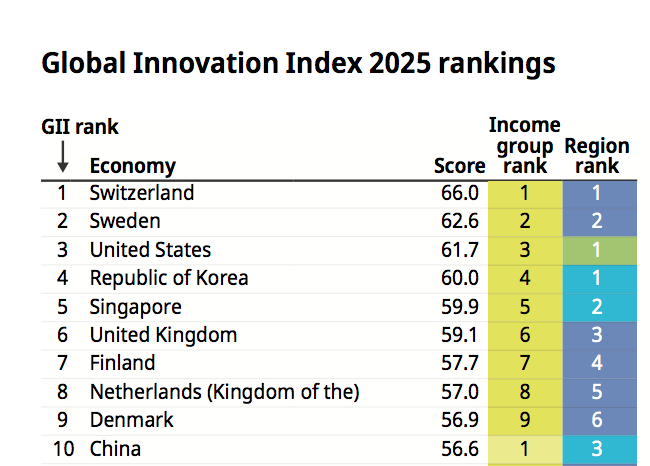
Core Insights - The Global Innovation Index (GII) ranks Switzerland, Sweden, the United States, South Korea, and Singapore as the top five innovative economies, with China making its debut in the top ten at the tenth position [1][3][4] - China has the highest number of innovation clusters in the top 100, totaling 24, with the Shenzhen-Hong Kong-Guangzhou cluster surpassing the Tokyo-Yokohama cluster to claim the top spot [1][4][6] - The GII report highlights the need for thoughtful policies, meaningful investments, and cross-sector collaboration to support and nurture innovation ecosystems [1][3] GII Rankings - The top ten economies in the GII are as follows: 1. Switzerland (Score: 66.0) 2. Sweden (Score: 62.6) 3. United States (Score: 61.7) 4. South Korea (Score: 60.0) 5. Singapore (Score: 59.9) 6. United Kingdom (Score: 59.1) 7. Finland (Score: 57.7) 8. Netherlands (Score: 57.0) 9. Denmark (Score: 56.9) 10. China (Score: 56.6) [2] China's Performance - China ranks 10th in the GII, with notable strengths in knowledge and technology output, second in R&D expenditure, and leading in patent applications globally [3][4] - The report indicates that China has become the largest contributor to global intellectual property, with its IP submissions exceeding the total of all other countries combined [4][5] - The GII report also notes the strong performance of middle-income economies, with China, India, Turkey, and Vietnam continuing to rise in rankings [3][4] Regional Innovation Clusters - The Shenzhen-Hong Kong-Guangzhou cluster is ranked first, followed by Tokyo-Yokohama, San Jose-Sunnyvale-Santa Clara, Beijing, and Seoul in the top five [6] - The Yangtze River Delta region has three clusters in the top 15, indicating a strong collaborative innovation environment [7][8] - The report emphasizes the importance of regional innovation centers, with significant advancements in the Beijing, Shanghai, and Guangdong-Hong Kong-Macau Greater Bay Area [7][8] Global R&D Trends - Global R&D investment growth is slowing, with a projected increase of only 2.9% in 2024, further declining to 2.3% in 2025, marking the weakest expansion in over a decade [9][10] - The report highlights a disparity in R&D spending across industries, with the pharmaceutical and biotechnology sectors maintaining the highest R&D intensity [10] - The software and ICT services sector has seen an increase in R&D spending share from 14% in 2018 to over 20% in 2024, while the automotive sector's share has decreased from over 18% to about 14% [10]
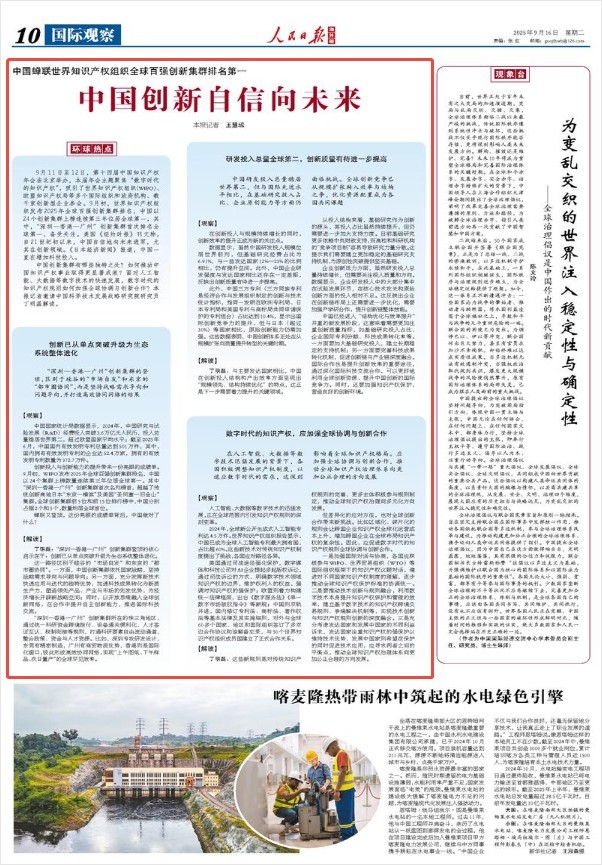
中国创新自信向未来(环球热点)
Ren Min Ri Bao Hai Wai Ban· 2025-09-15 22:49
Group 1 - The 14th China Intellectual Property Annual Conference focused on "Intellectual Property in the Digital Age," attracting numerous international organizations and innovative enterprises [1] - China ranked first globally for the third consecutive year in the WIPO's 2025 Global Top 100 Innovation Clusters, with 24 clusters listed, including the "Shenzhen-Hong Kong-Guangzhou" cluster, which ranked first for the first time [2][3] - China's R&D expenditure is projected to exceed 3.6 trillion RMB in 2024, maintaining the second position globally, surpassing the average level of EU countries [2][4] Group 2 - The "Shenzhen-Hong Kong-Guangzhou" innovation cluster's success is attributed to a strategic demand-oriented approach and efficient collaborative networks, differing from the spontaneous market approach of Silicon Valley and the urban synergy of Tokyo [3] - The Pearl River Delta region facilitates research collaboration through unified funding, equipment clearance, talent visa recognition, and tax system integration, enhancing the efficiency of innovation processes [3][4] Group 3 - Despite leading in R&D investment, China faces challenges in the proportion of basic research funding and original innovation capabilities compared to developed countries [5][6] - The share of triadic patents in China is 10.4%, indicating improved international competitiveness, but still lags behind Japan's over 30% [5][6] Group 4 - The digital age necessitates global coordination and innovation cooperation in intellectual property, as rapid advancements in AI and big data challenge traditional IP frameworks [8][10] - China has become the largest holder of AI patents globally, accounting for over 60% of the total, highlighting the need for adaptive IP regulations [8][10] Group 5 - Differing national approaches to IP protection create challenges for global innovation cooperation, necessitating dialogue and collaboration within international frameworks like WIPO and WTO [10] - Emphasizing the balance between strong IP protection for developed countries and promoting technology application for developing countries is crucial for a fair global IP governance system [10]
连续第三年全球第一我国创新动力强劲
Qi Lu Wan Bao· 2025-09-15 21:45
Group 1 - The core viewpoint of the article highlights that China continues to lead globally in the number of innovation clusters, with 24 clusters listed in the "2025 Global Innovation Index" released by the World Intellectual Property Organization [1] - China has maintained its position as the top country for three consecutive years in terms of the number of innovation clusters [1] - Among the top ten innovation clusters, China occupies three positions, ranking first, fourth, and sixth [1]

深港穗铁三角打造“东方创新极”
2 1 Shi Ji Jing Ji Bao Dao· 2025-09-15 07:15
Core Insights - The "Shenzhen-Hong Kong-Guangzhou" innovation cluster has surpassed the "Tokyo-Yokohama" cluster to become the top global innovation cluster according to the World Intellectual Property Organization (WIPO) [1] - The inclusion of venture capital in the evaluation criteria reflects a more comprehensive understanding of the innovation ecosystem's vitality in the Greater Bay Area [1][2] - The cluster excels in three key dimensions: PCT international patent applications (2nd globally), scientific paper publications (3rd globally), and venture capital indicators (6th globally) [1] Group 1: Innovation Ecosystem - The new ranking methodology captures the true competitive strength of the region, highlighting the balanced activity of inventors, research output, and capital supply [2] - The region is forming a self-reinforcing system characterized by high-density coupling of innovation elements, leading to continuous generation of new knowledge and enterprises [4] - The integration of top-tier talent and resources in the cluster is facilitated by high-level platforms, dense university networks, and rich data resources [4] Group 2: Academic and Research Contributions - The influx of international scholars, such as Fields Medal winner Shing-Tung Yau, indicates a growing academic presence in the region [3] - Guangzhou's unique position as a hub for national laboratories and high-level research institutions enhances its research capabilities [4][5] - The concentration of universities and research institutes in Guangzhou plays a significant role in technology transfer and innovation [5] Group 3: Economic and Industrial Impact - The collaboration among Shenzhen, Hong Kong, and Guangzhou has created a robust innovation chain, enhancing the probability of successful commercialization [6] - The emergence of unicorns like DJI and Crystal Tech illustrates the effective integration of knowledge, resources, and capital in the region [7] - The Greater Bay Area's innovation ecosystem supports rapid prototyping and mass production across various industries, including AI and healthcare [8]
国家知识产权局:我国创新集群数量连续三年位居全球第一(人民网)
Ren Min Wang· 2025-09-10 08:19
Group 1 - The World Intellectual Property Organization (WIPO) released the 2025 Global Top 100 Innovation Clusters ranking, with China having 24 clusters, maintaining the top position for three consecutive years [1][2] - The success is attributed to the country's emphasis on innovation, continuous growth in innovation investment, improved intellectual property protection, and enhanced innovation capabilities among various entities [1][2] - In 2024, China's total R&D expenditure is expected to exceed 3.6 trillion yuan, a year-on-year increase of 8.3%, ranking second globally, with an R&D intensity of 2.68%, surpassing the EU average [1][2] Group 2 - As of June 2025, China has 5.01 million valid invention patents, with 524,000 enterprises holding 3.73 million valid invention patents, highlighting the significant role of enterprises in innovation [2] - The Guangdong-Hong Kong-Macao Greater Bay Area, exemplified by the Shenzhen-Hong Kong-Guangzhou cluster, authorized 113,000 invention patents in 2024, accounting for 12.1% of the national total, and filed 19,000 PCT international patent applications, representing 27.5% of the national total [2] - The active innovation ecosystem in the Greater Bay Area attracts numerous high-tech companies and skilled talent, providing continuous momentum for regional innovation development [2][3]

王缉慈|探索先进制造业集群发展的关键:制度和技术创新+创业环境
Xin Lang Cai Jing· 2025-09-08 02:43
Core Viewpoint - The development of advanced manufacturing clusters in China is a strategic initiative aimed at fostering innovation and collaboration among enterprises and institutions within specific regions, enhancing the overall competitiveness of the manufacturing sector [1][3][9] Group 1: Definition and Characteristics of Advanced Manufacturing Clusters - Advanced manufacturing clusters are defined as networked industrial organizations where enterprises and institutions closely collaborate within a specific advanced manufacturing field [1] - The cultivation of these clusters involves selecting and incentivizing "leading" enterprises, establishing dynamic databases for these enterprises, and encouraging data sharing and platform empowerment [1][2] - The approach to developing these clusters is based on both top-down selection by the Ministry of Industry and Information Technology (MIIT) and bottom-up growth from existing industrial foundations [2][3] Group 2: Government and Policy Support - The MIIT's recognition of "national advanced manufacturing clusters" comes with central financial support, leading local governments to view them as policy dividends and tools for GDP growth [2] - Local governments often appoint a "chain leader" to oversee the cluster, providing guarantees to banks and facilitating funding, talent, and land for key industries [2] - The establishment of cluster governance signifies a shift towards a collaborative rule-making process involving multiple stakeholders rather than a purely government-driven initiative [3] Group 3: Case Study of Shenzhen's Advanced Battery Materials Cluster - Shenzhen has developed a closed-loop ecosystem for battery production, encompassing materials, cells, equipment, and recycling, positioning it as a global leader in battery technology innovation [4][6] - The entrepreneurial environment in Shenzhen is robust, with a collaborative spirit among numerous private enterprises, leading to significant advancements in battery technology [6] - The Shenzhen advanced battery materials cluster exemplifies the importance of a conducive innovation and entrepreneurial environment in fostering industry growth [6][7] Group 4: Innovation Ecosystem and Competitive Advantage - The innovation ecosystem in Shenzhen has enabled the advanced battery materials cluster to maintain international competitive advantages, characterized by a diverse and densely interconnected network of stakeholders [7][8] - The concept of "critical mass" is essential for understanding how innovation clusters achieve self-reinforcement and exceptional competitiveness in specific industries [7][8] - Advanced manufacturing clusters are seen as place-based innovation strategies that facilitate resource mobility and collaboration among startups, supporting entrepreneurship and technological innovation [8][9] Group 5: Future Considerations - While there are unique experiences in cultivating advanced manufacturing clusters in China, fundamental questions about the necessity and key factors for their development remain to be explored [9]




新华全媒+|成绩亮眼!连续3年全球第一 彰显创新“硬实力”
Xin Hua She· 2025-09-07 01:14
Group 1 - The World Intellectual Property Organization (WIPO) recently released the "2025 Global Innovation Index," listing 100 top innovation clusters, with China having 24 clusters, maintaining the top position globally for the third consecutive year [2][3] - Since 2017, WIPO ranks innovation clusters based on three indicators: international patent applications submitted through the Patent Cooperation Treaty (PCT), scientific paper publications, and the newly added venture capital transaction volume [3] - In 2024, China's total R&D expenditure exceeded 3.6 trillion yuan, a year-on-year increase of 8.3%, ranking second globally, with an investment intensity of 2.68%, surpassing the average level of EU countries [4] Group 2 - As of June 2025, China has a total of 5.01 million valid invention patents, with 524,000 enterprises holding valid invention patents, totaling 3.727 million patents, highlighting the significant role of enterprises in innovation [6] - The number of patent transfer and licensing registrations has reached 127,000 since the launch of the special action for patent transformation, with many high-value patents accelerating their application in high-end, intelligent, and green scenarios [6] - China's intellectual property legal framework is increasingly完善, with a social satisfaction score of 82.36 for intellectual property protection in 2024, setting a new historical high [7] Group 3 - The "Shenzhen-Hong Kong-Guangzhou" innovation cluster ranked first on the list for the first time, with a total of 113,000 invention patents granted in 2024 and 19,000 PCT international patent applications [8] - In the first half of this year, the PCT international patent application volume from the three regions exceeded 10,000, marking a year-on-year growth of 30.7%, indicating a strong growth momentum [8]

成绩亮眼!连续3年全球第一 彰显创新“硬实力”
Nan Fang Du Shi Bao· 2025-09-07 01:04
Group 1 - The World Intellectual Property Organization (WIPO) recently released the "2025 Global Innovation Index," highlighting that China has 24 innovation clusters ranked among the top, maintaining the highest number globally for three consecutive years [1][2] - The ranking is based on three main indicators: international patent applications submitted through the Patent Cooperation Treaty (PCT), scientific paper publications, and the newly added venture capital transaction volume [2] - In 2024, China's total R&D expenditure exceeded 3.6 trillion yuan, marking an 8.3% year-on-year increase, with a total investment intensity of 2.68%, surpassing the average level of EU countries [3] Group 2 - As of June 2025, China has a total of 5.01 million valid invention patents, with 524,000 enterprises holding these patents, showcasing the significant role of enterprises in innovation [4] - The "Shenzhen-Hong Kong-Guangzhou" innovation cluster ranked first on the list for the first time, with a total of 113,000 invention patents authorized in 2024 and 19,000 PCT international patent applications [5] - In the first half of this year, the PCT international patent application volume from the three regions exceeded 10,000, reflecting a robust year-on-year growth of 30.7% [5]
