
半导体产业自主可控

Search documents
芯耀辉完成上市辅导 瞄准国产半导体IP“强链补链”关键角色
Ju Chao Zi Xun· 2025-12-28 13:15
Core Viewpoint - The report indicates that ChipYaoHui Technology Co., Ltd. has successfully completed its IPO counseling work, establishing a solid foundation for its future operations in the capital market [1][3]. Group 1: Company Development - ChipYaoHui was founded in June 2020 and has rapidly become a significant player in China's semiconductor IP research and service sector [3]. - The company focuses on providing a comprehensive IP platform solution for chip design firms, particularly excelling in the critical area of interface IP [3]. - The company aims to support the construction and realization of China's large model computing chips through its self-controlled, full-stack domestic interface IP solutions [3][4]. Group 2: Market Recognition and Financing - The capital market has shown high recognition of ChipYaoHui's development prospects, as evidenced by its successful completion of a B-round financing in May, attracting major investment institutions [4]. - The funds raised will primarily be used to accelerate core technology innovation, deepen industry ecosystem construction, and promote the large-scale market application of domestic semiconductor IP [4]. - The company is positioned as a key player in the upstream of the semiconductor industry chain, with a mission to become a leading semiconductor IP company in China [4]. Group 3: Future Prospects - With the successful completion of the IPO counseling work, ChipYaoHui is entering a critical phase for its IPO application [4]. - A successful listing is expected to open broader financing and branding opportunities for the company, potentially accelerating the research and industrialization of high-end domestic IP technology [4].


半导体设备年度策略:聚四海星火,淬国之重器——全面为国产算力生产配套
2025-12-15 01:55
Summary of Semiconductor Equipment Industry Conference Call Industry Overview - The semiconductor industry is entering a significant decade-long cycle driven by AI demand, with the global semiconductor equipment market expected to exceed $1 trillion by 2030, and AI downstream applications projected to grow at a compound annual growth rate (CAGR) of 18% [1][4] - The domestic semiconductor industry faces urgent needs for self-sufficiency, with design capabilities still reliant on overseas products, while local suppliers show cost advantages in the inference stage [1][6] - The manufacturing sector has a high domestic production rate for mature processes, but advanced logic process capacity is limited yet gradually increasing [1][6] - The storage sector has a low domestic production rate, but the NAND segment is expected to catch up with international standards [1][6] Key Insights and Arguments - Investment strategies for 2026 will focus on the storage sector, driven by production expansion and order growth, with significant capital expenditure planned by major domestic internet companies [2] - The domestic semiconductor equipment market is projected to reach approximately $40 billion by 2025, with advanced logic expected to grow by 20%-25% in 2026 [2][16] - The demand for advanced logic and storage chips is substantial, with a monthly demand exceeding 70,000 wafers, while current advanced process capacity is only about 32,500 wafers [8] - The storage chip market is characterized by cyclical trends, with DRAM and NAND prices expected to rise due to AI demand, despite capital expenditure growth lagging behind demand [9] Policy Support and Market Dynamics - Government policies are crucial for the development of the domestic semiconductor industry, promoting the localization of the entire supply chain and providing opportunities for local enterprises [7] - The domestic semiconductor industry is still heavily reliant on foreign technology and equipment, but there are signs of improvement in local capabilities, particularly in mature processes [6][7] Company Focus and Investment Recommendations - Key companies to watch include: - **Zhongke Feicai**: Progress in testing equipment - **ChipSource Micro**: Expected to deliver coating and developing equipment by Q1 2026 - **Huahai Qingke**: High localization rate in CMP, with consumables accounting for over 30% of total revenue - **Maolai Optics**: Strong performance in lithography machines - **Jingzhida**: Leading in testing machines, with significant market value potential [17] - For investors seeking safety and absolute returns, companies like Huahai Qingke and Maolai Optics are recommended due to their stable growth and development potential [20] Future Trends and Opportunities - Domestic storage manufacturers are expected to expand high-end product lines to meet the demands of the current super cycle, with significant capacity expansion planned [10][14] - The AI demand is driving the development of high-end DRAM and NAND products, creating opportunities for domestic manufacturers to fill gaps left by international competitors [13] - The semiconductor testing machine market is anticipated to undergo significant changes, with companies like Jingzhida and Huafeng Measurement expected to benefit from increased demand [18] Conclusion - The semiconductor equipment industry is poised for substantial growth driven by AI demand and supportive government policies, with significant investment opportunities in storage and advanced logic sectors. Key players in the market are well-positioned to capitalize on these trends, making them attractive for investors looking for growth and stability in the sector [1][2][4][7][9][10][12][20]
维安股份重启上市辅导 电路保护与功率控制龙头再闯IPO
Ju Chao Zi Xun· 2025-12-11 03:17
Core Viewpoint - Shanghai Weian Electronics Co., Ltd. has submitted a report for its initial public offering (IPO) to the Shanghai Securities Regulatory Bureau, marking a renewed attempt to enter the capital market after previously withdrawing its application due to market conditions [1][3] Company Overview - Weian is a comprehensive solution provider specializing in circuit protection and power control, with its main business covering the research, production, and sales of electronic components, power semiconductor discrete devices, and analog integrated circuits [3] - The company's core products are divided into two categories: circuit protection products and power control products, which are essential for the safe, reliable, and efficient operation of electronic devices [3] Business Strategy - The company has a clear development path, starting with circuit protection and continuously expanding into the power control sector, creating significant technological and market synergies between its two business systems [3] - The importance of its products is increasing in the context of the growing integration and intelligence of electronic devices [3] Market Position - Weian has successfully entered the supply chains of numerous well-known international and domestic companies, establishing long-term stable partnerships with high-quality clients [3][5] - Its products are widely used in several key sectors of the national economy, including industrial IoT, consumer electronics, new energy, network communication, and automotive [4][5] Future Outlook - The initiation of the IPO guidance marks a new phase in Weian's listing process, with the global semiconductor industry's urgent demand for self-sufficiency and the increasing importance of basic electronic components [5] - The company's combination of technical depth and market breadth positions it as a leading player in its niche, making its future performance in the capital market worthy of ongoing attention [5]
粤芯半导体完成上市辅导 湾区半导体第三极加速崛起
Ju Chao Zi Xun· 2025-12-11 02:24
Core Viewpoint - The report from the China Securities Regulatory Commission indicates that GF Securities has completed the guidance work for the initial public offering of Yu Xin Semiconductor, marking the company's readiness to enter the domestic capital market [1][6]. Group 1: Company Overview - Yu Xin Semiconductor, established in December 2017 and headquartered in Guangzhou, is the first 12-inch wafer manufacturing platform in Guangdong Province, addressing the region's semiconductor supply issues [3]. - The company has rapidly expanded from consumer-grade chips to industrial and automotive-grade chips, boasting the largest 12-inch chip production capacity in Guangdong and the Greater Bay Area [3][4]. Group 2: Production and Growth - As of the end of 2023, Yu Xin Semiconductor has shipped over 800,000 wafers, with a year-on-year growth of 23.7% in analog chip production, establishing itself as a significant player in the domestic analog chip manufacturing sector [4]. - The company has completed multiple rounds of financing, attracting major industry and financial investors, and has been listed in the Hurun Global Unicorn List for three consecutive years (2022-2024) with a valuation of 16 billion RMB [4]. Group 3: Expansion Projects - The first phase of the project involves an investment of 10 billion RMB, focusing on 0.18-micron to 90-nanometer analog chips, achieving a monthly production of 40,000 12-inch wafers [5]. - The second phase, with an investment of 18.8 billion RMB, targets high-end analog chip technologies, adding another 40,000 wafers per month [5]. - A third phase is set to begin construction in 2022, aiming for completion by the end of 2024, which will increase total capacity to over 90,000 wafers per month [5]. Group 4: Industry Collaboration and Governance - Yu Xin Semiconductor collaborates with GAC Aion to promote the localization of automotive-grade chips and has established partnerships with universities and research institutions to enhance industry-academia cooperation [6]. - The company has a decentralized shareholding structure with no controlling shareholder, and its governance structure has been deemed compliant and ready for public listing [6].
全球晶圆厂设备支出预将六连增,中国380亿美元领跑!半导体设备ETF(561980)盘中上涨1.46%
Sou Hu Cai Jing· 2025-11-28 07:10
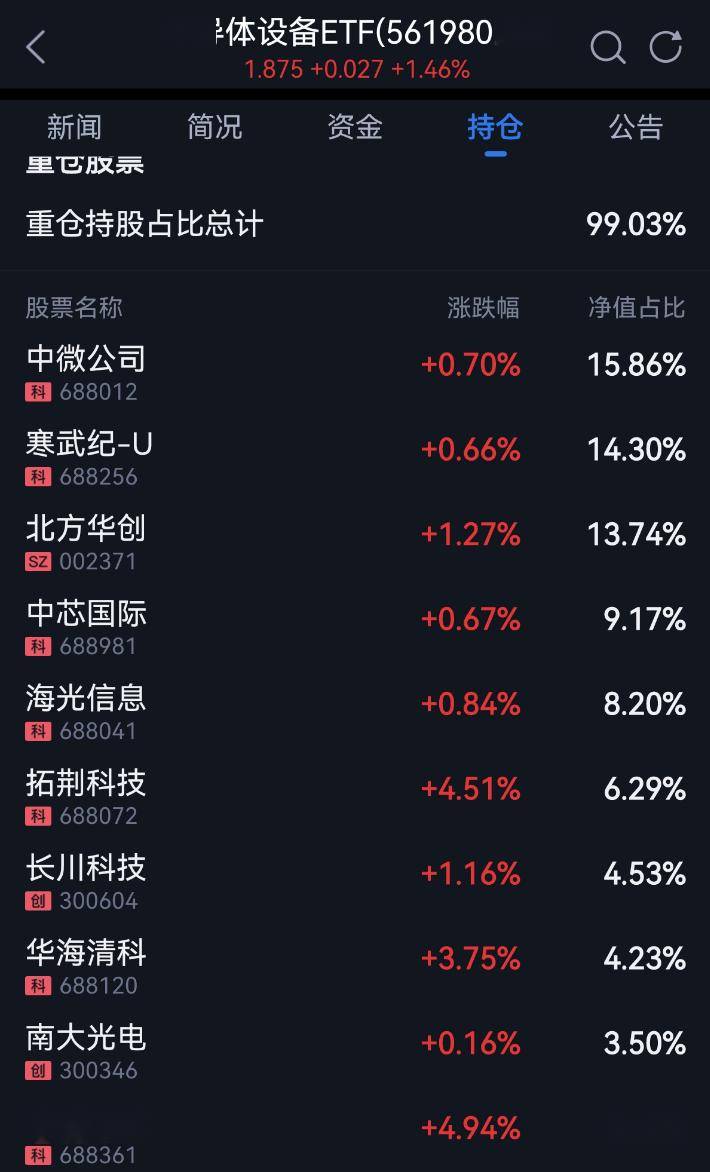
Group 1 - The semiconductor industry continues to show strength, with the semiconductor equipment ETF (561980) rising by 1.46% on the last trading day of the week, and several component stocks, including Jingyi Equipment, Tianyue Advanced, and Shanghai Xinyang, experiencing significant gains [1][2] - The domestic lithography machine sector has achieved a key breakthrough, with Shanghai Chip Microelectronics' first 350nm step lithography machine (model AST6200) completing factory debugging and acceptance, and is now being sent to the customer site [2] - Lithography machines represent the largest market share within semiconductor equipment, accounting for approximately 24% of the global semiconductor equipment sales, which are projected to reach around $109 billion in 2024 [3] Group 2 - The global wafer foundry revenue is expected to reach $199.4 billion in 2024, reflecting a year-on-year growth of over 25%, with a compound annual growth rate (CAGR) of 14.3% anticipated from 2025 to 2030 [5] - SEMI forecasts that global front-end facility equipment spending for wafer fabs will increase by 2% to $110 billion in 2025, marking the sixth consecutive year of growth since 2020 [5] - China is projected to maintain its leading position in global semiconductor equipment spending, with an estimated expenditure of $38 billion this year [5]
大基金一期加速退出,拟减持两家半导体龙头
第一财经· 2025-11-21 03:39
2025.11. 21 本文字数:1557,阅读时长大约3分钟 作者 | 第一财经 魏中原 国家集成电路产业投资基金有限公司(下称"大基金一期")正在加速回收投资的步伐,继续推进其对 早期投资项目的退出。 本周,两家科创板半导体公司燕东微(688172.SH)与拓荆科技(688072.SH)相继发布公告,披 露了大基金一期的减持计划,减持金额或超30亿元,再次引发市场对该产业基金资本运作的关注。 拟减持两家半导体龙头,回收资金或超30亿 半导体设备厂商拓荆科技11月20日晚间发布公告称,公司收到了股东大基金一期的减持计划告知 函。 大基金一期计划在2025年12月12日至2026年3月11日,通过大宗交易方式减持公司股份不超 过843.5万股,即不超过公司总股本的3%。 截至三季度末,大基金一期目前是拓荆科技的第一大股东,持股比例高达19.57%,持股数量 5502.67万股,所持股份全部为IPO前取得。大基金一期此次减持仅通过大宗交易进行,对二级市场 的直接冲击相对较小,3%的减持比例表明了其回收资金的节奏有所加快。 前日(19日)晚间,燕东微发布公告,公司持股5%以上股东大基金一期,因自身经营管理需要, ...



上海微电子(SMEE)背景及重组上市研究分析
Sou Hu Cai Jing· 2025-10-22 08:08
Company Overview and Research Background - Shanghai Micro Electronics Equipment (Group) Co., Ltd. (SMEE) is a leading enterprise in China's lithography machine sector, with its restructuring process attracting significant attention in the capital market and industry [2] - In October 2024, SMEE withdrew its IPO guidance application and opted for a backdoor listing, a strategic shift that reflects the increasing urgency for self-sufficiency in the semiconductor supply chain amid escalating Sino-U.S. tech competition [2] - The restructuring is crucial not only for the company's development prospects but also for China's semiconductor equipment industry to break through technological blockades and achieve independent innovation [2] Restructuring Plan and Shareholding Structure Adjustment - SMEE's restructuring plan features an "asset split + backdoor listing" approach, with plans to split its front-end lithography machine assets into Yuliangsheng and establish a new company, Chip-on-Micro Technology, for its back-end lithography machine business [4] - Shanghai Guotou has become the absolute controlling shareholder of SMEE, increasing its shareholding to 45.36% through the transfer of shares from Shanghai Electric Group and Shanghai Kechuang Group [4] - The restructuring is characterized by a "split + integration" model, with Chip-on-Micro Technology focusing on advanced packaging equipment and achieving over 500 lithography machine shipments within six months of its establishment [4] Regulatory Approval Progress - SMEE's restructuring is undergoing a complex and stringent review process, but it has been placed on a "green channel," potentially shortening the approval period to 30 working days [5] - The restructuring requires compliance with specific conditions, including a change in control and asset purchases exceeding 100% within 60 months, necessitating strict scrutiny from the China Securities Regulatory Commission (CSRC) [5] - The introduction of the "merger six rules" policy has simplified the review process, emphasizing support for strategic enterprises rather than profitability [5] Transaction Execution Progress - Key milestones in SMEE's restructuring include the completion of shareholding adjustments and the establishment of Chip-on-Micro Technology, indicating significant progress in business restructuring [6] - Market expectations value SMEE at approximately 600 billion yuan, based on its technological strength and market position, particularly in the 28nm lithography machine production breakthrough [6] - Asset evaluation, auditing, and legal due diligence are likely progressing smoothly, with a formal showcase of Chip-on-Micro Technology at the Bayxin Exhibition on October 15, 2025, indicating readiness for public display [6] Market Reaction and Media Coverage - The market has shown a mix of cautious optimism and heightened attention towards SMEE's restructuring, with related stocks experiencing notable price increases [7] - Several potential backdoor listing targets have issued clarification announcements denying involvement in SMEE's restructuring, reflecting market volatility and uncertainty [7] - Analysts have differing views on SMEE's valuation, with estimates ranging from 300 billion to 700 billion yuan, influenced by varying assessments of the company's technological capabilities and market outlook [7] Restructuring Timeline Prediction - Historical analysis of semiconductor mergers indicates varying timelines based on transaction complexity and regulatory environments, with simpler cases completing in as little as five days [9] - The overall trend shows that from 2020 to 2025, there have been nearly 270 merger and restructuring cases in the semiconductor industry, with 2024 seeing a peak of over 60 cases [10] - The predicted completion timeline for SMEE's restructuring ranges from December 2025 in an optimistic scenario to June 2026 in a conservative scenario, depending on regulatory approvals and transaction complexities [16][17] External Investment Layout - SMEE has made external investments in 10 companies, controlling 6, with a clear focus on the semiconductor industry chain and related technology sectors [19] - The majority of SMEE's investments occurred between 2003 and 2006, with recent activities indicating a resurgence in investment, particularly in 2022 and 2023 [20] - The total investment amount exceeds 1.3 billion yuan, with significant investments in companies like Shanghai Dongshu Investment Development Co., Ltd. and Shanghai Weiyao Industrial Co., Ltd. [20] Investment Layout by Industry Sector - SMEE's external investments are characterized by a focus on semiconductor equipment, extending upstream and downstream within the industry [21] - The company emphasizes vertical integration in the semiconductor equipment sector, with investments in specialized manufacturing and service companies [21] - Investments in emerging technology fields, such as smart sensors and automotive electronics, reflect SMEE's strategic foresight and alignment with national priorities for self-sufficiency [22][24] Key Investment Project Analysis - Shanghai Yixin Industrial Co., Ltd. is a crucial investment for SMEE, focusing on semiconductor device manufacturing and sales, enhancing control over the semiconductor equipment supply chain [23] - The joint venture with China Electronics Technology Group 45th Research Institute for Shanghai Micro Precision Machinery Engineering Co., Ltd. leverages existing technological expertise in lithography machine development [23] - Investments in companies like Shanghai Chip Material Technology Co., Ltd. and Shanghai Anzhixin Automotive Integrated Circuit Co., Ltd. highlight SMEE's commitment to emerging technology sectors and the automotive market [24] Investment Strategy Characteristics and Future Outlook - SMEE's investment strategy is marked by a clear focus on integrating the semiconductor equipment supply chain through strategic investments [25] - The company aims to achieve technological synergies through partnerships, reducing R&D risks while enhancing its competitive edge [26] - Future investments are expected to target core semiconductor technologies, materials, and cutting-edge fields like third-generation semiconductors and quantum chips, aiming to secure a leading position in future technology [30]
重塑话语权:新时达硬核技术为中国半导体制造打通自主可控关键链路
国芯网· 2025-10-17 04:39
Core Viewpoint - The semiconductor industry is crucial for national technology security and competitiveness, with a focus on achieving self-sufficiency in key equipment and components to overcome reliance on foreign imports [2]. Group 1: Industry Challenges and Policy Support - The Chinese semiconductor manufacturing sector has historically been dependent on imported equipment, with international firms holding over 90% of the market share, creating significant technological and market barriers [2]. - Recent government policies have aimed to boost domestic production capabilities, particularly in critical areas of the semiconductor supply chain [2]. Group 2: Technological Advancements - New Times has launched a self-developed series of semiconductor robots, establishing the first Class 1 cleanroom in the industry, which signifies a complete domestic production loop from design to mass production [2][7]. - The semiconductor robots have achieved ISO Class 2 cleanroom standards and have received certifications from TÜV SEMI and the Shanghai National Robot Testing and Evaluation Center, indicating that their core performance metrics meet international advanced levels [4]. Group 3: Cleanroom and Control Technology - New Times has built a Class 1 cleanroom production line in Shanghai, ensuring that all aspects of product assembly, equipment debugging, and factory testing meet wafer fabrication standards [7]. - The company has developed the SDC420/SDC620 series low-voltage direct-drive controllers, which integrate motion control and servo drive, achieving high precision positioning of ±0.05 mm, essential for wafer handling [7]. Group 4: Product Applications and Market Penetration - The semiconductor robots cover a wide range of applications, including wafer manufacturing, packaging, testing, and general logistics, with a product matrix consisting of eight series and dozens of models [11][12]. - Successful implementations of these robots in major semiconductor manufacturers like SMIC and Huazhong University of Science and Technology demonstrate their market viability and the accelerating maturity of the domestic semiconductor equipment ecosystem [17]. Group 5: Strategic Positioning and Future Outlook - New Times is positioned as a benchmark for domestic semiconductor robot technology, leveraging its advantages in cleanroom compatibility, vacuum adaptability, and integrated control technology to drive the localization of critical equipment [19]. - The advancements made by New Times not only represent milestones for the company but also contribute significantly to China's shift from a manufacturing powerhouse to a manufacturing stronghold, enhancing its position in the global semiconductor supply chain [20].


未见光刻机,新凯来依旧引爆“中国芯”
Jing Ji Guan Cha Bao· 2025-10-16 12:09
Group 1 - The core product launched by Wanliyan significantly enhances the bandwidth of domestic oscilloscopes to 90GHz, making it the second highest globally and the only one in China, breaking the Western "Wassenaar Arrangement" blockade [1][3] - The product is positioned as the world's first ultra-high-speed intelligent oscilloscope and the first full-screen oscilloscope, which is crucial for testing advanced chips like 7nm AI chips that require high bandwidth [3][4] - The development of this oscilloscope involved integrating seven key technology areas, showcasing the company's strong system integration and engineering capabilities [3][4] Group 2 - Newkailai's subsidiary, Qiyunfang, launched two EDA software products with independent intellectual property rights, which are essential for chip and PCB design, traditionally dominated by foreign companies [5][6] - The EDA software claims to improve performance by 30% over industry benchmarks and reduce hardware development cycles by 40%, indicating a significant enhancement in R&D efficiency [6][8] - The software supports large-scale, complex circuit designs and allows for collaborative design among multiple engineers, enhancing teamwork and efficiency [6][7] Group 3 - Newkailai's exhibition showcased a range of semiconductor manufacturing equipment, including 16 models for various processes such as thin film deposition and etching, named after famous Chinese mountains [9][10] - The equipment covers critical steps in chip manufacturing, indicating a comprehensive approach to the semiconductor supply chain [10][12] - The company emphasizes collaboration with domestic semiconductor manufacturers and research institutions to provide advanced solutions, moving away from isolated efforts [12][22] Group 4 - The semiconductor industry in China is shifting from individual breakthroughs to a more systematic and comprehensive strategy, as evidenced by the collaborative efforts seen at the Bay Area Semiconductor Industry Expo [16][22] - The integration of materials, equipment, and EDA tools is creating a positive feedback loop that enhances the overall resilience and strategic initiative of the industry [14][22] - The industry is encouraged to strengthen its "soft power" by nurturing talent and creating an innovative ecosystem that supports knowledge sharing and intellectual property protection [22]
湾芯展上“秀肌肉” 半导体产业链自主可控提速
Shang Hai Zheng Quan Bao· 2025-10-15 18:31
Core Insights - The 2025 Bay Area Semiconductor Industry Ecosystem Expo (Bay Chip Expo) officially opened on October 15, showcasing over 600 companies and covering more than 60,000 square meters, serving as a key platform to observe the development of China's semiconductor industry [1][2] Industry Developments - The Bay Chip Expo featured innovative products such as a semiconductor composite mobile robot from Huichuan Technology, which utilizes advanced technologies for high efficiency and precision in logistics within semiconductor manufacturing [2] - Jiangfeng Electronics presented an 8-inch silicon carbide (SiC) epitaxial wafer, which is more challenging to produce than the more common 6-inch wafers but offers significant cost advantages by allowing for more devices to be cut from a single wafer [2] - Huazhong Microelectronics highlighted its 12-inch wafer manufacturing capabilities, focusing on process nodes between 40nm and 90nm, catering to mature market demands [3] Self-Sufficiency in Semiconductor Industry - The Chinese semiconductor industry is progressively achieving full-chain self-sufficiency from raw materials to downstream applications, as stated by He Xiaolong, Chairman of Huazhong Microelectronics [4] - New products launched at the expo include a 90GHz ultra-high-speed oscilloscope by Wankai, which enhances domestic oscilloscope performance by 500%, breaking through previous Western technology restrictions [4][6] - Two new EDA design software products from Qiyunfang were introduced, improving performance by 30% and reducing hardware development cycles by 40%, filling a gap in high-end electronic design software in China [5][6] Market Trends and Future Outlook - Huichuan Technology reported that its industrial automation segment has achieved 90% self-sufficiency, with significant progress in MCU and logic chip production [6] - The industry is expected to leverage domestic demand and systematic R&D investments to upgrade and overcome challenges in high-end manufacturing and foundational tools [6]