反洗钱和反恐怖融资

Search documents
买黄金有大变化!这些新规,明起实施
Di Yi Cai Jing· 2025-07-31 02:30
Group 1 - The "Regulations on Sharing Government Data" will be implemented on August 1, emphasizing unified directory management of government data and restrictions on unauthorized use and sharing of data obtained through sharing [1] - The new "Classification and Directory of Occupational Diseases" will also take effect on August 1, expanding from 10 categories and 132 types of occupational diseases to 12 categories and 135 types, including new categories for occupational musculoskeletal diseases and occupational mental and behavioral disorders [1] - The "Administrative Penalty Discretionary Power Standards for Cybersecurity Violations" will be enforced on August 1, introducing heavier penalties for severe violations affecting network information and data security, particularly concerning personal information and minors [1] Group 2 - The "Management Measures for Reporting Cybersecurity Incidents in the People's Bank of China" will be effective from August 1, outlining reporting requirements for financial institutions regarding cybersecurity incidents and establishing classification standards for incident severity [2] - The "Defective Special Equipment Recall Management Rules" will be implemented on August 1, covering special equipment such as elevators and amusement rides, detailing the recall process from defect information collection to supervision [2] - The "Cosmetic Safety Risk Monitoring and Evaluation Management Measures" will take effect on August 1, focusing on monitoring five categories of risk substances that could harm human health, especially for vulnerable groups [2] - The "Labeling Management Regulations for Traditional Chinese Medicine Pieces" will be effective from August 1, 2024, requiring labels to include production dates and shelf life, with shelf life determined by manufacturers [2]
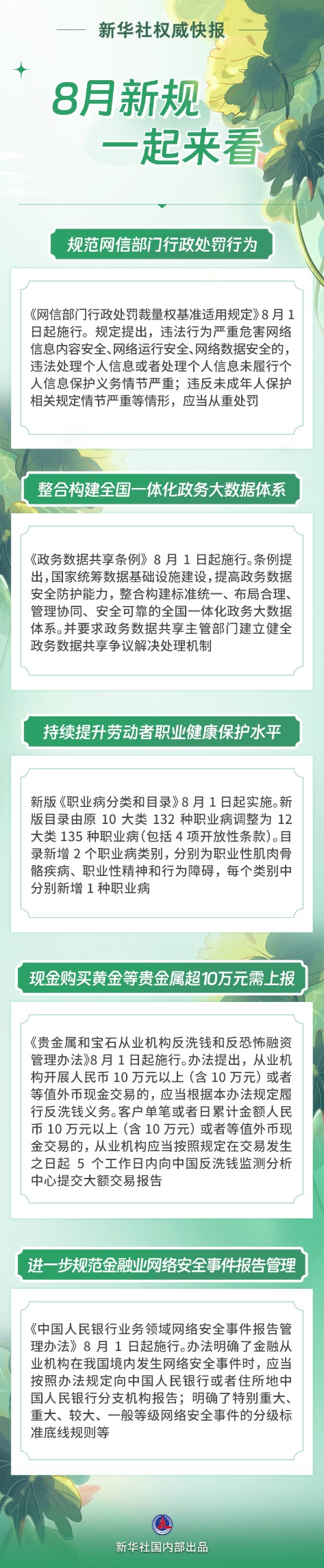
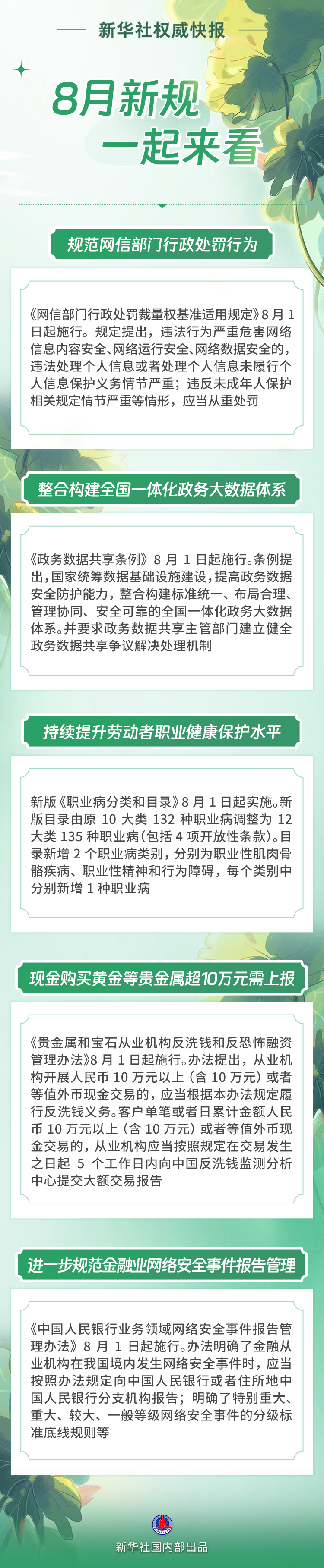
新华社权威快报 | 8月新规,一起来看
Xin Hua She· 2025-07-29 12:33
Group 1 - The new regulations effective from August include the implementation of a revised "Occupational Disease Classification and Catalog," which expands the categories from 10 to 12 and increases the total number of occupational diseases from 132 to 135, adding new categories for musculoskeletal diseases and mental disorders [3] - A new anti-money laundering regulation requires reporting of cash transactions exceeding 100,000 RMB or equivalent foreign currency, mandating institutions to submit large transaction reports within five working days [3] - The "Cybersecurity Incident Reporting Management Measures" will standardize the reporting of cybersecurity incidents in the financial sector, requiring institutions to report significant incidents to the People's Bank of China [3]

8月新规,一起来看
Xin Hua She· 2025-07-29 12:33
Group 1 - The "Regulations on Administrative Penalties by Cybersecurity Departments" will be implemented in August, aiming to standardize administrative penalties [1] - The "Regulations on Government Data Sharing" will take effect on August 1, focusing on the integration of a unified national government big data system, enhancing data security, and establishing a dispute resolution mechanism for data sharing [3] - The new version of the "Classification and Catalog of Occupational Diseases" will also be implemented on August 1, expanding from 10 categories and 132 types of occupational diseases to 12 categories and 135 types, including new categories for musculoskeletal diseases and mental disorders [3] Group 2 - The "Anti-Money Laundering and Counter-Terrorism Financing Management Measures for Precious Metals and Gemstone Practitioners" will require reporting of cash transactions exceeding 100,000 RMB or equivalent foreign currency starting August 1 [4] - Financial institutions must report cybersecurity incidents to the People's Bank of China according to the new "Management Measures for Reporting Cybersecurity Incidents in the Banking Sector," effective August 1 [4]
中国人民银行关于《关于落实〈金融机构反洗钱和反恐怖融资监督管理办法〉有关事项的通知(征求意见稿)》公开征求意见。
news flash· 2025-07-18 09:59
Core Viewpoint - The People's Bank of China is soliciting public opinions on the draft notice regarding the implementation of the "Supervision and Management Measures for Anti-Money Laundering and Anti-Terrorist Financing by Financial Institutions" [1] Group 1 - The draft notice aims to enhance the regulatory framework for financial institutions in China concerning anti-money laundering and anti-terrorist financing [1] - The People's Bank of China is seeking feedback from stakeholders to ensure comprehensive and effective implementation of the measures [1] - The initiative reflects the ongoing commitment of the Chinese government to strengthen financial security and compliance standards within the financial sector [1]
杭州硕丰自有资金投资有限公司:央行:8月1日起,现金买黄金钻石超10万元需上报
Sou Hu Cai Jing· 2025-07-05 08:15
Core Viewpoint - The People's Bank of China has issued the "Management Measures for Anti-Money Laundering and Anti-Terrorist Financing for Precious Metals and Gemstone Practitioners" to enhance regulatory compliance in the industry [1][5]. Group 1: Definition and Scope - Precious metals include gold, silver, platinum, and their various forms such as coins, standard bars, products, intermediate products, and refined raw materials [1]. - Gemstones refer to natural gemstones like diamonds and jade, including all types of raw materials and jewelry in physical form [1]. Group 2: Transaction Reporting Requirements - Institutions must fulfill anti-money laundering obligations for cash transactions of 100,000 RMB or more (including 100,000 RMB) or equivalent foreign currency [3]. - For transactions meeting the above threshold, institutions are required to conduct customer due diligence based on the "Know Your Customer" principle and submit a large transaction report to the Anti-Money Laundering Monitoring and Analysis Center within five working days [3]. Group 3: Implementation Timeline - The measures will take effect on August 1, 2025 [4].

财经早报:7月3日
Xin Hua Cai Jing· 2025-07-03 00:00
Group 1: Market and Economic Indicators - In June, the A-share market saw 1.65 million new accounts opened, bringing the total for the first half of the year to 12.6 million, a year-on-year increase of 32.77% compared to 9.49 million in the same period of 2024 [1] - The logistics industry in China reported a logistics prosperity index of 50.8% in June, up 0.2 percentage points from the previous month, indicating continued expansion in logistics business volume [1] - The Shanghai real estate market showed signs of recovery, with total transactions of new and second-hand housing reaching 1.311 million square meters in the first half of the year, a 17% increase year-on-year [1] Group 2: Company Announcements - Lixun Precision plans to issue shares overseas (H-shares) and list on the Hong Kong Stock Exchange [4] - Nanjing Shanglv expects a net profit decline of 67% to 78% year-on-year for the first half of the year [4] - Kaimeteqi reports normal operating conditions with no undisclosed significant matters [4] - Chengbang Co. states that its subsidiary, Xincun Electronics, currently has a small business scale [4] - Changchun High-tech's subsidiary, Fuxin Qibai monoclonal antibody for injection, has been approved for market entry in China [4] - Ruikang Pharmaceutical's director and vice president Li Zhe has been placed under detention [4] - Yonghui Supermarket reports that JD Shimao has reduced its stake in the company by 1.26% during the reduction period [4] - Betta Pharmaceuticals received approval from the National Medical Products Administration for the market application of Tartrate Teriparatide Capsules [4] - Hainan Highway plans to acquire a 51% stake in Jiaokong Petrochemical, which is expected to constitute a major asset restructuring [4]
下月起10万元及以上贵金属现金交易需报告
Zhong Guo Zheng Quan Bao· 2025-07-02 20:16
Core Viewpoint - The People's Bank of China has issued a new regulation aimed at anti-money laundering and counter-terrorism financing for precious metals and gemstones trading institutions, effective from August 1, requiring compliance for cash transactions exceeding 100,000 RMB or equivalent foreign currency [1][2]. Group 1: Regulatory Requirements - Institutions must submit a large transaction report to the Anti-Money Laundering Monitoring and Analysis Center within five working days for cash transactions of 100,000 RMB or more [2]. - The regulation defines precious metals as gold, silver, platinum, and related products, while gemstones include diamonds and jade [2][3]. Group 2: Risk Management - Institutions are required to conduct customer due diligence based on the "Know Your Customer" principle, especially for transactions exceeding 100,000 RMB or when there are suspicions of money laundering [3]. - Institutions must not provide services to unidentified clients or those using false identities and must take immediate action if invalid identification is detected [4]. Group 3: Risk Assessment - Institutions are mandated to regularly assess their exposure to money laundering risks, with evaluations not exceeding three years, and must reassess when significant changes occur in operations or environment [4]. - Prior to launching new products or services, institutions should evaluate the potential money laundering risks associated with these changes [4].
8月1日实行!现金买黄金钻石超10万元需上报
Zhong Guo Jing Ying Bao· 2025-07-02 12:26
Core Viewpoint - The People's Bank of China has introduced new regulations requiring reporting of cash transactions exceeding 100,000 RMB or equivalent foreign currency in the gold and diamond sectors to combat money laundering and terrorist financing [1][2]. Group 1: Regulatory Framework - The newly released "Management Measures for Anti-Money Laundering and Anti-Terrorist Financing in Precious Metals and Gemstone Industries" mandates that institutions must report large cash transactions within five working days [1]. - The regulations will take effect on August 1, 2025, and are aimed at enhancing the anti-money laundering framework in the precious metals and gemstones sector [1][2]. Group 2: Industry Characteristics - Precious metals trading is considered a high-risk area for money laundering due to its large transaction amounts and strong liquidity [2]. - The term "precious metals" includes gold, silver, platinum, and their various forms, while "gemstones" refers to natural stones like diamonds and jade [2]. Group 3: Compliance Obligations - Institutions must conduct customer due diligence based on the risk profile of clients, especially for cash transactions exceeding 100,000 RMB [3]. - Enhanced due diligence is required when there are reasonable grounds to suspect money laundering activities or doubts about the authenticity of customer identity information [3].
8月1日起,现金买黄金超10万元需上报!专家:对个人正常消费无实质影响
Zheng Quan Shi Bao Wang· 2025-07-02 12:17
Core Points - The People's Bank of China has issued the "Management Measures for Anti-Money Laundering and Anti-Terrorist Financing for Precious Metals and Gemstone Practitioners," effective from August 1, requiring practitioners engaged in cash transactions of 100,000 RMB or more to fulfill anti-money laundering obligations [1][2] - The threshold for reporting large transactions has been raised from 50,000 RMB to 100,000 RMB, aligning with international anti-money laundering standards [1][2] - The measures specifically target the precious metals and gemstones sector, which has been identified as a high-risk area for money laundering due to its cash-intensive nature [2] Industry Implications - The measures apply to institutions involved in the spot trading of precious metals and gemstones, including the Shanghai Gold Exchange and the China Gemstone and Jewelry Association, but do not cover futures trading [2] - The regulations aim to enhance customer information management and transaction record retention, thereby curbing hidden money laundering methods such as jewelry design and gold transfer [2] - Experts believe that the new regulations will not significantly hinder normal consumer purchases, as only a small percentage of transactions will require identity verification and transaction purpose disclosure [2]
央行新规:8月1日起,现金买黄金钻石超10万元需上报|快讯
Hua Xia Shi Bao· 2025-07-02 11:36
Core Viewpoint - The People's Bank of China has issued new regulations to enhance anti-money laundering and counter-terrorism financing measures in the precious metals and gemstones industry, raising the reporting threshold for large cash transactions from 50,000 RMB to 100,000 RMB, effective August 1 of this year [2][3]. Group 1: Regulatory Changes - The new regulation requires institutions to report cash transactions of 100,000 RMB or more, or equivalent foreign currency, within five working days of the transaction [2]. - The previous threshold for reporting was set at 50,000 RMB or equivalent foreign currency, indicating a significant increase in the cash transaction reporting limit [3]. Group 2: Compliance Obligations - Institutions must conduct customer due diligence based on the "Know Your Customer" principle when transactions exceed 100,000 RMB or if there are reasonable grounds to suspect money laundering activities [3][4]. - The regulation emphasizes the importance of verifying the authenticity, validity, and completeness of customer identity information, especially when there are doubts regarding previously obtained data [4].