干法电极技术

Search documents
清研电子重点支持2025固态电池行业年会暨固态电池金鼎奖颁奖典礼举办!
起点锂电· 2025-10-24 10:17
Core Viewpoint - The article highlights the upcoming 2025 Solid-State Battery Industry Annual Conference and the Golden Ding Award ceremony, emphasizing the importance of new technologies and collaborative ecosystems in the solid-state battery sector [2][13]. Company Overview - Shenzhen Qingyan Electronics Technology Co., Ltd. is a national high-tech enterprise nurtured by the Shenzhen Tsinghua University Research Institute, established in August 2020, and has gained attention in the new energy materials field due to over 20 years of technological accumulation [2]. Technological Innovations - The company focuses on powder film technology (PIFs) as a core driver for disruptive innovation across "materials - processes - equipment - applications," successfully breaking foreign technological barriers and establishing the largest automotive-grade supercapacitor dry electrode production line in China with an annual capacity of 1 million square meters [3][5]. - The dry electrode process eliminates solvent coating, directly hot-pressing active materials, binders, and conductive agents, simplifying the process and enhancing production efficiency [5]. Product Offerings - Main products include dry double-sided film machines, dry double-sided film composite mass production equipment, homogenization integrated machines, dry electrodes (including silicon-based dry electrodes), and supercapacitors [4]. Technical Advantages - The dry electrode technology offers multiple advantages, including high electrode density, reduced production costs, and environmental benefits by eliminating reliance on organic solvents like NMP [5][11]. - The company has applied for 40 core patents, with 20 granted, and its core technology has won the "23rd China Patent Excellence Award," indicating a significant difference in its intellectual property system compared to competitors [6]. Industrial Applications - Qingyan Electronics has established the first fully automated dry electrode production line in China with a capacity of 0.1 GWh, significantly reducing production costs and improving energy efficiency [12]. - The company has successfully delivered its self-developed high-speed wide-width dry electrode equipment to leading domestic manufacturers, marking a key breakthrough in solid-state battery manufacturing technology [12]. Event Details - The 2025 Solid-State Battery Industry Annual Conference will take place on November 8, 2025, at the Guangzhou Nansha International Convention and Exhibition Center, featuring over 1,000 participants and various industry leaders [13][15].


干法电极产业化迎关键突破:高能数造广州中试示范线正式投用
高工锂电· 2025-09-11 10:40
Core Viewpoint - The establishment of High Energy Digital's second headquarters in Guangzhou and the launch of China's first dry electrode pilot line for solid-state batteries represent a significant step in overcoming the industrialization challenges of the "dry electrode" process, facilitating the commercialization of solid-state batteries [3][5]. Group 1: Strategic Development - High Energy Digital has adopted a dual strategy of "R&D + industrialization" since its establishment in 2021, with a core R&D base in Xi'an and additional locations in Changchun, Ningbo, and Qidong to serve various segments of the battery supply chain [5]. - The choice of Guangzhou for the new headquarters aims to leverage the geographical and industrial cluster advantages of the South China region, enabling quick responses to the needs of downstream customers in the Pearl River Delta [5]. Group 2: Technological Advancements - The pilot line features a series of self-developed core equipment that work in synergy, utilizing high-precision process control to achieve breakthroughs in production technology [7]. - Key equipment includes the FF230L fiberization device for dust-free mixing, the FR100L fiber network reinforcement device for uniform material blending, and the MRC240-350L multi-roller film forming device, which ensures high precision in film thickness and width [7][8]. Group 3: Production Capacity and Efficiency - The pilot line is capable of producing 24,000 to 30,000 square meters of film per month, based on a film thickness of 100 microns and a width of 400 millimeters, meeting the needs of both small and large battery enterprises [9]. - The continuous production model of the line reduces production cycles by over 30% compared to traditional batch processes, while the total power consumption is approximately 600 kilowatts, achieving a 40% reduction in energy consumption per unit of production compared to wet processes [10]. Group 4: Cost and Quality Benefits - The pilot line offers quantifiable benefits for battery R&D companies, including a material loss rate of less than 3% and a 15% reduction in initial investment costs compared to wet processes, along with a 25% decrease in annual maintenance costs [12]. - The line incorporates 12 key monitoring points to ensure high consistency in product quality by tracking critical parameters such as fiberization temperature and film thickness [12]. Group 5: Flexibility and Customization - The pilot line is designed to accommodate various mainstream and advanced materials, with a professional team available to assist clients in optimizing processes based on material characteristics [13]. - By providing a platform that integrates advanced equipment, precise control, and flexible services, the Guangzhou pilot line aims to attract collaboration among industry players, promoting the maturation of dry electrode technology and the commercialization of solid-state batteries [13].

三星SDI组建新型电池电极研究部门
Ju Chao Zi Xun· 2025-09-01 12:28
Group 1 - Samsung SDI has established a new electrode research department named the Electrode Center, which is part of its mid-to-large battery business segment [1] - The company is considering applying dry electrode technology to all-solid-state batteries [1] - Earlier this year, Samsung SDI upgraded its battery factory in Göd, Hungary, investing approximately 100 billion KRW in the renovation [1] Group 2 - In June, Samsung SDI began dismantling three outdated production lines (lines 2 to 4) that were previously used for producing fifth-generation (P5) or lower-spec batteries [1] - The company is simultaneously upgrading the electrode process rolling equipment on line 7 [1] - The first factory has long utilized a winding process for battery production, which is transitioning to a stacking process to optimize internal space utilization and enhance energy density [1] Group 3 - Since 2018, Samsung SDI has accelerated the transition from winding to stacking processes, which improves the energy density of square batteries [1] - The equipment required for the stacking process is exclusively supplied by Philenergy [1]
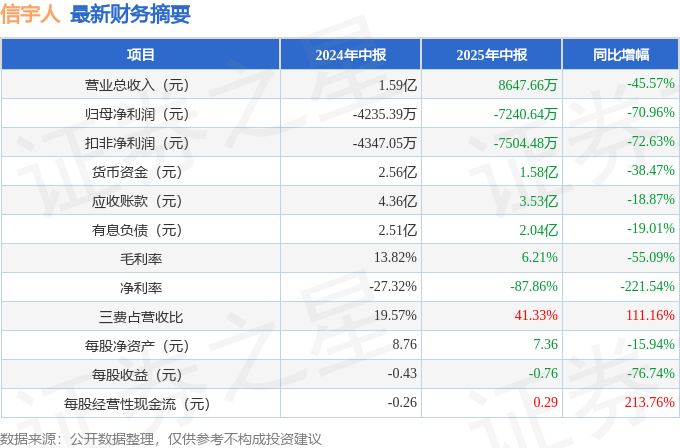
信宇人2025年中报简析:净利润同比下降70.96%,三费占比上升明显
Zheng Quan Zhi Xing· 2025-08-30 23:24
Financial Performance - The company reported a total revenue of 86.48 million yuan for the first half of 2025, a decrease of 45.57% year-on-year [1] - The net profit attributable to shareholders was -72.41 million yuan, down 70.96% year-on-year [1] - The gross margin was 6.21%, a decline of 55.09% compared to the previous year [1] - The net margin was -87.86%, a decrease of 221.54% year-on-year [1] - Total expenses (selling, administrative, and financial) accounted for 41.33% of revenue, an increase of 111.16% year-on-year [1] Cash Flow and Financial Health - The company's cash flow situation is concerning, with cash and cash equivalents at 158 million yuan, down 38.47% year-on-year [2] - The average operating cash flow over the past three years has been negative, indicating potential liquidity issues [2] - The ratio of cash to current liabilities is only 23.38%, suggesting limited financial flexibility [2] Product Development and Innovation - The company has successfully trial-produced a dry electrode equipment prototype, which is currently in the parameter adjustment and technical validation phase [3] - The dry electrode technology differs from traditional methods by eliminating the need for a film-making process, allowing for a more efficient production [3] - The company has achieved significant progress in solid-state electrolyte development, with halide solid electrolyte samples completed ahead of schedule [4] Material Development and Market Expansion - The company has maintained stable cooperation with major 3C clients for optical adhesives and tapes, with planned shipments proceeding as scheduled [5] - In the Micro LED sector, the company has made notable advancements in mass transfer films, with small batch shipments already achieved [6] - The water vapor barrier film has been successfully delivered to a flexible perovskite manufacturer, marking a breakthrough in this area [7]

固态电池系列之干法电极专题报告:革新技术,方兴未艾
Dongguan Securities· 2025-08-29 06:49
Investment Rating - Overweight (Maintain) [1] Core Viewpoints - The dry electrode process is a new battery manufacturing technology that does not use solvents, simplifying production and reducing costs by over 10% [3][30][37] - Solid-state batteries, leveraging high energy density and safety, are seen as the ultimate solution for next-generation lithium batteries, with dry electrode technology being a key driver for their industrialization [3][30][36] - The dry electrode process can increase battery energy density by approximately 20% and is better suited for the production of solid-state batteries, particularly those using sulfide electrolytes [30][31][36] Summary by Sections 1. Dry Electrode as a New Electrode Manufacturing Process - The dry electrode process differs from the traditional wet process by eliminating solvent use, which reduces energy consumption and production time [16][25] - The dry process faces challenges in achieving uniform mixing and film consistency, impacting yield rates [28][30] 2. Dry Electrode as a Key Technology for Solid-State Battery Industrialization - The dry electrode process is essential for the development of solid-state batteries, particularly those utilizing sulfide electrolytes, which have the highest ionic conductivity [33][36] - The first generation of solid-state batteries is expected to achieve production by 2027, with significant advancements in technology and production lines anticipated in 2025-2026 [42][43] 3. Equipment Demand Driven by Dry Electrode Process - The solid-state battery equipment market is projected to grow significantly, with an estimated market size of approximately 108 billion yuan by 2030, driven by the demand for new and upgraded equipment for the dry electrode process [45][47] - Key companies in the dry electrode equipment sector include leading firms with capabilities in solid-state battery production lines, such as Xian Dao Intelligent and Nacono [3][44]
干法电极设备迎全球“出货”小高峰
高工锂电· 2025-08-16 08:40
Core Viewpoint - The recent surge in the delivery of dry electrode equipment for next-generation battery manufacturing indicates a significant acceleration in the industrialization process of high-energy-density batteries, particularly solid-state batteries [4][10]. Group 1: Equipment Deliveries - Multiple domestic and international equipment companies have recently delivered dry electrode equipment, marking a transition from research validation to production line implementation [3]. - Li Yuanheng announced the delivery of a complete solid-state battery production line, including dry electrode equipment, to a leading domestic company [4]. - Qingyan Electronics and Qingyan Nako successfully delivered high-speed wide-format dry electrode equipment to a major domestic automotive company [5]. - LiCAP Technologies in the U.S. has completed the acceptance testing of its 300 MWh roll-to-roll production line, producing self-supporting positive electrode films [6]. Group 2: Technological Advancements - Qingyan Electronics' equipment can achieve a dual-sided composite film speed of 80 m/min for the negative electrode and 50 m/min for the positive electrode, with plans to increase the width to 1.2 meters [5]. - The dry electrode process eliminates solvent coating, drying, and recovery steps, significantly reducing energy consumption and manufacturing costs while avoiding solvent residue issues [7]. - The core technology of dry electrode production, fiberization equipment, accounts for over 30% of the equipment cost and faces challenges in achieving uniform powder mixing and mechanical strength [8]. Group 3: Future Prospects - The recent deliveries of solid-state battery equipment extend beyond dry electrodes, with Huacai Technology delivering core front-end equipment to a solid-state battery company [9]. - Huacai's equipment addresses the challenge of achieving uniform mixing of solid electrolytes and active materials, indicating advancements in the field [9]. - The overall trend of equipment deliveries suggests that the development of next-generation batteries is moving from laboratory settings to pilot lines and engineering validation, paving the way for mass production [10].

固态电池板块观点汇报
2025-07-22 14:36
Summary of Solid-State Battery Sector Insights Industry Overview - The solid-state battery sector is experiencing growth driven by technological advancements rather than market speculation, with new signed orders in the first half of 2025 showing a gross margin increase of 2-3 percentage points [1][2][3] - Major companies like BYD, Guoxuan, and FAW have launched automotive-grade solid-state cells, while CATL and Huawei are developing pilot lines with tangible products [1][2][3] Key Points and Arguments - **Policy Support**: The Chinese government is actively supporting solid-state battery development, with the Ministry of Industry and Information Technology (MIIT) launching a 6 billion RMB R&D initiative and the National Development and Reform Commission (NDRC) providing a 15% bond subsidy [1][2][7] - **Technological Breakthroughs**: Solid-state battery technology is advancing, with significant improvements in performance. The industry is expected to see a critical mass production window by 2027, with visible orders starting to materialize in 2026 [2][3][16] - **Manufacturing Differences**: Solid-state batteries differ significantly from traditional liquid lithium batteries in manufacturing processes, requiring new production lines and leading to increased capital expenditures [4][11][9] Market Dynamics - **Equipment Market Potential**: The value of a complete solid-state battery production line is approximately 500 million RMB per GW, expected to decrease to 200-300 million RMB during mass production, indicating a substantial growth opportunity compared to traditional liquid lithium battery equipment [11][16] - **Emerging Companies**: Key players in the solid-state lithium battery sector include BYD, CATL, Guoxuan, FAW, and Huawei, all of which are investing heavily in R&D and pilot production lines [5][6][14] Challenges and Innovations - **Dry Electrode Technology**: The dry electrode technology, which eliminates solvent use, presents challenges but offers significant advantages such as reduced energy costs and increased energy density, indicating a shift from wet to dry processes is likely [8][10] - **Valuation of Equipment Companies**: Solid-state battery equipment companies are generally valued between 15 to 30 times earnings, presenting a safety margin compared to higher valuations of other firms, with potential for significant upward movement as demand increases [15][16] Future Trends - The solid-state battery industry is poised for rapid development, with multiple catalysts expected in the second half of this year and into 2026, leading to a critical production phase in 2027 [3][17] - Companies with strong technological foundations and strategic positioning in the growth segments of the industry, such as Xian Dao Intelligent, Hangkong Technology, and Lianying Laser, are recommended for investment consideration [16][17]
上汽集团将推10万级半固态电池车型
高工锂电· 2025-07-21 10:37
Core Viewpoint - The introduction of semi-solid state batteries by SAIC Motor for its MG brand electric vehicle MG4, priced at 100,000 RMB, signifies a shift in the automotive market, targeting cost-sensitive consumers rather than high-end models, driven by advancements from its partner, Qingtao Energy [1][2] Summary by Sections Technological Breakthroughs - Qingtao Energy has achieved significant progress in its second-generation semi-solid state battery technology, reducing the electrolyte content to 5%, enhancing safety and low-temperature performance [1] - The battery has passed a "360-degree puncture test," demonstrating its safety by not catching fire or exploding under destructive conditions [1] - In low-temperature performance, the battery's range achievement rate at -7°C exceeds traditional lithium iron phosphate batteries by approximately 13%, with discharge power improved by over 20% [1] Performance Metrics - The system energy density of the new battery is reported to reach 400 Wh/kg, supporting a rapid charge of 400 kilometers in just 12 minutes [2] - The cycle life of the battery has improved by over 30% compared to traditional batteries due to the application of pre-lithiation negative electrode technology [2] Manufacturing Innovations - Qingtao Energy is focusing on "dry positive electrode technology," which eliminates solvents, significantly reducing processes, energy consumption, and production costs [3] - The company has announced successful pilot production of this dry process technology, achieving continuous manufacturing of electrode sheets and electrolytes [4] Patent and Equipment Development - SAIC and Qingtao's patent strategy covers the entire production chain, including equipment and materials, with innovations in multi-stage roller press equipment design [5] - The pilot stage requires approximately 5-6 dry roller press machines per GWh production line, each valued at around 6 million RMB, indicating a significant investment in scaling production [5] Material Selection Strategy - Unlike many companies pursuing high-nickel or sulfur-based routes, Qingtao is heavily investing in manganese-based positive electrode materials, which are abundant and cost-effective [7] - The solid-state electrolyte is expected to resolve issues related to manganese leaching in liquid systems, thus leveraging the advantages of manganese-based materials [7] Industrialization and Future Outlook - Qingtao's manganese lithium oxide project in Inner Mongolia has entered trial production, with full production expected by 2026, marking a significant step in the transition from first to second-generation products [8] - The company's "platformization" strategy aims to create a complete industrial chain for all-solid-state batteries, enhancing safety and allowing for flexible combinations of different electrode materials [8] - The launch of the MG4 will serve as a market test for the effectiveness of the combined "process + material" approach and its potential to reshape the industry landscape [8]


特斯拉将自产磷酸铁锂电池!
起点锂电· 2025-06-30 11:24
Group 1 - The event "2025 Fifth Electric Two-Wheeler Battery Swap Conference and Lightweight Power Battery Technology Summit Forum" will be held on July 10-11, 2025, in Shenzhen, focusing on battery swapping technology for two-wheelers [2] - Tesla is establishing its own battery production line to reduce reliance on battery manufacturers, with the completion of its first lithium iron phosphate battery factory in North America located in Sparks, Nevada [2][3] - The Nevada Gigafactory is one of Tesla's major battery production facilities, primarily producing batteries for energy storage and vehicles, while also planning to build a 4680 battery factory and an electric semi-truck factory [3] Group 2 - Tesla's upstream layout, including the operation of its lithium refining plant in Texas, is a significant indicator of its commitment to establishing a complete battery supply chain [6] - The Texas lithium refining plant is the first large-scale battery-grade lithium refining facility in the U.S., with an expected annual capacity of 50 GWh [6] - Tesla aims to reduce its dependence on Chinese raw materials, which currently account for about two-thirds of global lithium chemical production [7] Group 3 - The 4680 battery technology, developed by Tesla, includes self-extraction of lithium resources and in-house production of active materials, which could significantly lower costs if industrialized [10] - Tesla's 4680 battery production line has reportedly surpassed external suppliers in cost-effectiveness, with an annual production capacity exceeding 100 million units [10] - Despite advancements, the 4680 battery faces challenges in competing with other technologies, such as CATL's Kirin battery, and may not be suitable for large-scale energy storage applications [11][12]


每日速递 | 比亚迪与字节跳动深化合作
高工锂电· 2025-06-20 10:46
Group 1: Industry Developments - BYD and ByteDance are collaborating to establish an "AI + High-Throughput Joint Laboratory" to tackle key technical issues in power batteries such as fast charging, lifespan, and safety [1] - JinJing New Energy and EVE Energy have launched a global lithium battery recycling network platform to enhance the effective recovery and reuse of retired battery materials [3] - The green energy storage intelligent manufacturing project by Feimaotai has commenced in Tianjin, with an annual production capacity of 96GWh planned [5] Group 2: Technological Advancements - Envision AESC has received the Witness Laboratory Qualification Certificate from TÜV Rheinland, enabling independent testing according to international safety standards [7] - Formosa Plastics Group has initiated trial production of solid-state batteries, aiming for mass production by 2027 and focusing on applications in small electric vehicles and drones [9] - LG and Toyota are forming a joint venture in North Carolina to establish a battery recycling pre-treatment plant, with a planned annual capacity of 13,500 tons starting in 2026 [12] - Samsung plans to incorporate Tesla's dry electrode technology in its solid-state batteries set for release in 2027, targeting a specific energy density of 500Wh/kg and rapid charging capabilities [14]