
平台经济价格监管

Search documents
三部门:平台经营者应当公平公正开展补贴促销 不得虚假、夸大宣传补贴金额和力度
智通财经网· 2025-12-20 07:15
本规则所称价格行为,是指平台经营者、平台内经营者在销售商品或者提供服务过程中与价格相关的行 为,包括制定或者变更价格、价格标示、收取费用、实施补贴等行为。价格包括商品价格和服务价格。 第三条 平台经营者、平台内经营者实施价格行为应当遵循合法合规、公平诚信、规范透明、自愿平等 的原则,充分维护交易相对人的知情权、自主选择权和公平交易权等合法权益。 第二章 经营者自主定价 智通财经APP获悉,12月20日,国家发展改革委、市场监管总局、国家网信办联合印发《互联网平台价 格行为规则》。其中提出,平台经营者应当公平公正开展补贴促销,不得虚假、夸大宣传补贴金额和力 度。平台经营者开展补贴促销,应当在网站或者应用程序(APP)相应活动页面显著位置标示补贴及相关 促销活动规则,明确补贴对象、补贴方式、参与条件、起止时间等信息。规则自2026年4月10日起施 行,有效期为5年。 原文如下: 互联网平台价格行为规则 第一章 总则 第一条 为健全互联网平台常态化价格监管机制,规范相关价格行为,保护消费者和经营者合法权益, 推动平台经济创新和健康发展,根据《中华人民共和国价格法》、《中华人民共和国电子商务法》、 《中华人民共和国反 ...
周末重磅!三部门发文 事关互联网平台价格行为
Zheng Quan Shi Bao· 2025-12-20 03:27
三部门发布《互联网平台价格行为规则》。 据国家发展改革委网站12月20日消息,为健全互联网平台常态化价格监管机制,规范相关价格行为,保护消费者和经营者合法权益,推动平台经济创新和 健康发展,国家发展改革委、市场监管总局、国家网信办制定发布了《互联网平台价格行为规则》(以下简称《行为规则》)。 此前,国家发展改革委、市场监管总局、国家网信办于2025年8月23日至9月22日就《行为规则》公开征求社会意见。根据各方意见,进一步修改完善《行 为规则》,着力规范价格行为、推动公开透明、增强各方协同,构建良好平台生态。 一是规范价格竞争秩序。根据现行法律法规规定,细化实化监管要求,为平台经营者、平台内经营者提供明确的价格行为指引,推动形成优质优价、良性 竞争的市场秩序。 二是保护经营者自主定价权。完善对平台内经营者自主定价权的保护规定,明确平台经营者不得对平台内经营者的价格行为进行不合理限制或者附加不合 理条件。 三是保护消费者合法权益。落实明码标价制度,推动动态定价、差别定价等规则公开,规范免密支付、自动续期、自动扣款等服务,更好保护消费者的知 情权、选择权。 第二章经营者自主定价3条,主要是聚焦保护经营者自主定价权 ...

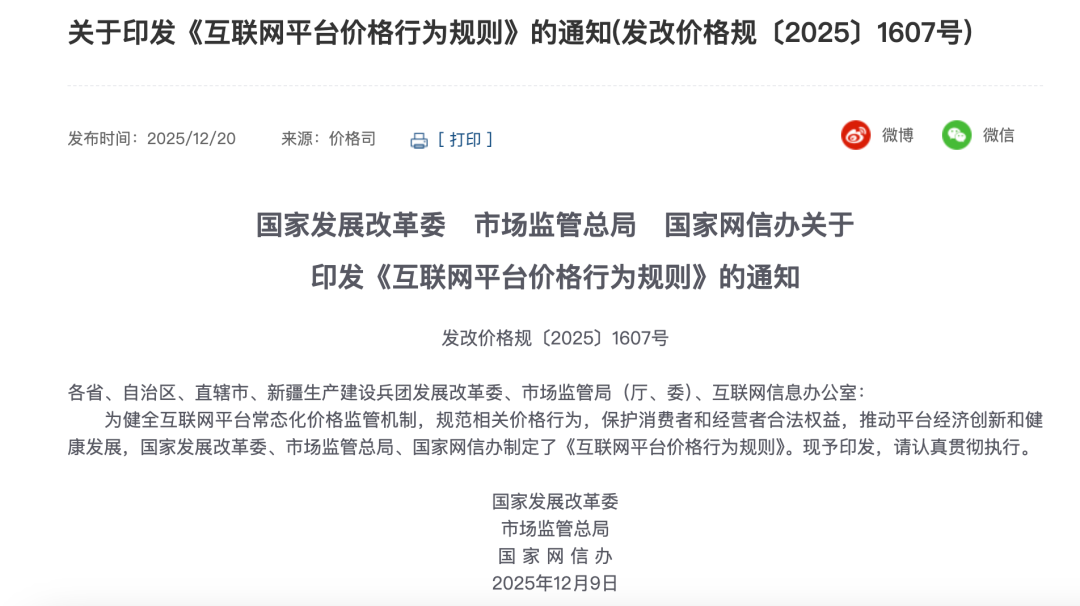
周末重磅!三部门发文,事关互联网平台价格行为
Xin Lang Cai Jing· 2025-12-20 02:58
炒股就看金麒麟分析师研报,权威,专业,及时,全面,助您挖掘潜力主题机会! 三部门发布《互联网平台价格行为规则》。 据国家发展改革委网站12月20日消息,为健全互联网平台常态化价格监管机制,规范相关价格行为,保 护消费者和经营者合法权益,推动平台经济创新和健康发展,国家发展改革委、市场监管总局、国家网 信办制定发布了《互联网平台价格行为规则》(以下简称《行为规则》)。 此前,国家发展改革委、市场监管总局、国家网信办于2025年8月23日至9月22日就《行为规则》公开征 求社会意见。根据各方意见,进一步修改完善《行为规则》,着力规范价格行为、推动公开透明、增强 各方协同,构建良好平台生态。 一是规范价格竞争秩序。根据现行法律法规规定,细化实化监管要求,为平台经营者、平台内经营者提 供明确的价格行为指引,推动形成优质优价、良性竞争的市场秩序。 二是保护经营者自主定价权。完善对平台内经营者自主定价权的保护规定,明确平台经营者不得对平台 内经营者的价格行为进行不合理限制或者附加不合理条件。 三是保护消费者合法权益。落实明码标价制度,推动动态定价、差别定价等规则公开,规范免密支付、 自动续期、自动扣款等服务,更好保护消费 ...
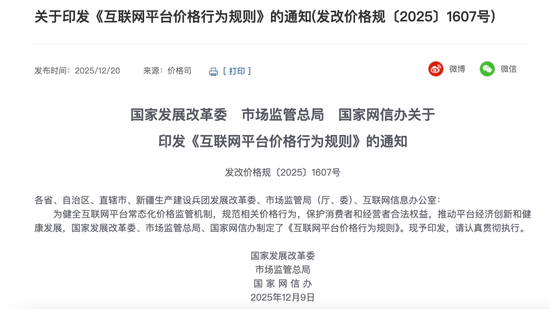
保护消费者和经营者合法权益 三部门最新印发
Shang Hai Zheng Quan Bao· 2025-12-20 02:27
国家发展改革委市场监管总局国家网信办 关于 印发《互联网平台价格行为规则》的通知 发改价格规〔2025〕1607号 各省、自治区、直辖市、新疆生产建设兵团发展改革委、市场监管局(厅、委)、互联网信息办公室: 为健全互联网平台常态化价格监管机制,规范相关价格行为,保护消费者和经营者合法权益,推动平台 经济创新和健康发展,国家发展改革委、市场监管总局、国家网信办制定了《互联网平台价格行为规 则》。现予印发,请认真贯彻执行。 国家发展改革委 市场监管总局 国家网信办 2025年12月9日 互联网平台价格行为规则 第一章总则 第一条为健全互联网平台常态化价格监管机制,规范相关价格行为,保护消费者和经营者合法权益,推 动平台经济创新和健康发展,根据《中华人民共和国价格法》、《中华人民共和国电子商务法》、《中 华人民共和国反不正当竞争法》、《中华人民共和国消费者权益保护法》、《中华人民共和国网络安全 法》、《中华人民共和国个人信息保护法》等法律法规,制定本规则。 第二条平台经营者、平台内经营者在中华人民共和国境内通过互联网平台等信息网络销售商品或者提供 服务等经营活动中的价格行为,适用本规则。 本规则所称平台经营者,是指 ...
为平台价格行为提供明确指引——国家发展改革委有关负责同志就《互联网平台价格行为规则(征求意见稿)》答记者问
Ren Min Ri Bao· 2025-08-24 08:32
Core Viewpoint - The introduction of the "Internet Platform Pricing Behavior Rules (Draft for Comments)" aims to promote healthy development in the platform economy by establishing clear pricing regulations and enhancing transparency in pricing practices [1][2][10] Group 1: Background and Objectives - The rapid development of the platform economy in China has positively impacted the real economy and consumer needs, necessitating clearer regulations on pricing behavior [2] - The rules are designed to balance development and regulatory compliance, ensuring a stable regulatory environment while promoting fair competition and protecting the rights of both operators and consumers [2][10] Group 2: Key Regulations - The rules focus on standardizing pricing behavior, including aspects like big data pricing, price subsidies, and pricing integrity, to foster a fair competitive market environment [3] - Transparency is emphasized, requiring platform operators to adhere to clear pricing standards and publicly disclose any changes in fees [3][6] - Collaboration among government departments, industry associations, and platform operators is encouraged to create a cooperative governance model [3] Group 3: Pricing Autonomy and Standards - The rules affirm the right of platform operators and internal operators to set their own prices, while also regulating the fees charged by platform operators to internal operators [4] - Operators are required to publicly disclose any changes to pricing structures and seek input from internal operators before implementing new fees [4] - Restrictions on platform operators are established to prevent unreasonable limitations on the pricing autonomy of internal operators [4][10] Group 4: Pricing Display and Competition - Clear pricing display requirements mandate that operators must transparently indicate prices and any additional fees associated with products or services [5][6] - The rules outline specific requirements for promotional pricing, ensuring that discounts and subsidies are accurately represented [6] - Regulations against unfair pricing practices, such as predatory pricing and price collusion, are detailed to maintain market order [7][8] Group 5: Consumer Protection and Market Impact - The rules aim to address common consumer grievances related to pricing practices, such as misleading discounts and hidden fees, thereby enhancing consumer trust [9] - By establishing clear pricing regulations, the rules are expected to create a more favorable environment for merchants operating on platforms, promoting healthy market competition [10]
国家发展改革委:为平台价格行为提供明确指引
Ren Min Ri Bao· 2025-08-24 01:40
Core Viewpoint - The introduction of the "Internet Platform Pricing Behavior Rules (Draft for Comments)" aims to promote the healthy development of the platform economy by establishing clear pricing regulations and enhancing transparency in pricing practices [1][2]. Group 1: Background and Purpose - The rapid development of the platform economy in China has positively impacted the real economy and consumer needs, necessitating clearer regulations on pricing behavior to protect consumer interests [2]. - Existing laws provide general guidelines, but specific regulations for the platform economy are needed to create a transparent and predictable pricing supervision mechanism [2]. Group 2: Overall Approach - The rules emphasize a balance between promoting development and regulatory compliance, focusing on standardizing pricing behavior, enhancing transparency, and fostering collaboration among stakeholders [3]. - Key objectives include regulating pricing behavior, promoting transparency, and enhancing cooperation among government, industry associations, and platform operators [3]. Group 3: Pricing Autonomy - The rules affirm the right of platform operators and internal operators to set prices autonomously while regulating the fees charged by platform operators to internal operators [4]. - Platform operators must publicly disclose fee standards and seek input from internal operators when changing pricing rules [4]. Group 4: Pricing Marking Requirements - The rules mandate clear price marking for goods and services, requiring operators to disclose all relevant pricing information without hidden fees [5]. - Specific requirements for promotional pricing, subsidies, and dynamic pricing are outlined to ensure clarity and fairness in pricing practices [5][6]. Group 5: Competition Behavior Regulation - The rules define standards for identifying unfair pricing behaviors such as predatory pricing, price discrimination, and price collusion to maintain a fair competitive environment [7]. - Operators are prohibited from forcing internal operators to sell below cost and must not engage in deceptive pricing practices [8]. Group 6: Consumer Protection - The rules aim to address common consumer grievances related to pricing practices, ensuring that consumers are better protected against misleading pricing and promotional tactics [9]. - By enhancing pricing transparency, the rules are expected to benefit both consumers and businesses operating on platforms [10].
国家发展改革委有关负责同志就《互联网平台价格行为规则(征求意见稿)》答记者问
智通财经网· 2025-08-23 08:41
Core Viewpoint - The National Development and Reform Commission (NDRC) has introduced the "Internet Platform Pricing Behavior Rules (Draft for Comments)" to regulate pricing behaviors in the platform economy, aiming to prevent unfair competition and ensure a transparent pricing mechanism [1][2]. Group 1: Background of the Rules - The rapid development of the platform economy in China has raised concerns regarding pricing behaviors that affect consumer interests, necessitating more detailed regulatory requirements [2]. - Existing laws such as the Price Law and the Anti-Unfair Competition Law provide general guidelines, but specific regulations for the platform economy are needed to ensure compliance and transparency [2]. Group 2: Overall Approach to Rule Formulation - The rules emphasize a balance between promoting development and regulatory compliance, focusing on price behavior standardization and enhancing transparency [3]. - The rules aim to protect the legitimate rights of both operators and consumers while fostering a healthy platform economy [3]. Group 3: Applicability of the Rules - The rules apply to both platform operators and internal operators, including those providing services or selling goods through the platform [4]. - Self-built website operators and other participants in the platform economy are also encouraged to follow these rules [4]. Group 4: Guiding Autonomous Pricing - The rules affirm the right of platform operators and internal operators to set prices autonomously while regulating the fees charged by platform operators [5][6]. - Operators are encouraged to innovate and improve service quality while adhering to fair pricing practices [6]. Group 5: Price Marking Requirements - The rules mandate clear price marking for goods and services, requiring operators to disclose pricing standards and avoid hidden fees [7][8]. - Promotional rules must be transparent, and any subsidies or discounts should be clearly communicated to consumers [7][8]. Group 6: Regulation of Price Competition - The rules define standards for identifying unfair pricing behaviors such as predatory pricing, price discrimination, and price collusion [9][10]. - Operators are prohibited from manipulating market prices or disseminating false information regarding price increases [10]. Group 7: Collaborative Governance Mechanism - The rules promote a collaborative governance approach involving regulatory departments, platform compliance management, and industry self-regulation [11]. - Regulatory bodies will conduct oversight and enforcement actions to ensure compliance with pricing behaviors [11]. Group 8: Implementation Timeline - The rules are currently open for public comment for one month, after which feedback will be reviewed and incorporated before final issuance [12].
规范价格行为、推动公开透明 促进平台经济高质量发展——详解《互联网平台价格行为规则(征求意见稿)》
Xin Hua She· 2025-08-23 07:22
Core Viewpoint - The article discusses the introduction of the "Internet Platform Pricing Behavior Rules (Draft for Comments)" aimed at promoting healthy development in the platform economy through standardized pricing behavior and enhanced transparency [1][2]. Background of the Rules - The rapid development of the platform economy in China has positively impacted the real economy and consumer needs, necessitating clearer regulations on pricing behavior to protect consumer interests [2]. - Existing laws provide general guidelines, but specific regulations for the platform economy are needed to ensure compliance and transparency [2]. Overall Approach to Rule Formulation - The rules emphasize a balance between promoting development and regulatory compliance, ensuring stability in regulatory systems while protecting the pricing autonomy of operators [3]. - Key focuses include standardizing pricing behavior, promoting transparency, and enhancing collaboration among stakeholders [3]. Applicability of the Rules - The rules apply to both platform operators and platform-based operators, including those who provide services or sell goods through these platforms [4]. Requirements for Price Marking Behavior - The rules mandate clear price marking on platforms, including the requirement to display product names, prices, and pricing methods [5][6]. - Specific guidelines for promotional pricing, subsidies, and dynamic pricing are also outlined to ensure clarity and fairness [6]. Regulation of Price Competition Behavior - The rules define standards for identifying unfair pricing practices such as predatory pricing, price discrimination, and price collusion to maintain market order [7][8]. - Operators are prohibited from using deceptive practices in pricing and must not manipulate market prices through collusion [8]. Implementation Timeline - The rules are currently open for public comment for one month, after which feedback will be reviewed and incorporated before final issuance [9].
三部门就互联网平台价格行为规则征求意见
Guan Cha Zhe Wang· 2025-08-23 07:14
Core Viewpoint - The National Development and Reform Commission (NDRC) has released a draft of the "Internet Platform Pricing Behavior Rules" to promote healthy development in the platform economy and ensure compliance with pricing regulations [1][2]. Group 1: Background of the Rules - The rapid development of the platform economy in China has positively impacted the real economy and consumer needs, necessitating clearer regulations on pricing behavior [2]. - Existing laws such as the Price Law and the E-commerce Law provide general guidelines, but specific regulations for the platform economy are needed to enhance transparency and compliance [2]. Group 2: Overall Approach to Rule Formulation - The rules aim to balance development and regulatory compliance, focusing on price behavior regulation, transparency, and collaboration among stakeholders [3]. - Key objectives include standardizing pricing behavior, promoting transparency in pricing, and enhancing cooperation among government, industry associations, and platform operators [3]. Group 3: Applicability of the Rules - The rules apply to both platform operators and platform merchants, ensuring that all entities involved in the platform economy adhere to the pricing regulations [4]. Group 4: Guiding Autonomous Pricing - The rules affirm the right of platform operators and merchants to set prices autonomously while regulating the fees charged by platform operators [5][6]. - Operators must publicly disclose any changes to fee structures and seek input from merchants [5]. Group 5: Price Marking Requirements - The rules mandate clear price marking for goods and services, including detailed information on pricing methods and promotional activities [7][8]. - Operators must transparently communicate any subsidies and promotional rules to avoid misleading consumers [7]. Group 6: Regulation of Pricing Competition - The rules define standards for identifying unfair pricing practices such as predatory pricing and price collusion, aiming to maintain fair competition [9][10]. - Operators are prohibited from using deceptive pricing strategies and must ensure that pricing practices are transparent and fair [10]. Group 7: Collaborative Governance Mechanism - The rules emphasize the importance of inter-departmental collaboration in regulating pricing behavior within the platform economy [11][12]. - Platform operators are required to establish internal compliance systems and facilitate self-regulation within the industry [12]. Group 8: Implementation Timeline - The draft rules are open for public consultation for one month, after which feedback will be reviewed and incorporated before final issuance [13].
国家发展改革委:对低价倾销、价格歧视等不正当价格行为在平台经济领域的认定标准作出细化规定
Bei Jing Shang Bao· 2025-08-23 05:30
Core Viewpoint - The National Development and Reform Commission, along with other regulatory bodies, has drafted the "Internet Platform Pricing Behavior Rules" to promote healthy development in the platform economy while ensuring regulatory compliance and transparency [1][2]. Group 1: Regulation and Compliance - The rules emphasize a dual approach of promoting development and regulatory compliance, combining preemptive guidance with ongoing supervision [1]. - The rules aim to standardize pricing behavior, enhance transparency, and protect the rights of both operators and consumers [1]. Group 2: Pricing Behavior Standards - The rules provide detailed standards for identifying unfair pricing behaviors such as predatory pricing, price discrimination, and price collusion within the platform economy [2]. - Platform operators are prohibited from forcing internal operators to sell below cost, which could disrupt market competition [2]. - The rules specify that operators cannot set different prices for the same product based on consumer data without their knowledge [2]. Group 3: Transparency and Integrity - The rules require strict adherence to clear pricing regulations and timely disclosure of any changes in fees to enhance social oversight [1]. - Operators are forbidden from using deceptive language or images in pricing, and from manipulating prices through false discounts or misleading comparisons [2].