平台经济反垄断

Search documents
市场监管总局:平台要求商家“全网最低价”可能构成垄断!8种垄断风险场景被明示
Sou Hu Cai Jing· 2025-12-17 09:20
Core Viewpoint - The recent guidelines from the State Administration for Market Regulation (SAMR) highlight potential monopolistic behaviors by platform companies, particularly regarding pricing strategies and algorithm transparency [1][3]. Group 1: Antitrust Guidelines - The newly released "Antitrust Compliance Guidelines for Internet Platforms" outlines eight new types of monopolistic risks for platform companies [1][4]. - One significant risk identified is the requirement for merchants to maintain "the lowest price across the internet," which may constitute abuse of market dominance or collusion [3][5]. - The guidelines emphasize the importance of algorithm transparency, aiming to prevent "algorithm collusion" and encourage platforms to develop systems for identifying and mitigating monopolistic behaviors [3][4]. Group 2: Enforcement Actions - Over the past three years, SAMR has conducted a special enforcement action in the consumer sector, resulting in 35 cases of collusion and 25 cases of market dominance abuse, with total fines amounting to 2.93 billion yuan [3]. - The guidelines summarize enforcement experiences and advise dominant platform companies to avoid implementing "choose one from two" practices through punitive or incentivizing measures [3][5]. - The SAMR aims to guide platform companies in enhancing risk identification, management, and compliance to effectively mitigate antitrust risks and promote healthy development of the platform economy [3].


“全网最低价”,可能构成垄断
Shang Hai Zheng Quan Bao· 2025-12-17 08:41
Group 1: Antitrust Regulations - The Market Regulation Administration has indicated that platforms requiring merchants to offer "lowest prices across the internet" may constitute abuse of market dominance or monopolistic agreements [1] - The recently released "Antitrust Compliance Guidelines for Internet Platforms (Draft for Comments)" outlines eight new types of monopolistic risks, providing practical compliance guidance for platform enterprises [1][2] - The guidelines emphasize the importance of transparent algorithms and encourage platforms to conduct algorithm screening to prevent monopolistic behaviors from the outset [1] Group 2: Tax Compliance Issues - The National Taxation Administration has publicly disclosed three cases of tax evasion involving platform enterprises, marking the first concentrated exposure of such cases [3] - Specific cases include a platform manipulating accounting entries to evade taxes, a logistics platform fabricating business operations to issue false invoices, and a flexible employment platform assisting in tax evasion through fictitious services [3] - One case has been referred to law enforcement for further investigation, while two others are undergoing judicial processes, with penalties imposed on involved companies [3] Group 3: Importance of Compliance - Platform enterprises play a significant role in the development of the digital economy, and their compliance directly impacts the value orientation of the entire industry [4] - Non-compliance by platform enterprises can lead to the dissemination of incorrect values among millions of operators and employees, hindering high-quality industry development [4] - Compliance is viewed as a crucial prerequisite for the sustainable growth of platform enterprises, which must enhance internal management and fulfill legal obligations to contribute positively to the high-quality development of the platform economy [4]
监管拟出新规促平台经济健康发展 8个风险提示为反垄断合规提供指引
Chang Jiang Shang Bao· 2025-11-16 23:44
Core Viewpoint - The recent "Double Eleven" shopping festival has highlighted ongoing issues of competition and regulatory scrutiny in the e-commerce sector, particularly regarding the "choose one" behavior among platforms, which may soon be addressed by new regulatory guidelines from the State Administration for Market Regulation (SAMR) [1][3]. Group 1: Regulatory Developments - On November 15, SAMR released a draft of the "Antitrust Compliance Guidelines for Internet Platforms," which aims to provide clear behavioral guidelines for platform operators and address new types of monopolistic risks in the industry [1][3][4]. - The guidelines consist of five chapters and 38 articles, focusing on four basic principles for antitrust compliance management and detailing eight specific risk examples related to monopolistic behavior [1][4]. Group 2: E-commerce Competition Issues - During the "Double Eleven" period, JD.com reportedly imposed price constraints on merchants, requiring them to maintain minimum prices on its platform and restricting promotional activities on competing platforms like Douyin [2][3]. - JD.com has faced accusations of enforcing "choose one" practices, which have led to public outcry and scrutiny, particularly after reports of significant fines imposed on brands like Midea [2][3]. Group 3: Market Dynamics and Implications - The ongoing conflict between platforms and merchants reflects a broader struggle for market dominance, with JD.com previously accusing competitors of similar "choose one" practices [3]. - The SAMR's response to these issues indicates a commitment to maintaining fair competition in the platform economy, which is crucial for protecting consumer rights and ensuring a healthy market environment [3][4].

中国拟出台新规优化平台经济竞争生态
Zhong Guo Xin Wen Wang· 2025-11-15 05:01
Core Viewpoint - China is drafting new guidelines to optimize the competitive ecosystem of the platform economy, aiming to help platform operators identify and mitigate risks associated with the abuse of market dominance [1][2]. Group 1: Regulatory Framework - The State Administration for Market Regulation (SAMR) has released a draft titled "Antitrust Compliance Guidelines for Internet Platforms" for public consultation [1]. - The guidelines are intended to assist platform operators in accurately identifying, assessing, and preventing antitrust compliance risks, thereby clarifying behavioral boundaries and stabilizing market expectations [1]. Group 2: Market Dynamics - The rapid development of China's platform economy has led to significant risks of monopoly, as platform operators can influence competition through rules, data, algorithms, and technology [1]. - The guidelines emphasize that larger platform operators must regularly assess their market dominance to avoid engaging in anti-competitive practices [1]. Group 3: Specific Risks and Recommendations - The guidelines provide examples of potential monopolistic risks in various scenarios, including unfair pricing, below-cost sales, account bans, "choose one from two" practices, and differential treatment [2]. - SAMR aims to enhance the confidence of platform operators in fair competition, encouraging them to move away from low-level homogeneous competition and to unlock their potential for forward-looking research and development [2].
互联网平台反垄断合规指引发布,八大场景成监管焦点
Huan Qiu Wang Zi Xun· 2025-11-15 03:50
Core Viewpoint - The article discusses the release of the "Antitrust Compliance Guidelines for Internet Platforms (Draft for Comments)" by the State Administration for Market Regulation, aimed at addressing new monopolistic risks in the platform economy and providing clear compliance pathways for platform operators [1][4]. Summary by Sections Introduction of Guidelines - The guidelines are a significant regulatory document in China's platform economy, focusing on problem-oriented approaches to new monopolistic risks [1][4]. High-Risk Scenarios - The guidelines identify eight high-risk scenarios, including algorithm collusion, unfair pricing, and discriminatory treatment, which cover critical aspects of platform operations such as data transmission and service pricing [3][4]. Compliance Principles - The guidelines emphasize four principles for compliance: targeted, comprehensive, penetrating, and continuous, requiring platforms to establish a full-chain compliance mechanism [3][4]. Nature and Purpose of Guidelines - The guidelines are characterized as non-binding compliance directives aimed at helping platforms proactively identify and mitigate risks, thereby reducing uncertainty costs and stabilizing market expectations [4][5]. Impact on Platform Economy - The ultimate goal of the guidelines is to foster innovation and healthy development in the platform economy by promoting fair competition and encouraging platforms to focus on high-quality research and service enhancement [5].
新华财经早报:11月15日
Xin Hua Cai Jing· 2025-11-15 01:26
Group 1: Government Policies and Economic Measures - The State Council, led by Premier Li Qiang, emphasizes the importance of "dual circulation" in the 14th Five-Year Plan, focusing on enhancing the adaptability of supply and demand in consumer goods and promoting consumption policies [1] - The China Securities Regulatory Commission (CSRC) is urged to develop strategic tasks for the capital market during the 14th Five-Year Plan, aiming for a more resilient and robust market [1] - The State Administration for Market Regulation is drafting new guidelines for antitrust compliance for platform operators, highlighting eight specific risks including algorithm collusion and "choose one from two" practices [1] Group 2: Financial Sector Developments - The People's Bank of China announces an 800 billion yuan reverse repurchase operation to maintain liquidity in the banking system, with a total of 5 trillion yuan expected to be rolled over by the end of November [1] - Data from the National Financial Supervision Administration shows that by the end of Q3 2025, the balance of inclusive loans to small and micro enterprises reached 36.5 trillion yuan, a year-on-year increase of 12.1% [2] Group 3: Market Performance and Company Announcements - The Shanghai Stock Exchange reports significant monitoring of stocks with abnormal fluctuations, including *ST Zhengping and *ST Yazhen, indicating heightened scrutiny in the market [2] - CATL announces that a shareholder intends to transfer 4.56324 million shares, representing 1% of the company's total share capital [5] - Shentou Energy plans to acquire 100% equity of Baiyin Huan Coal Power for 11.149 billion yuan [5]
互联网平台反垄断合规指引征求意见 权威解读来了
Yang Shi Wang· 2025-11-14 23:56
Core Viewpoint - The article discusses the introduction of the "Internet Platform Antitrust Compliance Guidelines (Draft for Comments)" aimed at guiding platform operators in China to effectively prevent antitrust compliance risks and promote healthy development of the platform economy [1][2]. Background of the Guidelines - The guidelines are a response to the decisions made at the 20th National Congress of the Communist Party of China, emphasizing the need for a fair competitive market environment and the establishment of a regular regulatory system for the platform economy [1][2]. - The guidelines aim to enhance the antitrust compliance level of platform operators and stimulate their internal motivation and innovative capabilities [1][2]. Features of the Guidelines - The guidelines are designed to promote innovation and healthy development within the platform economy by providing clear behavioral guidelines for platform operators [3][4]. - They are non-mandatory and serve as general guidance for antitrust compliance, helping to reduce uncertainty costs for platform operators [3][4]. Principles for Antitrust Compliance Management - The guidelines outline four principles for platform operators: 1. Targeted principle: Identify and assess compliance risks based on industry and business model [5][6]. 2. Comprehensive principle: Ensure full coverage of compliance across all business areas and departments [5][6]. 3. Penetrative principle: Establish a thorough compliance management system across all levels of the organization [5][6]. 4. Continuous principle: Maintain an effective compliance management system and regularly evaluate compliance status [5][6]. Identifying Antitrust Agreement Risks - The guidelines provide a framework for platform operators to identify risks associated with antitrust agreements, including specific behaviors that may constitute horizontal or vertical agreements [7][8]. - Examples of antitrust agreement risks are provided to assist platform operators in recognizing potential compliance issues [7][8]. Identifying Abuse of Market Dominance Risks - The guidelines emphasize the need for platform operators to regularly assess their market position and avoid behaviors that may constitute abuse of market dominance [8][9]. - Specific behaviors that may indicate abuse of market dominance are detailed, along with factors to consider when determining market dominance [8][9]. Risk Management Framework - The guidelines encourage platform operators to establish a comprehensive risk management system that includes risk assessment, reminders, prevention, and compliance rectification [12][13]. - Specific areas for review include platform rules and algorithms, with recommendations for ongoing monitoring and adjustment [12][13]. Importance of the Guidelines - The guidelines aim to optimize the competitive ecosystem by fostering a culture of fair competition and encouraging collaboration among platform operators [15]. - They are expected to enhance innovation capabilities and help platform operators gain recognition in a dynamic market environment [15].
《互联网平台反垄断合规指引(征求意见稿)》解读
Xin Hua She· 2025-11-14 23:22
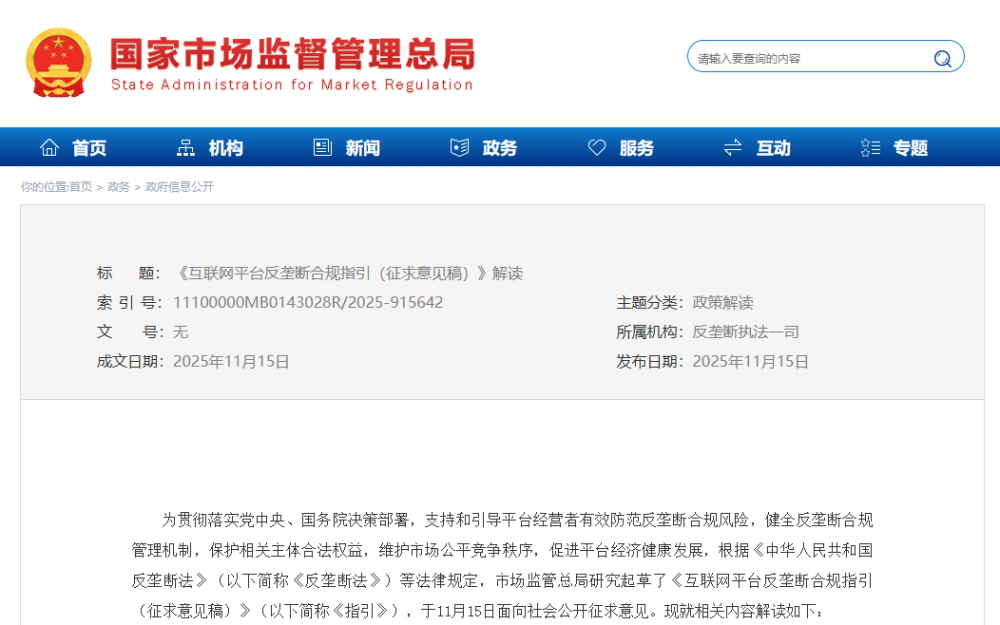
为贯彻落实党中央、国务院决策部署,支持和引导平台经营者有效防范反垄断合规风险,健全反垄断合规管理机制,保护相关主体合法权益, 维护市场公平竞争秩序,促进平台经济健康发展,根据《中华人民共和国反垄断法》(以下简称《反垄断法》)等法律规定,市场监管总局研 究起草了《互联网平台反垄断合规指引(征求意见稿)》(以下简称《指引》),于11月15日面向社会公开征求意见。现就相关内容解读如 下: 一、制定《指引》的主要背景是什么? 党的二十大对完善公平竞争市场经济基础制度,加强反垄断作出决策部署。党的二十届三中全会指出,促进平台经济创新发展,健全平台经济 常态化监管制度。《中共中央关于制定国民经济和社会发展第十五个五年规划的建议》强调,完善监管,推动平台经济创新和健康发展。2025 年《政府工作报告》明确,制定重点领域公平竞争合规指引。制定《指引》是贯彻落实党中央、国务院决策部署的具体举措,有利于完善平台 经济反垄断规则体系,提升平台经营者竞争合规水平,充分激发经营主体内生动力和创新活力。 近年来,我国平台经济快速发展,在提高社会资源配置效率、推动技术创新和产业变革、促进经济社会发展等方面发挥着重要作用。同时,互 联网平台 ...