
扩大对外开放

Search documents
人民日报社论:满怀信心 砥砺奋进 开创新局 ——元旦献词
Xin Hua She· 2025-12-31 12:25
Core Viewpoint - The article emphasizes the importance of confidence and determination in advancing China's modernization and economic development, highlighting achievements in 2025 and setting a positive outlook for the future [2][3][4]. Economic Performance - In 2025, China's economic total is expected to reach approximately 140 trillion yuan, with significant grain production and notable technological innovations [2]. - The country has made substantial progress in building a modern industrial system and deepening reforms, contributing to a stable and robust economic foundation [2]. International Engagement - China has expanded its openness to the world, with record transaction amounts at the China International Import Expo, showcasing the country's market potential [2]. - The successful hosting of the Shanghai Cooperation Organization summit in Tianjin reflects China's commitment to global governance and cooperation [2]. Strategic Focus - The article stresses the need to focus on domestic economic stability and international trade, while effectively managing risks in key sectors [3]. - It highlights the importance of maintaining a long-term perspective and resilience in the face of challenges, emphasizing the significance of the "14th Five-Year Plan" and the beginning of the "15th Five-Year Plan" [4][5]. Collective Effort - The article calls for unity and practical action among the people to achieve national development goals, emphasizing the role of collective effort in overcoming obstacles [6]. - It draws parallels between historical struggles and current challenges, encouraging a spirit of perseverance and determination [6].
2026年经济工作,武汉主抓五项重点任务
Chang Jiang Ri Bao· 2025-12-28 01:41
Core Viewpoint - The article emphasizes the importance of implementing economic strategies for 2026, focusing on internal demand, innovation, and regional development to ensure sustainable growth and stability in the economy [3][4][5]. Group 1: Economic Strategy - The city aims to adhere to the guiding principles of Xi Jinping's new era socialism and implement the spirit of the 20th National Congress, focusing on a stable yet progressive economic approach [4][5]. - There is a commitment to expanding domestic demand and enhancing the service and integration of the national market, highlighting the role of Wuhan as a market hub [6][9]. Group 2: Innovation and Technology - The strategy includes promoting deep integration of technological innovation and industrial development, with an emphasis on nurturing talent in education and technology [10][11]. - The goal is to accelerate the establishment of a modern industrial system that supports green development and innovation [11][12]. Group 3: Regional Development - The plan involves leveraging major opportunities for building a dual circulation system, enhancing regional coordination, and expanding high-level openness [13][14]. - There is a focus on urban renewal and improving city management to elevate the quality of urban living and infrastructure [15][17].


更大力度引外资 2025年版鼓励外商投资产业目录出炉 更多服务消费领域纳入全国鼓励范围 增加地区特色鼓励条目
Zheng Quan Shi Bao· 2025-12-24 18:53
Core Points - The National Development and Reform Commission and the Ministry of Commerce jointly released the "Encouraged Foreign Investment Industry Catalog (2025 Edition)" which will take effect on February 1, 2026, replacing the 2022 version, reflecting China's commitment to high-level opening-up [1][2] Group 1: Focus on Advanced Manufacturing - The new catalog emphasizes advanced manufacturing, guiding foreign investment towards high-end and intelligent manufacturing sectors, including the development and production of nucleic acid drugs, zero-magnetic medical equipment, intelligent detection equipment, and key components for robots [1][2] Group 2: Modern Service Industry Development - The catalog aims to enhance the high-quality development of the productive service industry, adding items such as new materials common technology platform operations, modern high-end shipping services, and virtual power plant operations, while also addressing consumer upgrade demands by including pet hospitals, sports tourism services, and "Internet + healthcare services" [1][2] Group 3: Regional Investment Expansion - The catalog expands the encouraged investment scope based on regional endowments, adding unique items for specific provinces, such as cruise tourism services in Liaoning, ice and snow equipment R&D in Heilongjiang, and marine environment governance in Hainan, promoting balanced regional development [2][3] Group 4: Policy Incentives for Foreign Investment - Industries included in the encouraged catalog will benefit from various policy incentives, such as exemption from import duties on self-used equipment, a reduced corporate income tax rate of 15% for investments in western regions and Hainan, and tax credit benefits for foreign investors reinvesting profits in eligible sectors [3][4] Group 5: Future Initiatives for Foreign Investment - The National Development and Reform Commission plans to enhance coordination and implementation of foreign investment initiatives, focusing on expediting major foreign investment projects, addressing bottlenecks in land use, environmental assessments, and energy consumption, and providing support for foreign enterprises [4]
增强新兴产业国际竞争力
Jing Ji Ri Bao· 2025-12-01 22:20
Core Viewpoint - The Ministry of Industry and Information Technology has initiated the creation of national emerging industry development demonstration bases, aiming to establish around 100 park-type and 1,000 enterprise-type bases by 2035 to support the development of emerging industries and enhance economic growth [1] Group 1: Emerging Industry Development - China's emerging industries exhibit significant characteristics such as innovation-driven growth, industrial clustering, deep integration of multiple chains, and sustainable development [2] - The development model combines "national coordination + local characteristics" and "emerging industry rise + traditional industry upgrade," achieving deep integration of innovation, industry, finance, and talent chains [2] - The recent government plans emphasize large-scale application demonstrations of new technologies and products, accelerating the scale development of emerging industries [2] Group 2: Challenges and Solutions - Despite progress, challenges remain, including insufficient core technology support, lack of motivation for international market expansion, and a shortage of high-end talent [3] - To enhance international competitiveness, a focus on technological innovation is essential, including strengthening basic scientific research and original innovation [3] - Collaboration across departments is necessary to support enterprises, universities, and research institutions in improving the conversion rate of scientific achievements [3] Group 3: International Market Expansion - There is a need to promote the expansion of emerging industries into international markets, particularly in regions like the Belt and Road countries, the Middle East, and Africa [4] - Establishing production bases and cross-border cooperation platforms tailored to local needs can enhance market penetration and international recognition [4] Group 4: Talent Development - A talent cultivation mechanism should be established to align educational content with industry needs, focusing on different development stages of emerging industries [4] - Promoting collaboration between educational institutions and enterprises can help adjust professional settings according to market demands and enhance the skill levels of the workforce [4]
中国成全球第二大消费市场和进口市场 坚定扩大对外开放与世界共享大市场机遇
Chang Jiang Shang Bao· 2025-11-10 06:33
Core Insights - China is actively expanding imports as part of its commitment as a responsible major country and to promote high-level opening-up [1][4] - The "Shared Market · Export China" initiative aims to balance import and export development while enhancing cooperation with global partners [2][3] - China has become the world's second-largest consumer and import market, with significant growth in import values over the past decade [1][5] Group 1: Import and Export Statistics - In 2024, China's total goods imports are projected to reach 18.4 trillion yuan, and service imports are expected to be 4.3 trillion yuan, both showing over 60% growth compared to ten years ago [1] - For the first three quarters of 2025, China's total goods trade reached 33.61 trillion yuan, with exports at 19.95 trillion yuan and imports at 13.66 trillion yuan, reflecting a 4% year-on-year growth [5] - In the first ten months of 2024, China's total goods trade value was 37.31 trillion yuan, with exports growing by 6.2% and imports remaining stable compared to the previous year [7] Group 2: Trade Partnerships and Initiatives - The "Shared Market · Export China" series will include over 100 events annually, focusing on various themes to enhance international trade connections [2][3] - China has implemented zero-tariff policies for 100% of products from least developed countries with which it has diplomatic relations, resulting in a 9.7% increase in imports from these nations [5] - The Ministry of Commerce is actively promoting foreign investment and addressing challenges faced by foreign enterprises through regular roundtable meetings [6] Group 3: Market Dynamics - China has maintained its position as the world's second-largest import market for 16 consecutive years, showcasing its commitment to expanding its market [4][5] - The first ten months of 2024 saw a notable performance from private enterprises, with their imports and exports reaching 21.28 trillion yuan, a 7.2% increase [7] - Major commodities imported by China have seen price declines, while the import value of electromechanical products has increased by 5.5% [8]
“十五五”中国大市场前景更广阔
Jing Ji Ri Bao· 2025-11-08 22:24
Core Insights - The China International Import Expo (CIIE) serves as a significant platform for showcasing quality products and advanced technologies, while also facilitating dialogue among participants about the opportunities presented during the "14th Five-Year Plan" period [1] Group 1: Market Opportunities - Multinational companies are leveraging the CIIE to expand their brand influence, with many expressing optimism about the long-term prospects of the Chinese consumer market during the "14th Five-Year Plan" [2] - The CEO of Thai Tencel Group highlighted that the company has invested 4.36 billion yuan in China over the past five years, enhancing its local operations and aligning its strategy with China's development goals [2] - The growing middle-income group in China is driving demand for high-quality products, prompting companies like Bunge to focus on providing diverse and reliable solutions to meet market needs [3] Group 2: Foreign Investment and Cooperation - The CIIE has facilitated numerous agreements between Chinese and foreign enterprises, with a notable signing amount of 1.828 billion USD during the event [5] - KPMG emphasized that China's commitment to high-level opening-up will create new advantages for attracting foreign investment, ensuring a transparent and stable environment for foreign businesses [4] - The China Energy Engineering Group has actively participated in international capacity cooperation, signing contracts exceeding 600 billion yuan in Belt and Road Initiative countries over the past five years [5] Group 3: High-Quality Development - The "14th Five-Year Plan" emphasizes high-quality development, with companies like Johnson Controls showcasing green technologies and digital applications that align with China's goals for sustainable development [7] - Rockwell Automation plans to apply digital and green technologies in emerging industries, supporting high-quality development in sectors such as new energy and advanced manufacturing [8] - Varian Medical is committed to enhancing healthcare services in China, focusing on technological innovation to improve medical capabilities and outcomes during the "14th Five-Year Plan" [8]

上海海关档案工作助力进博会“越办越好”
Zhong Guo Xin Wen Wang· 2025-10-31 06:13
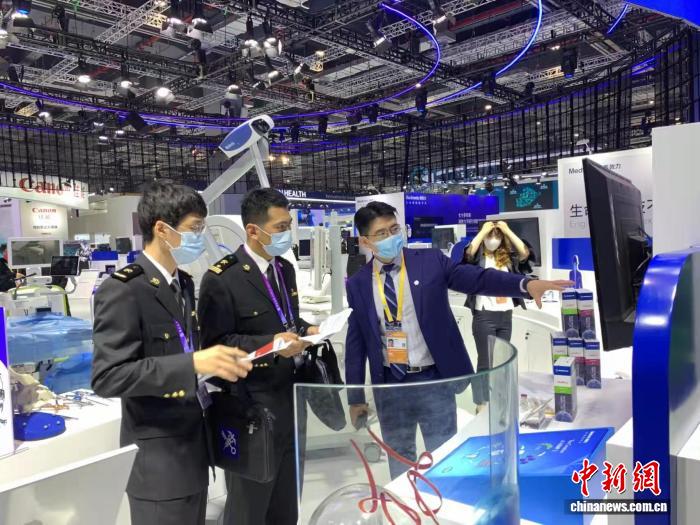
Core Insights - The Shanghai Customs is enhancing its archival work to support the upcoming China International Import Expo (CIIE), showcasing its commitment to facilitating trade and openness [1][2][3] Group 1: Archival Work and Data Utilization - Since 2018, every CIIE has been documented through a "pre-collection + full-process follow-up" archival model, resulting in a total of 97 document archives, 462 photo archives, 113 audio-visual archives, and 37 physical archives [2] - The archives serve as both historical records and innovative references, aiding in optimizing customs processes, expanding tax incentives, and simplifying approval procedures [2] - The "CIIE Smart Exhibition" system was introduced to streamline exhibition supervision and implement tailored management for each exhibition, reducing overall customs clearance time by 50% [2] Group 2: Achievements and Future Plans - Over the first seven CIIEs, the customs has supervised 3,395 batches of exhibits, totaling $253 million [2] - The Shanghai Customs will continue to employ the "pre-collection, full-process empowerment" model to ensure high-quality archival work for the eighth CIIE [3]
中国证监会主席吴清:增强多层次市场体系包容性和覆盖面
Zheng Quan Ri Bao· 2025-10-27 17:05
Core Viewpoint - The Chairman of the China Securities Regulatory Commission (CSRC), Wu Qing, emphasized the need for deepening reforms in the capital market to enhance its inclusiveness, adaptability, attractiveness, and competitiveness in the face of global changes and technological innovation [1] Group 1: Market Reform and Development - The CSRC plans to advance sector reforms to enhance the inclusiveness and coverage of the multi-level market system, including the implementation of the "1+6" policy for the Sci-Tech Innovation Board and the initiation of reforms for the Growth Enterprise Market [2] - The CSRC aims to provide more precise and inclusive financial services for new industries, new business formats, and new technologies by setting listing standards that align with the characteristics of innovative enterprises [2] Group 2: Strengthening Market Stability - The CSRC will introduce a refinancing shelf issuance system to broaden support channels for mergers and acquisitions, promoting the integration and strengthening of listed companies [3] - Efforts will be made to enhance the role of long-term funds as stabilizers in the market, including reforms in public funds and the promotion of long-term investment products [3] Group 3: Opening Up and International Cooperation - The CSRC has launched the "Qualified Foreign Investor System Optimization Work Plan" to improve the investment environment for foreign investors, including optimizing access management and expanding investment scope [3] - The CSRC will enhance the mutual connectivity mechanism and deepen practical cooperation between the mainland and Hong Kong markets [3] Group 4: Risk Prevention and Investor Protection - The CSRC is focused on strengthening risk prevention capabilities and enhancing regulatory measures to combat financial fraud and market manipulation [4] - A series of practical measures will be introduced to protect the rights of small and medium investors, including improving the fairness of trading environments and enhancing customer service levels in the industry [4]
兴业证券王涵 | 从资本市场视角看四中全会公报——提振信心,后市可期
王涵论宏观· 2025-10-23 15:41
Group 1 - The core viewpoint of the article emphasizes the significant enhancement of China's economic strength during the 14th Five-Year Plan, which serves as a fundamental support for the capital market's strong performance. However, there are two main concerns regarding the medium to long-term economic outlook: how to address the negative impacts of the external environment on China and how to better promote globalization to open up growth space for the Chinese economy [1] - The 20th Central Committee's Fourth Plenary Session report provides positive and clear responses to the aforementioned concerns, which will help further consolidate and enhance market confidence [1][2] - The meeting highlights the need for "strategic determination and historical initiative" to actively respond to complex environments, indicating a more proactive attitude from the central government in facing external challenges [1][2] Group 2 - The article outlines a dual approach to policy implementation, focusing on enhancing internal capabilities to address external uncertainties, particularly in technology self-reliance and national security [2] - The emphasis on expanding high-level openness is a key strategy to break external constraints, with a notable improvement in the priority of this goal compared to previous sessions [2] - The meeting is expected to further boost market confidence, reinforcing the foundation for a positive capital market outlook, as it addresses concerns about medium to long-term development [3]

“十五五”规划前瞻:扩大内需
Western Securities· 2025-10-17 07:25
Economic Growth Outlook - The "14th Five-Year Plan" is concluding this year, with the "15th Five-Year Plan" expected to maintain an annual growth target around 5%[1] - The average GDP growth during the "14th Five-Year Plan" was 5.5%, and if 5% is achieved in 2025, the average growth for this period will be 5.4%[1] - The contribution of domestic demand to economic growth during the "14th Five-Year Plan" was 87%, down from 95.7% in the "13th Five-Year Plan" period[2] Domestic Demand and Consumption - Final consumption contributed 59.6% to economic growth, up from 49% in the "13th Five-Year Plan" period[2] - Capital formation's contribution was 27.4%, down from 46.7% in the previous plan[2] - To expand consumption, stable employment and income growth are essential, alongside improvements in social security systems[2] Investment and Innovation - There is significant room for investment as China's per capita capital stock remains low compared to developed economies[3] - The focus during the "15th Five-Year Plan" will be on infrastructure, public safety, and technology innovation[3] - Enhancing total factor productivity is crucial for achieving the targeted 5% economic growth, with technology innovation being a core driver[3] Environmental and Trade Policies - China aims to peak carbon emissions before 2030, with non-fossil energy consumption expected to reach 19.8% by 2024, exceeding the "14th Five-Year Plan" target of 20%[7] - The trade surplus as a percentage of GDP has increased during the "14th Five-Year Plan," and efforts will continue to balance imports and exports in the "15th Five-Year Plan"[7]