
扩展现实(XR)

Search documents
3C设备周观点:三星Galaxy XR头显正式发布,阿里夸克AI眼镜开启预售:机械设备强于大市(维持评级)-20251026
Huafu Securities· 2025-10-26 10:38
Investment Rating - The industry rating is "Outperform the Market" [6][14] Core Insights - Samsung has officially launched its first native AI headset, the Galaxy XR, marking its entry into the extended reality (XR) field. This product is the first in the Android XR ecosystem and signifies a long-term collaboration between Samsung, Google, and Qualcomm, aiming to integrate AI technology into immersive computing [1] - Alibaba's Quark AI glasses have begun pre-sales, featuring a sleek black design and integration with various applications such as Amap, Alipay, Taobao, and Fliggy. Future plans include opening API interfaces to attract more developers [2] - Meta's smart glasses, Ray-Ban Display, have seen strong market demand, with nearly all retail locations sold out and trial appointments fully booked before November. Apple is reportedly developing competitive AI glasses, with plans to preview them in 2025 and release them in 2027, accelerating the timeline for a screen-equipped version originally set for 2028 [3] Summary by Sections - **Smart Glasses Market**: The report highlights the active participation of major players like Samsung, Alibaba, Meta, and Apple in the smart glasses market, indicating a growing trend and competition in this sector [1][2][3] - **Investment Opportunities**: The report suggests focusing on companies involved in smart glasses (e.g., Quick Smart, Deep Science, Rongqi Technology, Bozhong Precision), silicon-based OLED screens (e.g., Yirui Technology, Qingyue Technology), panel equipment (e.g., Liande Equipment), automation assembly equipment (e.g., Bozhong Precision), and 3D printing applications (e.g., Huashu High-Tech) [4]
3C设备周观点:三星Galaxy XR头显正式发布,阿里夸克AI眼镜开启预售:机械设备-20251026
Huafu Securities· 2025-10-26 09:50
Investment Rating - The industry rating is "Outperform the Market" [6][14] Core Insights - Samsung has officially launched its first native AI headset, the Galaxy XR, marking its entry into the extended reality (XR) field. This product is part of a long-term collaboration with Google and Qualcomm, aiming to integrate AI technology into immersive computing [1] - Alibaba's Quark AI glasses have begun pre-sales, featuring applications from various platforms and plans to open API interfaces for developers [2] - Meta's smart glasses have seen strong market demand, with nearly all retail locations sold out and trial appointments fully booked [3] - Apple is reportedly prioritizing the development of AI glasses to compete with Meta, with plans to preview the first model in 2025 and release it in 2027 [3] Summary by Sections - **Smart Glasses Market**: The report highlights the active participation of major players like Samsung, Alibaba, Meta, and Apple in the smart glasses market, indicating a growing trend and competition [1][2][3] - **Product Launches**: New products such as Samsung's Galaxy XR and Alibaba's Quark AI glasses are set to enhance the XR ecosystem and attract developer interest [1][2] - **Market Dynamics**: The report notes the competitive landscape, with significant advancements from companies like Meta and Apple, suggesting a robust future for the smart glasses segment [3] - **Investment Opportunities**: The report suggests focusing on companies involved in smart glasses, silicon-based OLED screens, panel equipment, automation assembly, and 3D printing applications [4]
3C设备周观点:三星Galaxy XR头显正式发布,阿里夸克AI眼镜开启预售-20251026
Huafu Securities· 2025-10-26 06:03
Investment Rating - The industry rating is "Outperform the Market" [6][13] Core Insights - Samsung has officially launched its first native AI headset, the Galaxy XR, marking its entry into the extended reality (XR) field. This product is the first in the Android XR ecosystem and signifies a long-term collaboration between Samsung, Google, and Qualcomm, aiming to deeply integrate AI technology into immersive computing [1] - Alibaba's Quark AI glasses have begun pre-sales, featuring a sleek black design and integration with various applications such as Amap, Alipay, Taobao, and Fliggy. Future plans include opening API interfaces to attract more developers [2] - Meta's smart glasses, Ray-Ban Display, have seen strong market demand, with nearly all retail locations sold out and trial appointments fully booked before November [3] - Apple is reportedly prioritizing the development of AI glasses to compete with Meta, with plans to preview the first model in 2025 and release it in 2027, while an originally planned display version has been accelerated [3] Summary by Sections - **Smart Glasses Market**: The report highlights the active participation of major players like Samsung, Alibaba, Meta, and Apple in the smart glasses market, indicating a growing trend and competition in this sector [1][2][3] - **Product Launches**: New products such as Samsung's Galaxy XR and Alibaba's Quark AI glasses are set to enhance the XR ecosystem and attract consumer interest [1][2] - **Market Dynamics**: The report suggests a robust demand for smart glasses, with significant sales and pre-orders indicating a positive market outlook [3] - **Investment Opportunities**: The report recommends focusing on companies involved in smart glasses, silicon-based OLED screens, panel equipment, automation assembly, and 3D printing applications, suggesting potential investment opportunities in these areas [4]
横店影视:XR体验业务已在部分试点影院落地,未来将覆盖更多下沉市场渠道
Bei Jing Shang Bao· 2025-10-13 09:47
Core Viewpoint - The company is gradually implementing its XR (Extended Reality) experience business in select pilot cinemas, aiming to enhance consumer engagement through immersive virtual reality experiences [1] Group 1: XR Experience Business - The XR projects allow consumers to transcend physical space limitations, transitioning from merely "watching films" to "entering films" [1] - During the pilot phase, the company is focusing on low-cost, high-quality, and flexible XR experience projects that align with its cinema operation model [1] - Key performance indicators such as foot traffic, user satisfaction, and return on investment are being closely monitored to ensure positive trends [1] Group 2: Expansion Strategy - The company plans to adopt a cautious expansion strategy to replicate the XR project in more cinemas, targeting deeper penetration into lower-tier market channels [1] - The goal is to provide diverse cultural consumption options for a broader consumer base [1] Group 3: Content Creation and Technology Collaboration - Continuous high-quality content creation is essential for the XR experience business, necessitating collaboration with technology and content production companies [1] - The company aims to enhance its technological capabilities, content production capacity, and innovation through these partnerships [1] - This strategy is expected to generate new business models and revenue channels, ultimately creating long-term value for shareholders [1]

沉浸式XR剧集《木兰2125》首发
Bei Jing Shang Bao· 2025-09-23 13:44
Core Viewpoint - The immersive XR film "Mulan 2125" has been launched at the 798 Super Dimension VR Cinema, marking a significant step in the commercialization of immersive content in the entertainment industry [1] Group 1: Company Information - The film "Mulan 2125" is produced by Weiling Times, a real-time cloud rendering solution provider, in collaboration with Haixi Media [1] - Weiling Times has announced the official commercialization of "Mulan 2125" at the 798 Super Dimension VR Cinema [1] Group 2: Industry Trends - "Mulan 2125" will also be available on mainstream immersive headset platforms such as Meta Quest and Apple Vision Pro, indicating a growing trend towards multi-platform distribution in the XR industry [1]
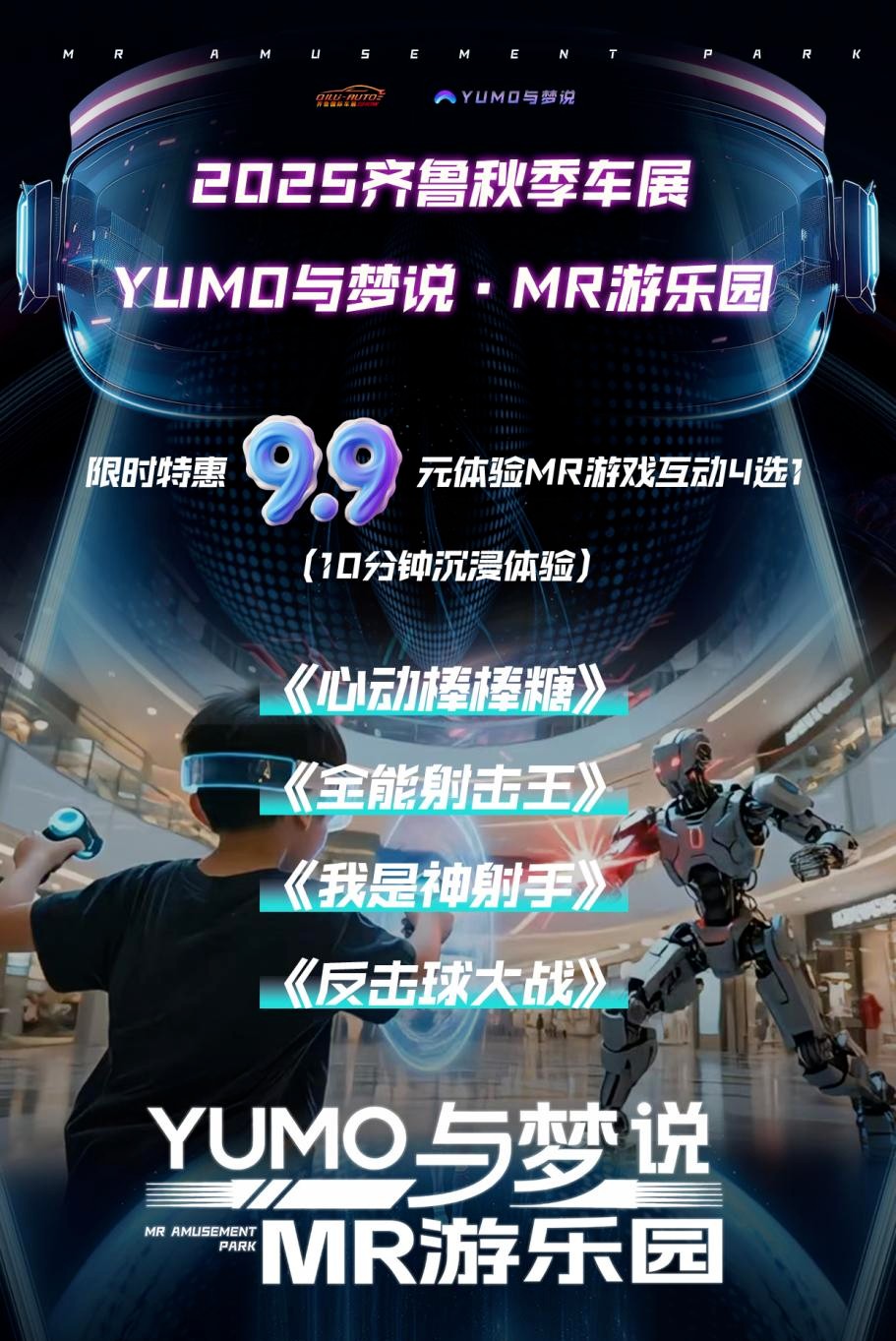
YUMO与梦说联合2025齐鲁秋季车展推出MR游乐园 弘阳广场店限时秒杀同步开启
Qi Lu Wan Bao· 2025-09-04 01:14
Core Insights - The immersive experience brand "YUMO与梦说" will collaborate with the 2025 Qilu Autumn Auto Show to create a dedicated MR amusement park, offering a unique technological experience at the event [1] - During the event, citizens can enjoy a 10-minute MR game interaction for only 9.9 yuan, with a choice of four different games, enhancing the automotive exhibition with technological fun [1] Game Offerings - The four MR games include: - "Heartfelt Lollipop," which creates a sweet and romantic interactive scene - "All-Round Shooting King," simulating a battlefield environment to test players' reflexes and skills - "I Am a Sharpshooter," featuring an archery scene for players to showcase their skills - "Counterattack Ball Battle," focusing on competitive gameplay for an exciting experience [3] - A new MR-themed game, "Dinosaur Raising Plan," will be launched at the subsequent pop-up store, allowing players to experience the growth of dinosaurs [3] XR and MR Technology - MR (Mixed Reality) focuses on real-time dynamic interaction, where virtual content interacts with the real environment following physical rules, while XR (Extended Reality) emphasizes immersive scene exploration with limited interaction [5] - The collaboration represents an innovative attempt to merge technology with culture and the automotive industry, providing diverse entertainment options for citizens [5]

超330亿,三星显示公布2025Q2最新财报
WitsView睿智显示· 2025-07-31 08:01
Core Viewpoint - Samsung Electronics reported a mixed performance for Q2 2025, with a slight year-on-year revenue increase but a significant drop in operating profit, indicating challenges in profitability despite stable revenue growth in certain segments [1]. Group 1: Revenue and Profit Overview - The consolidated revenue for Q2 2025 was 74.6 trillion KRW (approximately 385.68 billion RMB), a decrease of 5.8% quarter-on-quarter but an increase of 0.67% year-on-year [1]. - Operating profit for the same period was 4.7 trillion KRW (approximately 242.99 billion RMB), reflecting a year-on-year decline of 55.23% [1]. Group 2: Business Segment Performance Display Business - The display business generated revenue of 6.4 trillion KRW (approximately 330.88 billion RMB) with an operating profit of 0.5 trillion KRW (approximately 25.85 billion RMB) [3]. - Growth in mobile display revenue was attributed to strong market response to new smartphones and expansion in IT and automotive sales, while QD-OLED sales benefited from high demand in the gaming market [3]. - For H2 2025, the company anticipates revenue growth in mobile displays driven by new smartphone releases and aims to enhance market presence through differentiated technology [3]. Mobile Experience (MX) and Network Business - MX and network business revenue reached 29.2 trillion KRW (approximately 1,509.64 billion RMB) with an operating profit of 3.1 trillion KRW (approximately 160.27 billion RMB) [4]. - Despite a decline in smartphone shipments compared to Q1, revenue and operating profit saw year-on-year growth due to strong sales of Galaxy S25 series and Galaxy A series [4]. - Plans for H2 2025 include a focus on flagship smartphone sales, enhancing AI features in devices, and expanding the Galaxy ecosystem with new product forms [5]. Visual Display and Digital Home Appliances - Revenue from visual display and digital home appliances was 14.1 trillion KRW (approximately 728.97 billion RMB) with an operating profit of 0.2 trillion KRW (approximately 10.34 billion RMB) [6]. - The visual display segment saw increased sales of high-end products like Neo QLED and OLED TVs, although profitability declined due to slowing demand and intensified competition [6]. - The TV division plans to leverage seasonal demand and enhance high-value product lines to drive revenue growth in H2 2025 [6]. Semiconductor Business - The semiconductor division reported revenue of 27.9 trillion KRW (approximately 1,442.43 billion RMB) and an operating profit of 400 billion KRW (approximately 20.68 billion RMB) [7]. - The increase in sales was driven by high-value server memory products and growth in major foundry customer sales, with a quarter-on-quarter revenue increase of 11% [7]. - The company is responding to server demand by expanding sales of HBM3E and large-capacity DDR5 products, while SSD sales also saw growth [8]. - Expectations for H2 2025 include strong AI demand driven by continued investments from major cloud service providers, sustaining robust demand for DRAM and NAND products [9].
韩国要投资约25亿发展iLED显示,想摆脱中国对手追赶
Guan Cha Zhe Wang· 2025-07-16 02:46
Core Viewpoint - The South Korean government plans to invest 484 billion KRW (approximately 25.16 billion RMB) in inorganic light-emitting diode (iLED) display technology by 2032 to seek new growth engines for the country's display industry [1] Group 1: Investment and Development Plans - The investment will focus on developing iLED technologies, including Micro LED, quantum dots, and nano LED, while fostering the South Korean industrial ecosystem [1] - The Korean Display Industry Association announced its full support for the R&D projects related to inorganic light-emitting displays and the ultra-differentiated R&D projects for organic light-emitting diodes (OLED) [1][2] - The project will cover various areas, including epitaxial growth technology, chip transfer and bonding technology, and the development of high-resolution devices for augmented reality (AR) and extended reality (XR) [1][2] Group 2: Market Growth and Competitive Landscape - The global iLED market is expected to grow from USD 1 billion in 2026 to USD 32 billion by 2035 [2] - Despite maintaining a leading position in the OLED market, South Korea is significantly lagging in iLED technology, heavily relying on foreign-manufactured LED chips and materials [1][2] - The Korean display industry is facing increasing competition from China, which has made significant advancements in the display sector, particularly in liquid crystal displays (LCD) and OLED technology [2] Group 3: Strategic Initiatives - The OLED ultra-differentiation R&D projects focus on mobile OLED display technology for extreme environments, silicon-based organic light-emitting diode (OLEDoS) technology for XR devices, and ultra-realistic light field display technology [2] - The Korean Display Industry Association aims to develop transformative technologies to maintain competitiveness against rivals like China, including ultra-thin high-reliability component structures and next-generation large-size flexible panels [2][3] - The launch of these R&D projects is seen as a crucial step to enhance core technological competitiveness and maintain sovereignty amid the unstable trade environment, particularly due to the US-China trade war [3]

歌尔股份子公司获2.77亿增资 首季研发费达10.96亿行业居首
Chang Jiang Shang Bao· 2025-06-24 23:42
Core Viewpoint - Goer Group's subsidiary, Goer Optical, has completed a significant capital increase of 277 million yuan to enhance its financial health and support long-term development in the consumer electronics market, which is showing signs of recovery [1][2]. Group 1: Capital Increase and Ownership Structure - Goer Optical's registered capital increased from 982 million yuan to 1.059 billion yuan after the capital increase [2]. - Following the capital increase, Goer Group's ownership in Goer Optical decreased from 61.1022% to 56.6560%, while still remaining the controlling shareholder [2]. - Key stakeholders, including the chairman and major shareholders, participated in the capital increase, maintaining significant ownership stakes [2]. Group 2: Production Capacity and Technological Development - The capital increase will fund the addition of two fully automated optical module production lines, expected to boost production capacity by 30% [2]. - Goer Group has established multiple optical research and development centers, creating a comprehensive technology layout covering XR optical components, micro-projection, and automotive HUDs [3]. - The company has made strategic acquisitions, such as the purchase of Yuguang Technology, to enhance its capabilities in micro-nano optical devices and overall solutions for smart devices [3]. Group 3: Financial Performance and R&D Investment - In 2024, Goer Group reported revenue of approximately 100.95 billion yuan, a year-on-year increase of 2.41%, and a net profit of about 2.665 billion yuan, up 144.93% [5]. - For Q1 2025, the company achieved revenue of 16.305 billion yuan and a net profit of 469 million yuan, reflecting a year-on-year growth of 23.53% [5]. - R&D expenses for Q1 2025 reached 1.096 billion yuan, marking a 32.83% increase compared to the previous year, positioning the company as a leader in R&D spending among consumer electronics firms [1][7].

美媒:扎克伯格找到元宇宙“杀手级”应用
Huan Qiu Shi Bao· 2025-06-03 22:59
Core Insights - Meta's collaboration with Anduril Industries marks a significant shift in Silicon Valley's approach to military technology, indicating a growing acceptance of developing tech for warfare [1][2] - The partnership aims to create integrated extended reality (XR) products to enhance soldiers' situational awareness and control over autonomous platforms [1][2] - This collaboration may provide a lifeline for Meta's Reality Labs, which has incurred over $70 billion in losses since 2019, as it seeks to find viable applications for its technology [2][3] Industry Trends - The historical trajectory of technology innovation is reversing, with military applications now driving tech development rather than the traditional path of military to civilian use [3][4] - The collaboration reflects a broader trend where tech companies are openly promoting military applications as a selling point, contrasting with past practices of secrecy [2][3] - The partnership could redefine Meta's mission statement, as it increasingly engages in projects that may contribute to military conflicts, challenging its original vision of building human connections [4]
