技术红利

Search documents
帮主郑重:中国船舶净利暴增109%!三张底牌曝光,散户操作盯紧两条线
Sou Hu Cai Jing· 2025-08-30 09:44
Core Viewpoint - The company reported a significant profit increase of 109% year-on-year, reaching a net profit of 2.946 billion, with revenue surpassing 40.3 billion, yet the stock price remains stagnant around 37 yuan, raising questions about market dynamics and potential performance peaks [1]. Group 1: Performance Drivers - High-value orders were delivered in the first half of the year, with a notable increase in the price of civil shipbuilding and effective cost control leading to a significant rise in gross profit margin [3]. - Profits from joint ventures improved, with long-term equity investment income rising year-on-year, contributing to net profit growth [3]. - Operating cash flow turned positive, increasing from -3.814 billion to +2.355 billion, primarily due to increased sales revenue and improved cash collection [4]. Group 2: Strategic Advantages - The company has a robust order backlog, with civil ship orders valued at 233.487 billion, repair orders at 0.0766 billion, and offshore equipment orders at 0.3699 billion, providing strong support for future performance [5]. - The company leads in green ship technology, holding a 70% global market share in LNG dual-fuel and methanol-powered vessels, with a high proportion of new orders for mid-to-high-end ship types [6]. - Following the merger with China Shipbuilding Industry Corporation, total assets will exceed 400 billion, with annual revenue surpassing 130 billion, positioning the company as the largest publicly listed shipbuilding company globally [7]. - The company achieved breakthroughs in technology, filing 748 patent applications, with a gross margin of 25%-30% in military business and over 35% for LNG vessels, enhancing its technological premium by 30% [8]. Group 3: Market Considerations - The current price-to-earnings ratio (TTM) is approximately 32.48, and the price-to-book ratio (LF) is about 3.17, both higher than the global shipbuilding industry average of 25-28, although institutions project a target price of 41 yuan [9]. - Despite significant cash flow improvement, the long shipbuilding cycle and concentrated prepayment may lead to fluctuations [9]. - The effectiveness of the merger and integration with China Shipbuilding Industry Corporation is crucial, with expected annual operational cost savings exceeding 2 billion [10].



中创新航2025年上半年营收净利润双增长 规模效应与技术红利持续释放
Zheng Quan Ri Bao Wang· 2025-08-28 06:45
Core Insights - The company, Zhongchuang Innovation Technology Group Co., Ltd., reported a significant increase in revenue and profit for the first half of 2025, achieving revenue of 16.419 billion yuan, a year-on-year growth of 31.7%, and a profit of 753 million yuan, a substantial increase of 80.4% [1] - The company has reached historical highs in both power and energy storage shipments, with a power battery installation volume of 21.8 GWh, a year-on-year increase of 22.7%, ranking fourth globally and third domestically [1] Business Performance - In the passenger vehicle market, the company has successfully entered partnerships with major global automakers and is advancing battery mass production for multiple models, laying a solid foundation for sales in the second half of the year [2] - The commercial vehicle market has seen a remarkable year-on-year growth of 310% in installation volume, with the company ranking among the top three in monthly installation volume [1][2] - The energy storage market has positioned the company as the fourth largest globally in cell shipments, with successful entries into major projects in Latin America and South Africa [2] Technological Advancements - The company is advancing its high-energy solid-liquid hybrid battery and has made breakthroughs in solid-state battery research, with production lines now operational [2] - As the first company in the industry to pass compliance checks for eVTOL power battery manufacturing, Zhongchuang Innovation is exploring emerging markets, achieving scale deliveries in the low-altitude flight market [2] Strategic Goals - The company aims to build a cross-domain, cross-scenario energy storage product matrix, continuously expanding into new markets such as rail transportation, mining, low-altitude flight, and humanoid robots, while providing high safety, reliability, and performance product solutions [2]
【环时深度】印主权大语言模型评价两极分化,“印度AI使命”进展如何?
Huan Qiu Shi Bao· 2025-06-02 22:58
Core Insights - The release of India's sovereign large language model Sarvam-M has sparked significant debate, with mixed reviews labeling it both a milestone in AI development and a failure due to low initial download numbers [1][3][4] - India aims to become a global leader in AI, supported by the "India AI Mission" strategy launched in March 2023, which has a budget exceeding 100 billion rupees (approximately 8.4 billion yuan) [7][8] Group 1: AI Development and Challenges - Sarvam-M, developed by Sarvam AI, received praise for its focus on Indian languages and tasks but faced criticism for its low download count of only 334 in the first two days [3][4] - The "India AI Mission" aims to enhance the AI ecosystem through public-private partnerships, but most funding is allocated to infrastructure rather than research and development, with only about $11 million dedicated to R&D [9][10] - India ranks second globally in AI project contributions on GitHub, accounting for 19.9% of contributions, and has a high AI skill adoption rate among professionals [4][5] Group 2: Talent and Employment Impact - India has a significant talent pool, producing approximately 1.5 million STEM graduates annually, but faces a shortage of 213,000 AI professionals [8][12] - The World Economic Forum predicts a 38% "skills disruption" in India due to AI advancements, the highest among BRICS nations, indicating a need for reskilling [10][11] - A majority of Indian professionals recognize the importance of AI skills for career advancement, with 94% believing that mastering these skills will accelerate their professional development [12][13] Group 3: Global Position and Future Outlook - Despite its growing influence, India lags behind the US and China in private AI investment, attracting only $11.29 billion since 2013 compared to the US's $470.9 billion [5][6] - The lack of high-quality, India-specific training data poses a challenge for developing effective AI models, as local languages are underrepresented online [9][10] - The dual nature of AI's impact on India's economy presents both risks and opportunities, with potential job losses in the service sector alongside the need for policy changes to harness AI's benefits [12][13]

联芸科技:研发强度与财务健康的战略平衡
Huan Qiu Wang· 2025-05-26 01:03
Core Viewpoint - Lianyun Technology (688449.SH) has successfully listed on the Sci-Tech Innovation Board and reported a revenue growth of 11.19% year-on-year to 241 million yuan in Q1 2024, with a significant increase in R&D investment to 60.36%, raising concerns about its short-term profitability [1][2][4]. R&D Investment - The company's R&D expense ratio has historically ranged from 26.74% to 44.10%, with a Q1 2024 figure of 43.35%, while the 60.36% in Q1 2025 marks a significant deviation from this trend [2][7]. - The increase in R&D spending is attributed to substantial costs associated with product tape-out, with a year-on-year growth of 54.81% in Q1 2024 [2][4]. Financial Performance - Lianyun Technology's revenue from data storage control chips grew by 25.42% year-on-year to 920 million yuan in 2024, driven by successful market penetration in consumer electronics, enterprise, and industrial sectors [5][6]. - The AIoT business also showed strong growth, with revenue reaching 251 million yuan, reflecting a 73.61% year-on-year increase [6]. - The company maintains a low debt ratio of 18.05% compared to industry peers, enhancing its resilience against market fluctuations [9][10]. Technology and Market Development - The company achieved significant technological milestones in 2024, including the successful mass production of its first PCIe 5.0 control chip and advancements in UFS 3.1 control chips [5][6]. - Lianyun Technology's strategy focuses on deepening existing customer relationships while expanding into new markets, particularly in the IoT sector [6][10]. Strategic Balance - The company demonstrates a strategic balance between high R&D investment and financial health, positioning itself to withstand industry volatility while fostering sustainable growth [10].
研判2025!中国可穿戴设备主控芯片行业发展历程、产业链、发展现状、竞争格局及未来趋势分析:国产芯强势崛起,可穿戴主控芯片开启医疗级精度与智能独立终端新纪元[图]
Chan Ye Xin Xi Wang· 2025-05-24 02:09
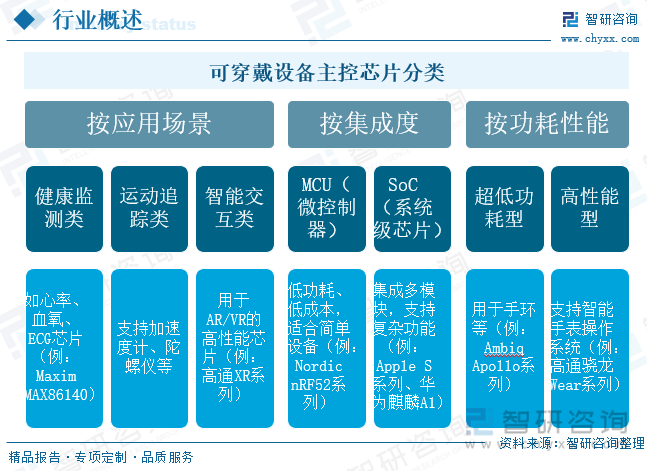
Core Insights - The Chinese wearable device main control chip industry has entered a new stage of high-quality development, driven by both technological breakthroughs and market scale, with a projected market size exceeding 10 billion yuan in 2024 [1][13] - Major product innovations are expected in 2024, including releases from Samsung, Huawei, and Juchip, marking a significant year for the industry [1][13] - The industry is anticipated to maintain a compound annual growth rate (CAGR) of over 20% from 2025 to 2028, positioning China as a key source of innovation in the global wearable chip market [1][13] Industry Overview - The wearable device main control chip serves as the core processor for devices like smartwatches and AR/VR glasses, integrating components such as CPU, GPU, memory, and communication modules [2][3] - The chips can be categorized by application scenarios (health monitoring, sports tracking, smart interaction), integration level (low-power MCU and multifunction SoC), and power performance (ultra-low power and high-performance types) [3][5] Development History - The industry has evolved through four strategic phases: initial reliance on foreign technology (2010-2014), breakthrough in domestic alternatives (2015-2018), innovation in mid-to-high-end markets (2019-2022), and current leadership in high-end markets (2023-present) [7][9] - Future advancements are expected in 10nm process technology, non-invasive medical monitoring, and AR/VR applications [7][9] Industry Chain - A complete collaborative innovation system has been established, covering upstream technology development, midstream product integration, and downstream application expansion [9][10] - Key players in chip design include Hengxuan Technology and Unisoc, while manufacturers like Huawei and Xiaomi integrate these chips into diverse products [9][10] Market Dynamics - The global wearable device market is projected to exceed 534.6 million units in 2024, with China leading at approximately 130 million units, accounting for 32% of global shipments [10][13] - The wrist-worn device market shows regional disparities, with China's shipments growing by 19.3% year-on-year [10][13] Competitive Landscape - The industry exhibits a "one strong, many strong" competitive structure, with Huawei dominating the high-end market and Hengxuan Technology leading in the mid-range [15][17] - Companies are focusing on differentiated competition through self-developed architectures and AI integration [15][17] Future Trends - The industry is transitioning from "catching up" to "leading" through an ecosystem of "chips + algorithms + cloud services" [19][20] - Key trends include the integration of low power and high computing power, with a shift towards independent terminal devices [21][22] - Medical health and industrial safety are emerging as core sectors, with significant market potential expected by 2025 [22][23] - Operating systems and data security are becoming focal points of competition, with ecological barriers gradually forming [23][24]