
数字化绿色化协同转型

Search documents
COP30“中国角”活动展示AI助力应对气候变化新成果
Xin Hua She· 2025-11-20 14:19
Group 1 - The "China Corner" Digital Day at COP30 focused on the application of artificial intelligence (AI) in global climate governance, showcasing China's latest achievements in green computing and climate services [1] - The Chinese delegation emphasized the need for collaborative transformation in digital and green sectors, encouraging diverse exploration and innovative practices in climate action [1] - AI advancements in meteorological forecasting were highlighted, with China utilizing AI for comprehensive forecasting from short-term to seasonal predictions, aiming to enhance agricultural information quality [1] Group 2 - Alibaba's "Eight Observations" meteorological model was presented, featuring a global-regional collaborative forecasting strategy that integrates multi-source meteorological data for hourly predictions at a 1-kilometer grid [2] - The updated model can predict significant climate events like El Niño and cold waves up to 12 months in advance and is applicable for renewable energy generation forecasting, improving grid management [2] - Tsinghua University's carbon neutrality research institute reported on AI achievements under the "Tian Gong Plan," which aids in calculating product carbon footprints and supports the development of a circular economy [2]
数读中国 9组数据速览“十四五”互联网发展“成绩单”
Ren Min Wang· 2025-11-07 01:52
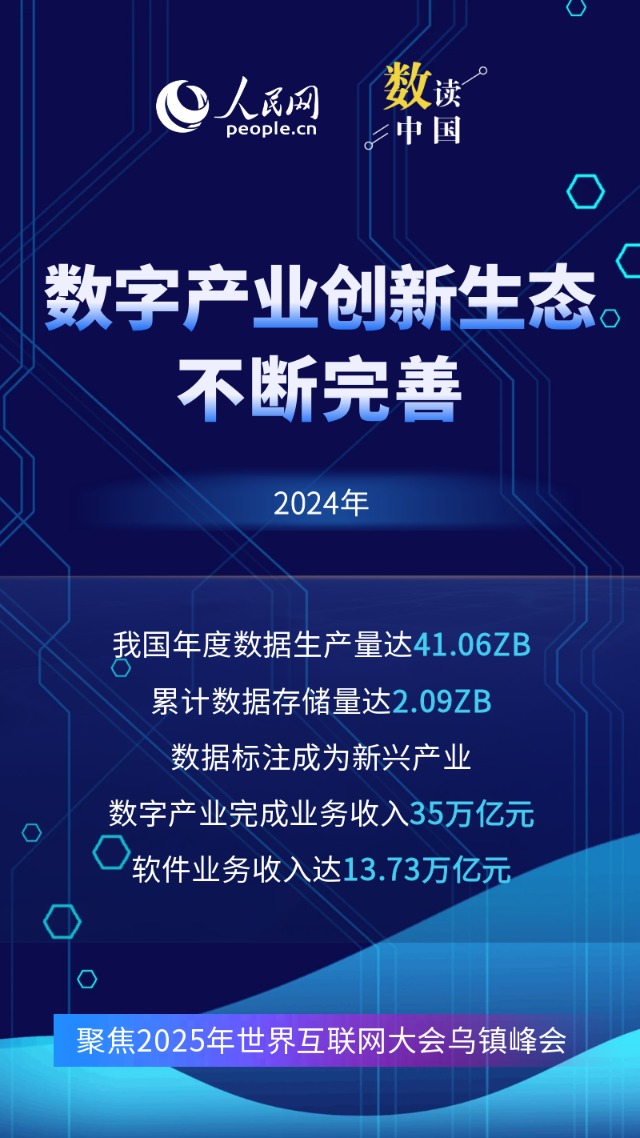
Core Insights - The article emphasizes the advancement of digital China construction as part of the "14th Five-Year Plan," highlighting a transition from "information interconnection" to "intelligent interconnection" in the internet sector [1] Group 1: Digital Economy Development - By the end of 2024, the digital R&D design tool penetration rate among key industrial enterprises is expected to reach 82.7%, with the CNC rate for critical processes at 65.3% [4] - The cumulative construction of 246 national green data centers is underway, accelerating the collaborative transformation of digitalization and greening [4] Group 2: Internet Governance - As of the end of 2024, over 150 laws, administrative regulations, and departmental rules related to the internet have been formulated and implemented, enhancing comprehensive network governance [5] Group 3: Digital Trade and E-commerce - In 2024, the issuance of opinions on digital trade reform and innovation aims to foster a high-level international cooperation environment, with cross-border e-commerce imports and exports reaching approximately 2.71 trillion yuan, a year-on-year increase of 14% [7] Group 4: Internet Penetration and User Demographics - By June 2025, the number of internet users is projected to reach 1.123 billion, with an internet penetration rate of 79.7%, and rural internet penetration at 69.2% [8][9] - The elderly user demographic is expanding, with a usage rate of 52.0% [9] Group 5: Infrastructure Development - As of July 2025, 5G base stations will total 4.598 million, with over 30.53 million gigabit network capability ports, achieving "gigabit access in every county and 5G access in every township" [11] - The total computing power scale ranks second globally, with significant advancements in the integrated computing network system [11] Group 6: Artificial Intelligence and Digital Services - During the "14th Five-Year Plan" period, China leads in 5G-A key technology research and international standard formulation, with AI patents accounting for 60% of the global total and the AI industry scale surpassing 700 billion yuan [14] - Online government services, medical services, and education users reached 1.004 billion, 393 million, and 293 million respectively, with over 1.2 billion users of the national medical insurance code [16]

为“亚太引擎”注入中国动力
Xin Hua She· 2025-10-28 07:05
Core Viewpoint - The upcoming APEC informal leaders' meeting in South Korea is set against a backdrop of sluggish global economic growth and rising protectionism, highlighting the region's desire for an open world economy and shared prosperity [1] Group 1: Economic Cooperation - China is a steadfast advocate for regional open cooperation, with trade relations with APEC economies becoming increasingly tight, as evidenced by a 2% year-on-year increase in imports and exports to APEC economies, reaching 19.41 trillion yuan, which accounts for 57.8% of China's total trade [2] - China's commitment to high-quality implementation of the Regional Comprehensive Economic Partnership (RCEP) and its progress in joining the Comprehensive and Progressive Agreement for Trans-Pacific Partnership (CPTPP) and the Digital Economy Partnership Agreement (DEPA) demonstrate its determination to build an open APEC economy [2] Group 2: Innovation and Development - The current wave of technological revolution and industrial transformation presents opportunities for digital and green development, which are crucial for shaping new advantages in the Asia-Pacific region [3] - China's advancements in mobile payment technology and renewable energy projects in various countries illustrate its role in enhancing productivity and promoting sustainable development in the region [3] Group 3: Inclusive Growth - The uneven development in the Asia-Pacific region necessitates a focus on inclusive growth, with China advocating for the use of the APEC platform to strengthen economic and technical cooperation, particularly for developing economies and vulnerable groups [4] - China's global development initiative has yielded results in the Asia-Pacific, with specific projects aimed at poverty alleviation and public health cooperation, reflecting its commitment to shared development [4] - The 14th Five-Year Plan outlines China's future development blueprint, emphasizing its potential to provide new opportunities for the Asia-Pacific and global development through sustained modernization and high-level openness [4]

新华时评丨为“亚太引擎”注入中国动力
Xin Hua She· 2025-10-28 01:24
Group 1: Core Perspectives - The upcoming APEC informal leaders' meeting in South Korea is set against a backdrop of sluggish global economic growth and rising protectionism, highlighting the region's desire for an open world economy and shared prosperity [1] - China is committed to promoting regional integration and connectivity, leveraging technological innovation to enhance development momentum, and fostering inclusive growth to inject new energy into the Asia-Pacific economy [1][2] Group 2: Economic Cooperation - Open cooperation is deemed essential for the Asia-Pacific region, with China being a key trade partner and a vital node in regional supply chains, as evidenced by a 2% year-on-year increase in China's trade with APEC economies, reaching 19.41 trillion yuan, which constitutes 57.8% of China's total trade [2] - China's proactive engagement in regional trade agreements, such as the RCEP and the completion of the China-ASEAN Free Trade Area 3.0 negotiations, underscores its commitment to building an open Asia-Pacific economy [2] Group 3: Innovation and Development - The current wave of technological revolution and industrial transformation presents opportunities for digital and green development, with China focusing on enhancing productivity through collaboration in cutting-edge fields like AI and healthcare [3] - Successful examples of Chinese technology facilitating local economies, such as mobile payment systems in Malaysia and renewable energy projects in Thailand, illustrate the shared innovation opportunities and sustainable development goals [3] Group 4: Inclusive Growth - The uneven development in the Asia-Pacific necessitates a focus on inclusive growth, with China advocating for economic and technical cooperation to support developing economies and marginalized groups [4] - China's global development initiative is yielding results in the region through various projects aimed at poverty alleviation and public health cooperation, reflecting its commitment to a win-win cooperation model [4] - The recent approval of China's 15th Five-Year Plan outlines a roadmap for future development, promising to unleash greater market potential and cooperation opportunities for the Asia-Pacific and global development [4]
特稿|携手擘画亚太繁荣新图景
Xin Hua Wang· 2025-10-26 01:40
Core Points - The article highlights the anticipation surrounding President Xi Jinping's attendance at the APEC Leaders' Informal Meeting, emphasizing the importance of his proposals for cooperation and development in the Asia-Pacific region [1][2][3]. Group 1: APEC Meeting Significance - The APEC meeting is viewed as a critical moment for fostering cooperation in the Asia-Pacific region, with Xi's participation expected to enhance regional collaboration and sustainable economic development [2][3]. - Xi's previous contributions to APEC, including the Beijing Declaration, continue to guide the agenda and are highly regarded by regional experts [2][3]. Group 2: China's Role in Regional Development - China is recognized as a steadfast supporter of APEC, with its initiatives aimed at promoting open and inclusive cooperation among member economies [3][4]. - Experts express hope that Xi will introduce new ideas and proposals to strengthen regional cooperation and address challenges posed by unilateralism and protectionism [3][4]. Group 3: Economic Growth and Innovation - The article notes that Xi's emphasis on green innovation and digital transformation is expected to create new growth momentum for the Asia-Pacific region [6][7]. - China's commitment to high-quality development and sustainable practices is seen as a driving force for regional economic advancement [6][7]. Group 4: Global Economic Governance - The article discusses the importance of Xi's global governance initiatives, which aim to enhance cooperation and address global challenges, thereby contributing to regional stability and prosperity [10]. - The anticipation of Xi's leadership in promoting a cooperative and inclusive economic framework is highlighted as essential for the Asia-Pacific's role in global economic governance [10].
2025年度制造业数字化转型典型案例集
中国信通院· 2025-09-30 12:55
Report Industry Investment Rating There is no information provided regarding the report's industry investment rating. Core Viewpoints of the Report The report is a collection of typical cases of digital transformation in the manufacturing industry in 2025. It is organized by the China Academy of Information and Communications Technology on behalf of the Ministry of Industry and Information Technology. The collection includes 59 typical cases, covering 15 city cases, 9 park and cluster cases, and 35 enterprise cases. The goal is to promote the digital transformation of the manufacturing industry by sharing successful experiences and practices [6]. Summary by Directory City Chapter - **Hebei Tangshan**: Aims to build a new industrial base in the Bohai - Rim region. It promotes digital transformation through policy planning, pilot construction, and digital industry development. It has achieved results in pilot demonstration, platform construction, and 5G application [19][21][24]. - **Shanghai Songjiang**: Promotes the digital transformation of small and medium - sized enterprises by building a top - level closed - loop mechanism, a three - level linkage system, a precise service resource pool, an innovative publicity matrix, and a public service platform. It has enhanced digital service supply, promoted transformation, and built intelligent manufacturing factories [28][30][35]. - **Jiangsu Changzhou**: Adopts a "rating - diagnosis - improvement - training - chain" approach to solve the problems of enterprises' reluctance, fear, and inability to transform. It has achieved policy support, demonstration effects, and strengthened infrastructure [42][44][49]. - **Zhejiang Ningbo**: Explores a "4M" work path (Method + Machine + Material + Man) to empower the digital transformation of the manufacturing industry with artificial intelligence. It has made achievements in industry demonstration, intelligent equipment, data elements, and talent aggregation [57][60][65]. - **Zhejiang Huzhou**: Drives green intelligent manufacturing with digital and intelligent technologies, constructs a "1 + 3+N" work system, and promotes the digital transformation of the traditional manufacturing industry. It has led in AI application, achieved significant digital transformation in characteristic industries, and is at the forefront in digital - green integration [73][75][78]. - **Anhui Wuhu**: Promotes the digital transformation of enterprises through top - level design, optimizing the transformation ecosystem, pilot demonstration, and creating a transformation atmosphere. It has cultivated many intelligent factories and platforms [87][89][94]. - **Fujian Quanzhou**: Improves the "government - enterprise - service" transformation ecosystem to promote the digital transformation of manufacturing enterprises. It has advanced digital transformation and improved the transformation ecosystem [99][101][107]. - **Jiangxi Yingtan**: Integrates "policy - technology - finance - service" elements to achieve cluster - based digital transformation. It has created digital transformation benchmarks, built a provincial "copper industry brain", and strengthened talent support [112][114][118]. - **Shandong Jinan**: Implements a digital transformation action with a 16 - character working method. It has promoted network infrastructure construction, project development, and the emergence of pilot demonstrations [125][127][131]. - **Henan Luoyang**: Solves the problems of enterprises' reluctance, fear, and inability to transform through various measures such as changing concepts. It has formed a good situation where leading enterprises lead and small and medium - sized enterprises follow [141][143]. Park and Cluster Chapter - **Suzhou Industrial Park**: Focuses on building a high - standard digital park with intelligence, data, and networking [12]. - **Hangzhou High - tech Industrial Development Zone**: Integrates resources, strengthens mechanisms, and builds platforms to promote the digital transformation of large - scale industrial enterprises [12]. - **Hefei New Station High - tech Industrial Development Zone**: Empowers the digital transformation of the "chip" and "screen" industries with digital and intelligent technologies [12]. - **Shangrao Economic and Technological Development Zone**: Builds an ecological system for digital transformation through "three - dimensional linkage" [12]. - **Zhengzhou High - tech Industrial Development Zone**: Empowers the systematic leap of the manufacturing cluster with "computing power + brain" dual - core drive [12]. - **Chengdu High - tech Industrial Development Zone**: Breaks through the transformation difficulties of small and medium - sized enterprises with financial tools and promotes the "point - line - surface" integrated work of "intelligent transformation and digital transformation" [12]. - **Wuxi Internet of Things Cluster**: Accelerates the construction of a comprehensive digital transformation ability center and promotes the digital transformation of Internet of Things enterprises [12]. - **Wenzhou Yueqing Electrical Cluster**: Promotes the digital transformation of the electrical industry cluster through "chain - based collaboration" [12]. - **Chengde High - end Energy Equipment Cluster**: The chain - leader leads the digital transformation from the "chain" to the "cluster" to activate the high - quality development of the industrial cluster [12]. Enterprise Chapter - **Aviation and Medical GE Healthcare Systems Co., Ltd.**: Digitally empowers the intelligent and flexible manufacturing of high - end CT detectors [14]. - **Taiji Computer Co., Ltd.**: Builds a "full - domain intelligent connection" ecosystem to empower the innovation and development of smart parks [14]. - **China Automotive Data (Tianjin) Co., Ltd.**: Applies large - language model technology to promote the intelligent application of automobile test scenarios [14]. - **CITIC Dicastal Co., Ltd.**: Upgrades the lighthouse with artificial intelligence [14]. - **Shanxi Jinbo Biotech Co., Ltd.**: Applies its self - developed "AI Collagen Brain System" to achieve cost - reduction and efficiency - improvement in the enterprise's full - life - cycle management [14]. - **Harbin Electric Machinery Co., Ltd.**: Applies artificial intelligence and flexible manufacturing technology to build a fully digital and flexible production workshop for stator laminations [14]. - **CSIC Longjiang Guanghan Gas Turbine Co., Ltd.**: Empowers the independent development of the full - life - cycle of gas turbines with full - business - chain digital technology [14]. - **Baowu Equipment Intelligent Technology Co., Ltd.**: Applies an equipment remote intelligent operation and maintenance platform to promote the digital transformation of the steel industry [14]. - **Yangtze River Pharmaceutical Group Co., Ltd.**: Applies artificial intelligence, big data, and the Internet of Things to achieve accurate traceability of drug quality [14]. - **CRRC Nanjing Puzhen Co., Ltd.**: Applies artificial intelligence image processing and deep - learning technology to achieve intelligent remote diagnosis and analysis in multi - professional intelligent operation and maintenance [14]. - **Jiangyin Xingcheng Special Steel Co., Ltd.**: Manages and innovates the special steel process collaboratively based on data elements and artificial intelligence [14]. - **SUPCON Technology Co., Ltd.**: Applies industrial AI technology to help chlor - alkali enterprises achieve low - carbon, cost - reduction, quality - improvement, and efficiency - enhancement [14]. - **Ningbo Orient Cable Co., Ltd.**: Applies trusted technology to achieve energy - conservation and emission - reduction in cable enterprises' energy - carbon management [14]. - **Tongkun Group Co., Ltd.**: Conducts intelligent practices in a "5G full - connected + digital twin" polyester fiber future factory [14]. - **Anhui Gujinggong Wine Co., Ltd.**: Applies 5G + industrial Internet technology to promote the digital and intelligent transformation of the liquor - production scenario [14]. - **Changhong Meiling Co., Ltd.**: Promotes the transformation and upgrading of the smart supply chain based on 5G + industrial Internet technology [14]. - **Fujian Fubusi Textile Co., Ltd.**: Applies industrial Internet and AI technology to achieve cost - reduction, efficiency - improvement, and intelligent production in the textile and fabric industry [14]. - **Jiangxi Weimian Textile Group Co., Ltd.**: Reduces operating costs in intelligent spinning based on AI + visual digital twin [14]. - **Changhe Aircraft Industries (Group) Co., Ltd.**: Builds an intelligent manufacturing workshop for key helicopter machining parts based on digital twin technology [14]. - **Weichai Power Co., Ltd.**: Builds a data - empowered platform for the entire industrial chain to promote the ecological - level collaborative development of high - end power systems [14]. - **Shandong Daiyin Textile Group Co., Ltd.**: Applies intelligent manufacturing technology to achieve international and personalized high - end customization in suit production [16]. - **Kaios Technology (Qingdao) Co., Ltd.**: Applies a group - level industrial Internet platform to improve the enterprise's operation and management capabilities [16]. - **Zhongchuang Zhiling (Zhengzhou) Industrial Technology Group Co., Ltd.**: Builds a lighthouse factory in the coal - mining machinery industry [16]. - **Hunan Taixin Ceramics Co., Ltd.**: Applies industrial vision large - models and digital integration technology to promote the collaborative development of the entire ceramic chain, achieving quality improvement and green emission - reduction [16]. - **Liuyang Yihelong Fireworks Group Co., Ltd.**: Applies a micro - data platform and AIOT technology to achieve intelligent transformation of the high - risk fireworks production industry, improving both safety and production efficiency [16]. - **RootCloud Co., Ltd.**: Applies industrial AI large - model technology to promote the multi - modal large - model application in ship - repair business [16]. - **Foshan Haitian (Gaoming) Flavoring Food Co., Ltd.**: Conducts a digital and intelligent transformation practice in the traditional brewing industry with a "lighthouse factory" [16]. - **Gree Electric Appliances, Inc. of Zhuhai**: Develops a digital ecosystem for controller manufacturing based on artificial intelligence [16]. - **TCL Mobile Communications Co., Ltd.**: Applies digital technology to achieve full - process efficient collaboration and benefit improvement in the intelligent manufacturing of mobile intelligent terminals [16]. - **Guangxi Huasheng New Materials Co., Ltd.**: Applies AI technology to achieve intelligent control in the alumina production process [16]. - **Wide - Area Digital Technology Co., Ltd.**: Applies AI and industrial Internet technology to achieve full - process intelligent energy - conservation, cost - reduction, and efficiency - improvement in the electrolytic aluminum factory [16]. - **Seres Automobile Co., Ltd.**: Applies multi - modal deep - learning technology to online detection and control of new - energy vehicle welding spot quality [16]. - **Guiyang Aero - Engine Precision Casting Co., Ltd.**: Builds a digital and intelligent workshop for the casting of aero - engine directional crystal turbine blades [16]. - **Xi'an Geely Automobile Co., Ltd.**: Applies visual AI technology to promote the entire - process manufacturing [16]. - **Xinjiang Kunlun Zinc Industry Co., Ltd.**: Applies a comprehensive empowerment platform and other technologies to achieve digital and intelligent transformation in the lead - zinc smelting project [16].
事关全面绿色转型,福建发布行动方案
Zhong Guo Zheng Quan Bao· 2025-09-14 10:34
Core Viewpoint - The Fujian Provincial Government has issued an action plan to accelerate the green transformation of the economy and society, focusing on developing green low-carbon industries and promoting sustainable practices across various sectors [1]. Group 1: Green Low-Carbon Industry Development - The action plan emphasizes the growth of green low-carbon industries, particularly in areas such as optoelectronics, integrated circuits, and new energy, aiming to cultivate national-level strategic emerging industry clusters [1]. - By 2030, the scale of the energy-saving and environmental protection industry is expected to reach approximately 300 billion yuan [1]. Group 2: Traditional Industry Transformation - The plan outlines the need for green low-carbon transformation and upgrading of traditional industries, with a focus on controlling high energy consumption and emissions [2]. - New and expanded projects in key industrial sectors must meet energy efficiency benchmarks and environmental performance standards [2]. - By 2026, over 71% of key business processes are expected to be fully digitalized [2]. Group 3: Energy Transition - The action plan calls for the clean and efficient use of fossil energy, with a gradual reduction in coal consumption during the 14th and 15th Five-Year Plans [3]. - By 2030, the proportion of non-fossil energy consumption is targeted to exceed 30% [3]. - The plan includes the development of offshore wind power and nuclear energy projects, as well as the exploration of marine energy [3]. Group 4: Green Transportation Infrastructure - The plan aims to build green transportation infrastructure, including the digital transformation of cross-strait transportation networks and the construction of low-carbon stations and airports [4]. - By 2030, the carbon emission intensity of operational transportation tools is expected to decrease by approximately 9.5% compared to 2020 [4]. Group 5: Green Building Development - The action plan mandates strict adherence to energy-saving and carbon reduction standards in building construction, promoting the development of green buildings [5]. - The plan encourages the construction of ultra-low energy consumption buildings in suitable regions [5].
高质量完成“十四五”规划|“十四五”以来数字中国建设取得显著成就
Xin Hua She· 2025-08-14 05:01
Group 1 - The core viewpoint is that during the "14th Five-Year Plan" period, China has made significant progress in digital infrastructure and technology, leading to a strong economic and social development [1][2] - By June 2025, the total number of 5G base stations is expected to reach 4.55 million, and the number of gigabit broadband users is projected to be 226 million [1] - China's computing power ranks second globally, showcasing the country's advancements in digital infrastructure [1] Group 2 - The data industry in China has experienced rapid growth, with the number of data enterprises expected to exceed 400,000 and the industry scale reaching 5.86 trillion yuan by 2024, a 117% increase compared to the end of the "13th Five-Year Plan" [2] - Software revenue is anticipated to grow by 80% compared to 2020, while the added value of the electronic information manufacturing industry is expected to increase by over 70% [2] - The government has implemented a series of policies to promote the market-oriented allocation of data elements, transforming vast data advantages into new national competitive advantages [2]
上半年我国社会物流总费用与GDP比率降至14%——1300亿元物流成本是如何省下的
Xin Hua Wang· 2025-08-04 09:35
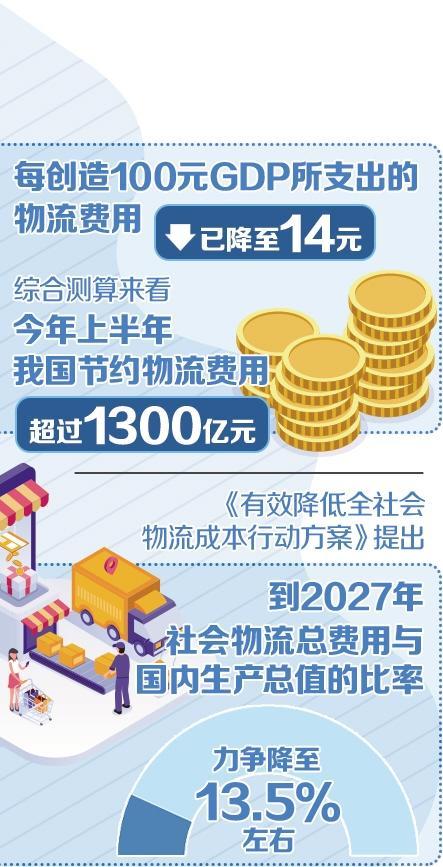
Core Insights - The ratio of total logistics costs to GDP in China decreased to 14% in the first half of the year, reflecting improved supply chain efficiency and resulting in savings of over 130 billion yuan [2][3] - The government aims to reduce this ratio to around 13.5% by 2027 through comprehensive reforms and initiatives [3][4] Logistics Cost Reduction - The decline in logistics costs is attributed to industrial upgrades and technological advancements, with digitalization and green transformation playing significant roles [3][4] - The logistics industry is experiencing fundamental changes due to the adoption of digital technologies, which optimize management systems and reduce empty transport rates [3][4] Institutional Cost Reduction - Reducing institutional costs is crucial for lowering overall logistics costs, addressing issues like industry monopolies and regional protectionism [4] - Current logistics costs in China remain higher than the average levels in developed countries, necessitating efforts to break bottlenecks in cross-border logistics and multimodal transport [4] Regional Targets and Collaboration - Local governments, such as Shanghai and Guangdong, have set higher targets for logistics cost reduction compared to the national average, contributing to overall cost reduction efforts [4] - Future strategies should focus on leveraging digital empowerment, optimizing infrastructure, and collaboratively reducing institutional costs to achieve high-quality development in the logistics sector [4]
半年省了1300亿元!
Zhong Guo Jing Ji Wang· 2025-08-03 01:25
Core Insights - The ratio of total logistics costs to GDP in China decreased to 14% in the first half of the year, reflecting improved supply chain efficiency and resulting in savings of over 130 billion yuan [1][2][3] - The government aims to reduce this ratio to approximately 13.5% by 2027 through comprehensive reforms and initiatives [1][2] Group 1: Logistics Cost Reduction - The total logistics costs saved in the first half of the year exceeded 130 billion yuan, indicating a significant reduction in logistics expenses relative to GDP [1] - The decrease of 0.1 percentage points in the logistics cost ratio suggests enhanced supply chain collaboration, benefiting the real economy [1][2] - The government has outlined a plan to further reduce logistics costs through reforms in transportation systems and the integration of supply chains [1][3] Group 2: Digital and Green Transformation - The logistics industry is undergoing fundamental changes due to digitalization and green initiatives, with companies optimizing management systems and reducing empty transport rates [2] - The adoption of automated warehousing and new energy transport tools has significantly lowered overall energy consumption [2] - Continuous efforts are needed to implement policies aimed at reducing logistics costs, as the current ratio still falls short of the set targets [2][3] Group 3: Structural Challenges and Future Directions - China's logistics costs remain higher than the average of developed countries, necessitating the removal of bottlenecks in cross-border logistics and multimodal transport [3] - Future focus should be on enhancing railway freight volumes and optimizing waterway transport, alongside investment in key infrastructure [3] - Local targets, such as Shanghai's goal of reducing the logistics cost ratio to below 12% by 2027, provide a buffer for national averages and encourage overall cost reduction [3]