
植物肉

Search documents
太突然!曾获比尔·盖茨投资 知名品牌退出中国 浙江工厂不到5年就停产 经销商称“现在卖的是库存和美国进口品”
Mei Ri Jing Ji Xin Wen· 2025-11-30 16:07
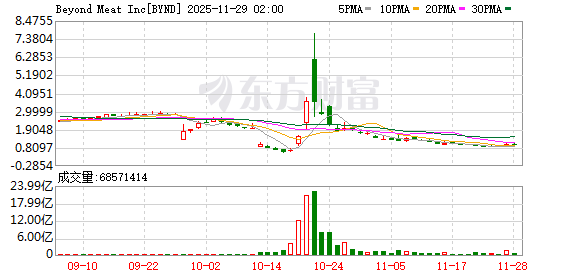
Core Viewpoint - Beyond Meat, known as the "first stock of plant-based meat," has closed its flagship stores on major e-commerce platforms in China, indicating a significant retreat from the market [2][3]. Company Overview - Beyond Meat was founded in 2009 and went public in 2019, experiencing a stock price surge of 163% on its debut. Notable investors include Bill Gates and Leonardo DiCaprio [4]. - The company initially entered the Chinese market in 2020 through partnerships with major food chains like Starbucks and KFC, aiming to capture the B2B market [4][6]. Market Performance - As of November 30, 2023, Beyond Meat's flagship stores on Tmall and Pinduoduo have ceased operations, with the Tmall store announcing plans to terminate operations by November 27, 2025 [2][3]. - The company has faced declining revenue, with a drop from $419 million in 2022 to $326 million in 2024, and a cumulative loss of $864 million during the same period [8]. - In the third quarter of 2025, Beyond Meat reported a revenue of $214 million, a year-on-year decrease of 14.37%, and a net loss of $193 million, worsening from a loss of $115 million in the previous year [8]. Product Pricing and Consumer Perception - Beyond Meat's products are priced higher than local alternatives, with plant-based meat products costing over 60 yuan per kilogram, comparable to domestic beef prices [3][7]. - Consumer feedback indicates dissatisfaction with the taste and texture of plant-based meat, with many describing it as inferior to real meat [10][12]. Industry Trends - The plant-based meat sector in China has seen a decline in investment and interest since late 2021, with many startups facing financial difficulties or shutting down [9]. - A report indicates that approximately 74% of consumers are not inclined to repurchase plant-based meat products, primarily due to taste issues [10]. - Despite challenges, the market for plant-based meat in China is projected to grow, with estimates suggesting a market size of $760 million by 2024 and $3.85 billion by 2033, maintaining a compound annual growth rate of around 20% [13]. Stock Performance - Beyond Meat's stock has significantly declined, trading at $0.982 per share as of November 28, 2023, with a total market capitalization of $445 million [14].

太突然!曾获比尔·盖茨投资,知名品牌退出中国,浙江工厂不到5年就停产,经销商称“现在卖的是库存和美国进口品”
Mei Ri Jing Ji Xin Wen· 2025-11-30 15:18
Core Viewpoint - Beyond Meat, known as the "first stock of plant-based meat," has quietly closed its flagship stores on major e-commerce platforms in China, indicating a significant retreat from the market [1][3]. Company Overview - Beyond Meat, founded in 2009 and listed on NASDAQ in 2019, has prominent investors including Bill Gates and Leonardo DiCaprio. Its main products include plant-based burgers and other meat alternatives [3][5]. - The company entered the Chinese market in 2020, establishing a factory in Jiaxing, Zhejiang, and launched products tailored for Chinese consumers [5][6]. Market Performance - As of November 30, 2023, Beyond Meat's official flagship store on Tmall is no longer searchable, and its Pinduoduo store is also non-functional [1][3]. - The company has faced declining revenue, with a drop from $419 million in 2022 to $326 million in 2024, and a cumulative loss of $864 million during the same period [11]. Product Pricing and Consumer Perception - Beyond Meat's products are priced higher than local alternatives, with plant-based beef priced over 60 yuan per kilogram, comparable to domestic beef prices [3][8]. - Consumer feedback indicates dissatisfaction with the taste and texture of plant-based meat, with many describing it as inferior to real meat [13][15]. Industry Trends - The plant-based meat sector in China has seen a decline in investment and interest since late 2021, with many startups facing financial difficulties or shutting down [12][16]. - Despite the challenges, the market for plant-based meat is projected to grow, with estimates suggesting a market size of approximately $7.6 billion by 2024, potentially reaching $38.5 billion by 2033 [16]. Financial Status - As of November 28, 2023, Beyond Meat's stock price has plummeted to $0.982 per share, with a total market capitalization of only $445 million [17].

“人造肉”千亿赛道的坍塌:资本的幻想与精英主义的泡沫
硅谷101· 2025-11-26 01:17
这是一个曾被比尔·盖茨、李嘉诚、小李子押注的千亿赛道,如今却沦为华尔街的笑话。2019年,Beyond Meat上市首日暴涨163%,一度被视为“拯救地球的未来”;而2025年,它的股价已较高点跌去99.5%,甚至沦为被散户爆炒的Meme“妖股”。更讽刺的是,为了生存,曾经的行业颠覆者Impossible Foods竟然宣布:考虑在植物肉里加“真肉”。 从受到全球资本疯狂追捧,到如今裁员、濒临破产,人造肉行业究竟做错了什么?是口感和价格的双输局面,还是资本健康神话的泡沫破裂?本期视频,我们将实地品尝硅谷现存的人造肉汉堡,并探访超市货架,翻开配料表、融资图,用亲身体验与客观数据揭开人造肉的真相。这场打着拯救地球旗号的科技精英主义实验,到底错在了哪里?人造肉还有机会东山再起吗? 你会看到: 人造肉神话破灭:从华尔街宠儿到妖股玩具 黄金赛道急冻:资本骤冷、投资退潮,消费者们用脚投票 Beyond Meat绝境:10亿美元债务危机下“回光返照”的妖股 Impossible Foods叛变:撕下100%植物基的最后一块遮羞布 不香了的人造肉:口味与价格是永远的痛点 健康神话的破灭:从“健康食品”到“超加工食品”(UPF ...


“植物肉”能当真肉吃吗?行业路向何方?四款产品测评
Bei Ke Cai Jing· 2025-11-25 07:23
Core Insights - The plant-based meat sector is experiencing renewed interest, highlighted by the stock price fluctuations of Beyond Meat, which saw a significant rise followed by a decline [1][24] - Despite initial hype, the plant-based meat industry has faced challenges such as taste, high prices, and market saturation, leading to a reevaluation of its potential [2][24] - Experts remain optimistic about the future of the domestic plant-based market, driven by increasing health and environmental awareness [2][26] Industry Overview - Plant-based meat was once considered a new trend in the food industry, with significant investment and market entry from various players between 2019 and 2022 [22][24] - The number of plant-based meat companies surged during this period, with 35 financing events recorded, primarily between 2019 and 2022 [22][24] - Major brands, including both local and international players, have entered the market, offering a variety of plant-based products in restaurants and retail [23][24] Product Evaluation - Recent evaluations of plant-based meat products revealed significant differences in taste and texture compared to traditional meat, with many products failing to meet consumer expectations [3][11] - Price comparisons show that some plant-based products are more expensive than their meat counterparts, raising concerns about consumer acceptance [4][15] - Nutritional assessments indicate that while some plant-based options offer lower energy and fat content, they may also contain higher sodium levels, which poses health risks [13][14] Market Challenges - The plant-based meat industry is undergoing a "shakeout," with many companies facing declining revenues and market exits due to high costs and product quality issues [24][25] - The industry's initial strategy of directly comparing plant-based products to meat has led to consumer disappointment, as many products do not deliver the expected taste and texture [24][25] - The need for a shift in marketing strategy is emphasized, focusing on the unique benefits of plant-based products rather than direct competition with meat [25][26] Future Directions - Industry experts suggest that the future of plant-based meat lies in emphasizing its unique nutritional and environmental benefits rather than positioning it as a meat substitute [25][26] - There is a call for improved product development, focusing on taste and cost-effectiveness to enhance consumer acceptance and encourage repeat purchases [26][27] - Collaboration with the restaurant sector is seen as crucial for increasing consumer exposure and acceptance of plant-based products [27]

净亏扩大 别样肉客抛弃“肉”
Bei Jing Shang Bao· 2025-11-13 15:45
Core Viewpoint - Beyond Meat, known as the "first plant-based meat stock," reported a 14.73% decline in revenue for the first three quarters of 2025, with net losses widening, prompting a strategic shift to expand beyond plant-based meat products and seek new growth models [1][2]. Financial Performance - For the first three quarters, Beyond Meat achieved a total revenue of $214 million, a year-on-year decrease of 14.37%, and a net loss of $193 million, compared to a net loss of $115 million in the same period last year [1][2]. - In Q3 alone, revenue was $70.22 million, down 13.32% year-on-year, with a net loss of $111 million, significantly larger than the $26.58 million loss in the same quarter last year [1][2]. Sales Decline Factors - The revenue decline is attributed to a 10.3% decrease in product sales and a 3.5% drop in average selling price, influenced by reduced distribution points in U.S. retail channels and decreased sales to fast-food clients in international food service [2]. - Non-operating factors, including non-cash impairment charges related to certain long-term assets, contributed to the widening net loss [2]. Market Challenges - The current demand weakness for plant-based meat is believed to stem from the products' inability to meet mainstream market needs, as indicated by the product lifecycle theory, suggesting that plant-based meat remains in a niche market without a solid consumer base [2]. - Significant gaps in taste, price, and nutritional composition compared to real meat, along with stable or declining prices for traditional meat, further compress the market space for plant-based alternatives [2]. Strategic Shift - To address the current challenges, Beyond Meat is implementing a transformation plan, shifting focus from meat imitation to traditional plant proteins, and gradually phasing out the "Meat" label [4]. - This strategic pivot is seen as rational, aligning with health food trends and leveraging existing supply chains to enhance gross margins, while also exploring new product forms like ready-to-eat protein bars and plant-based milk [4].
净亏损扩大 “植物肉第一股”别样肉客押注植物蛋白
Bei Jing Shang Bao· 2025-11-13 14:57
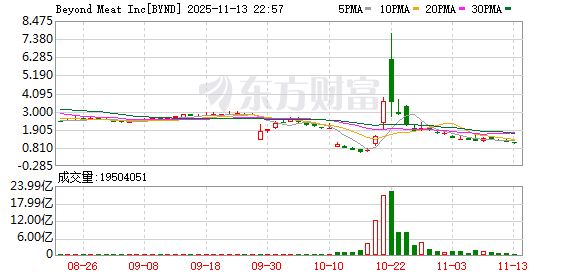
Core Viewpoint - Beyond Meat, known as the "first plant-based meat stock," reported a 14.37% decline in revenue for the first three quarters of 2025, with net losses widening, and projected fourth-quarter sales below market expectations [2][4][5] Financial Performance - For the first three quarters, Beyond Meat achieved revenue of $214 million, down 14.37% year-over-year, and a net loss of $193 million compared to a net loss of $115 million in the same period last year [4] - In Q3 alone, revenue was $70.22 million, a 13.32% decrease year-over-year, with a net loss of $111 million, significantly larger than the $26.58 million loss in the same quarter last year [4] - The revenue decline was attributed to a 10.3% decrease in product sales volume and a 3.5% drop in average selling price [4] - The U.S. retail channel saw a net revenue decline of 18.4% to $28.54 million, with a 12.6% drop in sales volume [4] Market Outlook - Beyond Meat's projected net revenue for Q4 2025 is between $60 million and $65 million, lower than the market expectation of $70.03 million [5] - Analysts suggest that the weak demand for plant-based meat may stem from its inability to meet mainstream market needs, as indicated by the product lifecycle theory [5][7] Industry Context - Since 2021, the enthusiasm in the capital market for plant-based meat has waned, with many companies exiting the sector [7] - The plant-based meat industry faces significant uncertainty, with consumer acceptance and business models still needing maturation [7][8] Strategic Transformation - To address current challenges, Beyond Meat is pursuing a transformation plan, including cost reduction and strategic growth initiatives [8][9] - The company has completed key transformation steps, including debt restructuring and increasing liquidity [8] - Beyond Meat aims to shift its focus from meat imitation to traditional plant proteins, launching products like "Beyond Ground" that do not mimic meat [9] - This strategic pivot is seen as aligning with health trends and enhancing profit margins by leveraging existing supply chains [9]
净亏损扩大,“植物肉第一股”别样肉客押注植物蛋白
Bei Jing Shang Bao· 2025-11-13 13:07
Core Viewpoint - Beyond Meat, known as the "first plant-based meat stock," reported a 14.37% decline in revenue for the first three quarters of 2025, with net losses widening, prompting a strategic shift to expand beyond plant-based meat products [1][3][6] Financial Performance - For the first three quarters, Beyond Meat achieved revenue of $214 million, down 14.37% year-over-year, and a net loss of $193 million, compared to a net loss of $115 million in the same period last year [3][6] - In Q3 alone, revenue was $70.22 million, a 13.32% decrease year-over-year, with a net loss of $111 million, significantly larger than the $26.58 million loss in the same quarter last year [3][6] - The decline in revenue is attributed to a 10.3% decrease in product sales volume and a 3.5% drop in average selling price [3][4] Market Dynamics - The U.S. market has seen the most significant decline, with net revenue from U.S. retail channels dropping 18.4% to $28.54 million and sales volume decreasing 12.6% [3][4] - The overall demand for plant-based meat appears weak, as the products struggle to meet mainstream market needs, remaining largely in niche segments [4][7] Strategic Shift - Beyond Meat is transitioning its focus from meat imitation to traditional plant proteins, as evidenced by the launch of "Beyond Ground," which contains only plant-based ingredients and no meat analogs [8][9] - The company aims to become a "global protein company" by diversifying its product offerings and enhancing its operational efficiency [8][9] Industry Context - The plant-based meat sector is facing significant challenges, with many companies exiting the market due to unmet consumer expectations regarding taste, price, and nutrition [7][8] - Analysts suggest that the capital market's enthusiasm for plant-based meat has waned, shifting towards more diverse protein solutions with technological barriers [7][8]
Prediction: Beyond Meat Stock Will Underperform for the Year Despite Its Recent 440% Rally
Yahoo Finance· 2025-11-06 14:00
Core Viewpoint - Beyond Meat has become a popular meme stock despite struggling for years, with a 97% drop from its initial public offering price in 2019 before a recent rally, but the outlook for a comeback in 2025 appears bleak [1] Group 1: Stock Performance - The recent rally in Beyond Meat's stock is not due to improved performance, as the company has been in decline for years, with negative operating margins and previously negative gross margins [3] - The stock has already begun to decline, currently sitting 54% below its recent highs, indicating the risks associated with meme stocks [5] - Retail investor enthusiasm has driven the stock's rise, but this is not based on genuine confidence in the company's potential [5][6] Group 2: Market Conditions - Interest in plant-based foods has significantly decreased since Beyond Meat's public debut, leading to a challenging market environment [7] - CEO Ethan Brown noted that Beyond Meat's performance is affected by "softness" in the plant-based category, particularly in U.S. retail and international foodservice channels [8] - The company is implementing cost-cutting measures to improve operational efficiency, but these efforts cannot alter the current market realities [8] Group 3: Opportunities and Partnerships - Despite the challenges, Beyond Meat has received positive recognition for its products in taste tests, indicating a market for its offerings [10] - The company has expanded its partnership with Walmart, which could provide some growth opportunities [4][10]
美国素汉堡公司股票四天暴涨超10倍,工厂在中国嘉兴
Huan Qiu Wang Zi Xun· 2025-10-24 02:28
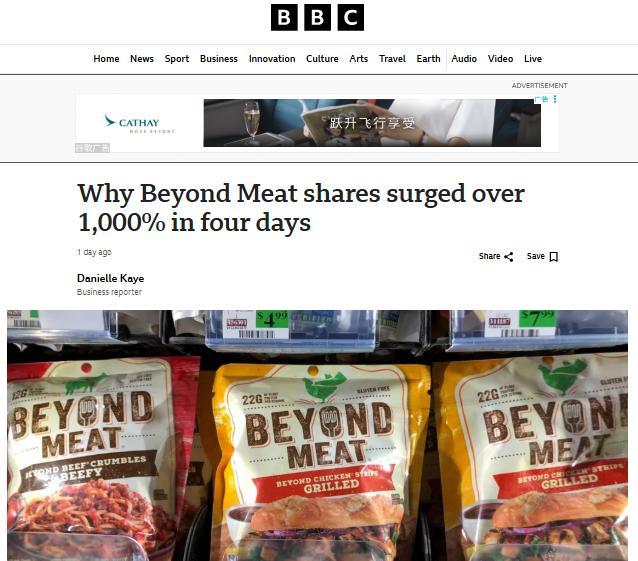
Core Viewpoint - Beyond Meat's stock price surged over 1000% in four days, indicating a potential resurgence in the plant-based meat market, driven by social media and new distribution agreements with Walmart [1][4]. Group 1: Stock Performance and Market Reaction - Beyond Meat's stock experienced a dramatic increase, with a peak rise of over 1000% within four days, reflecting intense market enthusiasm [1]. - The surge in stock price is linked to a Reddit post that ignited retail investor interest, positioning Beyond Meat alongside other "meme stocks" like GameStop and AMC [4]. Group 2: Distribution and Consumer Engagement - Beyond Meat announced a new distribution agreement with Walmart, allowing its products to reach a broader consumer base, which is seen as a transformative catalyst for demand [4][6]. - The combination of Walmart's distribution capabilities and social media buzz created a dual-driven model of consumer engagement, addressing both availability and desirability [4][5]. Group 3: Global Production and Supply Chain - Beyond Meat's factory in Jiaxing, China, plays a crucial role in its global supply chain, aimed at reducing costs and meeting market demands [6]. - The Jiaxing facility utilizes advanced production technology to ensure efficient and scalable manufacturing of plant-based products, supporting Walmart's renewed order demand [6]. Group 4: Market Outlook and Challenges - Despite the current market excitement, experts caution that short-term enthusiasm does not guarantee long-term success, emphasizing the importance of product quality, taste, and consumer experience [7]. - The plant-based meat industry faces challenges, including the lack of national standards in China, which may affect consumer acceptance and market growth [7]. - The global plant-based meat market is projected to grow at a compound annual growth rate of over 10%, with China's market expected to exceed 10 billion RMB by 2025 [7][8].
Beyond Meat shares drop below $1 on investor concerns
Yahoo Finance· 2025-10-14 19:43
Core Insights - Beyond Meat's shares have fallen below $1, raising concerns among investors regarding the company's strategy to reduce debt by issuing more shares [1][3] - The company plans to reduce its debt load by $800 million and extend the maturity of some debt, which includes exchanging $202.5 million of debt due in 2027 for new debt maturing in 2030 [2] - Despite initial popularity, demand for Beyond Meat's products in the U.S. has not met expectations, leading to a 15% decline in net revenue in the first half of the year [1][5] Financial Performance - Beyond Meat's stock closed at $1.04 per share and opened at 92 cents the following day, reflecting a 12% drop in mid-day trading [3] - The company's shares have decreased by 73% since the beginning of the year [3] Market Position - Beyond Meat was once a leading player in the plant-based meat sector, attracting high-profile investors and ambitious expansion plans [4] - However, U.S. consumer interest has waned due to taste preferences and ingredient concerns, compounded by inflation-related cost increases [5] Geographic Demand - While demand for Beyond Meat's products has been stronger in Europe, U.S. fast food chains have been hesitant to incorporate these products into their menus [6] - The company has also suspended operations in China earlier this year due to poor sales [6] Strategic Direction - The CEO has indicated a shift in branding strategy, focusing on using "Beyond" as the primary brand and expanding into other protein offerings beyond animal meat replicas [7]