
欧元区通胀

Search documents
能源价格下跌 欧元区通胀回落至一年多以来低位
Sou Hu Cai Jing· 2026-02-04 10:41
Core Viewpoint - Eurozone inflation has entered a period of weakness, with a significant drop in January, leading to expectations that the European Central Bank (ECB) will maintain its current interest rates for the foreseeable future [1] Inflation Data - Eurozone inflation rate fell to 1.7% in January, the lowest level since September 2024, primarily driven by declining energy prices [1] - Core inflation, excluding volatile items such as energy, food, alcohol, and tobacco, slightly decreased from 2.3% in December to 2.2% in January, attributed to a slowdown in service prices [1] Market Expectations - The market widely anticipates that the ECB will keep interest rates unchanged during its upcoming meeting and throughout the remainder of the year [1] - Eurozone inflation has been hovering around 2% for at least a year, indicating a stable yet low inflation environment [1] Currency Movements - The euro has strengthened against the dollar, influenced by uncertainties surrounding Trump’s policies and concerns regarding the independence of the Federal Reserve, which has sparked discussions about potential rate cuts [1]
年内加息呼声渐消 经济学家普遍预计欧洲央行将维持利率不变至明年底
智通财经网· 2026-01-30 02:23
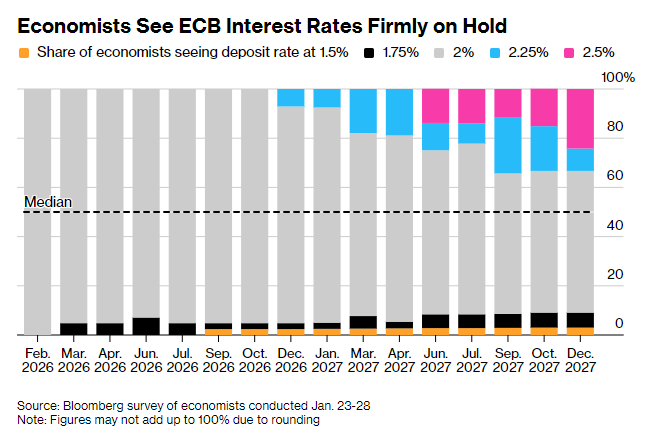
Core Viewpoint - The European Central Bank (ECB) is expected to maintain current interest rates until at least the end of next year, with market expectations for rate hikes in 2026 diminishing [1][4]. Group 1: Interest Rate Projections - Economists predict that the ECB will keep the deposit rate at 2% during the monetary policy meeting on February 4-5 [1]. - The proportion of economists expecting at least one rate hike before 2028 has increased from about 25% to one-third, although the percentage anticipating a hike within this year has decreased [1]. Group 2: Economic Uncertainty - Ongoing economic uncertainties, including potential trade conflicts initiated by U.S. President Trump, are contributing to a cautious outlook [4][7]. - The strong euro is putting pressure on Eurozone exports, further complicating the inflation outlook, which remains below target [4]. Group 3: Inflation and Economic Growth - The ECB's latest economic forecasts indicate that consumer price inflation in the Eurozone will be slightly below the 2% target in 2026 and 2027, returning to target levels only by 2028 [8]. - Economists foresee greater downside risks to inflation in the coming months, with a slight increase in upside risks for 2027 [8]. Group 4: Market Sentiment and Predictions - Despite the prevailing sentiment, traders are increasing bets on potential rate cuts by the ECB, with about 40% of economists believing that the likelihood of a rate cut is higher than that of a rate hike [9]. - The economic outlook for the Eurozone is heavily reliant on increased government spending on infrastructure and defense, particularly in Germany, which is expected to outperform the Eurozone average in this regard [9]. Group 5: Structural Economic Factors - A shift in perspective among economists indicates that structural factors are now seen as the primary constraints on Eurozone economic output, contrasting with previous views that emphasized cyclical factors [12]. - The ECB is likely to emphasize that monetary policy has limited effectiveness in addressing structural economic shortcomings, aiming to quell market speculation regarding rate cuts [12].

经济学家维持欧元区2026年经济增长和利率预期不变
Xin Hua Cai Jing· 2026-01-23 09:05
Group 1 - The core viewpoint of the articles indicates that economists have maintained stable forecasts for the Eurozone's economic growth, inflation, and interest rates for 2026, with inflation hovering around the European Central Bank's (ECB) target of 2% [1] - It is anticipated that the ECB will keep the deposit rate unchanged at 2% during its meeting on February 5, marking the fifth consecutive time this rate will be maintained [1]

调查:欧元区2026年前景持稳 经济学家维持增长和利率预期不变
Xin Hua Cai Jing· 2026-01-23 06:50
Core Insights - Economists maintain stable forecasts for Eurozone economic growth, inflation, and interest rates for 2026 despite early-year volatility [1] Economic Growth and Inflation - Inflation is hovering around the European Central Bank's (ECB) target of 2%, expected to be a key anchor for monetary policy [1] Interest Rates - The ECB is expected to keep the deposit rate unchanged at 2% during the meeting on February 5, marking the fifth consecutive time [1] - In a survey conducted from January 20 to 22, all 83 economists predicted no change in interest rates [1] - Approximately 85% of economists (67 out of 79) believe rates will remain unchanged until 2026, an increase from about 75% in the previous month and two-thirds in November [1] - Among 36 respondents regarding the management committee's next actions, the majority indicated a likelihood of rate hikes rather than cuts [1]
FXTRADING 经济数据汇总(亚太区01/20)
Sou Hu Cai Jing· 2026-01-19 18:02
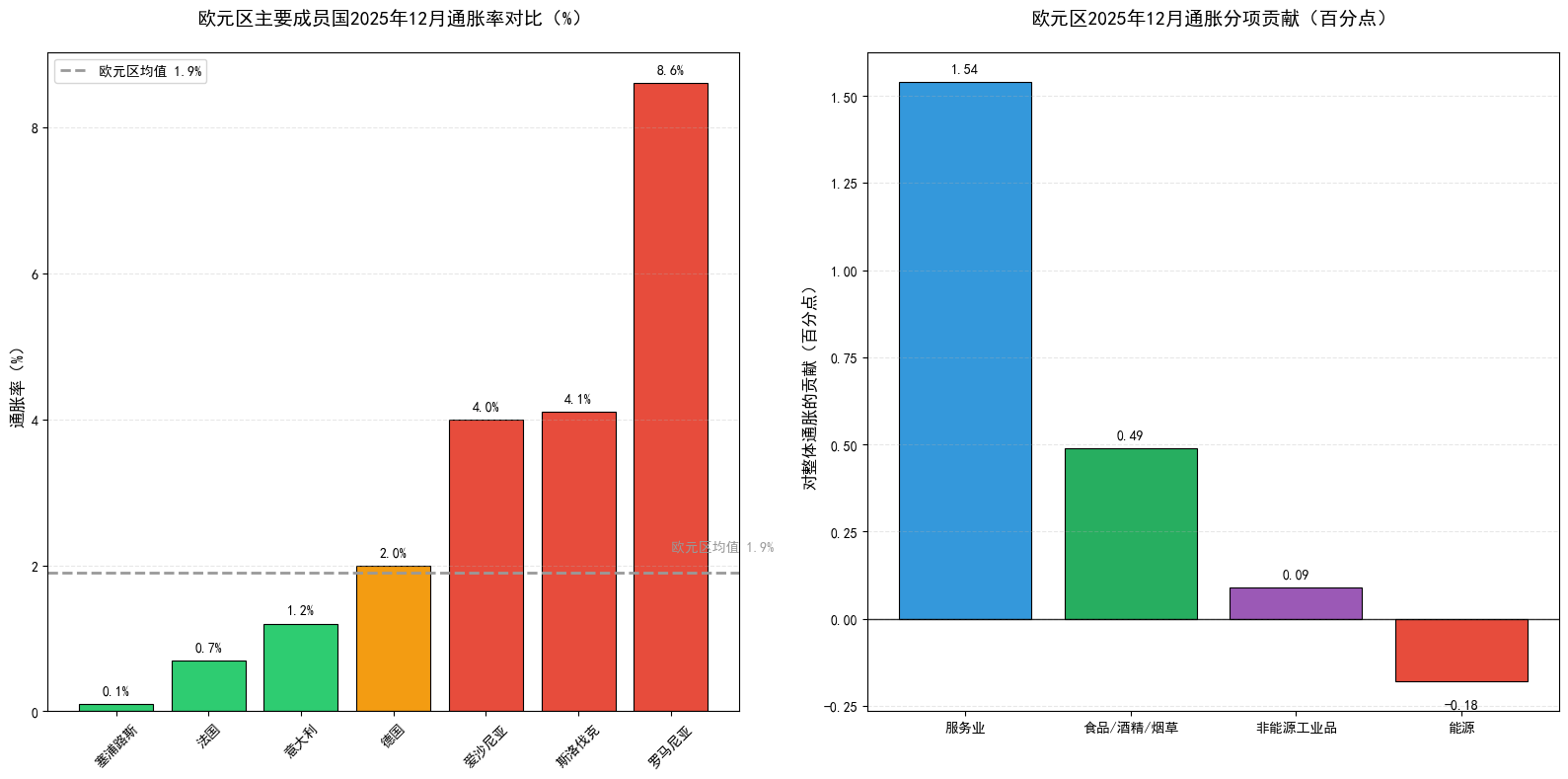
Group 1: Eurozone Inflation Trends - The Eurozone's consumer price index (CPI) increased by 1.9% year-on-year in December 2025, down from 2.1% the previous month, indicating a gradual easing of price pressures [2] - Core inflation, excluding volatile items like energy and food, slightly decreased from 2.4% to 2.3%, suggesting enhanced stability in the price structure [2] - The services sector was the primary driver of inflation, contributing 1.54 percentage points to overall CPI growth, significantly more than other categories [2] Group 2: Global Economic Vulnerabilities - The Governor of the Bank of England, Andrew Bailey, warned that the global economy is entering a more unstable period due to a shift from traditional unipolar or bipolar structures to a more complex multipolar landscape [4] - Structural pressures such as slowing labor productivity, aging population demographics, rising geopolitical security spending, and climate change impacts are exacerbating economic vulnerabilities [4] - Bailey emphasized the need for international cooperation to maintain economic stability and urged countries to avoid economic decoupling and rising protectionism [4] Group 3: Federal Reserve Independence Concerns - Chicago Fed President Austan Goolsbee expressed concerns about risks to the independence of the Federal Reserve, warning that political interference could have disastrous effects on the U.S. macroeconomy [6] - He noted that any deviation from technical judgment in monetary policy could reignite inflation, especially as inflation is currently controlled but not fully dissipated [6] - Historical examples of countries that undermined central bank independence, such as Zimbabwe, Russia, and Turkey, serve as warnings against such practices [6] Group 4: European Central Bank Policy Stance - European Central Bank (ECB) officials have signaled stability in policy, with Chief Economist Philip Lane stating that the Eurozone economy is currently balanced and there is no urgent need to adjust existing interest rate policies [8] - Lane believes the current policy rate range aligns well with inflation near target and a robust labor market, justifying the maintenance of the status quo to observe further economic developments [8] - He indicated that unless there are significant external disruptions, the current policy stance could be sustained for an extended period [8]

欧元区2025年12月通胀降至1.9% 货币政策宽松预期升温
Xin Lang Cai Jing· 2026-01-19 12:02
Core Insights - The Eurozone's Harmonized Index of Consumer Prices (HICP) rose by 1.9% year-on-year in December 2025, down from 2.1% in November, indicating a continued easing of inflationary pressures below the European Central Bank's (ECB) target of 2% [1][2] - The inflation dynamics are characterized by "service-led" growth and "energy drag," with services contributing +1.54 percentage points to inflation, while energy prices negatively impacted by -0.18 percentage points [1][2] Inflation Contributions - Services sector remains the largest contributor to inflation, with a year-on-year increase of 3.4%, driven by rising labor costs and year-end consumption [1] - Food, alcohol, and tobacco contributed +0.49 percentage points, reflecting seasonal supply fluctuations and a decline in processed food prices due to improved supply chains [2] - Non-energy industrial goods showed a minimal contribution of +0.09 percentage points, with a year-on-year increase of only 0.4%, indicating weak manufacturing demand [2] Regional Disparities - Inflation rates vary significantly across Eurozone member states, with Cyprus at the lowest rate of 0.1%, followed by France (0.7%) and Italy (1.2%) [3] - High inflation is concentrated in Eastern European countries, with Romania leading at 8.6%, attributed to currency fluctuations and high energy dependency [3] ECB Policy Implications - The recent inflation data has clarified market expectations regarding the ECB's monetary policy, with a consensus that approaching the inflation target may support interest rate cuts in 2025 [3][4] - The persistence of service inflation may lead the ECB to maintain a cautious approach, avoiding abrupt policy shifts [3] Future Considerations - Upcoming adjustments to HICP methodology starting February 4, 2026, may impact historical inflation data and trends, particularly with the inclusion of gambling services [4] - Key indicators to monitor include the sustainability of service inflation declines and the ability of high-inflation Eastern European countries to align with regional trends [4][5]
荷兰国际:欧洲央行可静观其变 等待更多数据指引
Xin Lang Cai Jing· 2026-01-07 13:07
Core Viewpoint - The European Central Bank (ECB) can afford to wait for more economic data before making its next move, as indicated by Bert Colijn from ING [1] Group 1: Inflation Trends - Eurozone inflation rate decreased from 2.1% in November to the target level of 2.0% in December [1] - Factors such as a stronger euro, low energy prices, and slowing wage growth suggest that price increases will continue to moderate in the coming months [1] - Despite recent increases in corporate price expectations for goods, inflation is not expected to fall significantly below 2% [1] Group 2: Future Economic Outlook - By late 2026, inflation may face upward pressure again due to expected moderate boosts from fiscal spending on economic growth [1] - The ECB has the capacity to wait for more signals regarding the direction of the economy and inflation before deciding on its next steps [1]

11月欧元区通胀升至2.2%,央行或推迟降息预期
Shang Wu Bu Wang Zhan· 2025-12-05 14:02
Core Viewpoint - The Eurozone inflation rate unexpectedly rose to 2.2% in November, despite remaining close to the European Central Bank's (ECB) target of 2% for most of the year, indicating that the ECB may not lower interest rates in the short term [1] Group 1: Inflation Data - The inflation rate in the Eurozone increased to 2.2% in November, contrasting with the previous trend of staying near the ECB's target [1] - Core inflation remained unchanged at 2.4%, driven by rising service prices, while durable goods prices showed weakness [1] Group 2: Market Expectations - The data supports the ECB's current assessment that inflation is largely under control, leading to expectations that the ECB will maintain a cautious stance and will not rush into a rate-cutting cycle [1]
【环球财经】欧元区11月通胀小幅回升至2.2% 服务价格涨幅居前
Xin Hua Cai Jing· 2025-12-02 13:55
Core Insights - The Eurozone's annual inflation rate for November is projected at 2.2%, an increase from 2.1% in October, marking the second consecutive month of rise [1] Inflation Breakdown - Service prices are expected to rise the most, with a projected increase of 3.5% in November, up from 3.4% in October [1] - Food, alcohol, and tobacco prices are anticipated to increase by 2.5%, remaining stable compared to the previous month [1] - Non-energy industrial goods prices are expected to rise by 0.6% [1] - Energy prices continue to be in negative territory but with a reduced decline, projected to decrease by 0.5%, an improvement from a 0.9% drop in October [1] Country-Specific Inflation Rates - Germany's inflation rate for November is expected to be 2.6%, showing an upward trend from the previous month [1] - Spain and Luxembourg are projected at 3.1% and 3.6% respectively [1] - France's inflation rate is expected to remain low at 0.8% [1] - Italy's inflation is projected at 1.1% [1] - Some countries still exhibit high inflation rates, such as Croatia at 4.3% and Austria at 4.1% [1]
【财经分析】PMI数据描绘欧元区稳定增长前景 欧洲央行2026年可能维持利率不变
Xin Hua Cai Jing· 2025-11-21 14:25
Core Viewpoint - The Eurozone's business activity shows steady growth in November, indicating economic resilience, with improved business confidence suggesting continued momentum and a balanced inflation outlook, potentially leading the European Central Bank (ECB) to stabilize interest rates by 2026 [1][6]. Economic Indicators - The Eurozone's November composite PMI slightly decreased from October's two-year high of 52.5 to 52.4, remaining above the 50 mark, indicating ongoing economic expansion [2]. - The services sector's PMI rose to 53.1 in November, the fastest growth in 18 months, supported by robust new orders, while employment growth was cautious [2]. - Manufacturing PMI fell to 49.7, indicating a return to contraction, with new orders and employment both declining, suggesting a lack of clear direction in the sector [2]. Country-Specific Insights - Germany's November composite PMI dropped to 52.1, with manufacturing PMI falling to 48.4, reflecting a significant decline in new orders, particularly in exports [3]. - France's November composite PMI improved to 49.9, nearing stability after over a year of decline, with services PMI rising to 50.8, indicating a slight recovery in business activity [4]. ECB Outlook - The ECB is expected to maintain interest rates through December and into next year, supported by resilient economic growth and improved business confidence [6][7]. - ECB officials have indicated that current interest rates are appropriate, with a focus on balancing inflation risks and economic performance [8].