深港通

Search documents
深港通9年成交131万亿元
Shen Zhen Shang Bao· 2025-12-05 16:49
Group 1 - The Shenzhen-Hong Kong Stock Connect has been operational for 9 years, facilitating cross-border trading and enhancing the accessibility of Chinese capital markets for global investors [1][2] - As of December 4, the cumulative transaction amount of the Shenzhen-Hong Kong Stock Connect reached 131 trillion yuan, with the Shenzhen Stock Connect accounting for 103 trillion yuan and the Hong Kong Stock Connect for 28 trillion yuan [1] - The number of stocks available for trading through the Shenzhen Stock Connect has increased from 881 to 1,636, while the Hong Kong Stock Connect has grown from 417 to 581 stocks [1] Group 2 - The Shenzhen market is characterized by a strong focus on technology innovation, with over 70% of companies being high-tech enterprises and nearly 50% in strategic emerging industries [2] - Investors have net bought 630.7 billion yuan in high-tech companies and 478.8 billion yuan in strategic emerging industry companies through the Shenzhen Stock Connect [2] - The proportion of trading volume from the ChiNext board has increased to 38% since the implementation of the registration system reform [2] Group 3 - The Shenzhen-Hong Kong Stock Connect has contributed positively to the improvement of investor structure, the dissemination of value concepts, and the enhancement of the quality of listed companies in the A-share market [2] - Future plans include enhancing the attractiveness and competitiveness of the Greater Bay Area capital markets to promote high-quality development [2]
九载深港通:市场双向赋能的核心意义
Sou Hu Cai Jing· 2025-12-05 13:54
Core Insights - The Shenzhen-Hong Kong Stock Connect has evolved into a crucial channel for cross-border investment, facilitating asset allocation for both domestic and international investors over the past nine years [2][3][10] Group 1: Market Development - The Shenzhen-Hong Kong Stock Connect officially launched on December 5, 2016, enhancing the connectivity between mainland China and Hong Kong capital markets [2] - The cumulative transaction amount has exceeded 131 trillion yuan, indicating significant growth in cross-border investment [2] - The daily trading volume for the Hong Kong Stock Connect is projected to reach 43.1 billion yuan by 2025, a nearly 94-fold increase from 4.55 billion yuan in 2016 [3] - The daily trading volume for the Shenzhen Stock Connect is expected to reach 1,111.5 billion yuan by 2025, a 71-fold increase from 15.4 billion yuan in 2016 [3] Group 2: Liquidity and Investment Philosophy - The Shenzhen-Hong Kong Stock Connect has injected substantial liquidity into both markets, with cumulative transactions of 102.89 trillion yuan for the Shenzhen Stock Connect and 28.46 trillion yuan for the Hong Kong Stock Connect [4] - The integration of investment philosophies between the two markets has been facilitated, with long-term value investment concepts from the Hong Kong market influencing A-share investors [4] Group 3: Regional Collaboration and Innovation - The Shenzhen-Hong Kong Stock Connect leverages the Guangdong-Hong Kong-Macau Greater Bay Area to enhance capital flow and support high-end manufacturing and green economy sectors [6] - The collaboration includes the launch of a comprehensive fund platform and the development of indices, promoting capital support for new productive forces in the region [6] Group 4: Future Opportunities and Challenges - The Shenzhen-Hong Kong Stock Connect faces new opportunities and challenges as China's capital market opens further, with potential optimizations including expanding the range of eligible stocks and improving risk management [10] - The upcoming "Top 100 Hong Kong Stocks" evaluation is expected to provide valuable insights for investors seeking quality Hong Kong stock opportunities [10]

9周年!深港通累计成交131万亿元
证券时报· 2025-12-04 23:36
Core Viewpoint - The Shenzhen-Hong Kong Stock Connect has been operational for 9 years, contributing significantly to the development of an open and inclusive capital market, enhancing collaboration in the Guangdong-Hong Kong-Macao Greater Bay Area, and supporting the growth of new productive forces. Group 1: Mechanism Optimization for High-Level Opening - The Shenzhen-Hong Kong Stock Connect has continuously improved its mechanism design, enhancing cross-border trading convenience and market attractiveness. Measures include expanding daily quotas, broadening the range of tradable securities, and optimizing trading calendars. As of December 4, the number of stocks available for trading in the Shenzhen Stock Connect reached 1,636, while the Hong Kong Stock Connect had 581 stocks. The cumulative transaction amount for the Shenzhen-Hong Kong Stock Connect reached 131 trillion yuan, with 103 trillion yuan from the Shenzhen Stock Connect and 28 trillion yuan from the Hong Kong Stock Connect. Since 2025, the average daily transaction amount for the Shenzhen Stock Connect has been 111.1 billion yuan, growing at an annual rate of 73%, while the Hong Kong Stock Connect has seen an average daily transaction amount of 46.7 billion HKD, with an annual growth of 94% [1]. Group 2: Capital Support for New Productive Forces - The Shenzhen market is characterized by a strong focus on technological innovation, with over 70% of high-tech enterprises and nearly 50% of strategic emerging industry companies. The Shenzhen-Hong Kong Stock Connect serves as a bridge, accelerating the influx of cross-border capital into new economic sectors. As of December 4, among the stocks in the Shenzhen Stock Connect, 1,110 companies are classified as high-tech enterprises, and 758 as strategic emerging industry companies, representing 72% and 49% of the total, respectively. Cumulative net purchases by investors in high-tech and strategic emerging industry stocks reached 630.7 billion yuan and 478.8 billion yuan, respectively. Since the reform of the ChiNext board and the pilot registration system, the proportion of ChiNext stocks in the transaction amount of the Shenzhen Stock Connect has increased to 38%, indicating a clear trend of international capital flowing into innovative sectors [2]. Group 3: Financial Integration in the Greater Bay Area - By 2025, the Shenzhen Stock Exchange aims to leverage its geographical advantage next to Hong Kong to expand cooperation and innovate collaboration models, further deepening the interconnection of capital markets between Shenzhen and Hong Kong. Initiatives include the launch of the Shenzhen-Hong Kong Stock Connect Advanced Manufacturing Index and the Green Low-Carbon Index to guide resource optimization in capital markets. Additionally, a comprehensive fund platform was established to enhance the operational efficiency of the Hong Kong fund market. The Shenzhen Stock Exchange, in collaboration with the Hong Kong Stock Exchange and the Guangzhou Futures Exchange, hosted the 2025 Greater Bay Area Exchange Technology Conference, focusing on promoting financial technology development and application in the region. Over the past nine years, the Shenzhen-Hong Kong Stock Connect has operated steadily, contributing positively to improving investor structure, promoting value concepts, and enhancing the quality of listed companies, while also reinforcing Hong Kong's status as an international financial center [3].

深港通开通九周年 双向开放成效显著
Zheng Quan Ri Bao· 2025-12-04 16:42
Core Insights - The Shenzhen-Hong Kong Stock Connect has officially celebrated its ninth anniversary, marking a significant milestone in China's capital market opening and integration with global markets [1] - The program has facilitated a steady increase in trading volume and has become a vital channel for foreign investors to access China's economic growth [1][2] Group 1: Trading Performance - As of December 4, the total trading volume of the Shenzhen-Hong Kong Stock Connect has exceeded 131 trillion yuan, with Shenzhen Stock Connect accounting for 103 trillion yuan and Hong Kong Stock Connect for 28 trillion yuan [1] - Daily average trading amounts since 2025 have reached 1.111 billion yuan for Shenzhen Stock Connect and 46.7 billion HKD for Hong Kong Stock Connect, indicating a new peak in trading activity [1] Group 2: Focus on Innovation and Technology - The Shenzhen Stock Connect has effectively directed cross-border funds towards new economic sectors, with over 70% of listed companies in Shenzhen being high-tech enterprises and nearly 50% in strategic emerging industries [2] - As of December 4, 1,110 high-tech companies and 758 strategic emerging industry companies are included in the Shenzhen Stock Connect, representing 72% and 49% of the total respectively [2] - The net buying amount for high-tech and strategic emerging industry stocks has reached 630.7 billion yuan and 478.8 billion yuan respectively, highlighting the trend of international capital seeking opportunities in innovation [2] Group 3: Regional Integration and Collaboration - The Shenzhen Stock Exchange has leveraged its geographical proximity to Hong Kong to enhance cooperation and deepen market connectivity since 2025 [3] - Initiatives such as the launch of the Shenzhen-Hong Kong Advanced Manufacturing Index and the Green Low-Carbon Index aim to guide capital towards key sectors [3] - The establishment of a comprehensive fund platform in Hong Kong has improved market efficiency, while collaborative events like the Greater Bay Area Exchange Technology Conference have fostered innovation in financial technology [3] Group 4: Future Outlook - The Shenzhen Stock Exchange aims to enhance the attractiveness and competitiveness of the Greater Bay Area capital market, contributing to high-quality development in the capital market [3]
12月1日深港通非银(983053)指数跌0.35%,成份股海德股份(000567)领跌
Sou Hu Cai Jing· 2025-12-01 12:02
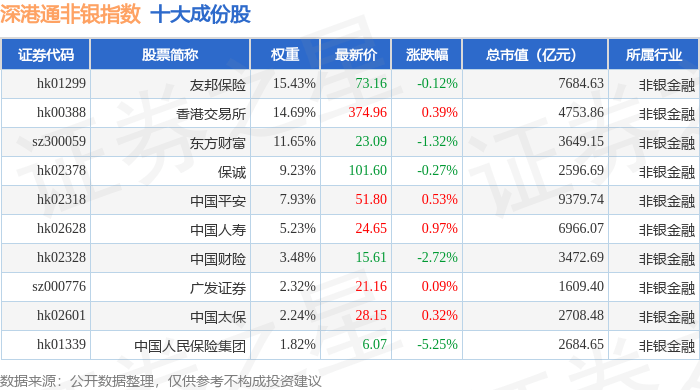
Core Viewpoint - The Shenzhen-Hong Kong Stock Connect Non-Bank Index (983053) closed at 7020.28 points on December 1, experiencing a decline of 0.35% with a trading volume of 20.159 billion yuan and a turnover rate of 0.54% [1] Group 1: Index Performance - On the same day, 34 constituent stocks rose, with Changjiang Securities leading with a 2.27% increase, while 20 stocks fell, with Haide Shares leading the decline at 9.97% [1] - The top ten constituent stocks of the Shenzhen-Hong Kong Stock Connect Non-Bank Index are detailed, with AIA Group holding the highest weight at 15.43% and a latest price of 73.16 yuan, despite a slight decrease of 0.12% [1] Group 2: Market Capitalization - The total market capitalization of the top ten stocks ranges from 1.609 billion yuan for Guangfa Securities to 7,684.63 billion yuan for AIA Group, indicating significant variations in company sizes within the index [1] Group 3: Capital Flow - The net outflow of main funds from the index's constituent stocks totaled 1.288 billion yuan, while retail investors saw a net inflow of 1.046 billion yuan, indicating differing investor behaviors [1] - Detailed capital flow data shows that Bohai Leasing had a net inflow of 36.79 million yuan from main funds, while Changjiang Securities experienced a net outflow of 13.50 million yuan [2]





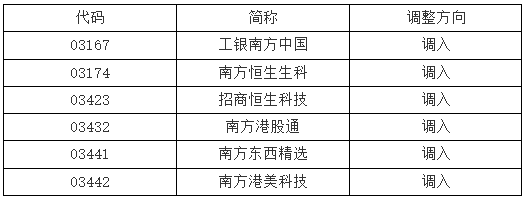
深港通下的港股通ETF名单调整 2025年11月10日起生效
Zheng Quan Shi Bao Wang· 2025-10-31 09:11
Core Points - The Hong Kong Stock Connect ETF list will undergo adjustments, effective from November 10, 2025 [1] Group 1 - The adjustment of the ETF list under the Stock Connect program indicates a strategic shift in investment opportunities for investors in the Hong Kong market [1]
深交所发布2025年国庆节、中秋节期间深港通下的港股通交易日安排
Zheng Quan Shi Bao Wang· 2025-09-25 09:24
Group 1 - The Shenzhen Stock Exchange announced the trading schedule for the Hong Kong Stock Connect during the National Day and Mid-Autumn Festival in 2025, indicating that there will be no Hong Kong Stock Connect services from October 1 to October 8, 2025 [1] - The Hong Kong Stock Connect services will resume on October 9, 2025, as per the regular schedule [1] - Additionally, the weekends of September 28, 2025, and October 11, 2025, will be market holidays [1] Group 2 - The clearing and settlement of Hong Kong Stock Connect transactions will follow the arrangements made by China Securities Depository and Clearing Corporation Limited [1]
深交所:深港通下的港股通标的证券名单调整 调入晋景新能
Zheng Quan Shi Bao Wang· 2025-09-23 01:25
Group 1 - The Shenzhen Stock Exchange announced an adjustment to the list of Hong Kong Stock Connect eligible securities due to the share split of Jin Jing New Energy (01783) [1] - The adjustment will take effect from September 23, 2025, with Jin Jing New Energy (02945) being added to the list [1]
港股券商十年行情回顾与未来展望
Xin Lang Cai Jing· 2025-09-11 08:20
Core Viewpoint - The Hong Kong stock brokerage sector has experienced a significant rebound, with the brokerage index rising 150% over the past decade, reaching a historical high, driven by various market factors and policy changes [1][10]. Group 1: Market Performance and Historical Context - The Hong Kong stock market has undergone approximately seven rounds of brokerage rallies from January 2013 to August 2025, showcasing its volatility and recovery capability [1]. - The first major rally from March 2014 to May 2015 saw the Hong Kong Securities Index increase by 162%, while the Hang Seng Index rose by 32% [4]. - Subsequent rallies included a 21% increase in the Hong Kong Securities Index from February to April 2016 and a 20% increase from December 2017 to January 2018 [5][6]. - The most recent rally from September 2024 to now has resulted in a 151% increase in the Hong Kong Securities Index, with a 40% rise in the Hang Seng Index, indicating a significant outperformance of 111% [9]. Group 2: Factors Driving the Market - The initial rally was fueled by expectations surrounding the Shanghai-Hong Kong Stock Connect, increased corporate financing activities, and a loose liquidity environment [1]. - The second rally was supported by rising international oil prices and policy measures such as reserve requirement cuts in mainland China, alongside the anticipation of the Shenzhen-Hong Kong Stock Connect [2]. - Major policy reforms in 2017, particularly new listing rules by the Hong Kong Stock Exchange, attracted substantial southbound capital and provided new growth drivers for the brokerage sector [3]. - The COVID-19 pandemic in 2020 led to a significant increase in global liquidity, accelerating the return of Chinese concept stocks to Hong Kong, which boosted brokerage business growth [7]. - Recent market improvements have been attributed to favorable policies and enhanced market sentiment, particularly benefiting Chinese brokerages in underwriting and placement activities [8]. Group 3: Future Outlook - The current brokerage market is characterized by significant policy support, active international and domestic capital responses, and rapidly expanding trading volumes [10]. - The valuation of the brokerage sector is recovering quickly, although individual stock performance shows notable divergence, with some stocks still at historical lows and possessing recovery potential [10]. - Future performance of the Hong Kong brokerage sector will be influenced by global liquidity, policy directions, and corporate fundamentals, making it a sector to watch for investment opportunities [10].
中华交易服务沪深港300指数上涨1.5%,前十大权重包含汇丰控股等
Jin Rong Jie· 2025-08-22 14:17
Core Points - The Shanghai Composite Index opened high and rose, with the CES300 index increasing by 1.5% to 5259.53 points, with a trading volume of 633.5 billion yuan [1] - The CES300 index has seen a 3.98% increase over the past month, an 8.01% increase over the past three months, and a year-to-date increase of 16.99% [1] - The CES300 index is designed to reflect the overall performance of eligible securities under the "Shanghai-Hong Kong Stock Connect" and "Shenzhen-Hong Kong Stock Connect" [1] Index Holdings - The top ten holdings of the CES300 index include Tencent Holdings (8.77%), Alibaba-W (5.11%), HSBC Holdings (4.03%), Kweichow Moutai (2.27%), Xiaomi Group-W (2.17%), China Construction Bank (2.12%), CATL (1.87%), AIA Group (1.76%), Meituan-W (1.64%), and Ping An Insurance (1.61%) [2] - The market share of the CES300 index holdings is 51.07% from the Hong Kong Stock Exchange, 29.35% from the Shanghai Stock Exchange, and 19.58% from the Shenzhen Stock Exchange [2] - The industry composition of the CES300 index holdings includes Financials (29.42%), Consumer Discretionary (15.15%), Communication Services (14.38%), Information Technology (10.00%), Industrials (8.74%), Consumer Staples (6.06%), Health Care (5.19%), Materials (3.64%), Energy (2.77%), Utilities (2.63%), and Real Estate (2.02%) [2] Tracking Funds - Public funds tracking the CES300 index include Dachen CES300C and Dachen CES300A [3]