渐进式创新

Search documents
星巴克们为什么需要新的“中国合伙人”
Tai Mei Ti A P P· 2025-08-30 06:38
Group 1: Starbucks Case Study - Starbucks is seeking local partners in China by selling a stake in its operations, with a valuation of up to $10 billion [2] - The company plans to retain 30% ownership while distributing the remaining shares among buyers, each holding no more than 30% [2] - Despite facing intense competition, Starbucks maintains a high growth rate in China, with store numbers projected to reach 7,828 by June 2025, accounting for about 20% of its global total [2] - Starbucks' market share has declined from 42% in 2017 to 14% in 2024, while its competitor Luckin Coffee has expanded to 24,097 stores, nearly three times the number of Starbucks locations in China [2] Group 2: IKEA's Strategy in China - Ingka Group, IKEA's sister company, is planning to sell 10 shopping centers in China for approximately 16 billion yuan, with the deal led by Taikang Life [3] - Ingka operates 10 shopping centers in China with a total investment of about 27.5 billion yuan and a leasing area of approximately 943,000 square meters [3] - The sale indicates a shift from a heavy asset management model to a lighter asset operation model due to significant operational pressures [3] Group 3: Challenges Faced by Foreign Enterprises - Foreign companies in China, particularly in the automotive sector, are experiencing increased anxiety due to competitive pressures and changing market dynamics [5] - Many foreign firms are struggling to adapt as they continue to view China primarily as a manufacturing hub, while local competitors have rapidly evolved [5] - Companies that do not innovate or adapt to local market demands are at risk of losing market share to domestic brands [6] Group 4: Innovation and Cultural Differences - The concept of "disruptive innovation" by Clayton Christensen is relevant to understanding the challenges faced by foreign companies in China [7][8] - Foreign firms often struggle with decision-making efficiency due to cultural differences and lengthy approval processes from headquarters [10][11] - The need for local leadership with a deep understanding of both the local market and the company's core values is critical for success in China [12][13] Group 5: Market Adaptation and Future Directions - Starbucks must evolve beyond incremental innovation to maintain its position in the market, especially against local competitors like Luckin and Manner [17] - The selection of local leaders who can bridge cultural gaps and drive strategic changes is essential for foreign brands to thrive in China [12][17] - The ability to adapt to the unique preferences of Chinese consumers will determine the future success of foreign brands in the market [12][17]



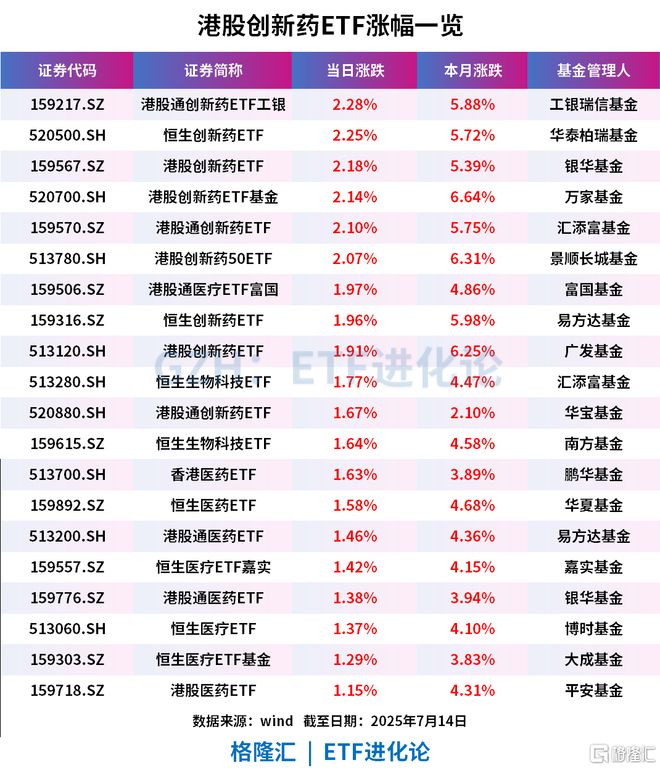
港股创新药再度走高,恒生创新药ETF、港股创新药ETF、港股通创新药ETF涨超2%
Ge Long Hui· 2025-07-14 07:55
Group 1 - The Hong Kong stock market for innovative drugs has seen significant gains, with companies like Bohan Bio rising over 17%, and other firms such as Sihuan Pharmaceutical and Sanofi Biotech also experiencing substantial increases [1] - Various ETFs related to innovative drugs have also performed well, with multiple funds rising over 2% and others over 1.5% [1][3] Group 2 - Recent updates from the National Healthcare Security Administration indicate that several new innovative drugs have been rapidly entering hospitals, with a focus on those included in the medical insurance directory by May 2025 [5][6] - Notable drugs showing fast hospital admission growth include those from Kangfang Biotech and Shanghai Yizhong, among others [6] Group 3 - Citigroup's research report highlights a significant increase in market interest in the healthcare sector, particularly in innovative drugs, with expectations for the CXO sector to gain attention due to improved fundamentals and attractive valuations [7] - The report also mentions that WuXi AppTec's revenue for fiscal year 2024 is projected to reach 39.24 billion RMB (approximately 5.4 billion USD), with a growth forecast of 10%-15% for 2025 [7] Group 4 - According to CICC's research, China's innovative drug sector is transitioning into a phase of gradual innovation, gaining international competitiveness [8] - The report emphasizes that the domestic innovative drug industry is expected to reach a turning point by 2025, shifting from capital-driven growth to profit-driven growth [8]
不想换工作,如何提升工作收入呢?| 螺丝钉带你读书
银行螺丝钉· 2025-06-21 10:20
Core Viewpoint - The article emphasizes the importance of continuous self-improvement and innovation within one's current job to enhance income potential, rather than switching industries or jobs entirely [4][5][6]. Group 1: Industry Selection for Income Growth - The article discusses three key criteria for selecting high-income potential industries: long lifespan (long slope), proximity to money (thick snow), and being in a period of industry dividends [3]. - It highlights that many individuals are already entrenched in their current jobs, making it challenging to switch industries [4]. Group 2: Becoming an Industry Expert - To increase income, individuals should strive to become experts in their field through gradual innovation rather than mere repetition of tasks [5][6]. - The article suggests that even small improvements can lead to becoming a leading expert over time [6][7]. Group 3: Shifting Perspectives - It encourages a shift in perspective from "working within the company" to "working within the industry," which can help individuals position themselves as experts rather than just employees [10][12]. - The article argues that being an expert provides bargaining power, unlike being a mere worker [13][14]. Group 4: Profit Centers vs. Cost Centers - The article advises individuals to aim for roles in profit centers rather than cost centers, as the latter are often the first to face cuts during economic downturns [15][18][20]. - It notes that the same department can be a profit center in one company and a cost center in another, highlighting the importance of strategic positioning [16][17]. Group 5: Entrepreneurship and One-Person Companies - Establishing a "one-person company" is presented as a viable way to increase income, especially for skilled professionals like dentists and lawyers who can operate independently [21][23]. - The article acknowledges the challenges of starting a business, including high failure rates, but emphasizes the potential for higher income through self-employment [26][30]. Group 6: Equity Incentives - For those unwilling to take on the risks of entrepreneurship, seeking companies that offer equity or profit-sharing incentives is recommended as a way to capture full labor value [32][33]. - The article stresses that both paths require significant experience and expertise to be successful [34]. Group 7: Identifying Industry Growth Points - Understanding industry trends and identifying growth points is crucial for accumulating relevant skills and staying ahead [35][47]. - The article uses the example of the index fund industry, which saw explosive growth after a slow start, to illustrate the importance of early positioning in emerging sectors [39][41][44].

燃油车“回潮”!多车企聚焦发力内燃机,69.3%购车者将燃油车作为首选
Hua Xia Shi Bao· 2025-05-08 09:12
Core Insights - The energy consumption landscape during the "May Day" holiday shows strong market performance for both electric and fuel vehicles, with a 28% year-on-year increase in electric vehicle charging at highway service areas [2] - Despite advancements in charging infrastructure, 69.3% of car buyers still prefer fuel vehicles, indicating a complex market demand [2] - Major automakers are adopting a "dual-track" technology strategy to address diverse market needs, exemplified by Great Wall Motors' "pan-internal combustion engine strategy" [2] Industry Trends - The penetration rate of new energy vehicles in China reached 47.6% in 2024, a 12 percentage point increase year-on-year, yet fuel vehicles still hold significant market share due to diverse regional and usage scenarios [3] - Traditional automakers are innovating to enhance the competitiveness of fuel vehicles, with Geely's G-Power system achieving a thermal efficiency of 44.26% and Changan's new Blue Whale power platform achieving low fuel consumption [3] Technological Developments - Multinational brands are implementing differentiated technology strategies, such as Audi's integration of a 48V mild hybrid system with its EA888 Evo4 engine, reducing fuel consumption in the Q7 model [4] - Modular platforms are being developed to accommodate fuel, hybrid, and electric powertrains, allowing for a 30% reduction in single vehicle R&D costs [4] Market Dynamics - The sustained demand for fuel vehicles in China is driven by user preferences, technological complementarity, and the adaptability of the industrial base [6] - In the family first-time buyer segment, 63% of price-sensitive consumers prefer fuel vehicles due to lower purchase costs and convenience [6] - The fuel vehicle supply chain remains robust, with 75% of the 23,000 automotive parts companies focusing on fuel vehicle components [6] Global Perspective - Fuel vehicle market share remains high in regions like Southeast Asia, the Middle East, and Africa, with Chinese automakers optimizing products for these markets [7] - In 2024, fuel vehicle exports from China are expected to reach 2.34 million units, a 27% year-on-year increase, with the average export price rising from $12,000 to $18,000 [7] - The market is evolving through demand segmentation, technological integration, and global expansion, indicating that the coexistence of fuel and electric vehicles will characterize the automotive industry for the next decade [7]