特朗普主义

Search documents
特朗普下了血本
Hu Xiu· 2025-10-16 06:20
Group 1 - The core agreement between Trump and Argentine President Milei involves a significant currency swap totaling $20 billion, which is viewed by many U.S. media as an emergency credit or loan from the U.S. Treasury to the Milei government [1][2][6]. - The currency swap agreement is designed to be controllable, allowing for gradual exchanges rather than a lump-sum payment [3]. - The U.S. aims to stabilize Argentina's fragile financial market and support Milei ahead of the upcoming legislative elections on October 26, where losing majority seats could severely limit his government's economic control [4][5][8]. Group 2 - This marks the first large-scale U.S. financial assistance to a foreign government in economic distress since the $20 billion loan to Mexico during the Clinton administration in 1995 [6]. - The U.S. government has also purchased an unspecified amount of Argentine pesos, marking the fourth time since 1996 that the U.S. has bought foreign currency [7]. - Argentina's foreign reserves are critically low, with only about $33 billion reported, but much of this is not readily available for supporting the peso [13][14][15]. Group 3 - The agreement is seen as a way to make the loan assistance sound more palatable, as the U.S. dollar is already a global currency and does not require conversion to other currencies for transactions [16][17]. - Argentina has a history of alternating between left and right governments, with leftist administrations typically signing currency swap agreements with China and rightist governments seeking financial aid from the IMF and the U.S. [18]. - The U.S. support for Argentina is also viewed as a strategic move to counterbalance China's influence, as China is Argentina's largest trading partner [22]. Group 4 - The U.S. Treasury Secretary has emphasized the commitment to take necessary measures to maintain peso market stability [23]. - There are criticisms regarding the U.S. assistance to Argentina, especially from agricultural sectors in the U.S. that feel their interests are being overlooked [21][23]. - The political dynamics in South America are shifting, with the U.S. keen on supporting right-wing governments like Milei's to counter leftist trends in the region [25][26].


美国为何发起自杀式攻击,帝国的疯狂教给世界最后一课
Sou Hu Cai Jing· 2025-10-15 13:48
Group 1 - The core argument is that the tariffs imposed by the Trump administration have negatively impacted the U.S. economy, leading to increased costs for businesses and consumers, market volatility, and disruptions in the global supply chain [1][3][11] - The root cause of the current situation in the U.S. is long-standing social issues, including wealth concentration and increasing inequality, which have left many citizens feeling abandoned by the system [3][11] - Trump's tariff policies, initiated in 2018, aimed to combat unfair trade practices but resulted in retaliatory measures from other countries, adversely affecting U.S. farmers and manufacturers [5][9] Group 2 - The tariffs led to significant cost increases for American consumers, with estimates indicating that tariffs imposed in 2018 alone cost U.S. companies and consumers an additional $51 billion [9][11] - Despite the intention to reduce the trade deficit, the tariffs have not achieved this goal; instead, the trade deficit has increased due to higher import costs without a corresponding improvement in exports [9][11] - The economic policies have contributed to a decline in U.S. global influence, with a shift towards isolationism and protectionism, which threatens democratic values and accelerates the de-dollarization process [13][18] Group 3 - The long-term outlook is pessimistic, with expectations of continued trade friction and potential inflation resurgence, leading to increased business failures and a search for alternative trade partners by allies [17][18] - The article emphasizes the need for continuous investment in education and public welfare to prevent societal division and political crises, highlighting the responsibility of elites to address inequality [15][18]

美国“MAGA三代领袖”被刺:凶手竟然是“极右翼”?背后是“谁来继承特朗普”的暗战
Hua Er Jie Jian Wen· 2025-09-13 05:50
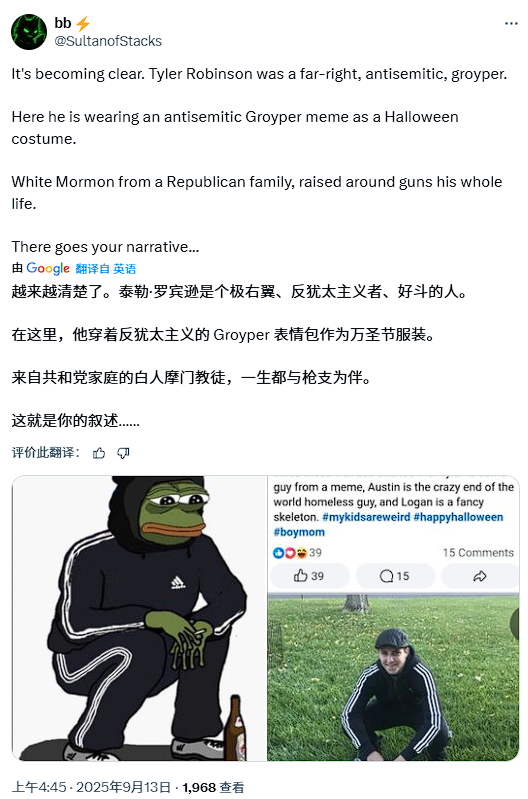
Core Points - The assassination of Charlie Kirk, a prominent conservative activist and ally of Trump, reveals a complex political landscape, suggesting the suspect may be linked to the far-right rather than the "radical left" as initially claimed [1][2][12] - The suspect, Tyler Robinson, has raised questions about his political affiliations, with speculation about his connection to the "Groyper" movement, which has been in conflict with mainstream conservatives like Kirk [1][3][6][18] Group 1: Incident Overview - Charlie Kirk was shot and killed in Utah, with Tyler Robinson arrested as the suspect after his father reported him following a confession [1][2] - Initial reactions from Trump and Vice President Vance blamed the "radical left," but investigations suggest Robinson's ties to the far-right [1][2] Group 2: Political Implications - The incident highlights deep ideological rifts within the conservative movement, particularly between mainstream conservatives and the far-right represented by figures like Nick Fuentes [1][18] - Kirk was seen as a moderate voice within the conservative movement, often criticized by the far-right for his positions, which may have contributed to the tensions leading to his assassination [18][19] Group 3: Suspect's Background - Tyler Robinson's political leanings have come under scrutiny, with social media users linking him to the "Groyper" movement based on his attire and online behavior [3][6][8] - Despite these claims, authorities have not confirmed Robinson's membership in any far-right organizations, and he was registered as an independent voter [12] Group 4: Groyper Movement - The "Groyper" movement, associated with white nationalism and led by Nick Fuentes, has been in conflict with mainstream conservative groups, including Kirk's "Turning Point USA" [13][15][17] - The movement gained notoriety for disrupting conservative events and challenging figures like Kirk, accusing them of diluting Trump’s message [17][18] Group 5: Future of Conservative Politics - The power struggle for the future of Trumpism is intensifying, with figures like Fuentes positioning themselves as challengers to mainstream conservatism [20][21] - Experts express concern that the absence of moderate voices like Kirk may lead to a rise in more radical and violent rhetoric within the conservative movement [22]
特朗普主义与全球经济秩序新趋势|封面专题
清华金融评论· 2025-08-01 09:21
Core Viewpoint - The article discusses the evolution of the global economic order since the 1980s, highlighting the impact of globalization and free trade, the rise of "America First" ideology, and the challenges faced by China in this changing landscape [1][4]. Group 1: Globalization and Economic Order - Since the 1980s, globalization and free trade have formed the foundation of the current global economic order, driven by neoliberal reforms initiated by leaders like Reagan and Thatcher [3]. - The principle of "capital supremacy" underpins the liberal global economic order, advocating for the free flow of goods, technology, and capital across borders [3]. Group 2: Impact on American Society - While globalization has benefited the U.S. economy, the gains have been concentrated among multinational corporations and elite groups, leading to significant losses for the broader American populace [4]. - The closure of approximately 60,000 factories since 2001 has resulted in the loss of 4.8 million manufacturing jobs, exacerbating social inequalities [4]. Group 3: Political Response and Ideological Shift - The "America First" movement, associated with Trumpism, emerged as a reaction against the perceived failures of globalization, advocating for the interests of the working class and small businesses [4][6]. - Tariffs are viewed as a strategic tool to counteract the loss of comparative advantage in manufacturing, aiming to bring jobs back to the U.S. and stimulate economic growth [5]. Group 4: Biden Administration's Approach - The Biden administration has continued some of Trump's economic policies, reflecting the political reality that defending worker interests has become a central theme in American politics [9][10]. - Despite efforts to correct course, such as reducing tariffs, the Biden administration has faced challenges in reversing the trend of de-globalization [9][10].

【环时深度】这份“右翼愿望清单”,潜伏在美国现行政策中
Huan Qiu Shi Bao· 2025-06-15 22:59
Core Points - The "2025 Plan" is a comprehensive policy roadmap developed by the Heritage Foundation, aimed at institutionalizing Trumpism and outlining a conservative agenda for a potential second Trump administration [1][2][3] - The plan consists of four main pillars: presidential missions, a personnel database, the establishment of a "Presidential Executive Academy," and a 180-day action handbook for the new administration [2][3] - The plan proposes significant reforms across various sectors, including drastic tax cuts, the abolition of the Department of Education, and changes to immigration and environmental policies [3][9] Group 1: Plan Overview - The "2025 Plan" is a 920-page document released by the Heritage Foundation, detailing a $22 million initiative developed in collaboration with over 100 conservative groups [1][2] - The plan is described as a "transition plan" based on the assumption that Trump and the Republican Party will win the upcoming presidential election [1][2] Group 2: Key Components - The first pillar emphasizes expanding presidential powers and reforming federal agencies, including the dismissal of leadership in the State Department in favor of conservative figures [2][3] - The second pillar involves creating a personnel database to identify federal employees loyal to Trump and conservative ideals, akin to a "right-wing LinkedIn" [3][4] - The "Presidential Executive Academy" is an online education system aimed at training individuals on government operations, although it has been criticized for its ideological bias and lack of substantive content [4] Group 3: Implementation and Impact - As of July 2023, over 40% of the 313 objectives outlined in the "2025 Plan" have been achieved or are in progress, with 98 objectives completed and 66 currently being implemented [9] - Critics argue that the plan poses significant risks to democratic institutions and civil liberties, with concerns raised by organizations like the ACLU regarding its potential to undermine rights for immigrants and marginalized groups [9][10] - The plan's authors and contributors have strong ties to the Trump administration, with many having held positions in Trump's first term, indicating a continuity of influence [5][6][8] Group 4: Future Outlook - Despite Trump's public distancing from the "2025 Plan," its proposals continue to be integrated into government policy, with ongoing efforts to implement its agenda [9][11] - Analysts suggest that the conservative authors of the plan are engaged in a long-term strategy to reshape American governance and societal structures, aiming to reverse progressive policies from previous decades [11]
越模仿特朗普,“死”得越快?
Hu Xiu· 2025-05-19 05:58
Core Points - The recent Australian federal election resulted in a decisive victory for the Labor Party, solidifying its dominance in the political landscape with 90 seats in the House of Representatives compared to only 40 for the opposition [1] - The defeat of Peter Dutton, the opposition leader known as the "Australian Trump," signifies a significant setback for the conservative camp, which is now facing marginalization [2][3] - Similar trends are observed in Canada and the UK, where conservative parties have also faced defeats, indicating a broader decline of right-wing populism in Western politics [4][6] Summary by Sections Australian Political Landscape - The Labor Party's overwhelming win in the recent election has further entrenched its position, leaving the conservative opposition in a weakened state [1] - Peter Dutton's unexpected loss highlights the internal strife and fragmentation within the conservative ranks, making it difficult for them to regain their footing in the coming years [2][3] Canadian Political Context - The Canadian Liberal Party, leaning center-left, successfully defeated the Conservative Party, which had been leading in polls by 25 percentage points [4] - Pierre Poilievre, the Conservative leader often compared to Trump, also faced a significant defeat, indicating a similar trend of conservative decline in Canada [5] UK Political Dynamics - The UK Conservative Party has suffered losses in local elections, losing control of several councils and mayoral positions to the populist Reform Party led by Nigel Farage [6] - The leadership of Kemi Badenoch, a staunch Trump supporter, has not been able to reverse the party's declining fortunes, suggesting a potential leadership challenge in the near future [7][9] Broader Implications for Western Conservatism - The election outcomes across Australia, Canada, and the UK signal a clear message: conservative parties attempting to emulate Trump are not benefiting but rather accelerating their political decline [11] - The unique political and social contexts in these countries differ significantly from the conditions that allowed Trump's rise in the U.S., making such emulation ineffective [15][22] - The extreme rightward shift of conservative parties has alienated moderate voters, leading to further internal conflicts and a loss of mainstream support [16][17] Conclusion on Political Trends - The failures of conservative leaders like Dutton and Poilievre reflect a collective misalignment with voter sentiments, as they struggle to connect with the electorate's pressing concerns [37][42] - The ongoing political landscape suggests that conservative parties must reassess their strategies and move away from Trump-like tactics to regain relevance and support [43]
6月19日-20日,与吴晓波、王辉耀、津上俊哉、秦朔共答“贸易波动”下的出海考卷
吴晓波频道· 2025-05-12 00:30
Core Viewpoint - The article discusses the evolving landscape of Chinese enterprises going global, emphasizing the need for deeper integration into global supply chains and the importance of adapting to new economic realities amid ongoing U.S.-China trade tensions [3][4][8]. Group 1: Global Economic Context - The ongoing U.S.-China trade talks are seen as both a risk mitigation opportunity and a new round of strategic competition [5][6]. - The global supply chain is undergoing significant adjustments, and Chinese companies are at a pivotal point to redefine their roles in this new environment [3][4]. Group 2: Chinese Enterprises' Global Strategy - Chinese enterprises are encouraged to move beyond mere product exports to actively participate in global production, research, and sales, enhancing their competitive edge [15][19]. - The importance of technological innovation, particularly in AI, big data, and cloud computing, is highlighted as a key driver for enterprises going global [12][13]. Group 3: Sustainability and Brand Influence - Green and sustainable development are becoming critical considerations for Chinese companies as they expand internationally, showcasing their commitment to global environmental standards [16]. - The growing international brand influence of Chinese enterprises is noted, with efforts to participate in global governance and standard-setting [17][18]. Group 4: Challenges and Opportunities - The article identifies the need for Chinese companies to build a "true going global" capability, focusing on geographical, cognitive, and value chain dimensions [38][39]. - It emphasizes the importance of local integration and understanding cultural nuances to avoid pitfalls in foreign markets [41][43]. Group 5: Strategic Insights from Experts - Experts suggest that the current trade environment necessitates a strategic shift for Chinese companies, moving from cost-driven decisions to value-driven approaches [22][25]. - The article also warns against the pitfalls of assuming that domestic strategies will directly translate to success in international markets, advocating for a more nuanced understanding of local dynamics [46][48].

协议的政治后果:乌克兰,何去何从?
虎嗅APP· 2025-03-04 00:07
Group 1 - The article discusses the complexities of the Ukraine situation and the contrasting approaches of Trump and Zelensky regarding U.S. support and NATO membership [4][6][10] - Trump’s primary goal is to achieve a ceasefire in the Russia-Ukraine conflict, while Zelensky seeks U.S. security guarantees and NATO membership [7][8][12] - The article highlights the historical context of Ukraine's security concerns, including past failures of international guarantees after the Soviet Union's collapse and during the Crimea crisis [9][10] Group 2 - The article critiques the diplomatic incident involving Trump and Zelensky, emphasizing the lack of trust and fundamental disagreements between them [5][14] - It suggests that if Ukraine signs a mining agreement with the U.S., it may lead to a ceasefire but could result in long-term negative consequences for Ukraine, such as unresolved territorial disputes and lack of security guarantees [14][30] - The author argues that Trump's pragmatic approach prioritizes U.S. interests and financial considerations over moral obligations, which could reshape international relations [11][31] Group 3 - The article explores the rise of Trumpism as a reaction to the perceived failures of the post-2008 global order, highlighting the divide between elite interests and those of the general populace [17][21] - It discusses the implications of Trump's policies on U.S. global standing and the potential erosion of moral authority in international relations [31][32] - The author warns that the current geopolitical landscape is marked by complexity and ambiguity, making it difficult to achieve clear resolutions to conflicts like the Ukraine situation [28][29]