绿色低碳高质量发展

Search documents
林武会见中核集团客人
Da Zhong Ri Bao· 2026-02-11 00:59
Core Viewpoint - The meeting between the Secretary of the Provincial Party Committee of Shandong and the leadership of China National Nuclear Corporation (CNNC) emphasizes the commitment to deepen strategic cooperation in nuclear energy technology and its applications, aiming for energy transition and sustainable development in Shandong [1] Group 1: Strategic Cooperation - The meeting highlighted the intention to enhance strategic cooperation between Shandong Province and CNNC, focusing on nuclear technology research and development [1] - Both parties discussed the comprehensive utilization of nuclear energy and advanced equipment manufacturing as key areas for collaboration [1] Group 2: Project Development - There is a mutual agreement to accelerate the planning and construction of major projects related to nuclear energy in Shandong [1] - The collaboration aims to promote the implementation of advanced nuclear energy technologies in the region [1] Group 3: Energy Transition - The discussions included a focus on facilitating energy transition and promoting green, low-carbon, high-quality development in Shandong [1]

生态环境领域科技成果转化绿皮书发布
Zhong Guo Hua Gong Bao· 2026-02-06 04:48
Core Viewpoint - The "Green Book on the Transformation of Scientific and Technological Achievements in the Ecological Environment Sector (2025)" highlights the shift of ecological environment technology in China towards solving practical problems, with achievement transformation becoming a core engine driving green, low-carbon, and high-quality development [1] Policy Guidance - The policy framework is increasingly完善, with laws such as the "Law of the People's Republic of China on Promoting the Transformation of Scientific and Technological Achievements" and the "Law of the People's Republic of China on Scientific and Technological Progress" establishing a solid legal foundation [1] - Key reforms in职务科技成果赋权, evaluation reform, and state-owned asset management innovation have effectively stimulated transformation vitality [1] Practical Innovation - A diverse transformation ecosystem is formed by local explorations, innovations from universities and research institutions, and enterprise-led initiatives [1] - In 2024, the total amount of transformation contracts from units under the Ministry of Ecology and Environment reached 4.07 billion yuan, with an average annual growth of approximately 7% [1] - Over 80% of typical case analyses show that enterprise-led cases dominate, with transformation clusters forming in regions such as the Yangtze River Delta, Beijing-Tianjin-Hebei, and Guangdong-Hong Kong-Macao [1] - Process and product innovations are becoming the leading forms of transformation [1] Future Outlook - The "Green Book" emphasizes the need to address challenges such as insufficient high-quality supply of achievements, weak pilot testing, and inadequate financial support [1] - It advocates for the construction of a new transformation ecosystem that deeply integrates government, industry, academia, research, application, and finance [1] - The goal is to promote deep collaboration between technological innovation and industrial innovation, injecting continuous momentum into the modernization of harmonious coexistence between humans and nature [1]
菏泽市守牢生态底线 赋能高质量发展
Qi Lu Wan Bao· 2026-02-05 14:41
Core Viewpoint - The city of Heze has made significant progress in improving its ecological environment quality since the start of the "14th Five-Year Plan," focusing on precise pollution control and comprehensive environmental protection measures [1]. Group 1: Pollution Control Measures - The city has implemented targeted pollution prevention strategies, including the management of 5,367 air-related enterprises under differentiated emergency control, aiming for a 19.6% improvement in the air quality index by 2025 compared to the end of the "13th Five-Year Plan" [2]. - PM2.5 concentration is targeted to decrease to 42 micrograms per cubic meter, representing a 22.2% improvement, with the goal of achieving 250 days of good air quality and only 5 days of heavy pollution [2]. - In water environment management, the city has enhanced urban and rural sewage treatment facilities and established a comprehensive monitoring mechanism, with 1,016 water-related enterprises under grid-based supervision, maintaining a 100% rate of good water quality at eight national monitoring points [2]. Group 2: Source Control and Environmental Safety - The city emphasizes source control as a fundamental strategy, maintaining a 100% safety utilization rate for key contaminated land over the past five years [3]. - A total of 512 various environmental hazards have been rectified through special inspections of industrial solid waste and hazardous waste, with 35 provincial-level "waste-free cells" established [3]. - Since 2021, 112 environmental law enforcement cases have been filed, including 51 cases targeting illegal hazardous waste activities and data falsification, reinforcing environmental safety measures [3]. Group 3: Service Optimization for Green Development - The city has optimized environmental assessment approval processes, reducing the approval time for reports to 10 and 5 working days respectively, with 418 projects approved to support 2,350 key projects [4]. - Carbon emission reduction requirements for "two high" projects have been strictly enforced, with 291.9 million tons of carbon emission quotas adjusted and 1,794 discharge permits issued [4]. - The city promotes a balanced approach to regulation and service, achieving over 50% of non-on-site enforcement, ensuring responsive support through policy advocacy and targeted assistance [4]. Group 4: Future Outlook - The Heze Ecological Environment Bureau aims to continue enhancing air quality, water ecological protection, and soil and groundwater pollution prevention, while promoting carbon reduction, pollution control, and green growth [4]. - The bureau is committed to high-level environmental protection to support high-quality development, laying a solid ecological foundation for the "15th Five-Year Plan" [4].
十万亿背后的城市力量:山东全域竞逐稳增长
Feng Huang Wang Cai Jing· 2026-02-05 07:44
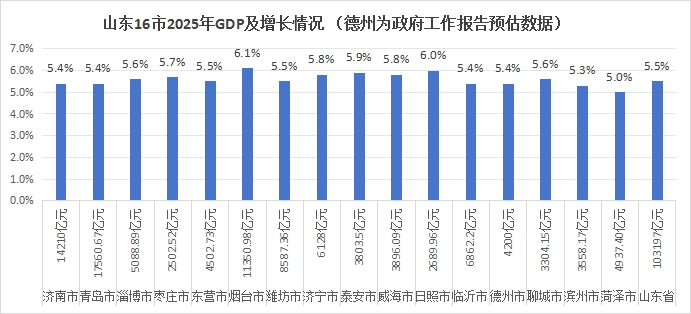
Economic Growth Overview - In 2025, Shandong's 16 cities are experiencing a "reshuffling" of economic growth rates, with a clear trend of regional collaboration and competition [3] - The economic growth rates of various cities are concentrated between 5.0% and 6.1%, indicating both steady progress and strong momentum in certain cities [3] - Yantai leads the province with a GDP of 11,350.98 million yuan, growing by 6.1% year-on-year, supported by significant contributions from all three industrial sectors [3] Key Cities and Contributions - Yantai and Rizhao are the only cities in the province with growth rates exceeding 6%, with Rizhao achieving a GDP of 2,689.96 million yuan, growing by 6% [3] - Major cities like Jinan, Qingdao, Yantai, and Weifang continue to play a crucial role in supporting the provincial economy, contributing over 53% of the total economic growth [4] - Traditional strong cities maintain stable growth around 5.4%, providing solid support for the overall provincial economy [4] Industrial Development - The "number one project" initiative is central to the economic stability and growth of Shandong's cities, focusing on high-end, intelligent, and green transformations [6] - Yantai's industrial output value increased by 13.5% in 2025, driven by key projects in the chemical and non-ferrous metal industries [6][8] - Jinan's equipment manufacturing sector saw a remarkable growth of 16.8%, significantly contributing to the overall industrial growth [8] Domestic Demand and Investment - Expanding domestic demand and promoting consumption are vital for economic growth in 2025, with cities implementing targeted actions to boost consumer spending [10] - For instance, Liaocheng's retail sales reached 1,388 million yuan, growing by 5.9%, while Rizhao's retail sales increased by 6.5% [10] - Investment in strategic emerging industries such as new energy and high-end equipment is on the rise, fostering a positive cycle of investment driving industry, which in turn supports consumption [12] International Trade and Economic Resilience - Shandong's total import and export value is projected to reach 35,300.3 million yuan in 2025, growing by 4.5%, surpassing the national average [12] - The province is actively expanding international markets and enhancing trade resilience through various initiatives [12] - The combined efforts of major cities, industrial foundations, and activated domestic markets showcase Shandong's robust economic resilience and commitment to high-quality development [12]

“2026年山东省政府工作邀您建言献策”活动圆满落幕
Da Zhong Ri Bao· 2026-02-05 01:15
Core Insights - The "2026 Shandong Provincial Government Work Solicitation" event successfully concluded, gathering public opinions to inform the government work report [2][4] - A total of 39 suggestions from the public were directly integrated into the government work report, reflecting the government's commitment to listening to public voices and addressing their concerns [4] Group 1: Event Overview - The event, themed "Gathering Wisdom for Development, Uniting Efforts for a New Chapter," lasted over a month and aimed to solicit diverse opinions from society [2] - It was launched on December 23, 2025, and included 17 core topics covering economic, social, cultural, ecological, and governance dimensions [2] Group 2: Public Participation - The event received significant attention, with over 100,000 netizens browsing the suggestion platform and more than 1,000 suggestions collected [3] - Suggestions included innovative ideas such as a rural mutual aid pension model and the cultivation of key industries like new energy vehicles and high-end equipment [3] Group 3: Government Response - Each suggestion was carefully categorized and reported to relevant departments, with 164 suggestions submitted to the government work report drafting team [4] - This marks the fifth consecutive year that the Shandong Provincial Government has initiated this public consultation activity, establishing a strong connection between the government and the public [4]
周乃翔会见新西兰客人
Da Zhong Ri Bao· 2026-02-04 01:04
Core Viewpoint - The meeting between the Vice Governor and the New Zealand Ambassador highlights the strengthening of economic and cultural ties between Shandong Province and New Zealand, with a focus on expanding cooperation in various sectors [1] Group 1: Economic Development - Shandong is recognized as a major province in China in terms of population, culture, resources, and economy, aiming to become a leader in green, low-carbon, and high-quality development [1] - The province is committed to deepening reforms and becoming a significant economic growth area in Northern China, creating favorable conditions for cooperation with New Zealand [1] Group 2: Cooperation Areas - There is an emphasis on expanding trade and cooperation in fields such as biotechnology, modern agriculture, new energy, digital technology, cultural tourism, and education and training [1] - The meeting encourages strong Shandong enterprises to invest in New Zealand while welcoming New Zealand businesses to develop in Shandong [1] Group 3: Diplomatic Relations - The New Zealand Ambassador praised the achievements of cooperation between New Zealand and Shandong, expressing a commitment to promote further exchanges and cooperation in trade, investment, culture, and education [1]
万华化学百万吨布局磷酸铁锂项目
鑫椤储能· 2026-02-03 06:25
Core Viewpoint - The article highlights the significant investment by Wanhua Chemical in lithium iron phosphate (LFP) production, emphasizing its strategic importance in the new energy sector and the growing demand for LFP in both power and energy storage batteries [5][9]. Group 1: Project Details - Wanhua Chemical is establishing a lithium iron phosphate project in Laizhou with an annual production capacity of 650,000 tons [5]. - The project is located in the Yinhai Chemical Industry Park, Laizhou, Shandong Province, covering an area of 371,647 square meters (approximately 557 acres) [6]. - The second phase of the green electricity industrial park will produce an additional 200,000 tons of lithium iron phosphate [7]. Group 2: Market Context - The demand for lithium iron phosphate is surging, with China's shipments reaching 2.575 million tons in the first three quarters of 2025, marking a year-on-year increase of 60.8% [9]. - The price of lithium iron phosphate has risen significantly, exceeding 40,000 yuan per ton, with storage-type prices ranging from 39,100 to 42,200 yuan per ton [9]. - The global electrochemical energy storage market saw a year-on-year shipment increase of 98.5% in the same period, indicating a robust market outlook [9]. Group 3: Strategic Implications - Wanhua Chemical's entry into the lithium iron phosphate market is seen as a pivotal event, signaling a new phase of competition characterized by technology, cost, scale, and sustainable development [10]. - The project aligns with Wanhua Chemical's overall development strategy, enhancing its supply chain and competitive capabilities in the international market [8][10].

青岛:锚定“双碳”目标,推动绿色低碳高质量发展
Zhong Guo Fa Zhan Wang· 2026-02-02 09:38
Core Viewpoint - Qingdao City is committed to achieving its "dual carbon" goals by promoting green transformation across key sectors such as energy, industry, construction, transportation, and technology, leading to significant progress in green, low-carbon, and high-quality development by 2025 [1] Group 1: Policy and Mechanism Optimization - The municipal government emphasizes high-level planning for "dual carbon" initiatives, formulating major policies and addressing significant issues to promote green and low-carbon development [2] - A comprehensive implementation plan for accelerating green transformation has been issued, aiming to create a resource-saving and environmentally friendly spatial layout, industrial structure, and lifestyle [2] - Various departments have established a responsibility list for key projects and policies to support green and low-carbon transformation [2] Group 2: Financial and Tax Support - Financial institutions in Qingdao have issued loans totaling 183.6 billion yuan, with 10 billion yuan allocated to 24 key carbon reduction projects, resulting in a carbon reduction of 23.6 million tons [3] - Tax incentives have been implemented, with 1.866 billion yuan in purchase tax exemptions for new energy vehicles and additional exemptions for energy-saving products [3] Group 3: Energy Structure Optimization - Coal consumption is maintained below 30%, with non-fossil energy consumption reaching 13.6%, a year-on-year increase of 2.8% [4] - Energy efficiency has improved, with energy intensity decreasing by 5.6% year-on-year, and Qingdao's carbon output efficiency rated as A high-efficiency class [4] Group 4: Manufacturing and Industrial Upgrades - The city has allocated approximately 800 million yuan for technological upgrades, benefiting over 360 enterprises, with notable achievements in energy efficiency [5] - A total of 67 national-level green factories and 66 provincial-level green factories have been recognized, promoting green manufacturing [5] Group 5: Green Construction and Urban Development - Qingdao has issued plans for green urban construction, aiming to establish a framework for green development and promote energy-efficient buildings [7] - Over 1.318 million square meters of energy-efficient buildings have been completed, with a significant focus on rural clean heating improvements [7] Group 6: Transportation and Infrastructure Development - The city has made strides in green transportation, with 100% of new energy buses in operation and significant advancements in electric vehicle infrastructure [9] - The promotion of green ports and shipping corridors has led to a 75% increase in shore power usage [8] Group 7: Innovation and Technology Advancement - Qingdao is advancing key technology projects in green and low-carbon sectors, with funding allocated for research in hydrogen energy and solid-state batteries [10] - The establishment of engineering research centers and support for solid-state battery projects are part of the city's innovation strategy [10] Group 8: Future Directions - Qingdao will continue to deepen its carbon peak pilot city construction, focusing on energy, industry, urban construction, transportation, and public institutions to enhance energy efficiency and carbon reduction [11]
十万亿大省迈上新征程
Jing Ji Guan Cha Bao· 2026-02-01 04:39
Core Insights - Shandong is positioned as a significant economic growth engine in Northern China, with a projected GDP exceeding 10 trillion yuan by 2025, contributing 7.4% to the national economy [4][5][13] - The province is focusing on high-quality development, aiming to establish a green, low-carbon economy and enhance its global competitiveness [5][23] Industry Developments - The aerospace industry in Shandong is developing rapidly, with the Yantai Dongfang Spaceport successfully launching 137 satellites and establishing a comprehensive aerospace industry chain [3][16] - Shandong is becoming a hub for new energy vehicles, with production expected to exceed 1.1 million units by 2025, accounting for 15.2% of the national lithium battery output [4][11] - The traditional textile industry is innovating through technology, such as extracting fibers from shrimp shells and waterless dyeing processes [19][21] Investment and Projects - Shandong is prioritizing project investments as a key driver for economic growth, with plans for 504 major projects and an investment target of over 160 billion yuan in 2026 [10][12] - The province is set to develop 2,000 provincial-level key industrial projects with a total investment exceeding 980 billion yuan by 2026 [12][13] - Major projects in the nuclear power sector are underway, with the Zhaoyuan nuclear power project expected to have a total investment of approximately 120 billion yuan [17][18] Technological Advancements - The Shandong Proton Center is expanding with a 1.5 billion yuan investment to enhance cancer treatment capabilities, aiming to create a comprehensive radiation therapy ecosystem [8][9] - The province is focusing on artificial intelligence and digital economy initiatives, with plans to establish a digital economy innovation development pilot zone [22][23] Urban Development - The integration of urban areas, particularly the Jinan and Qingdao metropolitan areas, is being emphasized to enhance regional economic collaboration and efficiency [23][24][25] - Shandong aims to improve transportation and connectivity within urban clusters, facilitating economic activities and population movement [23][26]

十万亿大省迈上新征程
经济观察报· 2026-02-01 04:30
Core Viewpoint - Shandong is positioned as a significant economic growth engine in Northern China, aiming to exceed a GDP of 10 trillion yuan by 2025, contributing to 7.4% of China's economy [10][11]. Group 1: Economic Growth and Development - Shandong's GDP reached 8.3 trillion yuan at the beginning of the 14th Five-Year Plan, with projections to surpass 10 trillion yuan by 2025 [10]. - The province is expected to enhance its economic contribution, with every 5 yuan of output in Northern China accounting for 1 yuan from Shandong [10]. - By 2035, Shandong aims to achieve a per capita GDP level comparable to that of moderately developed economies, improving the quality of life for its residents [11]. Group 2: Emerging Industries - Shandong is developing four trillion-level emerging pillar industries, including high-end equipment, information technology services, new energy, and new materials [26]. - The province's new energy vehicle production is projected to exceed 1.1 million units by 2025, with a total lithium battery output of 225 GWh, representing 15.2% of the national total [10]. - The aerospace industry is rapidly growing, with the Yantai Dongfang Spaceport successfully launching 137 satellites and establishing a comprehensive aerospace industry chain [9][25]. Group 3: Traditional Industry Transformation - Traditional industries in Shandong, such as textiles and petrochemicals, are undergoing significant transformations through technological innovation and sustainable practices [29][30]. - The petrochemical sector, while historically a strength, is being restructured from numerous small-scale operations to a more consolidated and efficient model [30][31]. - Shandong's focus on high-end, intelligent, and green transitions in traditional sectors is seen as essential for fostering new productive forces [29][32]. Group 4: Infrastructure and Project Development - Major projects are viewed as key drivers for economic growth, with Shandong planning to implement 2,000 provincial-level key industrial projects with over 980 billion yuan in total investment by 2026 [20][21]. - The province is also enhancing urban integration and developing metropolitan areas, with plans for 100 landmark projects to improve connectivity and collaboration [35][36]. - The establishment of the Jinan International Medical Center and the Shandong Proton Center exemplifies the focus on health and technology as part of the economic strategy [15][17]. Group 5: Future Outlook - Shandong's economic strategy is characterized by a commitment to innovation, sustainability, and the development of high-tech industries, positioning it as a model for regional economic development in China [34][36]. - The province's dual metropolitan areas of Jinan and Qingdao are expected to play a crucial role in driving regional economic growth and collaboration [35][36].