美联储降息预期降温

Search documents
公募基金泛固收指数跟踪周报(2025.11.10-2025.11.14):美联储降息预期降温,国内债市延续震荡-20251117
HWABAO SECURITIES· 2025-11-17 11:42
1. Report Industry Investment Rating - The report indicates that the current bond market has more opportunities than risks, especially from November to December [11]. 2. Core Viewpoints - Last week (2025.11.10 - 2025.11.14), the domestic bond market maintained an overall volatile pattern. The yield of 1 - year Treasury bonds rose by 0.59BP to 1.41%, the yield of 10 - year Treasury bonds remained flat at 1.81%, and the yield of 30 - year Treasury bonds fell by 1.00BP to 2.15%. The change in the wording of the third - quarter monetary policy implementation report towards further easing and the warming of inflation data led to a cooling of expectations for further monetary policy easing, resulting in a short - term continuation of the volatile pattern in the bond market [2][10]. - The US bond yield increased last week. The 1 - year US bond yield rose by 7BP to 3.70%, the 2 - year US bond yield rose by 7BP to 3.62%, and the 10 - year US bond yield rose by 3BP to 4.14%. The increasingly hawkish attitude of Fed officials led to a significant cooling of the market's expectation of a Fed rate cut in December [11]. - The issuance of Huaxia Anbo Warehouse REIT was very popular, achieving "one - day sell - out". The public offering part of Huaxia Anbo Warehouse REIT, which was launched on November 11, exceeded the initial fundraising scale limit in one day and started the proportional placement [12][13]. 3. Summary by Directory 3.1. Pan - fixed - income Market Review and Observation - **Domestic Bond Market**: The domestic bond market was volatile last week. The change in the monetary policy report's wording and the warming of inflation data affected the market. In the long term, the downward breakthrough of long - term yields depends on economic data and investors' risk preferences. Overall, the bond market from November to December has more opportunities than risks [10][11]. - **US Bond Market**: The US bond yield increased last week. The hawkish attitude of Fed officials and the under - expected auction yield of 10 - year US Treasury bonds led to a significant cooling of the market's expectation of a Fed rate cut in December [11]. - **REITs Market**: The CSI REITs Total Return Index rose by 0.86% last week, with the transportation, affordable housing, consumption, and warehousing and logistics sectors leading the rise, while the municipal environmental protection and data center sectors falling. The issuance of Huaxia Anbo Warehouse REIT was very popular [12]. 3.2. Public Fund Market Dynamics - The issuance of Huaxia Anbo Warehouse REIT was very popular, achieving "one - day sell - out". The public offering part exceeded the initial fundraising scale limit in one day, and the public investor subscription confirmation ratio was 5.83%, while the offline investor confirmation ratio was as low as 0.68% [12][13]. 3.3. Pan - fixed - income Fund Index Performance Tracking - **Performance Statistics**: - The money enhancement index rose by 0.03% last week, with a cumulative return of 4.30% since its establishment [4]. - The short - term bond fund selection index rose by 0.03% last week, with a cumulative return of 4.48% since its establishment [4]. - The medium - and long - term bond fund selection index rose by 0.07% last week, with a cumulative return of 6.82% since its establishment [4]. - The low - volatility fixed - income + fund selection index rose by 0.07% last week, with a cumulative return of 4.78% since its establishment [4]. - The medium - volatility fixed - income + fund selection index rose by 0.04% last week, with a cumulative return of 6.12% since its establishment [4]. - The high - volatility fixed - income + fund selection index fell by 0.06% last week, with a cumulative return of 8.11% since its establishment [4]. - The convertible bond fund selection index rose by 0.03% last week, with a cumulative return of 23.54% since its establishment [4]. - The QDII bond fund selection index rose by 0.08% last week, with a cumulative return of 10.35% since its establishment [4]. - The REITs fund selection index rose by 1.67% last week, with a cumulative return of 33.81% since its establishment [4]. - **Index Positioning**: - **Money Enhancement Strategy Index**: Aims at liquidity management, pursues a curve that surpasses money funds and rises smoothly, and mainly allocates money market funds and inter - bank certificate of deposit index funds [17]. - **Short - term Bond Fund Selection Index**: Aims at liquidity management, pursues a smooth upward curve on the basis of ensuring drawdown control, and mainly configures 5 funds with stable long - term returns, strict drawdown control, and significant absolute return capabilities [19]. - **Medium - and Long - term Bond Fund Selection Index**: Aims to obtain stable returns by investing in medium - and long - term pure bond funds, controls drawdowns, and tries to obtain excess returns relative to the medium - and long - term bond fund index. It selects funds with both returns and drawdown control, and flexibly adjusts the duration and the proportion of credit bond funds and interest rate bond funds according to market conditions [21]. - **Low - volatility Fixed - income + Selection Index**: The equity center is positioned at 10%, and 10 funds are selected each period. It focuses on selecting fixed - income + targets with an equity center within 15% in the past three years and recently, and emphasizes the holding experience [22]. - **Medium - volatility Fixed - income + Selection Index**: The equity center is positioned at 20%, and 5 funds are selected each period. It selects fixed - income + targets with an equity center between 15% and 25% in the past three years and recently, and focuses on the performance - risk cost - effectiveness [25]. - **High - volatility Fixed - income + Selection Index**: The equity center is positioned at 30%, and 5 funds are selected each period. It selects fixed - income + targets with an equity center between 25% and 35% in the past three years and recently, and focuses on selecting targets with strong stock - picking ability and certain offensiveness on the equity side [26][29]. - **Convertible Bond Fund Selection Index**: Selects bond - type funds with the average proportion of convertible bond investment in bond market value greater than or equal to 60% in the latest period and greater than or equal to 80% in the past four quarters as the sample space. It constructs an evaluation system from multiple dimensions and selects 5 funds to form the index [30]. - **QDII Bond Fund Selection Index**: Selects 6 funds with stable returns and good risk control based on the credit and duration of overseas bonds to form the index [33]. - **REITs Fund Selection Index**: Selects 10 funds with stable operation, reasonable valuation, and certain elasticity based on the underlying asset types of REITs to form the index [34].
全线暴跌!超23万人爆仓
Zhong Guo Ji Jin Bao· 2025-11-14 05:39
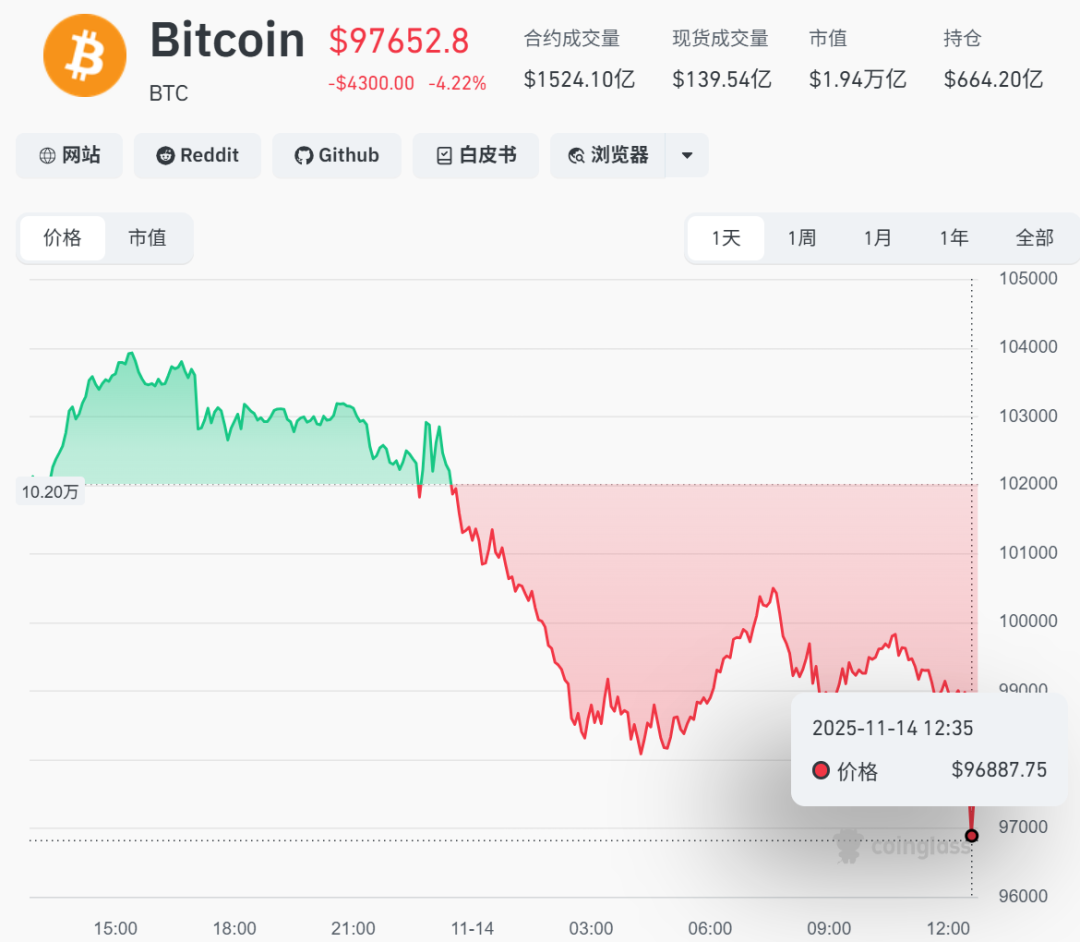
Core Viewpoint - The cryptocurrency market has experienced a significant downturn, with major cryptocurrencies like Bitcoin and Ethereum seeing substantial price drops, leading to over 230,000 liquidations totaling approximately $1.024 billion [1][7]. Market Performance - Bitcoin's price fell below $97,000, with a 24-hour decline of over 4% [1]. - Ethereum approached $3,100, experiencing a nearly 10% drop within the same timeframe [3]. - Other major cryptocurrencies, including Solana, Dogecoin, XRP, and Cardano, also reported notable declines [5]. Liquidation Data - Over 230,000 traders were liquidated in the past 24 hours, with total liquidations amounting to $1.024 billion, of which $888 million were from long positions and $136 million from short positions [7]. - The largest single liquidation occurred on the HTX-BTC-USDT pair [7]. Market Dynamics - Data from CoinGlass indicates that the majority of the selling pressure is driven by U.S. retail investors, with the Coinbase premium index showing deep negative values, suggesting significant selling pressure in the U.S. market compared to buying interest in Asia and Europe [8]. - The correlation between Bitcoin and the Nasdaq index remains high at 0.8, with Bitcoin's price movements being more bearish than the stock index, reflecting greater sensitivity to negative market sentiment [9]. Macroeconomic Factors - Concerns over the U.S. government's inability to release key economic data due to a recent "shutdown" have contributed to market uncertainty, with potential implications for interest rate decisions [10]. - Federal Reserve officials have expressed hawkish views regarding inflation, indicating a cautious stance on future interest rate cuts, which may further impact the cryptocurrency market [10].

美股三大指数集体下跌 原油期货价格上涨
Qi Huo Ri Bao Wang· 2025-08-26 05:21
Group 1 - The three major U.S. stock indices closed lower on August 25, with the Dow Jones Industrial Average down 349.27 points to 45282.47, a decline of 0.77% [1] - The S&P 500 index fell by 27.59 points to 6439.32, a decrease of 0.43%, while the Nasdaq Composite dropped 47.24 points to 21449.29, down 0.22% [1] - Market sentiment was affected by a cooling expectation of a potential interest rate cut by the Federal Reserve in September, alongside rising dollar index and U.S. Treasury yields, putting pressure on risk assets [1] Group 2 - In the oil futures market, President Trump warned of potential stricter sanctions on Russia if direct talks between Russian and Ukrainian leaders do not occur within two weeks, raising concerns about tighter global oil supply [2] - As a result, international oil prices increased, with WTI crude oil futures rising by $1.14 to settle at $64.80 per barrel, a gain of 1.79%, and Brent crude oil futures up $1.00 to $68.22 per barrel, an increase of 1.49% [2] Group 3 - Intel warned in a filing with the SEC that the U.S. government's acquisition of approximately 10% of its shares, making it the largest shareholder, could pose risks to the company's business development, leading to a 1% drop in its stock price [1]
特写:金价高位横盘数月 深圳水贝商家很“淡定”
Sou Hu Cai Jing· 2025-07-17 11:15
Core Viewpoint - International gold prices have been fluctuating around the historical high of $3500 per ounce for nearly three months, with minimal impact on retail sales in Shenzhen's gold market [1][2] Group 1: Market Behavior - Retailers in Shenzhen, such as those in the Shui Bei area, report that high gold prices have not significantly affected their business, as consumers are becoming accustomed to the current price levels [1] - Consumers are showing interest in purchasing gold products like gold beans and small gold bars, which have lower processing fees and are easier to liquidate [1] - The price point of 800 yuan per gram is seen as a critical threshold for consumers, with some retailers successfully selling smaller gold items at prices below this level [1] Group 2: Price Stability and Future Outlook - The recent stability in gold prices has led to a lack of significant increase in gold recycling volumes, indicating consumer confidence in future price trends [2] - Analysts suggest that breaking through the previous high of $3500 per ounce requires new external factors, while current U.S. monetary policy and tariff uncertainties are influencing gold price stability [2] - The cautious outlook on U.S. monetary policy may limit gold price movements in the near term, despite ongoing inflation concerns related to tariffs [2]
美联储降息预期降温,黄金回落
Sou Hu Cai Jing· 2025-07-04 03:38
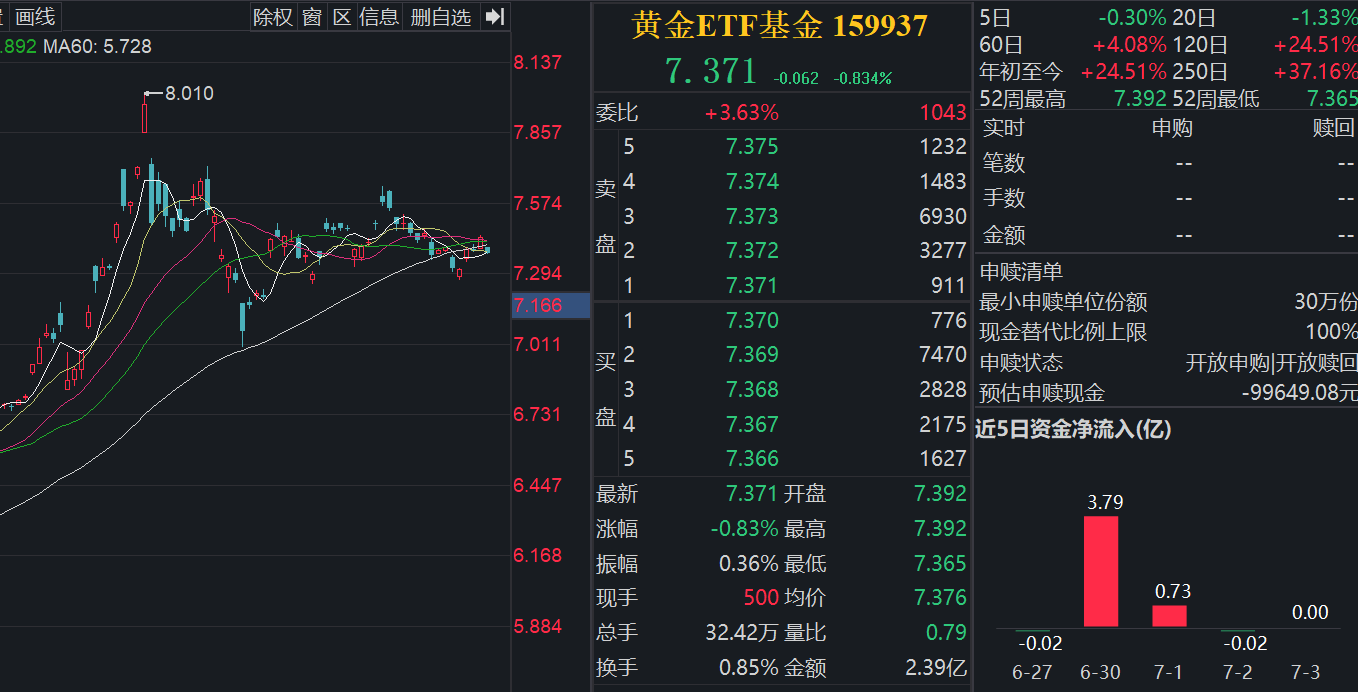
Group 1 - The strong U.S. employment data has diminished market expectations for a Federal Reserve rate cut, leading to a significant rise in the dollar index and a decline in spot gold prices [1][2] - In June, the U.S. non-farm payrolls increased by 147,000, surpassing the expected 110,000, while the unemployment rate fell to 4.1%, the lowest since February [1][2] - The likelihood of a rate cut in July is now considered nearly zero, with a 75% probability for a cut in September, indicating a resilient labor market [2][3] Group 2 - Analysts suggest that geopolitical factors will support gold prices in the long term, despite a decrease in rate cut expectations [3] - Central banks are expected to continue increasing their gold reserves due to rising dollar credit risks and strategic asset allocation needs [3] - The performance of gold assets remains strong during both overheating and recessionary economic cycles, making gold ETFs a viable investment option [3][5] Group 3 - The gold ETF (159937) experienced a decline of 0.8% on July 4, with a trading volume of 239 million yuan, but has seen a 4.08% increase over the past month [5] - The net inflow of funds into the gold ETF over the last five days was 447 million yuan, indicating continued investor interest [5]
盈信量化(首源投资)假期重磅消息!下周A股或将迎来新变数?
Sou Hu Cai Jing· 2025-06-02 02:24
Core Viewpoint - The recent introduction of quantitative trading regulations, the cooling of Federal Reserve rate cut expectations, and China's tariff countermeasures are the three major factors influencing the A-share market's performance, potentially leading to a low-open, high-close trend next week [1][3]. Regulatory Impact - The implementation of the "Procedural Trading Management Implementation Rules" by the three major exchanges in China will have a profound impact on the stock market ecosystem, establishing standards for high-frequency trading and introducing AI monitoring systems to address four types of abnormal trading behaviors [1]. - The new regulations may suppress the trading volume of quantitative strategies, which currently account for 25%-30% of total trading volume in A-shares, but will enhance trading fairness, benefiting retail investors in the long run [3]. Market Outlook - The Federal Reserve's recent statements have dampened global rate cut expectations, indicating that inflation may rise due to tariffs, which could lead to a cautious approach towards rate cuts [3]. - The shift in the Fed's stance from targeting a 2% inflation rate to a wait-and-see approach has resulted in a rise in the dollar index, putting pressure on risk assets, particularly interest rate-sensitive sectors like technology stocks [3]. Investment Strategy - Investors are advised to focus on two main themes: "beneficiaries of countermeasures" and "domestic demand recovery," targeting sectors and stocks that benefit from tariff countermeasures and domestic demand stimulus policies [3]. - A balanced allocation between technology growth stocks and high-dividend defensive stocks is crucial, as technology stocks may face short-term pressure from foreign capital withdrawal, while high-dividend stocks can provide protection during market volatility [3].