
美联储降息预期降温

Search documents
黄金白银,集体下跌!一则消息传来,油价大涨→
新华网财经· 2026-03-14 02:21
Group 1: Oil Market - The core viewpoint is that geopolitical tensions, particularly regarding U.S. military actions against Iran, have significantly impacted oil prices, leading to a notable increase in both U.S. and Brent crude oil prices [3] - On April 13, the price of light crude oil futures for April delivery closed at $98.71 per barrel, reflecting a rise of 3.11%, while Brent crude for May delivery closed at $103.14 per barrel, up by 2.67% [3] - For the week, U.S. oil prices increased by 8.59%, and Brent oil prices surged by 11.27% [3] Group 2: Precious Metals Market - The core viewpoint indicates that gold and silver prices have declined due to a cooling of interest rate cut expectations from the Federal Reserve and a rising U.S. dollar index [6] - On April 13, gold futures for April delivery settled at $5061.70 per ounce, down by 1.25%, while silver futures for May delivery closed at $81.343 per ounce, down by 4.43% [6] - For the week, international gold prices fell by 1.88%, and silver prices decreased by 3.52% [6]


金银价格大跳水
Xin Lang Cai Jing· 2026-02-17 08:19
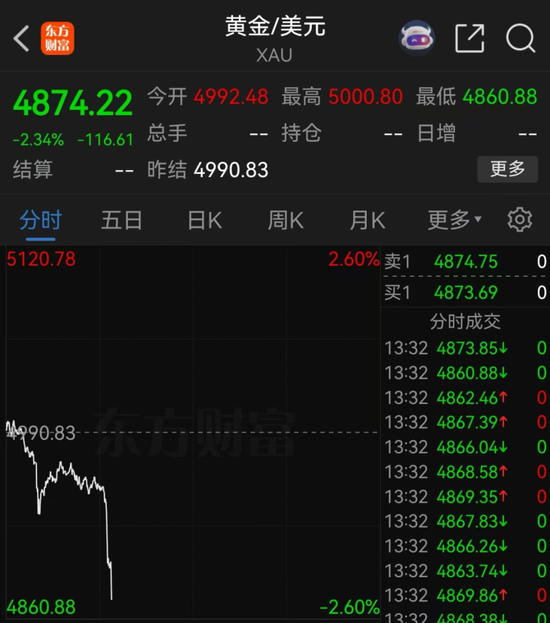
Core Viewpoint - The precious metals market is experiencing downward pressure due to a combination of factors, including a cooling expectation of interest rate cuts by the Federal Reserve and profit-taking by investors, leading to significant price drops in gold and silver [1][3]. Market Performance - On February 17, gold prices fell below $4,900 per ounce, dropping over 2% during the day, while silver prices decreased nearly 5%, falling below $73 [1][3]. - The trading volume in the precious metals market was low due to multiple major markets being closed for traditional holidays [1][3]. Price Movements - Gold opened at $4,874.22, reached a high of $4,992.48, and a low of $4,860.88, ultimately reflecting a decrease of 2.34% [4]. - Silver opened at $72.98, peaked at $76.55, and hit a low of $72.81, showing a decline of 4.75% [5].
现货黄金跌破4900美元!白银暴跌10%+,普通人抄底必亏
Sou Hu Cai Jing· 2026-02-14 00:17
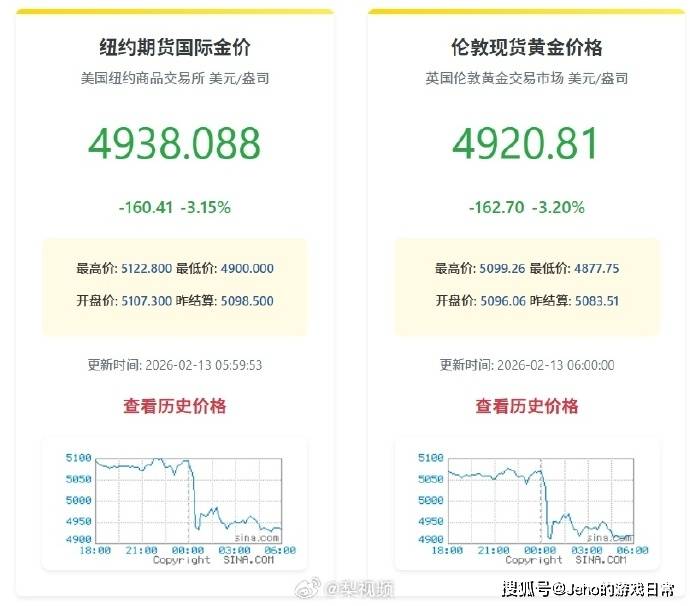
Core Viewpoint - The recent sharp decline in precious metals, particularly gold and silver, has surprised many investors, with gold dropping below $4900 and silver experiencing a single-day drop of over 10% [1][3]. Market Performance - As of the latest update, spot gold has decreased by 3.27% to $4917.09 per ounce, with a minimum price of around $4878 during trading. COMEX gold futures fell by 3.19% to $4936 per ounce [3]. - Silver has seen a more severe decline, with spot silver dropping 10.84% to $75.07 per ounce, and COMEX silver futures down 10.93% to $74.75 per ounce, marking one of the largest single-day declines since 2026 [3]. Economic Factors - The primary reason for the sharp decline in precious metals is the cooling expectations for interest rate cuts by the Federal Reserve, driven by stronger-than-expected U.S. employment data, which showed an addition of 130,000 jobs and a drop in the unemployment rate to 4.3% [5]. - A stronger U.S. dollar has also negatively impacted precious metals, making them more expensive for global buyers and reducing demand [5]. Trading Dynamics - Algorithmic trading has exacerbated the price drop, particularly through momentum-based risk-off strategies that trigger automatic sell orders when key price levels are breached [7]. - Profit-taking by investors who had previously benefited from rising prices has further contributed to the downward pressure on gold and silver prices [7]. Investment Guidance - Investors are advised against attempting to "buy the dip" due to the high volatility and potential for further declines in precious metals [9]. - For those already holding gold or silver investments, a long-term perspective is recommended, while short-term traders should consider cutting losses [9][10]. Future Outlook - Analysts suggest that precious metals may continue to experience volatility, with upcoming U.S. CPI data being a critical factor influencing future price movements [10]. - Long-term forecasts remain bullish for gold, with institutions like JPMorgan and Goldman Sachs predicting prices could exceed $6000 per ounce by year-end, while silver is expected to face short-term fluctuations but has a tight supply outlook [10].
艾默生电气股价高位回调,受大盘拖累与估值压力影响
Jing Ji Guan Cha Wang· 2026-02-12 17:12
Core Viewpoint - Emerson Electric (EMR.N) experienced a significant stock price decline of 4.05% on February 12, 2026, closing at $148.41 after reaching a historical high of $161.69 the previous trading day, indicating increased volatility at elevated price levels [1][2]. Stock Price Movement Reasons - The stock's decline followed profit-taking after hitting a record high, with a minimum intraday price of $145.79. The overall market sentiment was affected by a drop in major U.S. indices, with the Nasdaq down 1.55% and the Dow Jones down 1.10%. The commercial equipment services sector, to which Emerson belongs, fell by 0.69% [2]. - Market expectations for a Federal Reserve interest rate cut have cooled, and weak earnings guidance from some companies has impacted risk appetite. Emerson's price-to-earnings ratio (TTM) stands at 36.29, above the industry average, raising concerns among investors regarding the sustainability of automation demand and rising cost risks. Although some institutions have raised target prices, they have also highlighted uncertainties in the execution of business transformation [2]. Performance and Operating Conditions - For the first fiscal quarter of 2026 (ending December 31, 2025), Emerson reported an adjusted earnings per share of $1.46, exceeding market expectations. Revenue reached $4.35 billion, reflecting a year-over-year growth of 4.1%, with base orders increasing for the fourth consecutive quarter. The company plans to return $2.2 billion to shareholders through stock buybacks and dividends, and has raised its earnings per share guidance for fiscal year 2026 to a range of $6.40 to $6.55 [3].
微信封杀元宝?限制措施即日生效,腾讯股价大跌
Sou Hu Cai Jing· 2026-02-04 03:35
Group 1 - The core viewpoint of the articles highlights the crackdown on excessive marketing and inducement sharing behaviors related to the Spring Festival, with immediate measures taken to restrict access to certain links within WeChat [1] - Tencent's stock experienced a significant decline, dropping over 3% during trading, which negatively impacted the performance of the Hang Seng Tech Index [1] - The overall sentiment in the Hong Kong stock market is low, influenced by factors such as the cooling expectations of interest rate cuts by the Federal Reserve and disturbances in overseas situations, leading to a more than 20% decline in the Hang Seng Tech Index, with valuations falling to a near five-year low [1] Group 2 - The Hong Kong Stock Connect Technology ETF (159101) focuses on the technology sector, characterized by high elasticity [2] - The Hong Kong Stock Connect Internet ETF (520910) targets leading internet companies, benefiting from the AI narrative [3]

港股持续震荡调整,资金涌入恒生科技
Sou Hu Cai Jing· 2026-02-03 02:41
Core Viewpoint - The Hong Kong stock market has continued to experience a volatile adjustment trend this year, with the Hang Seng Tech Index recently undergoing a decline due to cooling expectations of interest rate cuts by the Federal Reserve [1] Group 1: Market Performance - The Hang Seng Tech Index has seen a year-to-date decline of nearly 1% [1] - The Hang Seng Tech Index ETF (513180) has followed the index's downward trend [1] Group 2: External Influences - There is a tightening expectation of overseas liquidity, influenced by the recent nomination of Kevin Warsh as the Federal Reserve Chair, raising concerns about financial conditions tightening [1] - The US dollar has experienced a slight strengthening, putting pressure on emerging market equity assets [1] Group 3: Investment Activity - Despite the ongoing adjustments in the Hong Kong stock market, there has been a counter-trend increase in capital, with over 200 million yuan being subscribed to the Hang Seng Tech Index ETF (513180) on February 2 [1]
高市早苗“放大招” 日元迎命运转折点
Jin Tou Wang· 2025-11-24 14:08
Core Viewpoint - The Japanese yen is experiencing upward movement against the US dollar due to increasing concerns over Japan's deteriorating fiscal situation and expectations of delayed interest rate hikes by the Bank of Japan [1][2] Group 1: Economic Stimulus and Fiscal Concerns - The Japanese government approved a significant economic stimulus plan totaling 21.3 trillion yen, marking the largest since the COVID-19 pandemic, with general account expenditures of 17.7 trillion yen, surpassing last year's 13.9 trillion yen [1] - This stimulus plan has heightened market concerns regarding Japan's fiscal health and the potential increase in government debt supply, keeping borrowing costs at multi-decade highs [2] Group 2: Currency Movements and Market Reactions - The USD/JPY exchange rate is expected to test resistance levels around 157.45-157.50, with potential upward movement towards 157.85-157.90, following a recent high [3] - A breakthrough above the 158.00 level could trigger further bullish momentum, while support levels are identified at 156.20-156.25 and 156.00, with significant support expected around 154.50-154.45 [3]
全线暴跌!22.7万人爆仓
天天基金网· 2025-11-21 05:20
Market Overview - Risk assets have experienced a significant sell-off, with cryptocurrencies and tech stocks leading the decline. Bitcoin and Ethereum both fell over 5%, while the total liquidation in the cryptocurrency market exceeded $8 billion, affecting approximately 227,000 traders [3][4]. - The South Korean Composite Index dropped over 3%, and the Nikkei 225 Index fell more than 2%, reflecting a broader concern over tech stock valuations [3][7]. Cryptocurrency Market - Bitcoin's price has dropped to approximately $87,200, marking a decline of over 7% year-to-date, which could result in its first annual drop since 2022 [4]. - The likelihood of Bitcoin falling below $90,000 by year-end has risen to 50%, while the chance of it surpassing $100,000 by 2025 is only 30% [4][6]. - Analysts indicate that Bitcoin has broken below its 50-day and 200-day moving averages, leading to a loss of interest from trend-following investors [5]. Federal Reserve and Economic Indicators - The Federal Reserve's expectations for interest rate cuts have significantly diminished, with Morgan Stanley no longer predicting a rate cut in December. The recent employment data showed a substantial increase in non-farm jobs, which has led to a reassessment of economic conditions [8][9]. - Federal Reserve officials have expressed concerns about inflation remaining around 3%, indicating a cautious approach towards future rate cuts [9][10]. Tech Stock Performance - Major tech stocks have seen substantial declines, with companies like SanDisk and Micron experiencing drops of over 20% and 10%, respectively. This trend is attributed to renewed fears of a tech valuation bubble [7][8]. - The sell-off in tech stocks has been exacerbated by the Fed's stance on interest rates, as officials have downplayed the likelihood of imminent rate cuts [8][9].

刚刚,全线暴跌!22.7万人爆仓
券商中国· 2025-11-21 01:36
Core Viewpoint - The recent sell-off in risk assets, particularly cryptocurrencies and tech stocks, is driven by renewed concerns over tech stock valuation bubbles and a significant cooling of expectations for interest rate cuts by the Federal Reserve [1][6][7]. Cryptocurrency Market - Bitcoin and Ethereum have both dropped over 5%, with Bitcoin trading at approximately $87,200 and Ethereum at around $2,853 [2]. - The cryptocurrency market has seen over $831 million in liquidations within 24 hours, affecting 227,000 traders, with long positions accounting for $696 million of the liquidations [2]. - Analysts indicate that Bitcoin's price is currently weak, having fallen below both the 50-day and 200-day moving averages, and the likelihood of Bitcoin dropping below $90,000 by year-end has risen to 50% [3]. - The overall decline in Bitcoin has erased all gains made this year, marking the first annual drop since 2022, with a cumulative decline of over 7% year-to-date [2]. Stock Market Performance - The tech sector has faced significant declines, with major companies like Nvidia and Micron experiencing drops of over 10% and 20% respectively [4]. - The South Korean Composite Index and the Nikkei 225 have both seen substantial declines, with the former down 3.65% and the latter down 2.26% [5]. - SoftBank Group's stock fell nearly 9%, while other tech-related stocks also experienced significant losses [5]. Federal Reserve's Interest Rate Outlook - The Federal Reserve's expectations for interest rate cuts have diminished, with Morgan Stanley no longer predicting a rate cut in December [6]. - Recent employment data showed a significant increase in non-farm payrolls, leading to a reassessment of the economic outlook and a belief that the economy may be more stable than previously thought [6]. - Federal Reserve officials have expressed caution regarding further rate cuts, highlighting ongoing inflation concerns and the potential for asset price adjustments [7].

冬季补库需求推动美国天然气价格阶段性反弹
Qi Huo Ri Bao Wang· 2025-11-20 01:27
Group 1: Natural Gas Price Trends - International natural gas prices have rebounded in mid-October after a prolonged decline, with the largest increase seen in U.S. natural gas prices due to export prospects and winter stockpiling [1] - European and Asian natural gas prices have seen smaller increases, as industrial demand remains weak, and while power generation demand has grown, it is insufficient to offset supply increases [1] - The rebound potential for international natural gas prices is limited due to relatively small declines in natural gas inventories in Europe and the U.S. compared to last year, alongside ongoing weak industrial demand [1] Group 2: Global Economic Uncertainty - The end of the U.S. government shutdown may lead to some recovery in the U.S. economy, potentially benefiting natural gas consumption [2] - Concerns over a capital market bubble driven by AI have intensified, with investors selling off assets ahead of key events, reflecting fears of high valuations similar to the 2000 internet bubble [2] - The expectation for a Federal Reserve rate cut in December has cooled, with significant internal disagreements among officials regarding inflation risks and economic data availability [2] Group 3: Supply Growth Projections - Global natural gas supply is expected to see explosive growth in 2026, primarily driven by new LNG capacity from the U.S., Canada, and Qatar, with an anticipated increase of 40 billion cubic meters, or 7% [3] - In the third quarter of 2025, global LNG exports reached 107 million tons, marking a 3% quarter-on-quarter increase and a 5% year-on-year increase, largely due to U.S. supply growth [3] - By 2030, global LNG capacity is projected to increase by approximately 300 billion cubic meters annually, significantly influenced by new U.S. and Qatari LNG projects [4] Group 4: Demand Dynamics - High natural gas prices have suppressed demand, particularly in price-sensitive Asian markets, with global demand growth expected to slow to about 1.5% annually from 2024 to 2030 [5] - European natural gas consumption has shown robust growth, driven mainly by the power sector, while industrial demand has declined due to high prices [6] - Asian natural gas demand has stagnated, with a projected decline in 2025, influenced by high LNG spot prices and macroeconomic conditions [6] Group 5: Winter Stockpiling and Future Outlook - Following significant consumption in the winter of 2024, EU natural gas storage levels were low in spring 2025, but strong summer LNG imports have supported rapid replenishment [7] - As of early October, EU storage levels reached 83%, still below last year's 93%, with U.S. storage levels also recovering after winter withdrawals [7] - The ability to replenish natural gas stocks in Europe and the U.S. will depend on winter weather conditions, with potential for strong price rebounds if a cold winter occurs [7] Group 6: Overall Market Outlook - Global economic growth in 2025 is expected to be influenced by U.S. tariff policies, Federal Reserve monetary policy, and European geopolitical crises, affecting industrial demand for natural gas [8] - While European natural gas power generation demand remains strong, Asian markets are seeing a decline due to increased reliance on nuclear and renewable energy sources [8] - In 2026, a potential recovery in industrial gas demand is anticipated, but significant supply growth may lead to oversupply pressures, limiting price increases [8]