股价操纵

Search documents
稳一稳 | 谈股论金
Sou Hu Cai Jing· 2026-01-19 09:57
Core Viewpoint - The A-share market experienced significant fluctuations today, primarily influenced by large-scale sell-offs in broad-based ETFs, with the Shanghai Composite Index and Shenzhen Component Index both closing in positive territory despite pressures from heavyweight stocks [1][2]. Market Performance - The Shanghai Composite Index rose by 0.29%, while the Shenzhen Component Index increased by 0.09% [1]. - A total of 3,454 stocks advanced, compared to 1,693 that declined, with a market turnover of approximately 2.7 trillion yuan [1]. - Despite a net outflow of 42.4 billion yuan from major funds, the median increase in individual stocks was 0.84%, indicating a positive performance for many, especially small and mid-cap stocks [1]. Sector Analysis - The main pressure on the indices came from heavyweight stocks, particularly in the financial sector, which includes banks, insurance, and securities, negatively impacting the overall index performance [1]. - Notable sectors that performed well included precious metals, electric grid equipment, and the recovering commercial aerospace sector, which saw a net inflow of 2.2 billion yuan [2]. Regulatory Environment - Recent news indicates that excessive speculation in thematic and concept stocks has drawn regulatory scrutiny, particularly in the commercial aerospace sector [2][3]. - The China Securities Regulatory Commission (CSRC) has emphasized the need to crack down on excessive speculation and stock price manipulation, which may lead to increased regulatory focus on such activities [3][4]. Market Sentiment and Future Outlook - The CSRC introduced the concept of "counter-cyclical regulation," suggesting potential measures to cool down an overheated market or support a rapidly cooling one [4]. - The overall market sentiment reflects a balance between investor desires for quick profits and regulatory aims for stability and long-term growth, with a call for investors to adopt a more restrained, long-term investment approach [4].
券商原首席分析师收钱写研报被判刑
Cai Jing Wang· 2025-12-26 14:48
Core Viewpoint - The article discusses a case involving two analysts from a brokerage firm who were convicted of accepting bribes to produce biased research reports, which contributed to stock price manipulation of a listed company, Jiangsu Litong Electronics Co., Ltd. [1][2] Group 1: Case Details - Analysts Zou and Cheng were sentenced to ten months and eight months in prison, respectively, with a one-year probation and a fine of 100,000 yuan each for accepting bribes [1][2] - Zou received 180,000 yuan for writing a report to boost market interest in Jiangsu Litong Electronics, while Cheng facilitated communication and received 50,000 yuan [2] - The case highlights a complete chain of interest transfer, from the company paying bribes to analysts producing tailored reports that inflated stock prices, allowing major shareholders to cash out at peak prices [1][2] Group 2: Stock Price Movement - Jiangsu Litong Electronics' stock price surged from 12.20 yuan per share in early April 2023 to a peak of 40.51 yuan per share by mid-November 2023, marking a 232% increase [3] - Following the price surge, major shareholders began to sell their shares, with the third-largest shareholder reducing their holdings by 2.2231 million shares at an average price of 32.7 yuan per share, cashing out approximately 73 million yuan [3] Group 3: Regulatory Implications - The incident underscores the need for independent and impartial research reports, as the practice of paid reports undermines analyst integrity and violates legal standards [4] - Regulatory authorities have maintained a stringent stance against violations in brokerage research, with recent actions categorizing paid reports as criminal offenses [5] - The case is part of a broader context where Jiangsu Litong Electronics was previously implicated in stock manipulation schemes, indicating ongoing scrutiny of its market activities [5]

104个账户白忙三年,金城医药董事长“炒自家股”反亏739万
Xin Lang Cai Jing· 2025-12-16 10:05
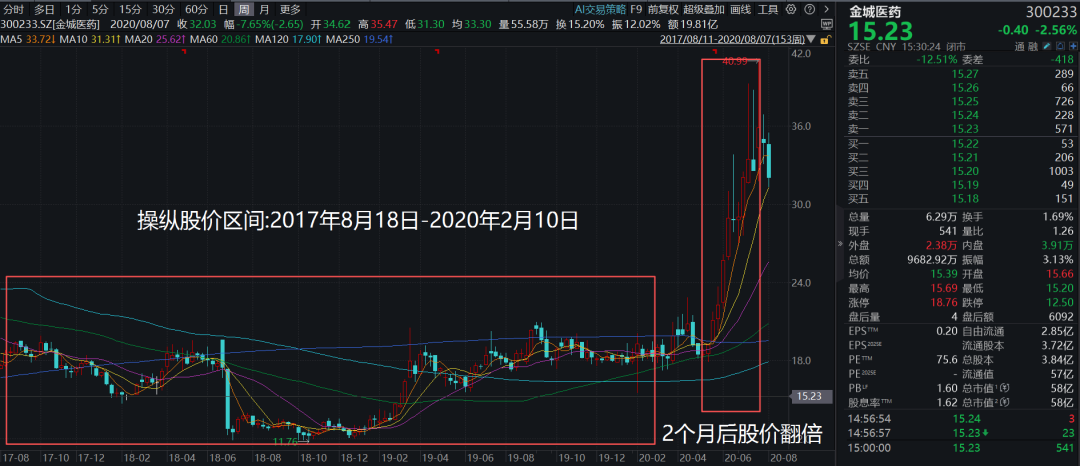
Group 1 - Zhao Yeqing, the chairman of Jincheng Pharmaceutical, was fined 1.5 million yuan and banned from the market for four years due to stock manipulation, leading to his resignation on the same day the penalty was announced [1][6][9] - The stock manipulation scheme involved 104 accounts and a total investment of over 2.1 billion yuan, resulting in a loss of approximately 7.39 million yuan [1][6][9] - The investigation and hearing process lasted over a year, with the China Securities Regulatory Commission (CSRC) formally announcing the penalty on December 10, 2025 [1][6][9] Group 2 - The manipulation occurred between August 2017 and February 2020, with the involved parties controlling 1.19 billion shares bought and 1.07 billion shares sold during 595 trading days [6][9][39] - The accounts held an average of 18.58 million shares daily, peaking at 32.09 million shares, which represented up to 9.04% of the circulating shares [39][41] - The CSRC's decision was based on the 2005 Securities Law, which was applicable at the time of the offenses, and the penalty was significantly lower than it would have been under the new law [2][34] Group 3 - As of December 16, 2025, Jincheng Pharmaceutical's stock price was 14.41 yuan per share, with a total market capitalization of 5.532 billion yuan [3][35] - The company reported a decline in revenue from its three main product lines in 2024, with decreases of 4.93%, 9.19%, and 13.39% respectively [18][49] - Despite the challenges, Jincheng Pharmaceutical's stock price increased significantly after the announcement of the chairman's penalty, with a peak increase of 70% from March 7 to March 26, 2025 [19][50] Group 4 - Jincheng Pharmaceutical has been considering a transition into the tobacco industry, establishing a new division for this purpose in 2024 [24][55] - The company has a history of significant cash dividends, planning to distribute approximately 56.9 million yuan in 2024, despite a projected net profit of only 197 million yuan [16][47] - The company has faced challenges with its acquisition of Jincheng Tail, which has reported cumulative losses exceeding 300 million yuan over five years [22][53]


金城医药股价操纵“闹剧”始末:104个账户交易额超21亿却亏739万
Xin Lang Cai Jing· 2025-12-15 13:33
Group 1 - The core issue involves the manipulation of Jincheng Pharmaceutical's stock by its actual controller Zhao Yeqing and two others, leading to penalties from the China Securities Regulatory Commission (CSRC) [1][16][20] - Zhao Yeqing, Wang Zhen, and Liu Feng were fined a total of 3 million yuan, with Zhao receiving a 4-year market ban, Wang a 3-year ban, and Liu a 30-month ban [1][20] - During the manipulation period from August 18, 2017, to February 10, 2020, the trio opened 104 accounts, trading a total of 2.134 billion yuan, resulting in a loss of 7.39 million yuan [2][19][20] Group 2 - The stock manipulation involved 595 trading days, with the accounts participating in trading on 502 days, buying 119 million shares for 2.134 billion yuan and selling 107 million shares for 1.87 billion yuan [3][19] - The stock price increased by 21.3% during the first phase of manipulation (August 2017 to June 2018), while the second phase (June 2018 to February 2020) saw a modest increase of 2.02% [4][19] - The company stated that the penalties only affect Zhao Yeqing personally and do not impact the company's operations, which continue to run normally [20][25] Group 3 - Zhao Yeqing resigned from his positions as chairman and director of Jincheng Pharmaceutical on the same day the CSRC announced the penalties, citing personal reasons [2][5][23] - As of December 11, Zhao directly held 722,750 shares, accounting for 1.88% of the total share capital, and indirectly held an additional 1.00% through Jinan Jincheng Industrial Investment Co., Ltd. [8][24] - The company has been facing challenges, with its latest financial report indicating a significant decline in revenue and net profit, marking the worst quarterly performance in eight years [14][31]
21亿砸进去血亏739万!某董事长操纵股价坑害股民,下场大快人心
Sou Hu Cai Jing· 2025-12-13 07:27
Core Viewpoint - The case of Zhao Yeqing, former chairman of Jincheng Pharmaceutical, highlights the absurdity of stock price manipulation, resulting in a loss of 7.39 million and a four-year market ban, despite an initial investment of 2.134 billion [2][4][6]. Group 1: Manipulation Details - Zhao Yeqing, along with Wang Zhen and Liu Feng, created a network of 104 accounts to manipulate stock prices over 595 trading days, with 502 days of frequent operations [4]. - At its peak, the self-buying and selling transactions accounted for 45.65% of the market's total volume, pushing the stock price up by 21.3%, significantly exceeding the 2.9% increase of the ChiNext Index during the same period [4]. - Despite a total buy-in of 2.134 billion and a sell-out of 1.87 billion, the operation resulted in a loss of 7.392 million [6]. Group 2: Regulatory Response - The regulatory investigation confirmed the manipulative intent of the three individuals, rejecting their claims of lacking subjective intent to manipulate stock prices [9]. - The total fines imposed amounted to 3 million, with Zhao Yeqing fined 1.5 million, Wang Zhen 1.2 million, and Liu Feng 300,000 [11]. - Zhao Yeqing received a four-year market ban, while Wang Zhen faced a three-year ban, preventing them from engaging in any securities-related activities during this period [11]. Group 3: Corporate Governance Implications - Following the administrative penalty, Zhao Yeqing resigned from all positions within Jincheng Pharmaceutical, emphasizing the separation of personal misconduct from the company [13]. - The incident raises concerns about the effectiveness of internal supervision mechanisms within listed companies, as the manipulation went undetected for nearly three years [13]. - The case serves as a warning for listed companies to strengthen internal governance and oversight of controlling shareholders to prevent similar incidents [15]. Group 4: Market Insights - The manipulation case reflects a broader issue of speculative behavior in the capital market, where individuals believe they can profit from stock price manipulation [17]. - The increasing regulatory scrutiny and the use of advanced technologies for market monitoring indicate a shift towards a more transparent and fair market environment [19]. - The case underscores the importance of adhering to market rules and maintaining a focus on fundamental company performance for long-term investment success [21].
操纵自家股价,上市公司董事长被曝光:最终亏了739万元
2 1 Shi Ji Jing Ji Bao Dao· 2025-12-12 02:58
Core Viewpoint - Jin Cheng Pharmaceutical's chairman Zhao Yeqing has resigned following an administrative penalty from the China Securities Regulatory Commission for stock manipulation involving the company's shares [1] Group 1: Resignation and Penalty - Zhao Yeqing submitted a written resignation as chairman of Jin Cheng Pharmaceutical [1] - The China Securities Regulatory Commission issued an administrative penalty decision against Zhao Yeqing for stock manipulation [1] Group 2: Details of Stock Manipulation - From August 18, 2017, to February 10, 2020, Zhao Yeqing, along with Wang Zhen and Liu Feng, manipulated Jin Cheng Pharmaceutical's stock [1] - The manipulation involved a group of 104 accounts, with a total buying amount of approximately 2.134 billion yuan and selling amount of about 1.870 billion yuan, resulting in a net loss of 7.392 million yuan [1] - The regulatory authority rejected the defendants' claims of "no manipulative intent" during the investigation [1] Group 3: Consequences - Zhao Yeqing was fined 1.5 million yuan and received a four-year market ban [1]
累计买入21亿!挖空心思操纵自家股价 金城医药董事长亏了739万
Mei Ri Jing Ji Xin Wen· 2025-12-11 22:23
Core Viewpoint - The investigation into Jincheng Pharmaceutical's actual controller, Zhao Yeqing, concluded with his resignation on the same day the results were announced, revealing a stock manipulation case that resulted in significant losses despite extensive trading activity [2][7]. Group 1: Investigation and Findings - Jincheng Pharmaceutical announced the resignation of its chairman Zhao Yeqing and the receipt of an administrative penalty decision from the China Securities Regulatory Commission (CSRC) [2]. - The investigation revealed that from August 18, 2017, to February 10, 2020, Zhao Yeqing, along with Wang Zhen and Liu Feng, manipulated the company's stock using a network of 104 accounts over 595 trading days [3]. - The account group held an average of 18.58 million shares, representing 5.68% of the company's circulating shares, with a peak holding of 32.09 million shares, or 9.04% [3]. Group 2: Trading Activities and Impact - During the manipulation period, the account group engaged in "matched orders," significantly affecting stock prices, with a notable price increase of 21.30% from February 1 to April 26, 2018, while the ChiNext index only rose by 2.90% [3]. - The account group executed trades between their own controlled accounts for 214 days, with trading volume exceeding 10% of the market volume on 76 days, and reaching as high as 45.65% on one occasion [4]. Group 3: Penalties and Consequences - The CSRC imposed a total fine of 3 million yuan on the three individuals involved, with Zhao Yeqing receiving a fine of 1.5 million yuan and a four-year market ban [6]. - Zhao Yeqing's resignation was stated to be due to personal reasons, and the company emphasized that the administrative penalty only affected him personally and would not impact the company's operations [7].
*ST亚振股价涨10倍吴涛浮盈54亿 前三季亏损3141万退市警报未解除
Chang Jiang Shang Bao· 2025-11-06 00:05
Core Viewpoint - *ST亚振 has experienced a dramatic stock price increase, rising from 4.45 CNY per share to 48.55 CNY per share, marking a staggering increase of 9.91 times, despite ongoing financial struggles and a risk of delisting [3][8][12]. Group 1: Stock Performance - On November 5, *ST亚振 closed at 46.77 CNY per share, with a daily increase of 5.01% and a significant volume of trading [2]. - The stock has been classified as a "10-bagger" alongside 上纬新材, despite facing regulatory scrutiny [3]. - The stock price surged significantly after a change in control, with the new owner, 吴涛, acquiring 50.47% of the company for approximately 7.61 billion CNY [4][11]. Group 2: Financial Performance - *ST亚振 has reported continuous losses from 2021 to 2024, with a loss of approximately 314.1 million CNY in the first three quarters of 2025, although this represents a reduction in losses compared to previous years [4][12]. - The company’s revenue has remained around 2 billion CNY, with a slight increase to 1.58 billion CNY in the first three quarters of 2025, reflecting a year-on-year growth of 4.20% [12]. Group 3: Ownership Changes and Market Behavior - The stock exhibited unusual ownership concentration prior to the price surge, with the number of shareholders dropping from 25,200 in March 2024 to 7,286 by June 2025, a decrease of 49.47% [10]. - Following the price increase, the number of shareholders rose again to 10,200 by September 2025, indicating a potential distribution of shares after the price spike [10]. - The stock price increase is attributed to two main catalysts: the change in control and asset acquisitions, including a recent purchase of 51% of 广西锆业 for 55.44 million CNY [11].

“小作文+语料污染”频扰股价 警惕AI灰产流水作业操纵市场
Xin Lang Cai Jing· 2025-10-20 20:24
Core Viewpoint - The stock price of Sanhua Intelligent Control experienced significant fluctuations due to rumors of securing a 5 billion yuan order from Tesla, leading the company to issue a clarification announcement regarding the false information [1] Group 1: Market Dynamics - The fluctuation in Sanhua Intelligent Control's stock price was part of a closed-loop chain involving "fabrication of false information - dissemination via social media - endorsement by AI models - triggering quantitative strategies - resonance of market sentiment" [1] - Other companies, such as 360 and Cixing, have also been affected by similar market rumors this year, indicating a trend where false information disrupts stock prices [1] Group 2: Technological Influence - The high frequency of social media and self-media appearances has facilitated the cross-border spread of misinformation [1] - The application of AI technology has amplified the spillover effects of such misinformation, leading to "corpus pollution" that disrupts stock prices [1] Group 3: Market Concerns - There is growing concern in the market regarding whether this phenomenon has evolved into a new type of "hat-snatching" trading, potentially indicating the existence of a stock price manipulation industry chain [1]

从679元到112元,再回到224元:药捷安康-B(02617)是谁在“造神”?
智通财经网· 2025-10-17 11:44
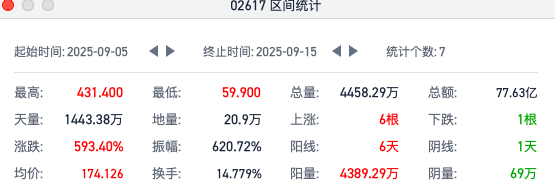
Core Viewpoint - The recent trading activity of Yaojie Ankang-B (02617) has exhibited extreme volatility, characterized by a rapid price surge followed by a significant decline, indicating a potential manipulation of stock prices by major players in the market [1]. Group 1: Price Surge Phase - From September 5 to September 15, 2025, the stock experienced a staggering increase of 593.40% with a volatility of 620.72%, marked by a high turnover rate of 14.78% and a dominant bullish trend with 6 up days against 1 down day [2][3]. - The total trading volume during this period reached 44.58 million shares, with a total transaction value of 7.763 billion [3]. - Major funds aggressively bought shares, creating a "star stock" effect to attract attention and speculative trading, while also facilitating a redistribution of shares from weaker hands to stronger ones [4]. Group 2: Distribution Phase - From September 16 to October 15, 2025, the stock price plummeted from a high of 679.50 to a low of 111.00, reflecting a maximum decline of over 72% [7][8]. - The trading volume during this period was 59.19 million shares, with a total value of 13.0581 billion, and a predominance of bearish trading days (13 down days vs. 6 up days) [8]. - The selling pressure was primarily driven by the deep stock connect funds, which significantly reduced their holdings, while the Shanghai stock connect funds attempted to stabilize the price through selective buying [9]. Group 3: Short-term Rebound - A brief rebound occurred on October 16 and 17, 2025, with a two-day increase of 78.85% and a volatility of 98.50%, indicating a classic "dead cat bounce" pattern [10][11]. - The total trading volume for this rebound was 22.76 million shares, all of which were bullish, suggesting that new buying interest emerged from international short-term traders [10][12]. - The rebound was not supported by the original major holders, who instead viewed it as an opportunity to reduce their positions, indicating a lack of confidence in a sustained recovery [14].