视频生成

Search documents
快手业绩会:加大AI投入 预计今年可灵收入约1.4亿美元
2 1 Shi Ji Jing Ji Bao Dao· 2025-11-19 14:37
Core Insights - Kuaishou's Q3 revenue reached 35.6 billion RMB, a year-on-year increase of 14.2%, with core business revenue growing by 19.2% [1] - The company's operating profit hit a record high, increasing by 69.9% year-on-year to 5.3 billion RMB, while adjusted net profit rose by 26.3% to 5 billion RMB [1] - The integration of AI capabilities into Kuaishou's business is a significant factor in its financial performance, with Keling AI generating over 300 million RMB in revenue during Q3 [1] Industry Dynamics - The video generation sector is experiencing rapid competition with numerous participants from both large internet companies and startups, indicating its potential as a high-quality market [2] - The industry is in an early stage of rapid technological iteration and product exploration, with competition driving advancements in video generation technology [2] - Keling AI remains a leader in the global video generation space, focusing on technological and product innovation to maintain its competitive edge [2] Product Strategy - Keling AI's core focus is on AI film creation, with an emphasis on resource aggregation to enhance technology and product capabilities [2] - The company plans to advance its product iterations by focusing on technological leadership and product imagination, utilizing multi-modal interaction concepts [2] - Keling AI aims to enhance the user experience for professional creators while exploring consumer applications, with plans to further commercialize its technology in the future [3] Financial Outlook - Kuaishou plans to increase investments in AI-related capabilities, expecting a mid-to-high double-digit percentage growth in overall capital expenditures for 2025 compared to the previous year [3] - Keling AI's projected revenue for 2025 is approximately 140 million USD, significantly higher than the initial target of 60 million USD [3] - Despite increased investments in AI capabilities and talent, the company remains confident in achieving year-on-year improvements in adjusted operating profit margins [3]

可灵AI全年收入约1.4亿美元,快手继续加大算力投入
Di Yi Cai Jing· 2025-11-19 14:24
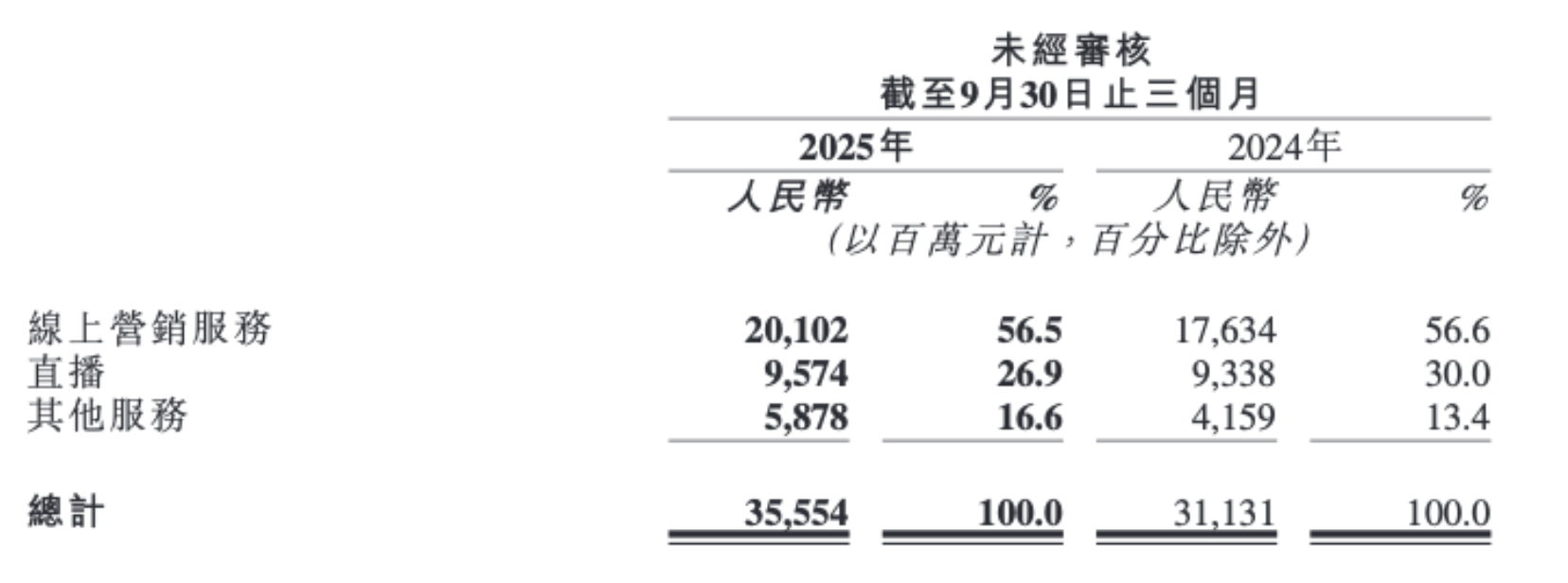
Core Insights - Kuaishou's Q3 2025 financial report shows a total revenue increase of 14.2% year-on-year to 35.6 billion RMB, with adjusted net profit rising by 26.3% to 5 billion RMB [1] - The online marketing services revenue grew by 14% to 20.1 billion RMB, while live streaming revenue increased by 2.5% to 9.6 billion RMB [1] - E-commerce GMV for Kuaishou increased by 15.2% year-on-year to 385 billion RMB, and the revenue from Keling AI exceeded 300 million RMB [1] Business Segments - Online Marketing Services: Revenue increased by 14% to 20.1 billion RMB [1] - Live Streaming: Revenue increased by 2.5% to 9.6 billion RMB [1] - Other Services: Revenue rose by 41.3% to 5.9 billion RMB, driven by growth in e-commerce and Keling AI [1] AI Development Focus - Keling AI remains a key focus in Kuaishou's earnings call, with the CEO highlighting the competitive landscape in video generation and the potential for rapid technological advancement [2] - The company aims to concentrate on AI film creation, enhancing technology and product capabilities through resource aggregation [2] - Kuaishou plans to further commercialize Keling technology in conjunction with social interaction, aiming for accelerated C-end application commercialization [2] Capital Expenditure and AI Integration - Kuaishou's CFO indicated that due to the unexpected growth of Keling AI, the company will increase its capital expenditure, expecting a mid-to-high double-digit percentage increase in 2025 compared to the previous year [3] - Keling AI is projected to generate approximately 140 million USD in revenue for 2025, surpassing the initial target of 60 million USD [3] - AI applications are being rapidly integrated within Kuaishou, with the self-developed AI programming tool CodeFlicker being widely adopted by engineers, generating nearly 30% of new code [3]

快手程一笑:可灵AI将重点聚焦AI影视制作场景 视频生成赛道仍在早期
Zheng Quan Shi Bao Wang· 2025-11-19 12:57
Core Insights - Kuaishou's CEO Cheng Yixiao highlighted the competitive landscape of the video generation sector, indicating it is a promising field with rapid technological iterations and product explorations [1][2] - The company reported that its Keling AI generated over 300 million yuan in revenue in Q3 2025, with a global user base exceeding 45 million and over 200 million videos and 400 million images created [1] - Cheng emphasized the vision of Keling AI to enable everyone to tell good stories using AI, focusing on film creation and enhancing both technology and product capabilities [2] Company Developments - Keling AI's recent advancements include the launch of the 2.5 Turbo model, which significantly improved text response, dynamic effects, style retention, and aesthetic quality [1] - The company aims to enhance the user experience for professional creators while exploring consumer applications, with plans to further commercialize Keling's technology in the future [2] - Cheng outlined a comprehensive path for the implementation of AI large models within Kuaishou, enhancing content and business ecosystems while improving internal organizational and R&D efficiency [2][3] Industry Trends - 2025 is viewed as a pivotal year for the deep application of AI, with new generation AI technologies like multimodal generation and agents being explored for more efficient user-centric applications [3] - Kuaishou is building a complete technology and application system centered on user needs, accelerating AI implementation to empower content and business ecosystems [3] - The company believes that a comprehensive AI application ecosystem will enhance its market adaptability and growth potential in the long term [3]
快手程一笑:视频生成是一个极具潜力的优质赛道
Zheng Quan Shi Bao Wang· 2025-11-19 12:00
Core Insights - The video generation sector is experiencing significant participation from various players, including major internet companies and startups, indicating its potential as a high-quality market [1] - The industry is still in the early stages of rapid technological iteration and product exploration, suggesting ongoing innovation and development [1] - Competition within the industry is accelerating progress, enhancing video generation technology to better meet user needs and penetrate more application scenarios [1]
快手(01024)程一笑:可灵AI将重点聚焦AI影视制作场景 视频生成赛道仍在早期
Zhi Tong Cai Jing· 2025-11-19 11:52
Core Insights - The video generation sector is experiencing rapid competition and technological evolution, indicating its high potential and early-stage development [1] - Kuaishou's AI division, Keling AI, aims to lead the global video generation market through continuous innovation and product development [1][2] - Keling AI's recent launch of the 2.5 Turbo model has significantly improved various performance metrics, achieving top rankings in global AI evaluation lists shortly after its release [1] Company Strategy - Keling AI's vision is to enable everyone to tell great stories using AI, focusing on AI film creation as its core objective [2] - The company is enhancing its technology and product capabilities through a dual approach of technological leadership and imaginative product development [2] - Keling AI is building a comprehensive creator ecosystem through initiatives like the "Future Partner Program," which connects creators with high-value commercial opportunities [2] Market Positioning - The integration of video generation with social interaction is accelerating the commercialization of C-end applications, with a focus on enhancing user experience for professional creators [3] - Keling AI remains optimistic about the commercial potential of video generation, planning to further productize its technology for C-end applications in the future [3]
何必DiT!字节首次拿着自回归,单GPU一分钟生成5秒720p视频 | NeurIPS'25 Oral
量子位· 2025-11-14 05:38
Core Viewpoint - The article discusses the introduction of InfinityStar, a new method developed by ByteDance's commercialization technology team, which significantly improves video generation quality and efficiency compared to the existing Diffusion Transformer (DiT) model [4][32]. Group 1: InfinityStar Highlights - InfinityStar is the first discrete autoregressive video generator to surpass diffusion models on VBench [9]. - It eliminates delays in video generation, transitioning from a slow denoising process to a fast autoregressive approach [9]. - The method supports various tasks including text-to-image, text-to-video, image-to-video, and interactive long video generation [9][12]. Group 2: Technical Innovations - The core architecture of InfinityStar employs a spatiotemporal pyramid modeling approach, allowing it to unify image and video tasks while being an order of magnitude faster than mainstream diffusion models [13][25]. - InfinityStar decomposes video into two parts: the first frame for static appearance information and subsequent clips for dynamic information, effectively decoupling static and dynamic elements [14][15][16]. - Two key technologies enhance the model's performance: Knowledge Inheritance, which accelerates the training of a discrete visual tokenizer, and Stochastic Quantizer Depth, which balances information distribution across scales [19][21]. Group 3: Performance Metrics - InfinityStar demonstrates superior performance in the text-to-image (T2I) task on GenEval and DPG benchmarks, particularly excelling in spatial relationships and object positioning [25][28]. - In the text-to-video (T2V) task, InfinityStar outperforms all previous autoregressive models and achieves better results than DiT-based methods like CogVideoX and HunyuanVideo [28][29]. - The generation speed of InfinityStar is significantly faster than DiT-based methods, with the ability to generate a 5-second 720p video in under one minute on a single GPU [31].

AI 大牛刘威创业公司完成 5000 万美元融资,12 月将发布新模型
AI前线· 2025-11-07 06:41
Core Insights - Video Rebirth, founded by Liu Wei, has completed a $50 million seed round funding to develop a video generation model aimed at the professional creative industry [2] - The company aims to make video creation as intuitive as conversing with a chatbot, providing controllable, high-fidelity, and physics-compliant AI video creation capabilities [2] - The funding will accelerate the development of their proprietary "Bach" model and unique "Physics Native Attention (PNA)" architecture, addressing significant challenges in the AI-generated entertainment (AIGE) sector [2] Funding and Development - The seed funding round was backed by Qiming Venture Partners and South Korean gaming company Actoz Soft Co. [2] - Video Rebirth plans to release the Bach model in December, along with an AI video generation platform to compete with OpenAI Sora [2][3] Competitive Landscape - Video Rebirth is entering a competitive field with major players like Google, ByteDance, and Kuaishou, which have shown strong monetization capabilities [3] - Kuaishou's Kling AI is projected to exceed $100 million in annual revenue by February next year [3] Model Performance - The newly evaluated Avenger 0.5 Pro model has shown significant performance improvements compared to its predecessor, ranking second in the Image to Video category on the Artificial Analysis Video Arena [3] - The model has not yet been made publicly accessible [3] Market Positioning - Liu Wei believes that while the landscape for large language models is dominated by major players, there is a fair opportunity for smaller teams in the video generation space [4] - The company will initially target professional users in the U.S. with a subscription model priced lower than Google Veo [4] Team and Expertise - Liu Wei and his team spent three months training the first version of their model, which incorporates industry-standard techniques with improvements for realistic object generation [4] - The team avoided using short video content for training to ensure higher model quality [4]

在夹缝中生存12年,他终于打造了国产AI活跃用户数第一的产品|WAVES
3 6 Ke· 2025-10-30 17:47
Core Insights - Fotor, an AI product founded by Duan Jiang, has over 10 million monthly active users and is a leading AI application in China, despite being based in Chengdu rather than major tech hubs [1][2] - The company transitioned from a simple image editing software to a profitable AI-driven platform, achieving a sevenfold increase in user scale and profitability after launching its text-to-image tool [1][4] - Fotor's journey reflects a non-typical entrepreneurial path, emphasizing the importance of perseverance and seizing opportunities when they arise [2][3] Company Development - Fotor was initially focused on the mobile internet market but shifted its strategy to overseas markets due to intense competition and funding challenges [2][5] - The company faced significant hurdles, including a lack of funding and the need to pivot to a paid model after exhausting initial financing [5][6] - Fotor's decision to focus on the PC market and SEO for customer acquisition proved beneficial, leading to a substantial increase in user engagement and revenue [5][6] Product Evolution - The launch of Fotor's text-to-image tool was a strategic response to the success of competitors like Midjourney, allowing the company to capitalize on a growing trend in AI image generation [3][4] - Fotor has expanded its offerings to include video generation, although initial attempts have been met with mixed results, leading to a focus on workflow improvements instead [8][9] - The company aims to combine traditional image tools with AI capabilities, positioning itself as a versatile product company in the AI landscape [9] Market Position - Fotor has established a strong presence in English-speaking markets, with the U.S., U.K., Canada, Australia, and New Zealand contributing significantly to its revenue [6] - The company has opted to decline investment offers, citing its current profitability and the need to find a clear direction for large-scale investments [7][8] - Fotor's user base is diverse, catering to both professional and casual users, which has been a key factor in its sustained growth [9]
美团LongCat-Video视频生成模型发布:可输出5分钟长视频
Feng Huang Wang· 2025-10-27 07:32
Core Insights - Meituan officially announced the release of the LongCat-Video video generation model, which is based on the Diffusion Transformer architecture and supports three core tasks: text-to-video, image-to-video, and video continuation [1] Model Features - LongCat-Video can generate high-definition videos at 720p resolution and 30 frames per second, with the ability to create coherent video content lasting up to 5 minutes [1] - The model addresses common issues in long video generation, such as frame breaks and quality degradation, by maintaining temporal consistency and motion rationality through video continuation pre-training and block sparse attention mechanisms [1] Efficiency and Performance - The model employs two-stage generation, block sparse attention, and model distillation techniques, reportedly achieving over a 10x improvement in inference speed [1] - With a parameter count of 13.6 billion, LongCat-Video has demonstrated strong performance in text alignment and motion continuity in public tests like VBench [1] Future Applications - As part of the effort to build a "world model," LongCat-Video may find applications in scenarios requiring long-term sequence modeling, such as autonomous driving simulations and embodied intelligence [1] - The release of this model signifies a significant advancement for Meituan in the fields of video generation and physical world simulation [1]

AI时代的短视频:Sora2的答案
新财富· 2025-10-24 08:08
Core Viewpoint - The article discusses the evolution of AI-generated video technology, particularly focusing on OpenAI's Sora 2, which aims to create a new platform for short video generation, similar to Douyin, while addressing the challenges of user engagement and commercial viability [2][17][20]. Group 1: Historical Context and Development - In 2015, the short video app Xiaokaxiu simplified video creation, which laid the groundwork for later platforms like Douyin that focused on music and lip-syncing [2]. - The rise of short videos and live commerce has transformed content creation into a mainstream activity, leading to the development of AI video generation technologies [2][4]. Group 2: Sora 2 Features and Innovations - Sora 2 introduces significant advancements, including long narrative integrity and physical logic realism, achieving an 88% accuracy in simulating physical laws, a 47% improvement from its predecessor [8]. - The platform allows for audio-visual integration, generating synchronized sound effects and dialogue, with a synchronization error of less than 120 milliseconds [9]. - Sora 2 supports multi-camera storytelling, maintaining consistency in character appearance and scene details across longer video formats, breaking the limitations of previous models [10]. Group 3: User Engagement and Social Interaction - Sora 2 features Cameo and Remix functionalities, enabling users to insert their likeness into AI-generated scenes and modify existing videos, fostering a new dimension of social interaction [11][15]. - The platform's design encourages browsing without the need for active creation, potentially broadening its user base and enhancing content virality [15]. Group 4: Competitive Landscape and Commercialization - OpenAI's shift towards commercialization is evident as it aims to transform from a research-focused entity to a product ecosystem builder, responding rapidly to competitive pressures from other AI models [17][20]. - The urgency for OpenAI to secure funding and achieve profitability is underscored by significant cash burn rates, with projections indicating a need for substantial revenue growth by 2029 [20]. Group 5: Challenges and Future Considerations - The article raises concerns about Sora's ability to maintain user engagement in a saturated short video market, questioning whether it can replicate the sustained popularity of platforms like Douyin [22][24]. - The potential for high-quality content generation through AI may not guarantee long-term user retention, as the novelty of AI-generated videos could wear off quickly [22][23].