非小细胞肺癌治疗

Search documents
港股异动 | 复宏汉霖(02696)涨逾5%再创新高 三款核心产品亮相WCLC 花旗称关注HLX43最新数据
智通财经网· 2025-08-14 05:43
Group 1 - Fuhong Hanlin's stock price increased by over 5%, reaching a new historical high of 81.35 HKD, with a trading volume of 178 million HKD [1] - The company had 10 lung cancer research abstracts selected for the 2025 World Lung Cancer Conference (WCLC), including 4 oral presentations and 2 poster discussions, covering key clinical scenarios in non-squamous/squamous non-small cell lung cancer (nsNSCLC/sqNSCLC) and extensive small cell lung cancer (ES-SCLC) [1] - The selected studies focus on three core innovative drugs: anti-PD-1 monoclonal antibody H drug Hanshu (sulizumab), anti-EGFR monoclonal antibody HLX07, and the world's first PD-L1 ADC HLX43, which has entered Phase II clinical trials [1] Group 2 - Citigroup anticipates that Fuhong Hanlin will present the latest data on HLX43 at the WCLC, which will further reveal its potential in treating non-small cell lung cancer (NSCLC) [2] - If HLX43 maintains an objective response rate (ORR) of 35% to 40% and a median progression-free survival (mPFS) of approximately 5.5 months in a larger sample, the data will be highly persuasive [2] - Citigroup estimates that the global study for third-line NSCLC treatment could start as early as the first half of 2026, with a risk-adjusted peak sales estimate for HLX43 reaching around 2.3 billion USD, indicating potential for further upside if more data is obtained [2]
同源康医药-B早盘涨超10% 公司发布艾多替尼片非小细胞肺癌II期临床试验结果
Zhi Tong Cai Jing· 2025-08-14 01:53
Core Viewpoint - Tongyuan Kang Pharmaceutical-B (02410) experienced a significant stock price increase, attributed to the acceptance of its innovative drug, Aditinib (TY-9591), for a key Phase II registration clinical trial in treating EGFR-mutant non-small cell lung cancer (NSCLC) [1] Company Summary - The company's stock rose over 10% in early trading and is currently up 4.78%, priced at 18.2 HKD with a trading volume of 32.2051 million HKD [1] - Aditinib (TY-9591) is a highly selective small molecule inhibitor targeting classic EGFR gene mutations, aimed at addressing unmet clinical needs in NSCLC patients with brain metastases [1] - The drug has shown excellent efficacy in controlling brain metastases and alleviating symptoms, potentially offering a new and more effective first-line treatment option for EGFR-mutant NSCLC patients with brain metastases [1] Industry Summary - The acceptance of the clinical trial results at the 2025 World Lung Cancer Conference (WCLC) highlights the ongoing advancements in targeted therapies for lung cancer, particularly for patients with specific genetic mutations [1] - The focus on brain metastases in NSCLC treatment reflects a growing recognition of the need for effective therapies in this challenging area of oncology [1]
埃万妥单抗新增适应症获批,用于晚期非小细胞肺癌一线联合治疗
Bei Ke Cai Jing· 2025-08-11 07:35
Core Viewpoint - Johnson & Johnson's drug Evusheld (Evusheld) has been approved by the National Medical Products Administration for use in combination with Lenvatinib (Lenvatinib) as a first-line treatment for adult patients with locally advanced or metastatic non-small cell lung cancer (NSCLC) carrying EGFR 19 exon deletions or L858R substitution mutations [1][2]. Group 1: Drug Approval and Indications - Evusheld has received approval for its third indication in lung cancer in China, previously being approved for patients with EGFR 20 exon insertion mutations and for those with classic EGFR mutations who progressed during or after EGFR TKI treatment [2]. Group 2: Lung Cancer Statistics and Treatment Challenges - Lung cancer is the most common malignant tumor in China, with incidence and mortality rates ranking first among malignant tumors, where non-small cell lung cancer accounts for 80%-85% of total lung cancer cases [1]. - Among patients with advanced non-small cell lung cancer with EGFR mutations, 25%-39% are unable to continue second-line treatment due to disease progression [1]. - The five-year survival rate for patients with advanced non-small cell lung cancer receiving EGFR TKI treatment is less than 20% [1]. Group 3: Mechanism and Benefits of Evusheld - The combination of Evusheld and Lenvatinib offers a new treatment option for patients with advanced non-small cell lung cancer, directly inhibiting tumor signaling pathways by blocking ligand binding and receptor degradation, while also providing immune cell-directed activity for more sustained clinical benefits [1].

强生(JNJ.US)宣布EGFR/c-MET双抗“埃万妥单抗”在国内获批一项新适应症
智通财经网· 2025-08-08 13:24
Core Viewpoint - Johnson & Johnson's Amivantamab has received approval for a new indication in China for the treatment of adult patients with locally advanced or metastatic non-small cell lung cancer (NSCLC) with specific EGFR mutations [1][2] Group 1: Drug Approval Details - Amivantamab is now approved in combination with Lenzatinib for first-line treatment of NSCLC patients with EGFR 19 exon deletions or L858R mutations [1] - This marks the third indication for Amivantamab in China, following its initial approval for EGFRex20ins mutation NSCLC in February 2025 and a subsequent approval for use with chemotherapy in April 2025 [2] Group 2: Global Approval History - Amivantamab was first granted accelerated approval in the United States in May 2021 [2] - To date, Amivantamab has received a total of four indications globally for the treatment of non-small cell lung cancer [2]


中金:维持和黄医药(00013)目标价30港元 评级“跑赢行业”
智通财经网· 2025-07-04 02:00
Core Viewpoint - CICC maintains its profit forecast for Hutchison China MediTech (00013) at $360 million for 2025 and $100 million for 2026, with a target price of HKD 30, indicating a 20.5% upside from the current stock price [1] Group 1: Drug Approval and Market Potential - The recently approved indication for Savolitinib is the largest for the drug to date [2] - Approximately 10-25% of non-small cell lung cancer (NSCLC) patients in the US and Europe have EGFR mutations, while the rate is as high as 30-40% in Asian patients [2] - MET amplification is a major mechanism of acquired resistance in EGFR-mutant NSCLC patients, with 15-50% of patients showing MET abnormalities after third-generation EGFR TKI treatment [2] Group 2: Clinical Trial Results - The approval is based on the SACHI Phase III study, which showed significant progression-free survival (PFS) benefits compared to platinum-based chemotherapy [3] - In the SACHI intent-to-treat population, the median PFS for the Savolitinib + Osimertinib combination was 8.2 months and 7.2 months, compared to 4.5 months and 4.2 months for the chemotherapy group, reducing the risk of disease progression by 66% and 60% respectively [3] Group 3: Ongoing Clinical Trials and Regulatory Progress - The SAFFRON Phase III clinical trial is ongoing, focusing on regulatory registration progress overseas [4] - The combination therapy received Fast Track designation from the FDA in 2023, with AstraZeneca conducting the SAFFRON trial to evaluate its effectiveness against platinum-based doublet chemotherapy in MET-overexpressing NSCLC [4] - Attention is recommended on the data readout from SAFFRON in 2026 and the overseas application status [4]
国产创新药获批新适应症,非小细胞肺癌治疗实现全病程覆盖
Yang Zi Wan Bao Wang· 2025-05-09 12:10
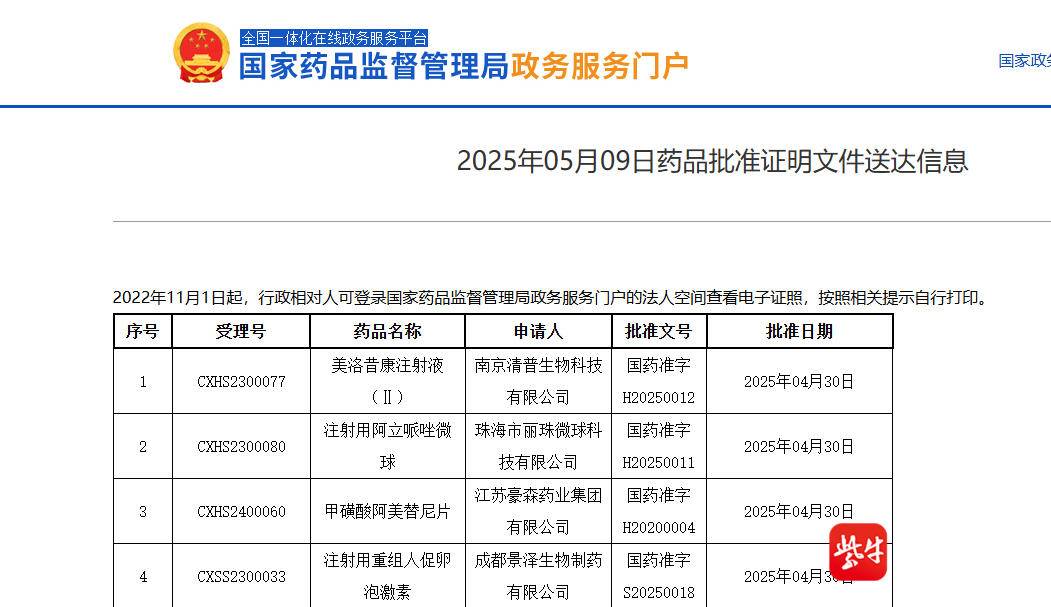
Core Viewpoint - The approval of the novel drug Amivantamab by Hansoh Pharmaceutical marks a significant breakthrough in the treatment of non-small cell lung cancer (NSCLC) in China, addressing a critical unmet medical need for postoperative patients with EGFR mutations [1][4]. Group 1: Drug Approval and Market Impact - On May 9, 2025, Hansoh Pharmaceutical announced that its self-developed class I new drug, Amivantamab, received approval from the National Medical Products Administration for use in adult patients with EGFR exon 19 deletions or exon 21 (L858R) substitution mutations after tumor resection [1]. - The approval allows Amivantamab to break the monopoly of imported drugs in this field, achieving parallel coverage with imported drugs and marking a significant advancement for domestic innovative targeted drugs in the comprehensive treatment of NSCLC [3]. Group 2: Clinical Significance and Expert Opinions - Professor Cheng Ying from the Chinese Society of Clinical Oncology highlighted that the high recurrence rate of operable NSCLC patients post-surgery indicates a substantial unmet treatment need, and the approval of Amivantamab provides new hope for long-term survival [4]. - The third-generation EGFR-TKI has become the standard treatment for EGFR-mutated NSCLC, and the rapid development of innovative targeted drugs in China has allowed them to catch up with international drugs [4]. - Since its approval in 2020, Amivantamab has made significant progress in the treatment of NSCLC, and the new indication expands its use from first-line and second-line treatments to adjuvant therapy, solidifying its position in the treatment landscape [4].

中新健康丨康方生物明星双抗数据不及预期?回应来了
Zhong Guo Xin Wen Wang· 2025-04-30 11:38
Core Viewpoint - 康方生物's new indication for依沃西单抗 has been approved by the National Medical Products Administration (NMPA) for first-line treatment of PD-L1 positive non-small cell lung cancer (NSCLC), based on positive results from the HARMONi-2 clinical trial [1][2]. Group 1: Clinical Trial Results - In the HARMONi-2 trial, the median progression-free survival (PFS) for the依沃西 group was 11.14 months, compared to 5.82 months for the帕博利珠 group, with a hazard ratio (HR) of 0.51, indicating a 49% reduction in the risk of disease progression or death [2]. - The interim analysis for overall survival (OS) showed a HR of 0.777, reflecting a 22.3% reduction in the risk of death for the依沃西 group compared to the帕博利珠 group [2]. Group 2: Market Reaction - Despite the positive clinical data,康方生物's stock fell over 19% on April 28, closing at 87.20 HKD per share, while its partner Summit's stock dropped more than 36% [3]. - Market sentiment suggests that while依沃西 shows clinical benefits compared to帕博利珠, it did not achieve the statistical significance expected by investors, as帕博利珠 has shown greater risk reductions in OS in previous trials [3]. Group 3: Company Perspective - 康方生物's CEO,夏瑜, stated that the market's interpretation of the data is somewhat misaligned, emphasizing that OS was not the primary endpoint of the study and that the low maturity of the OS data (39%) was intended to show a trend of benefit [3][4]. - The company designed the HARMONi-2 trial to focus on PFS as the primary endpoint, with the aim of obtaining approval for the first-line NSCLC indication in China [4].

JNJ's Rybrevant-Lazcluze Combo Outshines AZN's Tagrisso in Lung Cancer
ZACKS· 2025-03-31 14:42
Core Insights - J&J's phase III MARIPOSA study shows that the combination of Rybrevant and Lazcluze significantly extends overall survival in patients with EGFR-mutated non-small cell lung cancer compared to AstraZeneca's Tagrisso [1][2] Study Results - At a median follow-up of 37.8 months, patients on J&J's combo therapy had a median overall survival not yet reached, while those on Tagrisso had a median overall survival of 36.7 months [2] - 56% of patients on J&J's therapy were alive at 3.5 years compared to 44% on AstraZeneca's drug, indicating a potential extension of overall survival by at least one year with J&J's combination [2] Regulatory Approvals - The MARIPOSA study achieved its primary endpoint of significant improvement in progression-free survival, leading to J&J securing approval for the Rybrevant-Lazcluze combo in the U.S. and EU last year [3] - The EMA's Committee for Medicinal Products for Human Use issued a positive opinion for a subcutaneous version of Rybrevant combined with Lazcluze, with a final decision expected later this year [6] - The FDA approved the combination of Rybrevant and standard chemotherapy for advanced NSCLC after prior therapy failure, with similar approval in the EU last year [7] Competitive Landscape - J&J aims to position the Rybrevant-Lazcluze combo as the new standard of care against AstraZeneca's Tagrisso, which currently holds a significant market position due to its convenience as a once-daily pill [4] - J&J's regimen requires intravenous infusions, which may limit its adoption compared to Tagrisso [4] Future Developments - A key step for J&J is obtaining FDA approval for a subcutaneous version of Rybrevant to reduce administration time, following a previous rejection due to manufacturing concerns [5] - J&J is also exploring Rybrevant in other NSCLC settings, evaluating it in various clinical studies as monotherapy or in combination with other drugs [9]