AI加速器

Search documents
Meta被曝考虑采用谷歌TPU,美银:英伟达(NVDA.US)商用GPU优势仍难撼动 重申“买入”评级
智通财经网· 2025-11-26 06:52
智通财经APP获悉,在市场传闻Meta(META.US)正考虑使用谷歌(GOOGL.US)的TPU(线程处理单元) 来补充其现有的英伟达GPU供应后,美国银行重申了对英伟达(NVDA.US)、AMD(AMD.US)和博通 (AVGO.US)的"买入"评级。 阿利亚补充道:"商用GPU芯片具有诸多优势:现成可用、多云可移植性、英伟达的全栈软件和开发者 生态,以及面向不具备定制芯片专业知识的政府和企业本地客户的更大可寻址市场。此外,紧张的供应 链和英伟达的规模优势使得抢占过多份额变得更加困难,因为近中期内零部件供应不足,因此份额变化 本质上是渐进的。对于特定范围的内部工作负载,定制芯片可能成本更低,这可能适合像谷歌和Meta 这样拥有大量内部工作负载的客户。然而,它们在微软Azure或亚马逊AWS等公有云或100多个需要高 度灵活性的新云中用途较小,这就是为什么即使谷歌也在其公有云中使用GPU。" 美国银行分析师维韦克·阿利亚在给客户的一份报告中写道:"昨日晚些时候,市场消息称谷歌可能在明 年将其TPU出租给Meta,随后可能在2027年进行本地化部署。两家公司均未对此类交易发表任何官方评 论,但如果属实,这可能 ...



英特尔(INTC.US)CEO粉碎“带走台积电机密”谣言 在先进制程“生死战”中强调尊重IP
智通财经网· 2025-11-21 07:23
Group 1 - Intel's CEO Lip-Bu Tan strongly denied rumors regarding a new employee leaking trade secrets from TSMC, emphasizing respect for intellectual property [1] - TSMC's market capitalization exceeds $1.15 trillion in Taiwan and $1.5 trillion in the US, solidifying its position as the leading chip foundry [2] - TSMC has initiated an internal investigation regarding the potential unauthorized transfer of trade secrets by former executive Lo Wen-jen [2][3] Group 2 - Intel is focusing on advanced process technology to compete with TSMC and Samsung, aiming to produce chips at 2nm and below [4] - The company's strategic shift towards Intel Foundry aims to establish itself as a major player in high-end chip manufacturing for clients like Qualcomm [5] - Qualcomm is evaluating Intel for manufacturing its AI ASICs, indicating potential collaboration in the data center chip market [5][6]


Tenstorrent,估值30亿美金
半导体行业观察· 2025-11-19 01:35
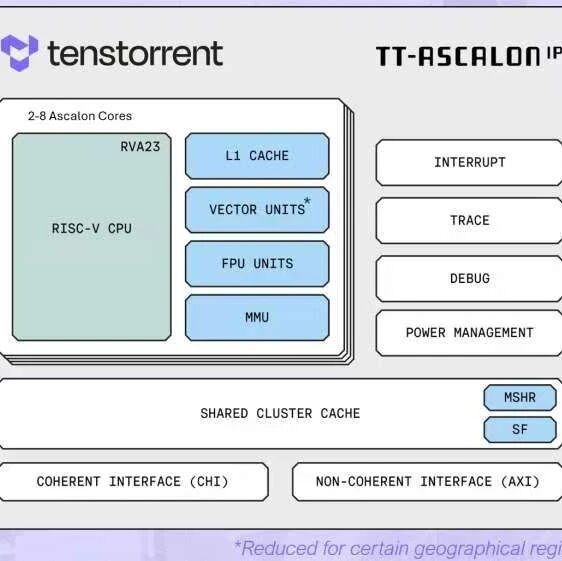
Core Insights - Tenstorrent, led by Jim Keller, has achieved a valuation of $3 billion in its recent funding round, focusing on scalable AI accelerators for cloud and edge computing [2] - The company is developing RISC-V CPUs and plans to license its designs to other entities, utilizing open-source technologies to reduce costs associated with high-bandwidth memory [2][3] - The first chip, Tensix processor, is produced in collaboration with GlobalFoundries and features a grid-based architecture for efficient tensor computation [4] Product Development - The Grayskull processor, Tenstorrent's first Tensix processor, simplifies programming and enhances scalability, featuring up to 120 Tensix cores and supporting various AI precision formats [3] - The Wormhole variant of Grayskull reduces the number of cores to 80 but increases SRAM capacity and adds support for more precision formats, with a local memory capacity of 12GB GDDR6 [3][4] - Tenstorrent's RISC-V CPU, Ascalon, is set to compete with Arm's Neoverse V2 and V3, with performance metrics of 10 to 20 SPECint2006/GHz [5] Market Strategy - Tenstorrent is focusing on IP licensing, with existing clients including LG and Hyundai, and aims to allow customization of its cores, which is uncommon in the industry [4][5] - The company plans to release new core generations every 18 months, with the next generation, Babylon, expected to enhance performance and efficiency [7] - Tenstorrent is exploring markets in industrial and medical sectors, which have traditionally been overlooked by competitors like Arm [7] Technological Advancements - The upcoming Tensix-Neo core adopts a cluster architecture for improved area efficiency and utilization, allowing for more modular and flexible designs [8][10] - Customers will have the option to customize certain parameters while Tenstorrent manages more complex configurations, offering innovative licensing for those interested in deeper customization [10]

全球首颗2nm GPU,要来了
半导体行业观察· 2025-10-10 00:52
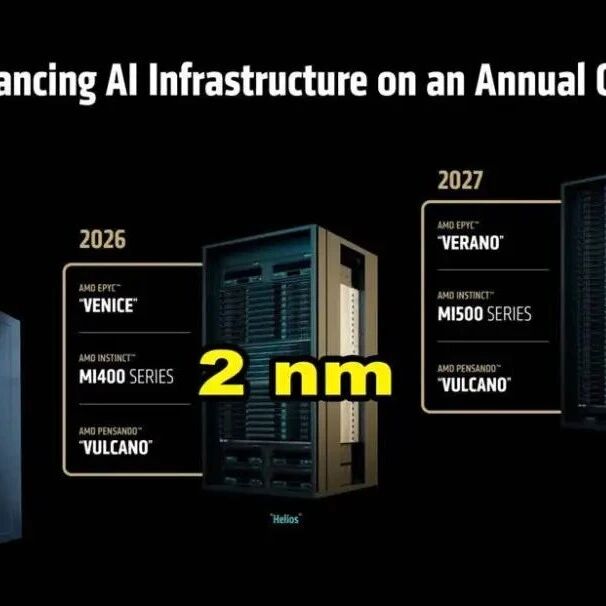
Core Viewpoint - AMD is set to launch its next-generation Instinct MI450 graphics accelerator using 2nm process technology, aiming to compete directly with NVIDIA's Rubin chip series [1][3][6] Group 1: Product Specifications - The Instinct MI450 will utilize TSMC's 2nm technology for its accelerator core chip (XCD), while the active interposer chip (AID) and media interface chip (MID) will be manufactured using TSMC's 3nm process [1][5] - MI450 is expected to deliver similar FP4/FP8 performance to NVIDIA's Rubin, but with 1.5 times the memory and bandwidth [3][5] - The MI400 series will integrate up to 432 GB of HBM4 memory, significantly enhancing bandwidth capabilities [7] Group 2: Market Positioning - AMD's data center operations head, Forrest Norrod, claims that MI450 will be the best solution for training, inference, distributed inference, and reinforcement learning, indicating confidence in competing with NVIDIA [6] - The MI450 is anticipated to be AMD's "Milan moment," referencing the significant leap made by AMD's EPYC server CPU series [6] - AMD plans to expand its rack options with the upcoming Helios system, which is expected to match the top configurations of NVIDIA's Rubin series [7] Group 3: Launch Timeline - The MI450 is projected to be released in 2026, coinciding with NVIDIA's launch of its next-generation Rubin series [7]

大芯片,一夜生变
3 6 Ke· 2025-09-19 02:15
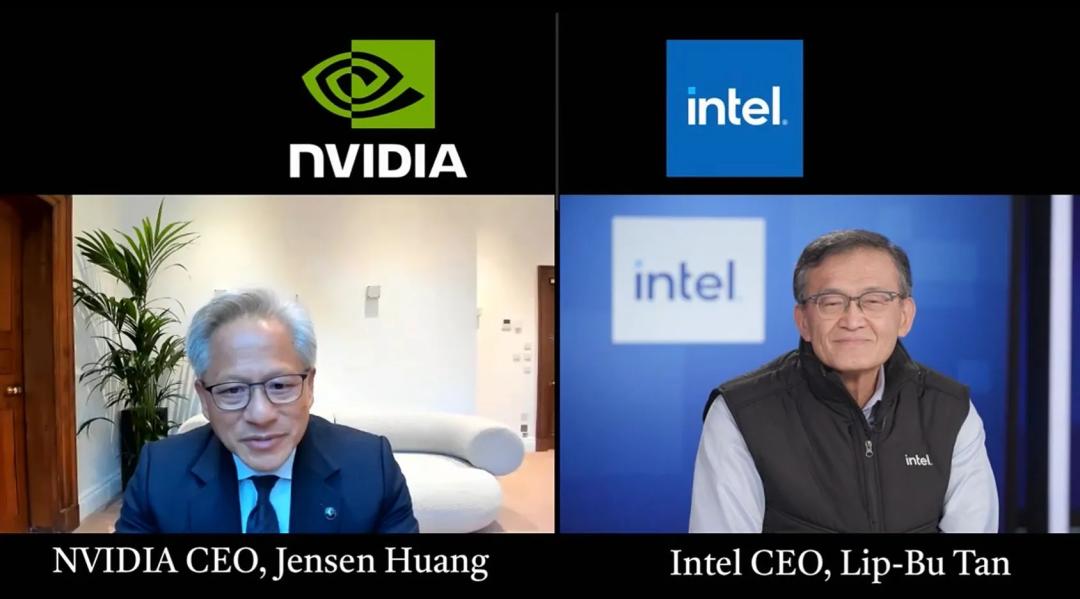
Core Insights - NVIDIA is investing $5 billion in Intel at a price of $23.28 per share, aiming to develop custom data center and PC products together to enhance applications for large-scale, enterprise, and consumer markets [1] - The collaboration will leverage NVIDIA's NVLink technology to integrate NVIDIA's AI and accelerated computing capabilities with Intel's leading CPU technology [1][4] - Intel will design x86 CPUs with integrated NVIDIA RTX GPU chipsets for the PC market, while NVIDIA will incorporate these CPUs into its AI infrastructure [1][4] Group 1 - NVIDIA's partnership with Intel allows it to expand into the integrated graphics market, previously dominated by Intel and AMD [4] - Intel's Xeon processors will play a larger role in NVIDIA's AI infrastructure and data center products, enhancing NVIDIA's offerings [4][6] - The integration of NVLink into Intel's CPU designs will enable NVIDIA to provide systems with both its own CPUs and Intel's Xeon processors [4][6] Group 2 - NVIDIA's NVLink technology offers significantly higher bandwidth compared to PCIe, with a maximum bidirectional bandwidth of 1.8 TB/s per GPU [7] - The collaboration allows for the expansion of GPU nodes from 8 to 72 in rack-scale architectures, enhancing performance capabilities [7] - Intel's adoption of NVLink marks a shift from its previous reliance on PCIe, indicating a strategic change in its approach to data center processors [6][8] Group 3 - NVIDIA's CEO Jensen Huang emphasized the potential for creating scalable AI supercomputers by integrating Intel's x86 CPUs into the NVLink ecosystem [9] - The partnership is expected to provide Intel with a competitive edge in the data center market against AMD [15][17] - The collaboration opens up a previously underserved market segment for NVIDIA, allowing it to integrate its GPU capabilities into Intel's chipsets [17][18] Group 4 - The deal raises questions about NVIDIA's future relationship with ARM and TSMC, as it shifts focus towards Intel for certain products [10][12] - Despite concerns, NVIDIA remains committed to its ARM roadmap and continues to collaborate with ARM-based SoC designers [11] - AMD is positioned as a potential loser in this scenario, as NVIDIA and Intel's partnership could disrupt the current competitive landscape [14][15]
英伟达(NVDA.US)H20芯片重获对华出口许可,Needham上调目标价至200美元
Zhi Tong Cai Jing· 2025-07-16 13:30
Core Viewpoint - Nvidia plans to resume sales of its H20 chip to the Chinese market after obtaining an export license from the U.S. government, which is expected to alleviate sales pressure in China [1][3]. Group 1: Nvidia's H20 Chip and Market Impact - The H20 chip, designed specifically for the Chinese market, features 96GB of HBM3 memory and 4.0TB/s memory bandwidth, with FP8 performance at 296TFLOPS and FP16 performance at 148TFLOPS, making it suitable for vertical model training and inference [2]. - The export restrictions imposed by the U.S. Department of Commerce had previously hindered Nvidia's ability to fulfill approximately $2.5 billion in chip shipments and nearly $8 billion in H20 orders [1][2]. - Analysts from Needham have raised Nvidia's stock price target from $160 to $200, maintaining a "buy" rating, reflecting optimism about the recovery of H20 chip sales [1]. Group 2: Future Projections and Product Development - Analysts estimate that starting from the third quarter of the 2026 fiscal year (October), the quarterly shipment volume of the H20 chip could reach $3 billion [1]. - Nvidia is also developing Blackwell architecture GPU variants (including models B30/B40/RTX6000D) tailored for the Chinese market, with expected shipments beginning between August and September [1][3]. - The policy adjustment and new product development are seen as strategic moves by Nvidia to address the demand in the Chinese market [1].
AMD宣布将重启对华出口AI芯片
天天基金网· 2025-07-16 06:10
Core Viewpoint - AMD plans to resume exports of its MI308 chip to China following the U.S. government's approval, marking a shift in the U.S. policy towards semiconductor sales to China [1] Group 1: U.S. Policy Changes - The U.S. Treasury Secretary mentioned that NVIDIA's approval to sell the H20 chip to China is justified as China has developed comparable chips [1] - The decision to allow AMD's MI308 chip to return to China represents a reversal from the previous stance of the Trump administration, which had been firm on restricting chip sales to China [1] Group 2: AMD's Strategic Moves - The MI308 chip is specifically designed by AMD as an AI accelerator for the Chinese market [1] - AMD's spokesperson confirmed that the U.S. Department of Commerce has informed the company that the license application for the MI308 product will enter the review process [1]

AMD宣布将重启对华出口AI芯片
券商中国· 2025-07-16 05:43
Group 1 - AMD plans to resume exports of its MI308 chip to China following approval from the U.S. government, marking a significant policy shift [1] - The MI308 chip is specifically designed by AMD as an AI accelerator for the Chinese market [1] - The U.S. Treasury Secretary indicated that NVIDIA's approval to export the H20 chip was based on China's development of comparable technology, suggesting a more lenient stance on chip exports to China [1] Group 2 - The recent approval for chip exports represents a reversal from the previous hardline stance of the Trump administration, which had been focused on restricting sales to China [1] - The easing of restrictions comes amid a period of improved U.S.-China relations, highlighted by NVIDIA's CEO meeting with Trump prior to the announcement [1]

AMD宣布将重启对华出口AI芯片
财联社· 2025-07-16 02:41
Core Viewpoint - AMD plans to resume exports of its MI308 chips to China following approval from the U.S. government, marking a significant policy shift in U.S.-China relations regarding semiconductor sales [1] Group 1: Company Actions - AMD's MI308 chip is specifically designed as an AI accelerator for the Chinese market [1] - The U.S. Department of Commerce has informed AMD that the license application for the MI308 product will enter the review process [1] Group 2: Industry Context - The decision to allow these products to return to China represents a reversal for the Trump administration, which had previously maintained a strict stance on limiting chip sales to China [1] - The recent thawing of U.S.-China relations may have influenced this decision, as evidenced by NVIDIA's CEO meeting with Trump prior to the announcement [1]

财报点评| AMD:营收、指引均超预期,CPU端全力追赶,GPU端仍未得青眼
贝塔投资智库· 2025-05-08 03:55
Core Viewpoint - AMD reported strong Q1 2025 earnings with a revenue of $7.44 billion, exceeding analyst expectations, but the stock has seen a decline of 17% year-to-date [1][2] Financial Performance - Q1 revenue reached $7.44 billion, a 36% year-over-year increase, surpassing the expected $7.12 billion; gross profit was $3.74 billion, up 46% year-over-year, with a gross margin of 50% [2] - Operating profit margin stood at 11%, with a profit of $710 million and an adjusted EPS of $0.96, better than the anticipated $0.94 [2] Business Segment Analysis - **Data Center Segment**: Revenue of $3.7 billion, a 57% year-over-year increase, driven by sales of EPYC CPUs and Instinct GPUs, outperforming the expected $3.66 billion [5] - **Client and Gaming Segment**: Revenue of $2.9 billion, a 28% year-over-year increase; client revenue was $2.3 billion, up 68% due to strong demand for Zen 5 architecture Ryzen processors, while gaming revenue fell 30% to $647 million due to a decline in semi-custom business [5] - **Embedded Segment**: Revenue of $823 million, a 3% year-over-year decrease, reflecting mixed demand in end markets [6] Guidance Under Tariffs - AMD anticipates a $700 million reduction in sales for its MI308 product due to new licensing requirements, impacting Q2 revenue; the annual revenue impact is projected at $1.5 billion [7] - Q2 revenue is expected to be around $7.4 billion, slightly above analyst expectations, with a non-GAAP gross margin forecasted at approximately 43% [7] - CEO Lisa Su expressed confidence in the company's performance despite tariff impacts, citing four consecutive quarters of accelerated year-over-year growth [7] Market Share Insights - AMD's CPU market share increased from 38.7% to 40.1%, with significant gains across all segments [8] - Desktop market share surpassed Intel at 50.3%, while laptop share rose to 28.2% [10] - Server market share reached a historic high of 31.6%, up from 16.2% in the previous quarter [10] GPU Market Dynamics - Despite a 62% year-over-year increase in capital expenditures among North America's top four cloud providers, AMD has not gained significant market share in the cloud business, remaining behind NVIDIA [11][12] - New product developments include the MI325X and MI350, with the latter expected to significantly enhance performance [12] Price Target Adjustments - HSBC raised its price target for AMD from $70 to $75, while Mizuho and Jefferies lowered their targets from $120 to $117 and from $120 to $100, respectively [13]