VIE架构

Search documents
创投铁幕之后,再筑新墙
3 6 Ke· 2025-10-30 17:21
Core Points - The core message of the "America First Investment Policy" is that American investors should focus on investing in the future of the United States rather than in other countries [1][2] Summary by Sections Policy Changes - The "America First Investment Policy" significantly expands the scope of the Reverse CFIUS (Committee on Foreign Investment in the United States) restrictions from three sensitive sectors (semiconductors, artificial intelligence, quantum computing) to include biotechnology, hypersonic technology, aerospace, advanced manufacturing, directed energy, and other areas influenced by China's "military-civil fusion" strategy [1][3] - The policy restricts various types of investments, including private equity, venture capital, greenfield investments, corporate expansions, and public securities trading [1][2] - It also limits funding sources, including pension funds, university endowments, and other limited partner investors [1][3] Impact on Chinese Investments - The policy may exert pressure on Chinese concept stocks (Chinese companies listed in the U.S.) from multiple angles, potentially affecting their market performance and regulatory scrutiny [2][10] - The expansion of restricted sectors under the policy indicates a more aggressive stance from the U.S. towards curbing China's technological advancements [2][4] Historical Context - The changes reflect a broader historical trend of the U.S. attempting to contain China's development in strategic industries and advanced technologies, a strategy that has been consistent since Trump's first term [4][5] Investment Environment - The "America First" label emphasizes that American capital should be directed towards U.S. industries, while investments from "friendly" nations are encouraged, contrasting with restrictions on investments from "foreign adversaries" [6][7] - The policy signals a potential increase in scrutiny for Chinese dollar funds investing in the U.S. market, which may face stricter CFIUS reviews [7][8] Regulatory Measures - The policy outlines enhanced regulatory measures for Chinese concept stocks, including stricter auditing requirements and potential risks of forced delisting if compliance with U.S. auditing standards is not met [10][11] - It emphasizes the need for thorough reviews of the auditability and corporate governance of foreign adversaries' companies listed in the U.S., particularly focusing on VIE (Variable Interest Entity) structures [14][15] Taxation Agreements - The policy raises the possibility of suspending or terminating the 1984 U.S.-China tax treaty, which could significantly increase the tax burden on economic exchanges between the two countries, impacting capital, labor, trade, and technology flows [2][17]
纳斯达克上市流程五个阶段:第2-6步 从红筹架构到递交招股说明书
Sou Hu Cai Jing· 2025-10-30 12:00
Core Viewpoint - The article outlines the steps for companies to prepare for an IPO on NASDAQ, emphasizing the importance of a well-structured framework and compliance with regulatory requirements, particularly in light of recent changes in approval processes for Chinese companies [4][6][18]. Group 1: IPO Process Overview - The NASDAQ listing process consists of five key stages, which typically take one to two months and are crucial for determining the success of the IPO [4]. - A red-chip structure is recommended for companies, as it allows for a robust offshore listing framework that is widely recognized by the SEC [4][5]. - The VIE structure is mentioned as an alternative for industries with foreign investment restrictions, but it faces significant approval limitations, with only three approvals per year from the Chinese regulatory body [7]. Group 2: Structural Framework - The initial step involves establishing a holding company in the Cayman Islands, which will control a Hong Kong company that, in turn, forms joint ventures or wholly foreign-owned enterprises with domestic companies [5]. - This structure facilitates offshore consolidation, fundraising, and risk isolation, creating a clear chain from the founding team to investors [6]. Group 3: Audit and Legal Compliance - Auditors can begin their work concurrently with the accounting process, which typically takes one to three months depending on the complexity of the business [7]. - Legal opinions from both Chinese and Cayman lawyers are necessary, especially for sensitive industries, to ensure full disclosure of regulatory attitudes and potential impacts [8][9]. Group 4: SEC Submission Strategy - The submission of the prospectus should be done confidentially to avoid delays caused by potential whistleblower reports, which can halt the review process [18][20]. - Companies must ensure that all risks, even minor ones, are disclosed to demonstrate responsibility to U.S. investors, as the SEC focuses on the authenticity of the information provided [12][14]. Group 5: Final Steps and Future Considerations - Once the fourth step is 30% to 50% complete, the fifth step can commence, involving due diligence by U.S. brokers and the submission of the listing application [15][16]. - Companies should consider their stock code carefully, as it can impact future global operations and fundraising efforts [17].


【锋行链盟】纳斯达克IPO红筹架构搭建流程及核心要点
Sou Hu Cai Jing· 2025-10-21 16:39
Core Concept - The article discusses the process and key points for establishing a red-chip structure for companies seeking to list on NASDAQ, emphasizing the need to transfer domestic operational rights to an offshore holding platform while complying with both Chinese and U.S. regulations [2][10]. Group 1: Basic Concepts and Types - Red-chip structure refers to domestic companies setting up holding companies in offshore locations (typically Cayman Islands or BVI) to list on foreign exchanges [2]. - There are two types of structures based on the control of domestic rights: pure red-chip structure and VIE (Variable Interest Entity) structure [4]. Group 2: NASDAQ IPO Red-chip Structure Setup Process - Initial preparation involves defining goals and conducting due diligence [2]. - Establishing an offshore holding structure includes setting up a Cayman company as the top-level holding entity, a Hong Kong company as an intermediary, and a WFOE (Wholly Foreign-Owned Enterprise) or VIE entity as the domestic operational entity [4][5]. - Restructuring domestic assets varies by structure type, with pure red-chip involving direct or indirect equity ownership and VIE relying on contractual agreements for control [4][9]. Group 3: Compliance and Regulatory Requirements - Compliance registration addresses foreign exchange and foreign investment issues, including necessary registrations for founders and WFOE [5][9]. - The importance of ensuring that agreements under the VIE structure comply with Chinese laws to avoid potential legal issues [10]. Group 4: Investor Introduction and IPO Preparation - Pre-IPO investors typically include private equity or venture capital funds, negotiating terms such as valuation and equity stakes [6][9]. - Preparing the NASDAQ listing application involves compiling an S-1 form that includes business descriptions, financial data, and risk factors [7][9]. Group 5: Listing and Post-Listing Arrangements - The listing process includes roadshows to attract institutional investors and finalizing the offering price based on market demand [8][9]. - Post-listing compliance requires adherence to SEC disclosure requirements and NASDAQ's ongoing listing standards [8][10]. Group 6: Key Considerations - The design of the structure must be rational, avoiding excessive SPV nesting to reduce compliance costs and regulatory risks [10]. - Tax optimization strategies are crucial, with the Cayman company offering tax neutrality and the Hong Kong company providing favorable tax arrangements [10]. - Transparency in information disclosure is essential to mitigate risks of litigation from investors regarding compliance issues [10].
红筹上市梦碎只因少做一步ODI备案?
Sou Hu Cai Jing· 2025-10-15 11:06
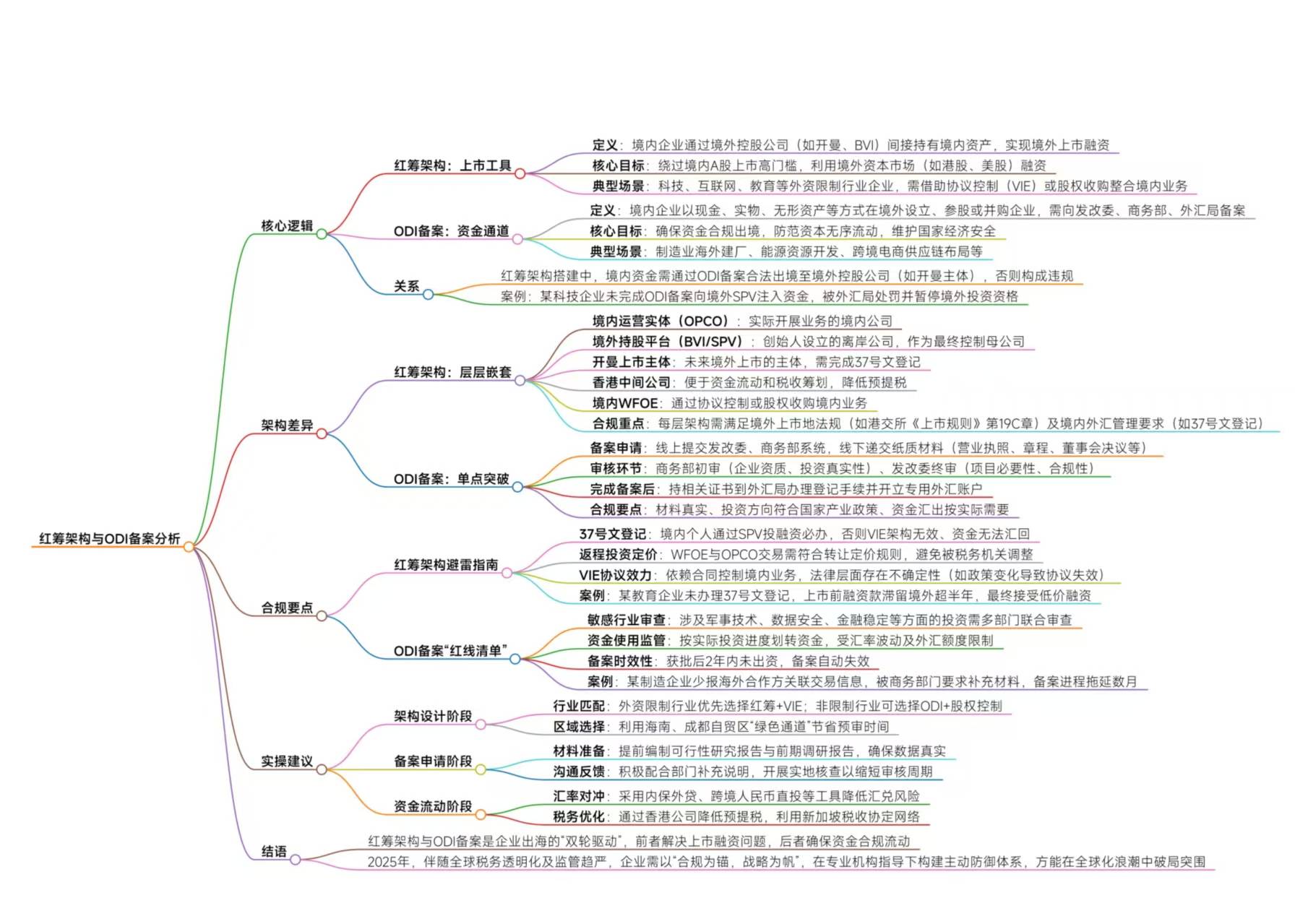
Core Viewpoint - The red-chip structure and ODI (Overseas Direct Investment) filing are independent yet closely related processes essential for companies seeking to go public and ensure compliant capital outflow [1][16]. Red-chip Structure - Definition: Domestic enterprises utilize offshore holding companies (e.g., Cayman Islands, BVI) to indirectly hold domestic assets for overseas listing and financing [3]. - Core Objective: To bypass the high barriers of domestic A-share listings and leverage overseas capital markets (e.g., Hong Kong, US) for financing [3]. - Typical Scenarios: Companies in restricted sectors such as technology, internet, and education use variable interest entity (VIE) agreements or equity acquisitions for domestic business integration [3]. ODI Filing - Definition: Domestic enterprises establish, invest in, or acquire foreign companies using cash, physical assets, or intangible assets, requiring filing with the National Development and Reform Commission (NDRC), Ministry of Commerce, and State Administration of Foreign Exchange [4]. - Core Objective: To ensure that funds can exit the country legally, prevent capital disorder, and maintain national economic security [5]. - Typical Scenarios: Overseas factory establishment in manufacturing, resource development in energy, and cross-border e-commerce supply chain layout [5]. Relationship Between Red-chip Structure and ODI Filing - Relationship: In establishing a red-chip structure, domestic funds must go through ODI filing to legally exit to the offshore holding company; failure to do so results in violations [6]. - Example: A technology company that failed to complete ODI filing before injecting funds into an offshore SPV faced penalties from the foreign exchange bureau, leading to a suspension of its overseas investment qualifications [6]. ODI Filing Process Design - Filing Application: Online submission to NDRC and Ministry of Commerce systems, followed by offline submission of physical documents (e.g., business license, articles of association, board resolutions) [9]. - Review Stages: Initial review by the Ministry of Commerce (enterprise qualifications, investment authenticity) and final review by NDRC (project necessity, compliance) [9]. - Post-filing: After completing the filing, companies must register with the foreign exchange bureau and open a dedicated foreign exchange account [9]. Compliance Risks in Red-chip Structure - Compliance Focus: Each layer of the structure must meet the regulations of the overseas listing location (e.g., Hong Kong Stock Exchange Listing Rules) and domestic foreign exchange management requirements [11]. - 37 Document Registration: Required for domestic individuals investing through SPVs; failure to register invalidates the VIE structure and prevents fund repatriation [12]. - Case Study: An education company that did not complete the 37 document registration faced delays in financing due to funds being stuck overseas for over six months [12]. Compliance Risks in ODI Filing - Risk Areas: Risks exist in the architecture design phase, filing application phase, and fund flow phase [14]. - Sensitive Industry Review: Investments in military technology, data security, and financial stability require joint reviews by multiple departments [15]. - Timeliness of Filing: If funds are not contributed within two years of approval, the filing automatically loses its validity [15]. Strategic Recommendations - Companies should adopt a compliance-centric approach while leveraging strategic frameworks to navigate the complexities of red-chip structures and ODI filings [16]. - Emphasis on proactive defense mechanisms and professional guidance is crucial for success in the global market [16].
集群集团控股宣布WFOE公司注册完成,赴美上市之路迈出关键一步
Sou Hu Cai Jing· 2025-10-15 01:29
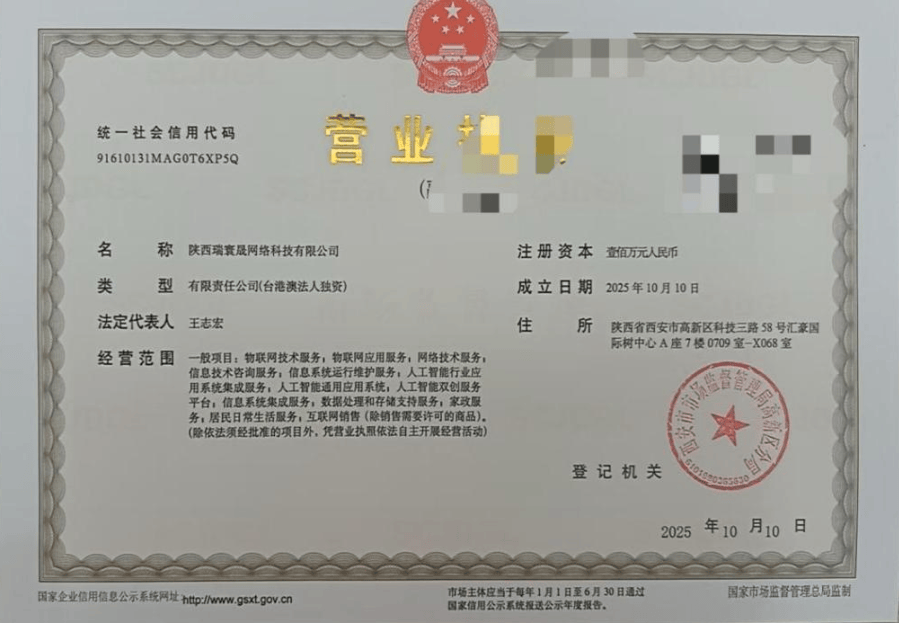
Core Viewpoint - The completion of the registration of the Wholly Foreign-Owned Enterprise (WFOE) marks a significant step for the company in establishing a Variable Interest Entity (VIE) structure and preparing for its entry into the U.S. capital market [1] Group 1: Overseas Structure Implementation - The completion of the WFOE registration is part of a systematic architecture that includes the establishment of a Special Purpose Vehicle (SPV) in the Cayman Islands as the future listing entity [3] - The company has successfully obtained the "Document No. 37" registration from the State Administration of Foreign Exchange, ensuring the legal transfer of domestic rights to the overseas listing entity [3] - The newly established WFOE, fully controlled by the Cayman listing entity, serves as the core operational entity within China, forming a standardized VIE structure [4] Group 2: Strategic Significance of the Structure - The completion of the WFOE registration and the approval of "Document No. 37" serve as a "passport" and "bridge" to the international capital market, representing a leap in corporate governance modernization [5] - The structure opens up international financing channels, paving the way for attracting top global investment institutions for private financing, thus enabling more efficient capital acquisition for rapid business expansion [5] - It ensures that future fundraising from overseas listings can be legally and smoothly transferred to the domestic operational entity, while also safeguarding the legal remittance of dividends to overseas shareholders [6] Group 3: Enhancement of Corporate Governance - The adoption of internationally accepted corporate governance and financial reporting standards will significantly enhance international investors' confidence and recognition of the company [7]
2025海外上市架构揭秘,不同行业企业差异化选择
Sou Hu Cai Jing· 2025-10-11 07:13
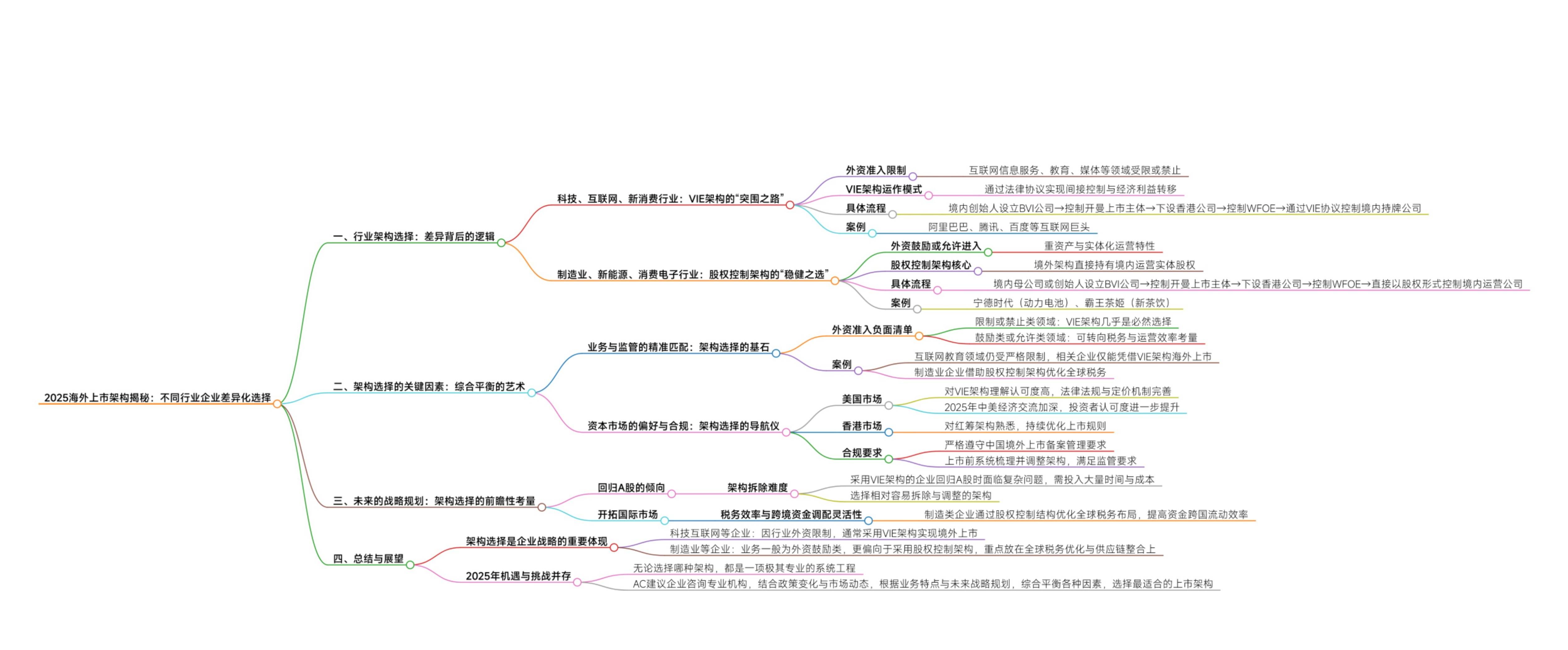
Core Insights - The enthusiasm of domestic companies for overseas listings continues to rise in 2025, with different industries showing distinct preferences for listing structures based on their business characteristics, regulatory environments, and capital needs [1] Group 1: Technology, Internet, and New Consumption Industries - Companies in the technology, internet, and new consumption sectors often face restrictions on foreign investment access, leading them to adopt the Variable Interest Entity (VIE) structure to attract international capital and achieve rapid listings [4][7] - The VIE structure operates through a series of legal agreements that allow indirect control and economic benefit transfer between domestic operating entities and overseas listed entities, exemplified by companies like Alibaba, Tencent, and Baidu [4][8] - The success of these internet giants using the VIE structure has provided valuable lessons for subsequent technology and internet companies, promoting widespread adoption of this model in the sector [4][11] Group 2: Manufacturing, New Energy, and Consumer Electronics Industries - In contrast, companies in manufacturing, new energy, and consumer electronics typically prefer equity control structures, such as the Red Chip structure, as they are generally encouraged or permitted for foreign investment [3][4] - The equity control structure allows direct ownership of domestic operating entities through offshore entities, facilitating legal and financial consolidation, as seen with companies like CATL and Bawang Chaji [4][11] - These companies focus on optimizing global tax structures and enhancing operational efficiency through their chosen listing frameworks, which is crucial for maintaining competitiveness in the global market [4][11] Group 3: Regulatory and Market Considerations - The alignment of business operations with regulatory requirements is a critical factor in choosing a listing structure, with companies needing to monitor changes in foreign investment policies closely [7][9] - Different capital markets exhibit varying levels of acceptance for listing structures, with the U.S. market showing a high understanding of the VIE structure, while Hong Kong is familiar with the Red Chip structure, both providing conducive environments for respective companies [8][9] - Companies must ensure compliance with regulations governing overseas listings to avoid delays in the listing process, emphasizing the importance of a well-structured approach to meet regulatory demands [9][10] Group 4: Future Strategic Planning - Companies should consider their future strategic plans, including the potential for returning to A-shares, when selecting a listing structure, as the complexity of dismantling certain structures can pose challenges [10][11] - The choice of listing structure reflects a company's strategic direction and intent, with technology and internet firms typically resorting to VIE structures due to foreign investment restrictions, while manufacturing firms focus on equity control structures for tax optimization and supply chain integration [11]
红筹还是VIE?一文读懂中国企业海外上市的两种核心路径
Sou Hu Cai Jing· 2025-09-24 11:16
Core Insights - The article discusses the different corporate structures (Red Chip vs. VIE) that companies are adopting for their listings, highlighting the strategic choices made by various firms in response to regulatory environments and industry characteristics [1][3][10]. Group 1: Corporate Structure Choices - Bawang Tea Ji opted for a traditional Red Chip structure instead of the VIE structure, reflecting the non-restricted nature of the new tea beverage industry, which allows for direct equity control [1][8]. - Yuanrong Qihang is building a Red Chip structure following Alibaba's exit, indicating a potential preparation for future overseas listings [1][8]. - Megvii Technology dismantled its VIE structure to facilitate a strategic shift towards domestic listing on the Sci-Tech Innovation Board, despite its subsidiary facing foreign investment restrictions [1][8]. Group 2: Factors Influencing Structure Selection - The choice between Red Chip and VIE structures is primarily influenced by industry attributes and the intended listing destination, with fully open industries favoring Red Chip structures and restricted industries leaning towards VIE [3][12]. - Regulatory scrutiny is more stringent for VIE structures, as evidenced by the longer approval times for VIE companies compared to non-VIE counterparts [5][9]. Group 3: Listing Pathways and Regulatory Considerations - Different listing pathways exist, including H-share direct listings for compliant companies, Red Chip structures for restricted industries, and A-share spin-offs for existing listed companies [11]. - Red Chip structures are generally easier to navigate for listings, while VIE structures face higher regulatory risks and complexities, impacting their acceptance in international markets [15][16]. Group 4: Control and Stability - Red Chip structures provide more stable control through direct equity ownership, while VIE structures rely on contractual agreements, which can introduce uncertainties regarding control stability [16][22]. - The regulatory environment and market conditions are dynamic, necessitating ongoing adjustments to corporate structures to align with strategic goals and compliance requirements [10].

【锋行链盟】纳斯达克IPO企业VIE架构设计重点
Sou Hu Cai Jing· 2025-09-23 16:49
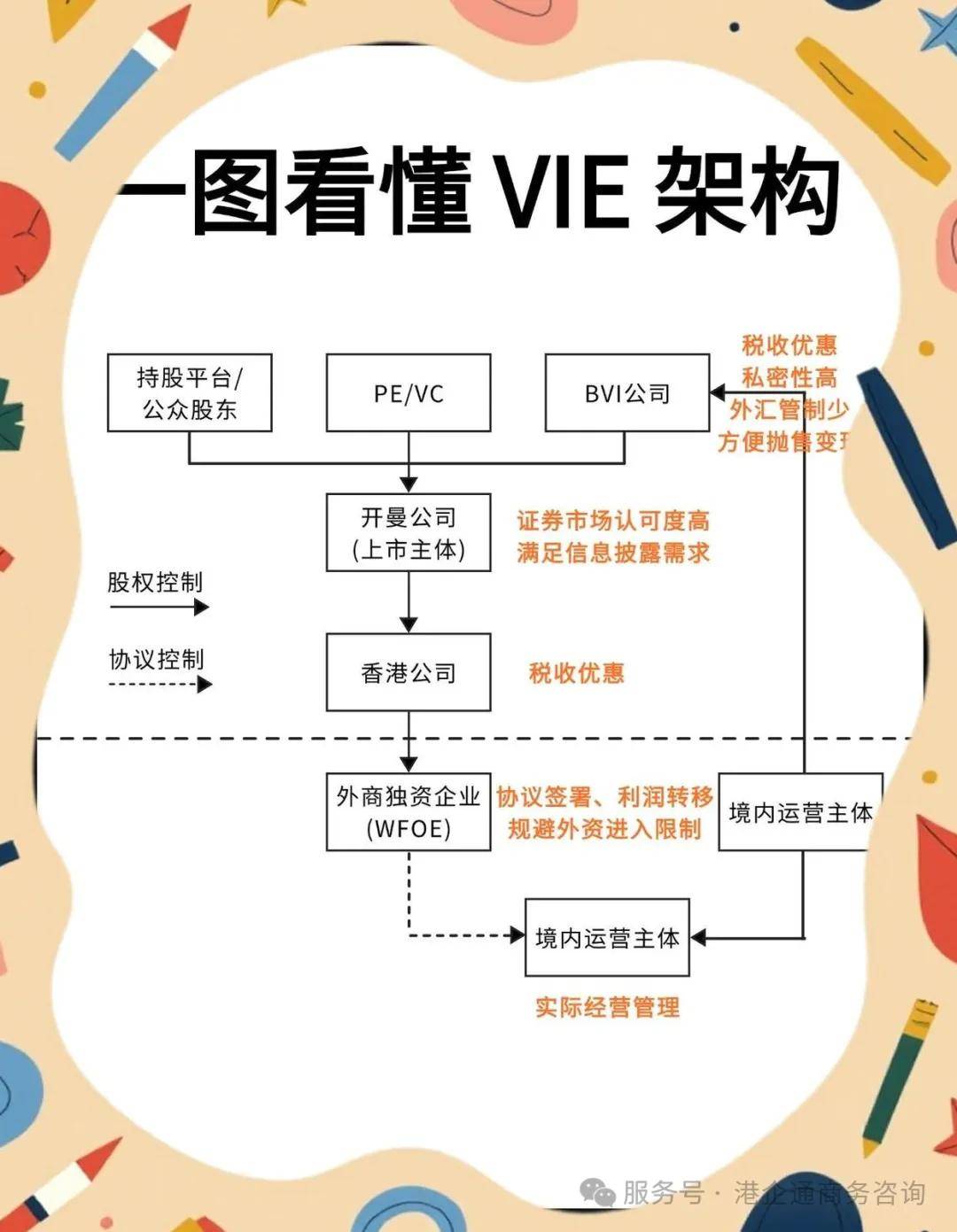
Core Design Logic - The essence of the VIE structure is to replace equity control with contractual control, addressing two types of contradictions [2] - The VIE structure achieves actual control and financial consolidation of the OPCO through a chain of entities: overseas listing entity → overseas holding layer → domestic WFOE → contractual control of domestic OPCO [2] Key Layer Design - The VIE structure typically includes 4-5 layers, with each layer's registration location, function, and design points precisely matching the objectives such as listing, holding, tax optimization, and compliance [3] - The overseas listing entity is usually a Cayman Islands company, while the overseas holding layer may be a BVI or Cayman intermediary company [3] Functional Design - The Cayman company is preferred for overseas listing due to no corporate income tax and a mature legal system allowing for "dual-class shares" [4] - The BVI company serves as a holding platform for founders, providing privacy and tax benefits [4] - The Hong Kong company acts as an intermediary layer, requiring substantial operations to avoid being classified as a "shell company" [4] Agreement Control System - The contractual control is the "soul" of the VIE structure, requiring 5-7 core agreements to ensure decision-making control, profit transfer, and risk isolation [6] - Key agreements include exclusive technology/service agreements, equity pledge agreements, voting rights entrustment agreements, and exclusive purchase rights agreements [6][8][10][12] Compliance and Risk Prevention - The compliance of the VIE structure directly impacts the ability to pass NASDAQ's listing review and ongoing compliance [18] - The WFOE must have a business scope closely related to the OPCO to avoid being classified as a "shell company" [18] - The OPCO must maintain an "internal capital control" structure to avoid triggering foreign investment restrictions [18] Tax Optimization - The VIE structure's tax design must balance profit transfer efficiency with tax risks, focusing on profit distribution between WFOE and OPCO [19] - The Hong Kong company can benefit from a reduced withholding tax rate of 5% under the "Mainland-Hong Kong Tax Arrangement" if it meets substantial operation requirements [19] Latest Regulatory Trends - The necessity of the VIE structure must be clearly justified in the prospectus to avoid being seen as regulatory evasion [20] - Compliance with data cross-border flow regulations is essential, especially if the OPCO handles user data [20] Industry Differentiation Design - For encouraged industries like renewable energy and biomedicine, a mixed structure of "equity control + contractual control" may be attempted to reduce policy risks [21] - Sensitive industries such as education and fintech require stricter contractual controls and contingency plans for structural adjustments [21]
拆解VIE架构:阿里、腾讯海外上市的“秘密武器”,如今还香吗?
Sou Hu Cai Jing· 2025-09-23 10:16
Group 1: Core Concept of VIE Structure - VIE, or Variable Interest Entity, is a financial structure that allows companies to bypass regulatory restrictions and achieve overseas financing through a series of legal agreements rather than direct equity control [3][4] - The VIE structure enables companies to maintain a domestic status while attracting foreign investment, which is crucial in sectors with foreign investment restrictions in China [5][6] Group 2: Benefits of VIE Structure - The VIE structure addresses three core challenges: circumventing foreign investment restrictions, facilitating overseas financing and listing, and providing tax optimization and flexibility [5][6] - Without the VIE structure, the current landscape of China's internet industry may not have achieved its remarkable growth [5] Group 3: Policy Evolution Related to VIE - The VIE structure has historically existed in a legal gray area, with Chinese regulators adopting a "don't acknowledge, don't deny, don't pursue" approach [6][7] - Recent regulatory changes indicate a shift from a permissive environment to a more stringent regulatory framework for VIE structures [7][8] Group 4: Classic Cases of VIE - Alibaba serves as a successful example of the VIE structure, achieving a record IPO in 2014 on the NYSE while complying with Chinese regulations [8] - Conversely, New Oriental and TAL Education faced significant challenges due to policy changes, highlighting the inherent risks of the VIE structure [8]
港股IPO筹备工作一览
梧桐树下V· 2025-08-04 07:26
Core Viewpoint - The article discusses the recent changes, regulations, and requirements for companies and intermediaries looking to list in Hong Kong, emphasizing the need for understanding the current listing system, business processes, and practical considerations in legal and tax matters [1]. Group 1: Listing Regulations and Requirements - The Hong Kong Stock Exchange (HKEX) serves as the regulatory body for the capital market, with specific rules for the Main Board and the Growth Enterprise Market (GEM) [3]. - Different listing qualifications apply based on the type of listing on the Main Board, including operational history, financial qualifications, and management continuity [3]. - The VIE (Variable Interest Entity) structure has specific regulatory requirements, including compliance and the need for regulatory confirmation [3][5]. Group 2: Listing Process and Stakeholders - The listing process involves submitting an application to the HKEX, which includes a review by the listing department and a hearing by the Listing Committee [5]. - Various professional institutions are involved in the listing process, including sponsors, compliance advisors, underwriters, lawyers, and accountants [5]. - The average time for domestic companies to complete the listing process in Hong Kong is over six months, with VIE structures taking longer due to additional regulatory scrutiny [5][6]. Group 3: Compliance and Regulatory Changes - Recent regulatory changes include a negative list system for prohibited listings, focusing on national security and significant legal violations [6]. - The new regulations require thorough internal control measures and compliance with foreign investment security reviews [6]. - Companies must ensure that their business operations and data protection measures comply with the new regulatory framework [6]. Group 4: Practical Insights and Case Studies - The article highlights the importance of understanding the differences between H-shares, red-chip companies, and VIE structures to effectively plan the listing path [16]. - It emphasizes the need to clarify the responsibilities of all parties involved in the listing process to mitigate legal risks [16]. - Successful case studies, such as Midea Group and Zhixing Automobile, are analyzed to extract key experiences and strategies for successful listings [16].