
新型能源体系

Search documents
“十四五”以来 内蒙古能源科技装备
Xin Lang Cai Jing· 2026-01-18 19:30
Group 1: Green Hydrogen and Coal Chemical Integration - The system successfully addresses the core contradiction between the intermittent and volatile nature of wind and solar power generation and the continuous stable production of hydrogen from coal chemical processes [1] - A multi-time scale control mechanism has been established to accurately smooth out fluctuations in wind and solar output and flexibly adapt hydrogen production loads, ensuring continuity in hydrogen production under high proportions of renewable energy [1] - The system utilizes laser wind radar and all-sky instruments combined with machine learning technology to achieve second-level wind and solar power forecasting with an accuracy exceeding 95% [1] Group 2: High-Efficiency Dual Extraction Thermal Power Generation - The 1000MW dual extraction thermal power generation unit is the first of its kind in China, designed to reduce coal consumption to 278.5 grams per kilowatt-hour, which is a reduction of 23 grams compared to conventional ultra-supercritical air-cooled units [2] - This unit can save approximately 115,000 tons of standard coal annually and reduce carbon emissions by 30.59 tons [2] - The maximum industrial steam extraction capacity of the unit is 600 tons per hour, providing a significant solution for centralized thermal power supply in industrial parks and urban residential users [2] Group 3: Grid-Based Pure Renewable Energy Systems - The construction and demonstration of this system break the traditional reliance on conventional rotating units, validating the correctness of grid-based energy storage technology for large-scale grid operations [3] - It opens new application scenarios for grid-based energy storage technology, enhancing grid short-circuit capacity, improving system inertia, and optimizing frequency and voltage control [3] - The system supports the development of clean energy consumption and explores new pathways for the renewable energy industry, contributing to the national "dual carbon" goals [3] Group 4: Intelligent Reactive Power Transformer - The 66kV magnetic-controlled intelligent reactive power transformer combines controllable reactors with transformers, effectively addressing the challenges of reactive power balance and voltage stability after large-scale renewable energy integration [4] - This transformer can quickly respond to reactive power changes from renewable generation, providing stable reactive support for grid integration [4] - It promotes the optimization and transformation of the energy structure [4] Group 5: Green Power Station Demonstration Project - The project achieves intelligent coordinated operation of high-proportion energy storage and wind-solar renewable energy, ensuring reliable energy supply and promoting the development of the "new energy + energy storage" model [5] - It features a storage system that accounts for approximately 30% of the total installed capacity of wind and solar, making it the largest integrated wind-solar storage power station under construction globally [5] - The project includes a digital management system that enhances the digital intelligence level of wind-solar storage stations [5]
视频丨年用电量首超10万亿度 展现中国经济发展活力
Yang Shi Xin Wen Ke Hu Duan· 2026-01-18 12:50
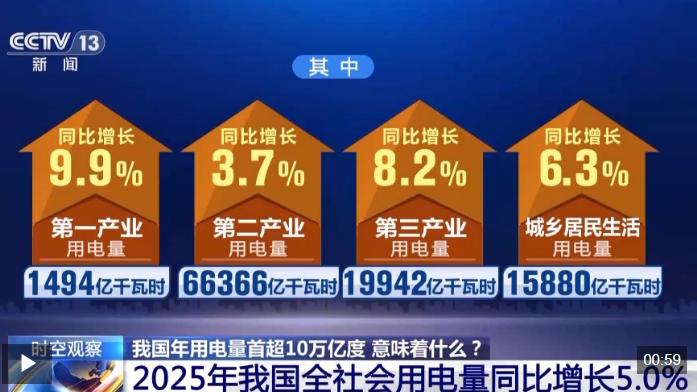
Core Insights - China's total electricity consumption is projected to exceed 10 trillion kilowatt-hours in 2025, marking the first time any country has reached this milestone, which is more than double the annual electricity consumption of the United States and surpasses the combined consumption of the EU, Russia, India, and Japan [2][4][5] Group 1: Electricity Consumption Breakdown - In 2025, total electricity consumption is expected to reach 10,368.2 billion kilowatt-hours, representing a year-on-year growth of 5.0% [2] - The breakdown of electricity consumption by sector includes: - Primary industry: 149.4 billion kilowatt-hours, up 9.9% - Secondary industry: 6,636.6 billion kilowatt-hours, up 3.7% - Tertiary industry: 199.4 billion kilowatt-hours, up 8.2% - Urban and rural residential electricity: 158.8 billion kilowatt-hours, up 6.3% [2] Group 2: Driving Forces Behind Growth - The tertiary sector and residential electricity consumption are the main drivers of overall electricity growth, contributing to 50% of the increase [4] - Within the tertiary sector, the electric vehicle charging and swapping services, as well as information transmission, software, and IT services, have seen significant growth rates of 48.8% and 17.0%, respectively [4][6] Group 3: Structural Changes in Energy Consumption - The second industry remains the primary electricity consumer, accounting for approximately 64%, with growth shifting from high-energy-consuming industries to high-end manufacturing [6] - In 2025, electricity consumption in the computer, communication, and other electronic device manufacturing sectors is expected to exceed 50 billion kilowatt-hours, surpassing traditional industries like steel and chemicals [6] Group 4: Digital Economy and Innovation - The digital economy is experiencing rapid growth, with the "East Data West Computing" initiative driving significant increases in electricity consumption in the data industry, particularly in Guizhou, where internet data service electricity consumption surged by 95.01% [8] - The demand for computing power is also rising exponentially, as evidenced by the Huawei Cloud data center in Guian New Area, which has seen a 56.92% increase in electricity consumption [8] Group 5: Implications of Exceeding 10 Trillion Kilowatt-Hours - The surpassing of 10 trillion kilowatt-hours indicates a robust and stable economic development across various sectors, reflecting the resilience of China's energy infrastructure and the strong integration capabilities of its modern industrial system [4][5] - The shift towards high-tech, high-value-added industries and the increasing share of green electricity supply signal a positive outlook for the development of a new energy system centered around renewable sources [8]

能源强国建设“大家谈”︱建设能源强国支撑经济社会发展全面绿色转型
国家能源局· 2026-01-17 10:33
Core Viewpoint - The article emphasizes the importance of building an energy powerhouse as a strategic foundation for achieving socialist modernization and carbon neutrality goals in China, highlighting the energy sector's critical role in national security and economic development [3][4]. Group 1: Building an Energy Powerhouse - Building an energy powerhouse is essential for achieving carbon peak and carbon neutrality goals, with a focus on increasing electrification and green electricity supply [4]. - The energy sector is a significant contributor to GDP, with the clean energy industry accounting for over 10% of GDP, necessitating a robust industrial and supply chain [4]. - The transition to a new energy system is crucial for the comprehensive green transformation of the economy and society, driven by the third energy revolution and advancements in artificial intelligence [4]. Group 2: New Energy System as a Driving Force - A new energy system is vital for ensuring national energy security, given China's resource endowment of "rich coal, poor oil, and little gas," and the high dependence on oil and gas imports [5]. - China has significant potential for wind and solar energy, with exploitable capacities exceeding 100 billion kilowatts and 400 billion kilowatts, respectively, which can meet future electricity demands [5]. - The cost of renewable energy has significantly decreased, with onshore wind power costs dropping over 60% and solar power costs falling by 80% in the past decade, making renewables more economically viable than coal [5]. Group 3: Climate Change Response - The new energy system is a necessary response to climate change, with China's commitment to reducing greenhouse gas emissions by 7%-10% from peak levels by 2035 [6]. - The energy sector accounts for over 80% of national carbon emissions, with the power industry being the main battlefield for carbon reduction efforts [6]. Group 4: Development Pathways for Energy Powerhouse - The 14th Five-Year Plan is a critical period for accelerating the construction of a new energy system, focusing on reforms, technological innovation, green consumption, and overall exports [8]. - Recommendations include deepening electricity market reforms, enhancing technological innovation in the energy sector, and promoting green low-carbon consumption models [9][10].
用电量突破10万亿度,我国是如何实现稳定、精准供电的?
Xin Lang Cai Jing· 2026-01-17 09:29
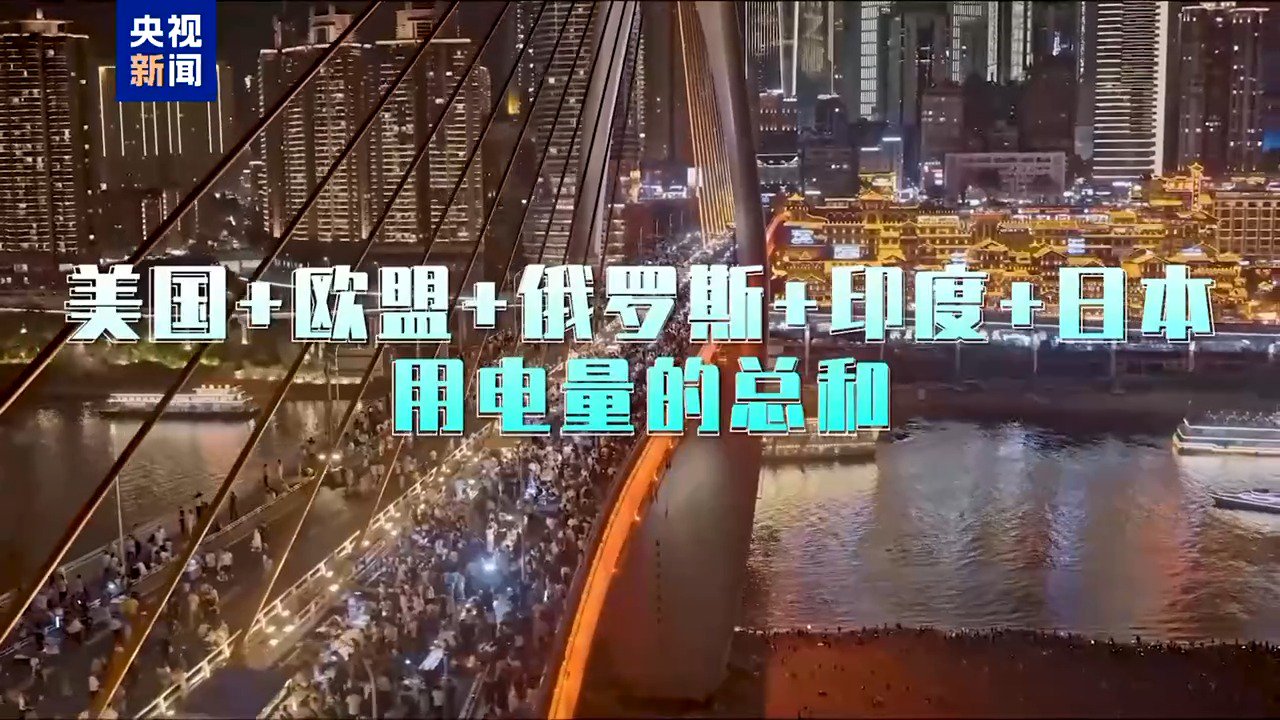
Group 1 - The core point of the article highlights that in 2025, China's total electricity consumption surpassed 10 trillion kilowatt-hours, setting a new record for any single country in history [1][3] - Over the past decade, China's electricity consumption doubled from 5 trillion kilowatt-hours to 10 trillion kilowatt-hours, indicating significant growth in energy demand [1][3] - China's electricity consumption now equals the combined total of the United States, the European Union, Russia, India, and Japan [1] Group 2 - In the summer of 2025, China faced extreme heat, with monthly electricity consumption exceeding 1 trillion kilowatt-hours for two consecutive months, and power loads breaking historical highs multiple times [2][5] - Despite these challenges, China's energy supply remained stable, showcasing the resilience of its energy system under dual pressures of safety and transformation [2][5] - The share of non-fossil energy in China's installed capacity has reached 61%, with one-third of total electricity consumption coming from green energy sources, reflecting a significant reduction in carbon footprint as the economy progresses [5] Group 3 - The article emphasizes the importance of precision in electricity supply, where fluctuations as small as 0.01 seconds can have significant impacts [7][9] - Advanced technologies such as BeiDou communication, cloud computing, and artificial intelligence are being utilized to enhance the efficiency of the electricity grid [9][11] - The construction of the world's largest energy storage facilities and complex market dispatch systems has achieved a supply-demand precision of "millisecond level," with national power reliability reaching 99.924% [11]
迈过十字路口的煤电一体化
Xin Hua Wang· 2026-01-16 05:30
Core Viewpoint - The integration of coal and electricity, known as "coal-electricity integration," has become a significant energy development model in China, allowing for direct conversion of coal to electricity, reducing costs and stabilizing supply [1] Group 1: Company Overview - Guoshen Company, a subsidiary of the State Energy Group, is one of the earliest and largest operators of coal-electricity integration in China, managing seven projects across regions and accumulating extensive experience [1] - The company faced challenges in its traditional operational model due to macroeconomic shifts and internal coordination issues, leading to inefficiencies in resource utilization [2][3] Group 2: Reform and Innovation - Over the past five years, Guoshen Company has undergone significant reforms to enhance internal collaboration, moving from a fragmented operational approach to a more integrated model [4][5] - The company developed a unique "three-in-three-out" collaborative efficiency model, which includes coal supply to power plants, water recycling, and ash utilization, resulting in cost savings and environmental benefits [5][6] Group 3: Management and Efficiency - The company established a new integrated management model that clarifies responsibilities and optimizes processes, leading to reduced management costs and improved operational efficiency [8][9] - In Xinjiang, management efficiency improved by 30% through focused resource integration and performance assessment, while in Shaanxi, departmental restructuring led to a 6% increase in individual efficiency [9][10] Group 4: Industry Context and Future Directions - The energy sector is undergoing a transformation, with coal's role shifting from a primary energy source to a flexible support resource amid the rise of renewable energy [12][13] - Guoshen Company is adapting to these changes by implementing four major initiatives aimed at enhancing capacity, quality, transformation, and efficiency, thus evolving its coal-electricity integration model to include renewable energy [14][15]
国家电网“十五五”计划投资4万亿元
Sou Hu Cai Jing· 2026-01-16 00:08
Core Viewpoint - The State Grid Corporation of China plans to increase its fixed asset investment to a historical high of 4 trillion yuan during the "15th Five-Year Plan" period (2026-2030), representing a 40% increase compared to the "14th Five-Year Plan" period (2021-2025) [2][3]. Investment Focus - The investment plan will focus on four main areas: 1. Strengthening the grid platform and constructing a new power system, aiming to establish a collaborative new grid platform integrating main networks, distribution networks, and microgrids [2]. 2. Accelerating the construction of ultra-high voltage direct current transmission channels, with a goal to enhance cross-region and cross-province transmission capacity by over 30% compared to the end of the "14th Five-Year Plan" [2]. 3. Promoting the construction of distribution networks in urban, rural, and remote areas, while exploring supply assurance and off-grid microgrid models [2]. 4. Solidifying digital infrastructure and implementing an "AI+" initiative to enhance digital empowerment of the grid [3]. Investment Growth - The State Grid has maintained a high investment growth rate, completing 538.1 billion yuan in grid investments in 2023, with projections of 609.2 billion yuan in 2024 and exceeding 650 billion yuan for the first time in 2025 [3]. - During the "14th Five-Year Plan," the total fixed asset investment is expected to exceed 2.85 trillion yuan, marking an increase of over 18% compared to the "13th Five-Year Plan" [3]. Strategic Importance - The Chairman of the State Grid emphasized the importance of expanding domestic demand as a strategic move for economic stability and security, advocating for greater investment in the grid to stimulate social investment and the development of supply chains [4]. - The company aims to align its development with national strategies, enhancing the integration of conventional and renewable energy sources, and supporting the development of large-scale wind and solar power bases [4]. Future Projections - By 2030, the "West-to-East Power Transmission" capacity is expected to exceed 420 million kilowatts, with an additional inter-provincial power exchange capacity of around 40 million kilowatts, supporting renewable energy generation to account for approximately 30% of total generation [4]. - The expected annual increase in installed capacity for wind and solar energy during the "15th Five-Year Plan" is around 20 million kilowatts, contributing to a target of 25% non-fossil energy consumption and 35% electricity share in terminal energy consumption [4].
4万亿!国家电网公布“十五五”投资重点
Sou Hu Cai Jing· 2026-01-15 23:23
Group 1 - The core investment plan of the State Grid Corporation during the "14th Five-Year Plan" period is projected to reach 4 trillion yuan, marking a 40% increase compared to the "13th Five-Year Plan" and setting a historical record [1] - Investments will focus on promoting green and low-carbon energy transition, constructing a new power system, and deepening technological innovation [1] - The company aims to achieve an average annual increase of 20 million kilowatts in installed capacity of wind and solar energy in its service areas, with non-fossil energy consumption reaching 25% and electricity accounting for 35% of terminal energy consumption [1] Group 2 - The company plans to enhance system regulation capabilities, optimize pumped storage station layouts, and support the large-scale development of new energy storage [1] - A new grid platform will be established, integrating trunk grids, distribution networks, and smart microgrids, while reinforcing the "West-to-East Power Transmission" and "North-to-South Power Supply" networks [1] - The construction of ultra-high voltage direct current transmission channels will accelerate, with cross-regional and cross-provincial transmission capacity expected to increase by over 30% compared to the end of the "14th Five-Year Plan" [1] Group 3 - The company will strengthen key core technology research, aiming to establish a globally influential original technology source in the energy and power sector [2] - There will be a focus on developing new productive forces, promoting deep integration of technological and industrial innovation, and enhancing the transformation of achievements into industrial development [2] - The company emphasizes internal development, optimizing business layout, and enhancing service capabilities to support national strategies [2] Group 4 - During the "14th Five-Year Plan" period, the State Grid Corporation completed a total fixed asset investment of over 2.8 trillion yuan, with annual investments projected to exceed 650 billion yuan in 2025 [3]
零碳园区用能结构怎么转型?凡鹏飞:采取“3+2”互补供电方式
2 1 Shi Ji Jing Ji Bao Dao· 2026-01-15 11:30
Core Viewpoint - The construction of national-level zero-carbon parks in China is set to begin, with a target of establishing around 100 parks during the 14th Five-Year Plan period, with the first batch of 52 parks expected to be completed by 2027 [1][10]. Group 1: Zero-Carbon Park Construction - The first batch of zero-carbon parks will focus on transforming energy consumption structures, with a goal of achieving at least 50% of electricity supply from renewable sources [1][4]. - The parks will serve as experimental fields for a new energy system, utilizing various green electricity supply models, including direct supply, nearby access to distribution networks, and distributed generation [2][9]. - The construction of these parks will be guided by a combination of local resource endowments, economic feasibility, technological viability, and policy environments [9][10]. Group 2: Green Electricity Supply Models - Three main models for green electricity supply have been identified: direct connection of green electricity, nearby access to incremental distribution networks, and distributed self-consumption [5][6][7]. - In addition to these models, parks can supplement their green electricity supply through green certificate trading and virtual power plants [8][9]. Group 3: Regional Distribution and Industry Types - The first batch of parks will cover all 31 provinces and regions, ensuring a diverse representation of both resource-rich and industrially advanced areas [10]. - The parks will primarily focus on low-energy, low-pollution, and high-value-added industries, while also addressing the decarbonization of traditional high-energy-consuming sectors [10]. Group 4: Challenges and Opportunities - The transition to zero-carbon parks faces challenges such as high initial investment costs and the need for systemic innovation in mechanisms and business models [15]. - Zero-carbon parks can help enterprises meet international low-carbon standards and enhance their competitiveness in global markets, particularly in light of evolving green trade rules [13][14].
国家电网:十五五支持新型储能规模化发展,服务零碳工厂和零碳园区建设
中关村储能产业技术联盟· 2026-01-15 06:01
Core Viewpoint - The State Grid Corporation of China plans to invest 4 trillion yuan during the "14th Five-Year Plan" period, representing a 40% increase compared to the previous plan, aimed at promoting high-quality development of the new power system industry chain and supply chain [2]. Group 1: Investment and Development Goals - The investment will focus on green transformation, aiming to support an average annual increase of 200 million kilowatts in installed wind and solar energy capacity, with non-fossil energy consumption expected to reach 25% and electricity's share in final energy consumption to reach 35% [2]. - The company aims to enhance system regulation capabilities and optimize the layout of pumped storage stations to support large-scale development of new energy storage [2]. Group 2: Infrastructure and Technological Advancements - The State Grid will establish a new power grid platform characterized by collaborative main and distribution networks, enhancing the "West-to-East Power Transmission" and "North-to-South Power Supply" networks, with cross-regional transmission capacity expected to increase by over 30% compared to the end of the previous plan [3]. - The company will accelerate the construction of ultra-high voltage direct current transmission channels and improve the flexibility of inter-regional support capabilities [3]. Group 3: Operational Efficiency and Strategic Focus - The company emphasizes internal development by enhancing operational management and optimizing long-term strategies and resource allocation, focusing on cost control and quality improvement in investments [4]. - The State Grid aims to play a stabilizing role in the national economy through sustained high-intensity investments, ensuring energy security and contributing to the establishment of a new energy system [4].

国家电网公司积极扩大有效投资助力新型能源体系和能源强国建设
Jing Ji Guan Cha Wang· 2026-01-15 04:51
Core Viewpoint - The State Grid Corporation of China is committed to enhancing its core functions and competitiveness to better serve national development goals and improve people's livelihoods, with a fixed asset investment of 4 trillion yuan during the 14th Five-Year Plan period, representing a 40% increase from the previous plan [1] Group 1: Focus on Green Transition - During the 14th Five-Year Plan period, the company aims to add approximately 20 million kilowatts of wind and solar energy capacity annually, targeting a non-fossil energy consumption share of 25% and an electricity share in final energy consumption of 35% [1] - The company will enhance system regulation capabilities and support the large-scale development of new energy storage, improving the integration and consumption of renewable energy [1] - The initiative includes the construction of zero-carbon factories and parks, meeting the needs for 35 million charging facilities and increasing the electrification level of end-use energy [1] Group 2: Strengthening the Power Grid Platform - The company plans to establish a new power grid platform characterized by collaborative main and distribution networks, further solidifying the "West-to-East Power Transmission" and "North-to-South Power Supply" networks [2] - The construction of ultra-high voltage direct current transmission channels will accelerate, with cross-regional transmission capacity expected to increase by over 30% compared to the end of the previous plan [2] - The company will enhance the construction of distribution networks in urban, rural, and remote areas, exploring off-grid microgrid models [2] Group 3: Empowering Technology and Accelerating Industrial Innovation - The company will focus on tackling key core technologies to establish a globally influential source of original technology in the energy and power sector, aiming for comprehensive self-control of critical technologies in the new power system supply chain [2] - There will be an emphasis on integrating technological and industrial innovation, promoting the transformation of achievements and industrial development [2] - The company aims to broaden the scope and depth of power services, creating a competitive and economically beneficial industrial cluster [2] Group 4: Enhancing Efficiency for Intrinsic Development - The company will strengthen management by embedding the "five values" throughout its operations, adopting a "tight budget" mindset to optimize long-term strategies and resource allocation [3] - Focus will be placed on cost control in construction, operational efficiency, and investment quality [3] - The company will continue to act as a "stabilizer" and "ballast" for the national economy through sustained high-intensity investments, accelerating the construction of a new power grid platform [3]