
数据安全

Search documents
围剿!美欧同时对中国电商出手,卖家又一生死局如何破?
Sou Hu Cai Jing· 2025-12-03 01:47
Core Viewpoint - The new wave of compliance challenges in cross-border e-commerce is driven by geopolitical tensions, with significant regulatory actions from the US and EU targeting Chinese products, marking the end of an era characterized by rapid growth based on price advantages and platform benefits [1] Group 1: Regulatory Environment - The US Congress has issued a "final ultimatum" to Amazon, requiring full disclosure of product origin information by November 28, including the percentage of US-made components and seller entity attributes [2] - The EU has initiated an anti-dumping investigation into Chinese robotic lawnmowers, citing systemic cost and price distortions in production, with a one-year investigation period [3] - Germany has announced a 23% VAT on all e-commerce packages from China, effective November 24, eliminating previous tax exemptions, with nearly 70% of international small packages entering Europe originating from China [3] Group 2: Underlying Causes - The tightening of regulations is influenced by rising trade protectionism, with countries focusing on domestic manufacturing and supply chain security post-pandemic [5] - The competition for supply chain dominance is intensifying, as Chinese cross-border e-commerce shifts from low-cost distribution to brand and localization strategies [5] - Data security concerns are emerging as new trade barriers, with US lawmakers emphasizing the need to identify whether sellers are US entities, reflecting deeper worries about data flow [5] Group 3: Impact on Chinese Sellers - The introduction of a 23% VAT in Germany significantly erodes profit margins for low-margin sellers, with an example showing a nearly 5 Euro tax increase on a 20 Euro product [7] - The potential for high anti-dumping duties from the EU could undermine the competitiveness of Chinese high-tech products, particularly robotic lawnmowers, which saw an 80.6% increase in exports to the EU in the first nine months of the year [7] - Compliance complexity is increasing, as Amazon's origin labeling requirements necessitate sellers to overhaul their supply chain data management systems, posing significant challenges for small and medium-sized sellers [7] Group 4: Strategic Solutions - A fundamental strategic shift is required for Chinese cross-border e-commerce, focusing on building brand value rather than competing solely on price [10] - Developing compliance capabilities should be viewed as a core competitive advantage, with the establishment of specialized compliance teams to monitor legal changes in target markets [10] - Diversifying market presence is crucial to mitigate risks associated with over-reliance on a single market, with opportunities in emerging markets and localized operations through overseas warehouses [10] - Embracing technological changes to reshape marketing strategies is essential, as AI-driven tools like Amazon's shopping assistant can significantly enhance conversion rates [10] - Building supply chain resilience through diversified production locations and partnerships with local firms can help balance cost and compliance needs [10] Group 5: Industry Evolution - The cross-border e-commerce sector is transitioning from a focus on quick profits to a more mature, detail-oriented approach, with compliance becoming a competitive edge [11] - Sellers who adapt quickly to the new regulatory environment may find opportunities for transformation, positioning themselves as leaders by prioritizing compliance and brand development [11]


2025年第三季度银行高管商业前景调查
Sou Hu Cai Jing· 2025-12-02 06:31
Core Insights - The report indicates strong support among bankers for the independence of the Federal Reserve, with 95% considering it important for monetary policy [1][11][27] - Data security is highlighted as the primary concern in third-party collaborations, with 47% of bankers citing customer data breaches as their top worry [2][14][42] - Overall, bankers express a stable outlook for the industry, with expectations of declining funding costs and a slight increase in loan demand [3][16][46] Group 1: Federal Reserve Independence - 95% of bankers believe maintaining the Fed's independence in monetary policy is important, with 75% stating it is "very important" [1][11][27] - 88% of bankers assert that a Fed governor should only be removed for proven misconduct, reflecting a desire for political neutrality in monetary policy [2][12][23] Group 2: Third-Party Risk Management - Customer data breaches are the foremost concern for 47% of bankers when selecting third-party vendors, followed by vendor-related reputational and operational risks at 38% [2][14][42] - Understanding cybersecurity risks, particularly regarding sensitive consumer data, is deemed the most critical factor in managing third-party relationships by 52% of bankers [2][37] Group 3: Business Outlook - 58% of bankers report that deposit competition has remained steady, with 37% anticipating increased competition in the coming year [3][15][46] - 77% of banks have seen a decrease in funding costs over the past year, and 80% expect further declines in the next 12 months [3][16][46] - 46% of bankers have experienced an increase in loan demand recently, with 47% projecting further growth in the next year [3][16][46] Group 4: Economic Confidence - 36% of bankers believe the economic situation has improved over the past year, the highest level since Q1 2022, and 32% expect further improvement [4][46] - The "Bank Experience Index" and "Bank Confidence Index" have both shown continuous growth, indicating positive sentiment among bankers regarding the industry [4][46] Group 5: Conclusion - The survey reflects a cautiously optimistic outlook for the banking industry, emphasizing the importance of Fed independence and data security in third-party relationships, alongside stable expectations for funding costs and loan demand [5][46]
Varonis Systems (NasdaqGS:VRNS) 2025 Conference Transcript
2025-12-01 21:37
Summary of Varonis Systems Conference Call Company Overview - **Company**: Varonis Systems (NasdaqGS:VRNS) - **Industry**: Cybersecurity - **Focus**: Data security and protection for enterprises across various sectors Key Points and Arguments 1. **Company History and Platform Evolution**: Varonis was founded to help enterprises protect their data, understand data locations, and assess associated risks. The platform has evolved to cover databases, SaaS applications, file systems, and collaborative platforms, transitioning to a SaaS-first model in recent years [5][10][20] 2. **Use Cases**: The primary use cases include visibility into data, risk reduction, and threat detection and response. The company aims to identify abnormal data access patterns similar to credit card fraud detection [6][8] 3. **Transition to SaaS**: Varonis announced a transition to SaaS at the beginning of 2023, aiming for 70%-90% of Annual Recurring Revenue (ARR) to come from SaaS by 2026. The transition period has been shortened from five years to three years due to strong performance [10][20][21] 4. **On-Prem Subscription Renewal Rates**: In Q3, the on-prem subscription renewal rate fell below historical levels (over 90%). Factors contributing to this included single-threaded customers, sales execution issues, and increased deal scrutiny [10][14][16] 5. **SaaS Business Performance**: Despite challenges in on-prem renewals, the SaaS business has significantly outperformed expectations, with ARR projected to reach approximately $600 million by 2025 [19][20] 6. **Data Security Demand**: Demand for data security is increasing, with budgets rising as organizations prioritize data protection, especially in light of generative AI advancements [25][27] 7. **Product Innovations**: Varonis has expanded its product offerings, including AI security and email security, to enhance its platform's capabilities. The acquisition of companies like Cyril and Slash Next has strengthened its position in database activity monitoring and email security [28][29][32] 8. **Federal Market Challenges**: The federal business underperformed in Q3 due to sales execution issues and the timing of FedRAMP certification, which complicated the sales process. The company remains committed to this vertical [40][41][43] 9. **Competitive Landscape**: The competitive environment has evolved, with more players entering the data security space. Varonis emphasizes its comprehensive coverage and rapid deployment capabilities as key differentiators [44][46] 10. **Future Growth Goals**: Varonis aims for 20% ARR growth, with a focus on transitioning customers to SaaS and enhancing the value proposition of its offerings. The company is actively engaging with customers to facilitate this transition [52][53] Additional Important Insights - **Customer Engagement**: The company is in discussions with customers who did not renew in Q3, aiming to convert them to SaaS [50][51] - **Market Positioning**: Varonis positions itself as a leader in data security, emphasizing the importance of data protection in the context of AI and productivity tools [26][27] - **Sales Enablement**: The integration of new products into the existing sales framework has been smooth, allowing for effective risk assessments and broader security offerings [30][32] This summary encapsulates the critical insights from the Varonis Systems conference call, highlighting the company's strategic direction, market challenges, and growth opportunities.

美股异动丨Coupang盘前大跌近9% 3370万个客户账户信息遭入侵外泄
Ge Long Hui· 2025-12-01 09:41
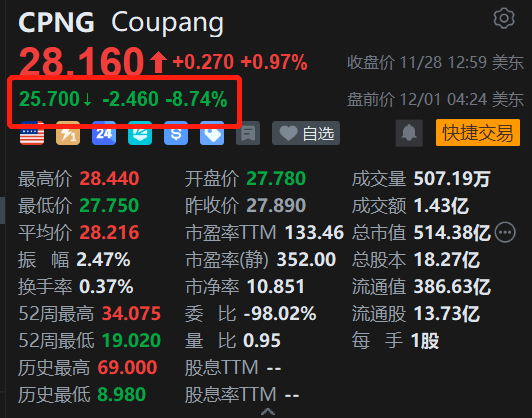
Core Points - Coupang, South Korea's largest online retailer, experienced a nearly 9% drop in pre-market trading due to unauthorized access to personal information of 33.7 million customer accounts [1] - The company, often referred to as the "Amazon of South Korea," is known for its "Rocket" fast delivery service, which is widely used by many South Koreans [1] - An investigation is ongoing, and the company is cooperating with law enforcement and regulatory agencies [1] Company Summary - Coupang's pre-market price was reported at $25.70, reflecting a decrease of $2.46 or 8.74% from the previous close [2] - The closing price on November 28 was $28.16, with a trading volume of 5.0719 million shares [2] - The company's market capitalization stands at $51.438 billion, with a total share count of 1.827 billion [2] - The stock has a 52-week high of $34.075 and a low of $19.020, indicating significant volatility [2]

安全至上:哪款国内问卷调查软件更适合敏感数据收集?
Sou Hu Cai Jing· 2025-12-01 03:05
Core Viewpoint - In the data-driven era, organizations prioritize not only the quantity of data but also its security, trustworthiness, and compliance, especially in sensitive scenarios like employee feedback and financial surveys [1][3]. Data Security Risks - Traditional survey tools often fall short in security and data governance, leading to risks such as unverified respondent identities, IP address manipulation, and data export without proper cleaning [3][4]. - Vulnerabilities in these tools can result in distorted results, biased decisions, and potential legal compliance issues [3][4]. Key Dimensions for Survey Tool Selection - **Identity and Sample Recognition Mechanisms**: Ability to distinguish between target users and non-target users, supporting verification methods like WeChat ID and IP checks [3][5]. - **Data Transmission and Storage Security**: Support for HTTPS, custom domain names, SSL certificates, and encrypted cloud storage [3][5]. - **Data Quality and Governance Processes**: Features like automated data cleaning, traceability, and logical validation to ensure reliable results [3][6]. Advantages of Questionnaire Network - **Technical Protection**: Implements multiple identity verification methods, such as WeChat ID restrictions and IP access controls, to prevent data manipulation [5][6]. - **Sample Quality Assurance**: Offers automated data cleaning and logical validation to enhance the credibility of results, especially for sensitive data [6][7]. - **Scenario Adaptability**: Supports various sensitive data collection scenarios, including employee feedback systems with strict data access requirements [7][8]. Practical Steps for Sensitive Data Research - Define target respondent groups by selecting options like "WeChat login only" to narrow the audience [8]. - Enable anti-fraud features such as device/IP response limits and verification mechanisms [9]. - Use custom domains and HTTPS links to enhance brand trust and security [10]. - Design logical validation questions to filter out non-target respondents [11]. - Clean and export data for further analysis using tools like SPSSPRO or Excel [12]. Importance of High-Security Platforms - Choosing a platform with robust security mechanisms reduces risks associated with data integrity and enhances the value of research outcomes [14]. - A secure platform allows organizations to focus on insights and strategy formulation rather than concerns about data authenticity [14].
South Korean e-commerce firm Coupang says 33.7 million customer accounts breached
Reuters· 2025-11-29 23:03
Core Insights - Coupang, a leading South Korean e-commerce company, reported that personal information from 33.7 million customer accounts was compromised due to unauthorized data access [1] Company Summary - Coupang has a significant customer base, with 33.7 million accounts affected by the data breach [1]

产业观察 | 大模型爆发带来新风险 AI安全博弈白热化:如何重构数字信任?
Mei Ri Jing Ji Xin Wen· 2025-11-28 11:53
Core Insights - The integration of AI and data security has reached a critical stage, with major tech companies releasing core solutions to shift the industry from passive defense to proactive governance [1][2] - High-quality data is essential for the effective functioning of AI models, as poor data leads to suboptimal outcomes [1][2] - The relationship between large models and data is likened to "rocket engines and fuel," emphasizing the need for deep collaboration [2] Industry Trends - By 2027, 60% of large enterprises in China are expected to adopt exposure management technology in their security operations centers to enhance incident response efficiency [1] - Currently, only 5% of Chinese enterprises deploying AI technologies are using collaborative AI defense strategies, but this is projected to rise significantly by 2028 [1] Technological Advancements - AI technology has improved the efficiency of data classification and grading by over three times, achieving an accuracy rate of over 95% [2] - In the API security domain, AI agents can filter non-API assets and create high-purity asset lists through advanced analysis techniques [2][3] Practical Applications - The advancements in AI and data security are not just theoretical; they have been transformed into mature solutions for industries such as finance and government [4] - AI's role in data security is twofold: enhancing security intelligence and ensuring the safety of intelligent systems [2] Regulatory Landscape - The balance between security and data utilization is a key focus, with industry leaders advocating for robust security measures to facilitate data flow [6] - Recent global regulatory changes, such as the relaxation of GDPR for AI training data, reflect a shift towards balancing technological competition and regulatory oversight [8] Collaborative Ecosystem - The establishment of a collaborative ecosystem involving government, enterprises, and research institutions is crucial for effective security measures [9] - The concentration of numerous small security firms in specific regions creates a unique competitive advantage, fostering a complete ecosystem of "security services + digital applications" [9]
英方软件跌4.50%,成交额3.47亿元,今日主力净流入-2953.08万
Xin Lang Cai Jing· 2025-11-28 08:21
Core Viewpoint - The company, Yingfang Software, is actively participating in the domestic software ecosystem and has established itself as a key player in data protection and replication technology, particularly in the financial sector and other industries. Group 1: Company Overview - Yingfang Software was founded on August 12, 2011, and went public on January 19, 2023. The company is based in Shanghai and specializes in providing data replication software, integrated hardware-software solutions, and related services [7] - The revenue composition of the company includes 60.37% from software products, 20.57% from software-related services, 15.97% from integrated hardware-software products, and 3.09% from other sources [7] Group 2: Market Position and Performance - As of September 30, the company had 6,509 shareholders, an increase of 0.91% from the previous period, with an average of 7,248 circulating shares per person, up by 1.32% [8] - For the period from January to September 2025, Yingfang Software achieved a revenue of 132 million yuan, representing a year-on-year growth of 11.26%. However, the net profit attributable to the parent company was -14.71 million yuan, which is a 53.56% increase in loss compared to the previous year [8] Group 3: Industry and Technological Integration - The company has joined the openEuler community and supports the Huawei Euler operating system, indicating a commitment to promoting domestic software innovation and self-sufficiency [2] - Yingfang Software is recognized as one of the top three suppliers in the domestic data replication and protection software market, with its products widely used in financial institutions and various sectors such as government, healthcare, and telecommunications [3][5] - The company has developed advanced data replication technologies compatible with various domestic and international software brands, including certifications with Kunpeng chips and cloud platforms [2][3] Group 4: Investment and Trading Insights - On November 28, Yingfang Software's stock fell by 4.50%, with a trading volume of 347 million yuan and a turnover rate of 13.53%, resulting in a total market capitalization of 4.466 billion yuan [1] - The average trading cost of the stock is 55.56 yuan, with recent buying activity observed, although the strength of this accumulation is not strong. The stock price is currently fluctuating between resistance at 59.10 yuan and support at 49.68 yuan [6]

环球问策:立体密算如何破解数据流通安全困境
Huan Qiu Wang· 2025-11-28 06:23
【环球网科技报道 记者 李文瑶】在人工智能浪潮席卷千行百业、算力网络加速构建的今天,数据要素已成为驱动数字经济的核心引擎。然而,数据在跨域 流通、协同计算过程中如何实现"可用不可见""可控可计量",始终是横亘在规模化应用前的安全天堑。传统的"补丁式"安全防护,在复杂的跨主体、高价值 数据协作场景中愈发显得力不从心。 "通过'立体密算体系',我们已经看到了三大转变正在发生,我们的安全体系由以人为本转变为技术为纲,由单点防御转变为体系化的防御,由经验驱动的 被动防御转变为理论闭环的主动防御机制。"曙光云副总裁孙会首在接受记者采访时如是说。这背后,是曙光云联合多家顶尖科研机构与行业伙伴,发布"立 体密算体系",旨在打造可信智能世界的新基础设施。 从 " 被动补丁 " 到 " 主动免疫 " :安全范式的根本性跃迁 当前,数据安全领域充斥着各类概念:隐私计算、机密计算、可信计算……它们之间究竟有何区别?为何需要提出"立体密算"这一新体系? "立体密算与当前主流机密计算的核心区别,在于从单点技术架构到体系性内生安全的范式跃迁。"曙光云总裁助理李明达指出,"主流机密计算核心在于依 托CPU硬件在不可信的环境中创建一个孤立的 ...

英方软件2025年11月27日涨停分析:营收增长+研发实力+数据安全
Xin Lang Cai Jing· 2025-11-27 01:56
Core Viewpoint - The stock of Yingfang Software (sh688435) reached its daily limit with a price of 63.11 yuan, reflecting a 15.99% increase, driven by revenue growth, strong R&D capabilities, and the increasing importance of data security [1][2]. Group 1: Financial Performance - In Q3 2025, the company's revenue grew by 36.07% year-on-year, indicating a strong business expansion trend [2]. - The net profit loss in H1 2025 narrowed by 55.35% year-on-year, signaling a positive market sentiment despite still being in a loss position [2]. Group 2: R&D and Market Position - The company has a robust R&D capability, holding 61 patents and 161 software copyrights, with R&D investment accounting for 59.83% of its expenditures [2]. - The international revenue saw a staggering increase of 2098.02% year-on-year, indicating successful international expansion [2]. Group 3: Market Trends and Technical Analysis - The data security sector is currently a market hotspot, with related stocks performing well, contributing to a sector-wide positive effect [2]. - Technical indicators suggest that if the stock breaks through key resistance levels and shows bullish signals, it may attract further investment from technical traders [2].