
消费者权益保护

Search documents
民生银行东营河口支行走进德胜街商户开展消保宣传活动
Qi Lu Wan Bao· 2025-10-17 07:47
Core Points - Financial security is crucial for consumers in the context of rapid economic development, prompting a financial knowledge promotion event by Minsheng Bank Dongying Hekou Branch [1] Group 1 - The event aimed to enhance financial literacy among merchants and residents, focusing on consumer rights protection and fraud prevention [1][2] - Staff prepared diverse promotional materials, including legal interpretations of consumer rights and case analyses of common fraud methods, providing targeted explanations based on merchants' needs [2] - The bank staff utilized interactive methods, such as a financial knowledge quiz, to engage participants, distributing over 200 promotional materials and answering more than 100 financial inquiries [3] Group 2 - The event reached over 50 merchants, successfully raising awareness about financial safety and consumer rights, including the right to information, choice, and privacy [3] - The bank plans to continue these promotional activities, expanding outreach and innovating methods to create a safe and harmonious financial consumption environment [3]

遭遇自动扣费如何投诉?网络时代新选择
Xin Lang Cai Jing· 2025-10-16 09:37
Core Viewpoint - The convenience of automatic billing has become a default option in many services, but it also hides significant risks for consumers, including unexpected charges and difficulties in obtaining refunds [1][2]. Group 1: The Gray Area of Automatic Renewal - The controversy surrounding automatic billing primarily revolves around "informed consent," as many applications set the "automatic renewal" option as the default, often obscuring cancellation options in small print [2]. - For platforms, automatic renewal enhances user retention and provides stable income, leading to a lack of transparency that undermines consumer rights [2]. - Legal experts indicate that failure to prominently inform users about upcoming renewals may violate consumer rights, and continued charges after cancellation could constitute breach of contract or unjust enrichment [2]. Group 2: Consumer Actions When Issues Arise - The most direct action for consumers facing unwanted renewals is to contact platform customer service, with some companies offering a "refund within seven days of automatic renewal" policy [3]. - However, not all platforms respond positively; some users report being denied refunds with excuses related to system limitations or lengthy review processes [3]. - If negotiations fail, consumers can file complaints with regulatory bodies, such as through the "12315" system, to report issues related to inadequate disclosure or misleading practices [3]. Group 3: New Options in the Digital Age - Increasingly, consumers are turning to social complaint platforms, such as "Black Cat Complaints," to report issues related to automatic billing [4]. - These platforms allow users to describe their problems and submit evidence, with the complaint process being publicly displayed to enhance transparency [4][5]. - The "red and black list" feature on such platforms provides consumers with pre-purchase insights, allowing them to see past complaint volumes and response rates, which serves as a warning for potential issues [6]. Group 4: Preventing Automatic Billing Traps - Prevention is easier than remedy; users should carefully read service terms, especially regarding renewal clauses, before subscribing [8]. - Many apps allow users to disable automatic renewal, but the option may be buried in settings, requiring thorough navigation [8]. - Regularly checking bank and payment records can help identify unusual charges, and users should cancel automatic renewals on both the platform and payment channels [8]. Conclusion - The original intent of automatic billing is to provide convenience, but a lack of transparency can lead to unfair charging practices [9]. - A healthy consumer environment requires proactive regulation from companies and vigilance from consumers, encouraging them to report issues to promote market fairness [9][10].
青旅推4元特价房,禁止40岁以上男性、30岁以上女性预定!门店回应:有权不接待特定群体,律师:涉嫌侵害消费者权益
新浪财经· 2025-10-15 09:12
Core Viewpoint - The recent practice of youth hostels in Chengdu offering special price rooms with age restrictions has sparked significant attention and concern regarding potential discrimination against consumers based on age and gender [2][9]. Summary by Sections Special Price Rooms and Age Restrictions - Some youth hostels are offering special price rooms as low as 4 yuan, but with age restrictions: men over 40 and women over 30 or 35 are prohibited from booking these rooms [2][7][8]. Justification for Age Restrictions - Staff members indicated that the age restrictions were implemented to reduce conflicts with customers who previously misunderstood the booking rules, leading to disputes and even police involvement [7]. Legal Implications and Consumer Rights - Legal expert Tan Mintao stated that the age restrictions constitute dual discrimination based on age and gender, violating consumer rights. The justification of "reducing trouble" is deemed subjective and insufficient for imposing such broad restrictions [9][10]. - The practice violates Article 16 of the Consumer Rights Protection Law, which mandates fair and reasonable trading conditions and prohibits forced transactions [10]. - Market regulatory authorities can impose penalties on businesses that set unfair trading conditions, including warnings, confiscation of illegal gains, and fines [10]. Consumers who face age-based denial of service are encouraged to retain evidence and report the issue to regulatory bodies [10].


企业投诉怕走弯路?按“场景”选对渠道很关键
Xin Lang Cai Jing· 2025-10-13 06:50
Core Viewpoint - The article emphasizes the importance of selecting the appropriate complaint channels for different types of consumer disputes, highlighting various platforms and their specific operational guidelines for effective consumer rights protection [1][9]. Group 1: Daily High-Frequency Disputes - Third-party platforms like Black Cat Complaints are effective for resolving common issues such as delivery errors and refund disputes, providing a user-friendly interface for consumers to submit complaints quickly [1][2]. - The Black Cat Complaints platform allows consumers to track the status of their complaints in real-time, ensuring transparency and accountability from the involved companies [2]. Group 2: Professional Field Issues - For specialized disputes in sectors like telecommunications, finance, and transportation, dedicated hotlines established by regulatory bodies offer targeted support, with staff knowledgeable about industry-specific regulations [3][4][5][6]. Group 3: Major Violations - In cases of significant violations such as fraud or counterfeit goods, official regulatory channels like the National 12315 platform and the 12345 government service hotline provide legal backing and are designed to handle complex complaints that may require inter-departmental coordination [7][8][9]. - The 12315 platform is specifically aimed at serious consumer issues, ensuring that complaints are processed by local market supervision departments, with a typical response time of seven working days [8]. Group 4: Best Practices for Consumers - Consumers are advised to keep evidence, accurately fill out required information, and track complaint progress, potentially using multiple channels simultaneously for enhanced protection [9].
别让消费积分沦为商家免责工具
Bei Jing Qing Nian Bao· 2025-10-13 03:21
Core Viewpoint - The article highlights the problematic nature of consumer points systems, where businesses often unilaterally clear points without notifying consumers, undermining consumer rights and trust [1][2][4]. Group 1: Issues with Consumer Points - Consumer points are intended as rewards for encouraging spending, but many businesses complicate the rules, making them difficult to understand and often changing them without proper notification [2][3]. - Some businesses use points as a way to deflect responsibility, offering them as compensation for service issues instead of addressing the underlying problems [2][3]. - The lack of transparency in points systems contributes to consumer frustration, as many terms are hidden in lengthy agreements, leading to feelings of being misled when issues arise [3]. Group 2: Recommendations for Improvement - Businesses should adhere to principles of honesty, clearly outlining the rules for earning, using, and expiring points, avoiding hidden traps [3]. - Regulatory bodies need to strengthen the oversight of points marketing practices, clarifying the distinction between points compensation and legal liabilities [3]. - Consumers should enhance their awareness of their rights and not remain silent on unreasonable terms, as each act of rational advocacy helps maintain market order [3].
视频平台VIP账号因登录设备多被“封号”,合理吗?
Huan Qiu Wang Zi Xun· 2025-10-11 12:44
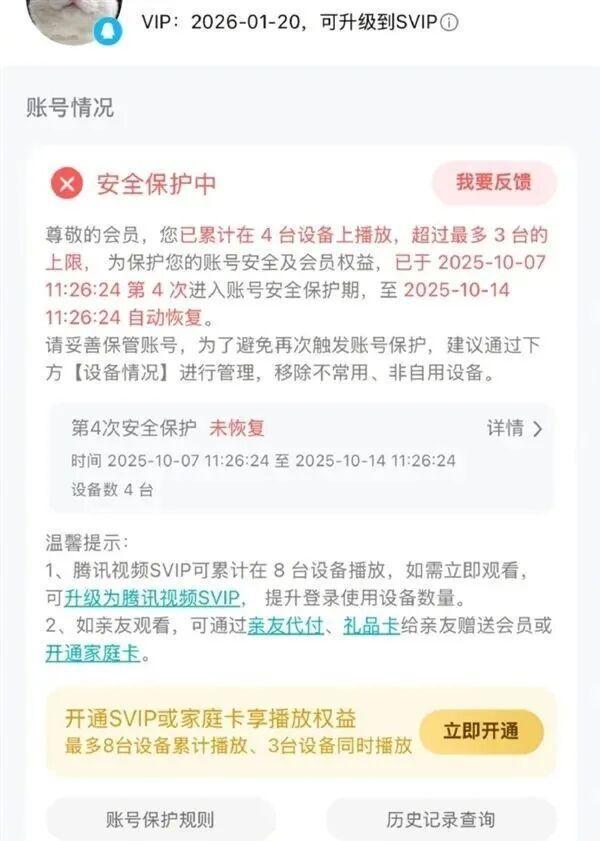
Core Viewpoint - The recent incident regarding Tencent Video accounts facing potential bans due to exceeding device login limits has sparked widespread attention and discussion among users [1][3]. Group 1: Account Restrictions - Tencent Video VIP accounts are limited to a maximum of 3 devices for login, while SVIP accounts can use up to 8 devices, with specific restrictions on simultaneous usage [5]. - Exceeding the device limit triggers a security protection period, which increases in duration with each subsequent violation, potentially leading to a complete account ban after 6 violations [4][5]. Group 2: Industry Context - Other video platforms, such as iQIYI, also impose similar device login restrictions, indicating a broader industry trend aimed at preventing account sharing and piracy [8]. - The prevalence of black market activities, including account sharing and piracy, has prompted platforms to implement stricter security measures to protect their services [11]. Group 3: Consumer Rights and Legal Perspectives - Legal experts have raised concerns about the clarity of the device limit rules and the adequacy of user notifications regarding penalties for exceeding limits, suggesting that platforms may not fully meet their obligations to inform consumers [12]. - The lack of clear communication about the criteria for device limits and the corresponding penalties could impact consumer rights and fair trading conditions [12].

路虎变丰田:携程租车被曝“货不对板” 验车单形同虚设
Xin Lang Ke Ji· 2025-10-11 12:09
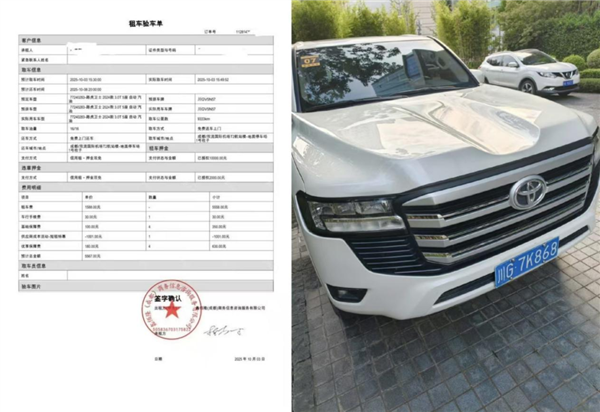
Core Viewpoint - Recent incidents of misleading vehicle rentals on Ctrip's platform have raised concerns about service quality and regulatory compliance, particularly following complaints from users about receiving different vehicles than those booked [1][2][4][11]. Group 1: User Complaints - A prominent social media influencer reported renting a Land Rover Defender but received a heavily used Toyota Land Cruiser instead, highlighting issues with vehicle condition and cleanliness [1][4]. - Multiple users have shared similar experiences, including receiving older models than those booked, indicating a pattern of "bait and switch" practices by rental companies on the platform [5][6]. - Complaints on the Black Cat Complaint platform have exceeded 140,000, with thousands specifically related to Ctrip's car rental service, including issues with refunds and insurance claims [11]. Group 2: Company Response and Management - Ctrip has not publicly responded to the complaints or the allegations of false advertising and inadequate vehicle condition checks [1][7]. - The company has faced regulatory scrutiny, with market regulators conducting interviews regarding its practices, which may violate e-commerce laws [11][12]. - Ctrip's management has been criticized for not effectively overseeing the quality of its partner rental companies, leading to inconsistent service levels [10][18]. Group 3: Financial and Market Implications - Ctrip's financial performance remains strong, with a reported total revenue of 28.7 billion yuan in the first half of the year, reflecting a 21% year-on-year increase [11]. - However, the recent stock sell-offs by top executives, totaling approximately 760 million yuan, have raised concerns about the company's future prospects and market confidence [12][16]. - The online car rental market in China is competitive, with Ctrip holding a 13% market share, trailing behind leading competitors, which may impact its growth if service issues persist [17][18].
新疆乌苏市市场监管局“铁拳”行动消费者权益保护典型案例
Zhong Guo Shi Pin Wang· 2025-10-11 09:40
Group 1 - The core issue involves misleading advertising practices by vendors selling colored Bodhi seeds and synthetic beeswax, resulting in administrative penalties [1][2][3] - The vendors, Qiao, Da, and Wan, were found to have sold products without proper documentation, falsely claiming them to be natural and of high quality [1][2][3] - The total amounts involved in these cases were 2800 yuan for Qiao, 5000 yuan for Da, and 1400 yuan for Wan, with illegal gains of 800 yuan, 430 yuan, and 200 yuan respectively [1][2][3] Group 2 - The administrative penalties included confiscation of illegal gains and fines, with Qiao and Da each receiving a warning along with their respective fines [1][2] - The actions of these vendors were in violation of the Consumer Rights Protection Law of the People's Republic of China, specifically Article 20, which addresses misleading advertising [1][2][3] - The enforcement actions were taken by the Urumqi Market Supervision Administration on September 16, 2025, following inspections conducted on July 23, 2025 [1][2][3]
路虎变丰田?携程租车被曝「货不对板」,验车单形同虚设? | BUG
Xin Lang Ke Ji· 2025-10-11 02:11
Core Viewpoint - The article highlights issues with Ctrip's car rental service, where customers have reported receiving different vehicles than what was booked, leading to accusations of false advertising and poor service quality [3][4][5][8][11]. Group 1: Customer Complaints - A prominent social media influencer reported renting a Land Rover Defender but received a Toyota Land Cruiser instead, which was in poor condition [5][8]. - Multiple customers have shared similar experiences, including receiving older models than what was advertised, raising concerns about the accuracy of vehicle descriptions on the platform [8][11]. - Users have expressed frustration over the verification process, claiming it is superficial and allows companies to evade responsibility for discrepancies [15][21]. Group 2: Company Response and Management - Ctrip has not publicly responded to the complaints raised by customers regarding the rental service [4][15]. - The company has faced scrutiny from regulatory bodies, with recent administrative talks highlighting potential violations of e-commerce laws [19][21]. - High-level executives at Ctrip have been selling shares, totaling approximately 760 million RMB, which has led to speculation about the company's future performance [4][21]. Group 3: Market Position and Competition - Ctrip ranks third in the online car rental market in China, holding a 13% market share, trailing behind Shenzhou Car Rental and Yihai Car Rental [22]. - The rapid growth of the online car rental market has led to increased competition, with new platforms emerging and challenging established players like Ctrip [22]. - The article indicates that Ctrip's service quality issues may hinder its ability to compete effectively in a market that is becoming increasingly saturated [18][22].

建行山东省分行:以消保之盾护金融民生 以专业之力筑生态之基
Qi Lu Wan Bao· 2025-10-10 03:44
金融是国民经济的血脉,消费者权益保护则是金融血脉健康流动的"安全阀门"。对金融业而言,消保工 作是践行"金融为民"初心的核心载体,是防范系统性金融风险的关键防线;对国家社会而言,它是维护 金融秩序稳定、夯实社会治理根基的重要支撑;对金融消费者而言,它更是守护"钱袋子"安全、提升获 得感幸福感的根本保障。 2025年9月15日至21日,中国建设银行山东省分行紧扣"保障金融权益 助力美好生活"主题,在全域开 展"2025年金融教育宣传周" 活动,以体系化部署、场景化服务、创新性实践,将金融知识送到群众身 边,为齐鲁大地金融生态和谐健康注入强劲"建行动能"。 高位统筹 织密消保"责任网" 消保工作的深度推进,离不开顶层设计的精准导航与全链条保障。建行山东省分行以"全行一盘棋"思 维,构建起责任明晰、能力过硬、触达广泛的消保工作体系。 建行山东省分行高度重视"2025年金融教育宣传周"活动,成立活动领导小组,同步制定下发2025年金融 教育宣传周活动方案,确保每一项消保任务都有专人抓、专人管。在行内能力提升层面,分行精选建行 学习平台"建消保 护权益"等栏目精品课程,组成2025年度消保学习必修课并在全辖推广,通过系 ...