
AI芯片

Search documents
开年双响:AI芯片资本化进程加速,国产算力进入新阶段
Xin Lang Cai Jing· 2026-01-05 11:45
Core Insights - The Chinese AI chip sector is experiencing significant capital events, highlighted by the listing of Birun Technology on the Hong Kong Stock Exchange as the first domestic GPU stock on January 2, 2026, alongside Baidu's Kunlun Chip submitting a listing application on January 1, 2026 [1][2][3] Group 1: Birun Technology - Birun Technology officially listed on the Hong Kong Stock Exchange on January 2, 2026, marking it as the first domestic GPU stock and the first new stock of the year [2][7] - Founded in 2019 by former SenseTime president Zhang Wen, Birun Technology achieved a remarkable milestone by completing its transition from establishment to listing in just six years [2][7] - The stock received extraordinary market enthusiasm, with over 2300 times subscription during the offering period, making it the largest new stock issuance since the implementation of the special technology company listing mechanism [2][7] - Birun Technology focuses on providing general intelligent computing solutions, with its self-developed Birun™ series GPU products at the core, enhancing the domestic high-performance computing ecosystem [2][7] Group 2: Kunlun Chip - Baidu announced on January 2, 2026, that its AI chip company Kunlun Chip submitted a confidential listing application to the Hong Kong Stock Exchange on January 1, 2026 [3][8] - Kunlun Chip originated from Baidu's Intelligent Chip and Architecture Department and completed its first round of independent financing in April 2021, with an initial valuation of approximately 13 billion yuan [3][8] - As of July 2025, Kunlun Chip has undergone D-round financing and has released three generations of products: K100/K200, R200 series, and P800 [3][8] - Despite the independent listing, Kunlun Chip is expected to remain a subsidiary of Baidu, maintaining close technical and business collaboration [3][8] Group 3: Market Trends - The domestic GPU industry is undergoing a rapid capital influx, with other companies like Tiandu Zhixin planning to list on January 8, 2026, and Suiruan Technology completing its IPO guidance on January 1, 2026 [5][10] - The acceleration of these companies' listings underscores the explosive growth in demand for domestic AI chips [10][11] - According to Zhi Shi Consulting, the market size of China's AI chip sector is projected to surge from 142.54 billion yuan in 2024 to 1,336.79 billion yuan by 2029, with an average annual growth rate of 53.7% from 2025 to 2029 [11]
黄仁勋摆“兆元宴”!
国芯网· 2026-01-05 11:07
国芯网[原:中国半导体论坛] 振兴国产半导体产业! 不拘中国、 放眼世界 ! 关注 世界半导体论坛 ↓ ↓ ↓ 1月5日消息,据台媒报道,英伟达CEO 黄仁勋将于本月赴台并参加英伟达台湾地区年会,并邀请"英伟达生态系"合作伙伴再现"兆元(即万亿元新台 币)"宴。 据悉,包括台积电董事长魏哲家、鸿海董事长刘扬伟、广达董事长林百里及副董事长梁次震、纬创董事长林宪铭、纬颖董事长兼首席战略官洪丽宁、和硕 集团董事长童子贤、仁宝董事长陈瑞聪等企业高管,将成为"兆元宴"的座上客。 第二步:在公众号里面回复"加群",按照提示操作即可。 爆料|投稿|合作|社群 文章内容整理自网络,如有侵权请联系沟通 据此前报道,黄仁勋已经于去年 11 月访问台积电,提出了对更先进 AI 芯片的迫切需求,而这一举动直接引爆了台积电的新一轮建厂热潮。 消息称台积电为了确保明年能有更多新产能上线,已紧急敦促上游设备供应商缩短交货时间。这一"催单"效应直接导致供应链进入"战时状态",预计相关 设备厂商的高强度出货将至少持续到 2026 年第二季度。 ***************END*************** 半导体公众号推荐 半导体论坛百万 ...



上海阵量智能:注册资本增至8.15亿,新增股东
Sou Hu Cai Jing· 2026-01-05 09:18
Group 1 - The core point of the article is that Shanghai Zhenliang Intelligent Technology Co., Ltd. has increased its registered capital to approximately 815 million yuan and has welcomed new shareholders [1] - The new shareholders include Ningbo Yuexiu Yongyuan Equity Investment Partnership and China State-owned Enterprise Mixed Ownership Reform Fund Co., Ltd. [1] - The company is affiliated with Xiwang Sunrise and focuses on the research and development of high-performance GPUs, positioning itself as a "chip company that understands AI better" [1]
A股收评:三大指数集体大涨,沪指12连阳重回4000点,深证成指、创指涨超2%北证50涨1.8%,脑机接口涨停潮!近4200股上涨,成交2.57万亿放量5015亿
Ge Long Hui· 2026-01-05 08:48
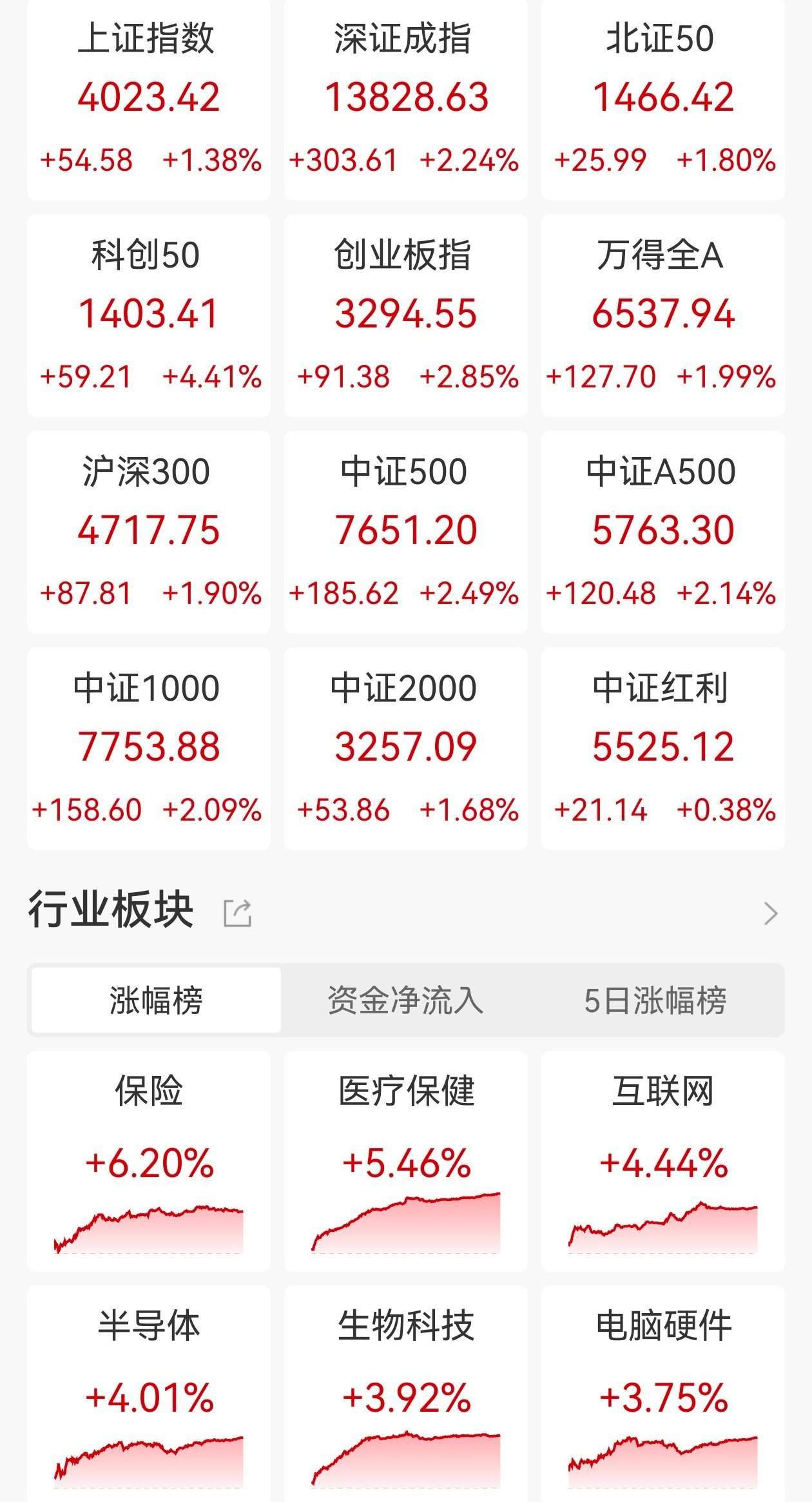
盘面上,马斯克计划2026年大规模量产脑机接口设备,脑机接口板块掀涨停潮,道氏技术(300409)、三 博脑科及乐普医疗(300003)等20余股涨停;保险股大涨,新华保险(601336)涨超8%;医疗器械板块走 高,赛诺医疗等多股涨停;AI芯片、存储芯片板块拉升,普冉股份、恒烁股份涨停;重组蛋白、快手 概念、CRO、游戏及Sora概念等涨幅居前。另外,海南、免税板块逆市下跌,海汽集团(603069)、海南 发展领跌;旅游酒店板块走低,凯撒旅业跌近7%;铁路公路、电机及航空机场等板块跌幅居前。(格隆 汇) 格隆汇1月5日|A股2026年首个交易日开门红,三大指数均大幅上涨,沪指12连阳重回4000点,深证成 指;截至收盘,沪指涨1.38%报4023点,深证成指涨2.24%,创业板指涨2.85%。全市场成交额2.57万亿 元,较前一交易日增量5015亿元,近4200股上涨。 | 上证指数 深证成指 | 北证50 | | --- | --- | | 4023.42 13828.63 1466.42 | | | +54.58 +1.38% +303.61 +2.24% +25.99 +1.80% | | | 科创5 ...




“国产GPU四小龙”燧原科技上市再进一步,哪些上市公司有望价值重估?
Mei Ri Jing Ji Xin Wen· 2026-01-05 08:08
每经记者|闫峰峰 每经编辑|吴永久 随着燧原科技完成IPO辅导,其背后潜伏的上市公司引发投资者关注。 证监会官网近日披露,上海燧原科技股份有限公司已完成IPO辅导工作,即将申报科创板上市。这家被 称为"国产GPU四小龙"之一的人工智能芯片企业正迎来其发展历程中的关键节点。而燧原科技背后的上 市公司到底有哪些?能否因此实现价值重估呢? 燧原科技获"券商一哥"加持 AI芯片公司IPO或催化背后股东重估 燧原科技专注于人工智能领域云端算力产品,致力于为通用人工智能打造算力底座。该公司已开发四代 AI芯片,产品线覆盖训练和推理两大场景。 燧原科技成立于2018年3月,由赵立东和张亚林共同创立。两位创始人均拥有丰富的AMD工作经历,在 芯片领域积累了深厚经验。赵立东曾服务于AMD并担任紫光集团副总裁,张亚林则曾是AMD上海研发 中心的核心技术负责人。 2025年世界人工智能大会上,燧原科技发布最新一代训推一体产品"燧原L600",支持FP8低精度计算, 可提升大模型训练速度并降低成本。目前,公司已在甘肃庆阳、江苏无锡、湖北宜昌等地布局智算中 心,积极参与"东数西算"工程。 2025年11月,基于当前资本市场环境变化和公 ...
公司卖给英伟达,人均喜提3000万
投中网· 2026-01-05 07:32
Core Viewpoint - Nvidia has agreed to acquire Groq, a high-performance AI accelerator chip design company, for $20 billion in cash, marking Nvidia's largest transaction to date, nearly tripling Groq's previous valuation of $6.9 billion within three months [3][7]. Group 1: Acquisition Details - The acquisition involves key Groq executives, including founder and CEO Jonathan Ross, joining Nvidia while Groq will continue to operate as an independent entity [4]. - Groq, founded in 2016 by former Google engineers, focuses on high-performance AI accelerator chip design, particularly for inference tasks [4][11]. - Nvidia's acquisition strategy is seen as a form of "acqui-hire," allowing the company to gain talent and technology while avoiding potential regulatory hurdles associated with traditional acquisitions [4][8]. Group 2: Financial Implications - Nvidia's offer includes generous compensation for Groq's shareholders, with approximately 85% of the payment made in cash upfront, and the remaining distributed over the next few years [9]. - Groq employees, approximately 600, will receive substantial financial incentives, with potential equity values estimated at $5 million per employee [4][9]. Group 3: Strategic Significance - The acquisition is viewed as a strategic move to strengthen Nvidia's competitive edge in the GPU market, especially as AI model focus shifts from training to inference, where traditional GPUs face limitations [4][12]. - Nvidia's purchase of Groq is compared to Microsoft's acquisition of GitHub, emphasizing its strategic importance in the AI landscape [11]. - The deal is expected to lock in customers, as AI labs now face the choice of either purchasing Nvidia GPUs or adopting Groq's LPU technology, thereby consolidating Nvidia's market position [12]. Group 4: Industry Trends - The AI chip market is evolving, with a clear divide between GPU-centric and non-GPU architectures, as companies like Google and Groq push for alternatives to traditional GPUs [14]. - The global AI chip market is projected to reach $413.8 billion by 2030, with non-GPU architectures expected to capture over 21% of the market share [15]. - In China, the trend towards non-GPU solutions is accelerating, with the market for non-GPU accelerated servers expected to approach 50% by 2029 [16].

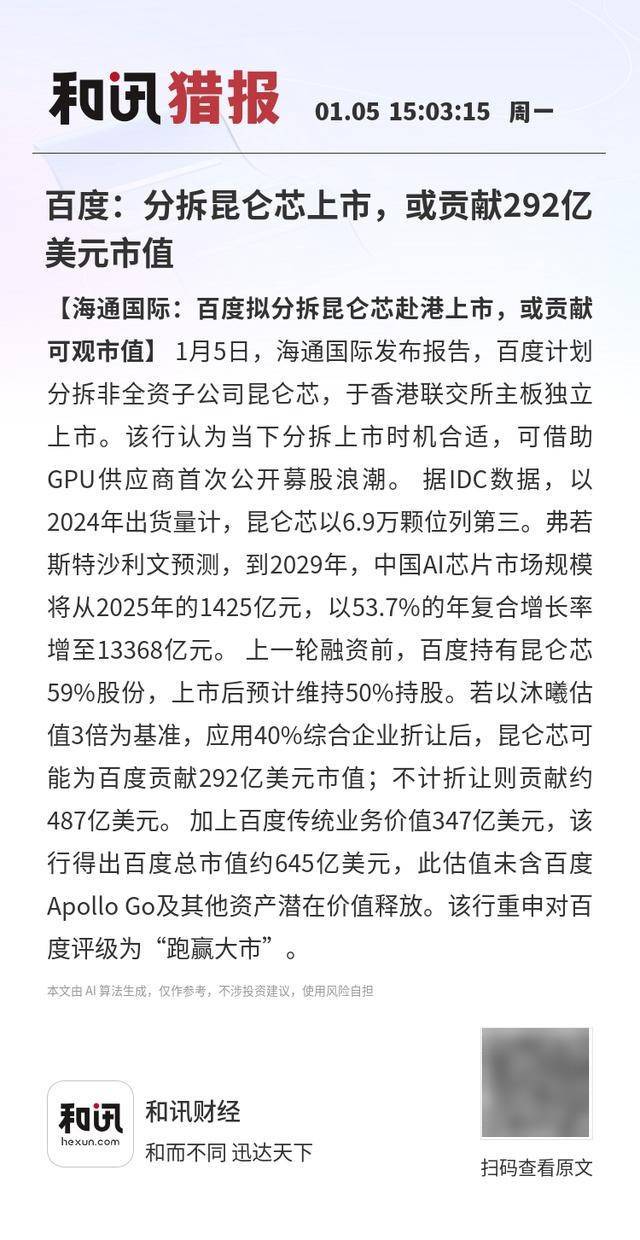
百度:分拆昆仑芯上市,或贡献292亿美元市值
Sou Hu Cai Jing· 2026-01-05 07:28
Group 1 - The core viewpoint of the article is that Baidu plans to spin off its subsidiary Kunlun Chip for an independent listing on the Hong Kong Stock Exchange, which is seen as a timely move to capitalize on the IPO wave among GPU suppliers [1] - According to IDC data, Kunlun Chip ranks third in terms of shipment volume with 69,000 units projected for 2024 [1] - Frost & Sullivan predicts that the AI chip market in China will grow from 142.5 billion yuan in 2025 to 1.3368 trillion yuan by 2029, representing a compound annual growth rate of 53.7% [1] Group 2 - Prior to the latest financing round, Baidu held a 59% stake in Kunlun Chip, and it is expected to maintain a 50% stake post-listing [1] - Based on a valuation of Kunlun Chip at three times its estimated value, and applying a 40% overall enterprise discount, it could contribute approximately 29.2 billion USD to Baidu's market value; without the discount, the contribution could be around 48.7 billion USD [1] - In addition to the value from Kunlun Chip, Baidu's traditional business is valued at approximately 34.7 billion USD, leading to a total estimated market value of about 64.5 billion USD for Baidu, excluding potential value releases from Baidu Apollo Go and other assets [1]

A股收评:放量逾5000亿元!沪指12连阳重回4000点,深证成指、创业板指涨超2%,脑机接口板块掀涨停潮
Ge Long Hui· 2026-01-05 07:12
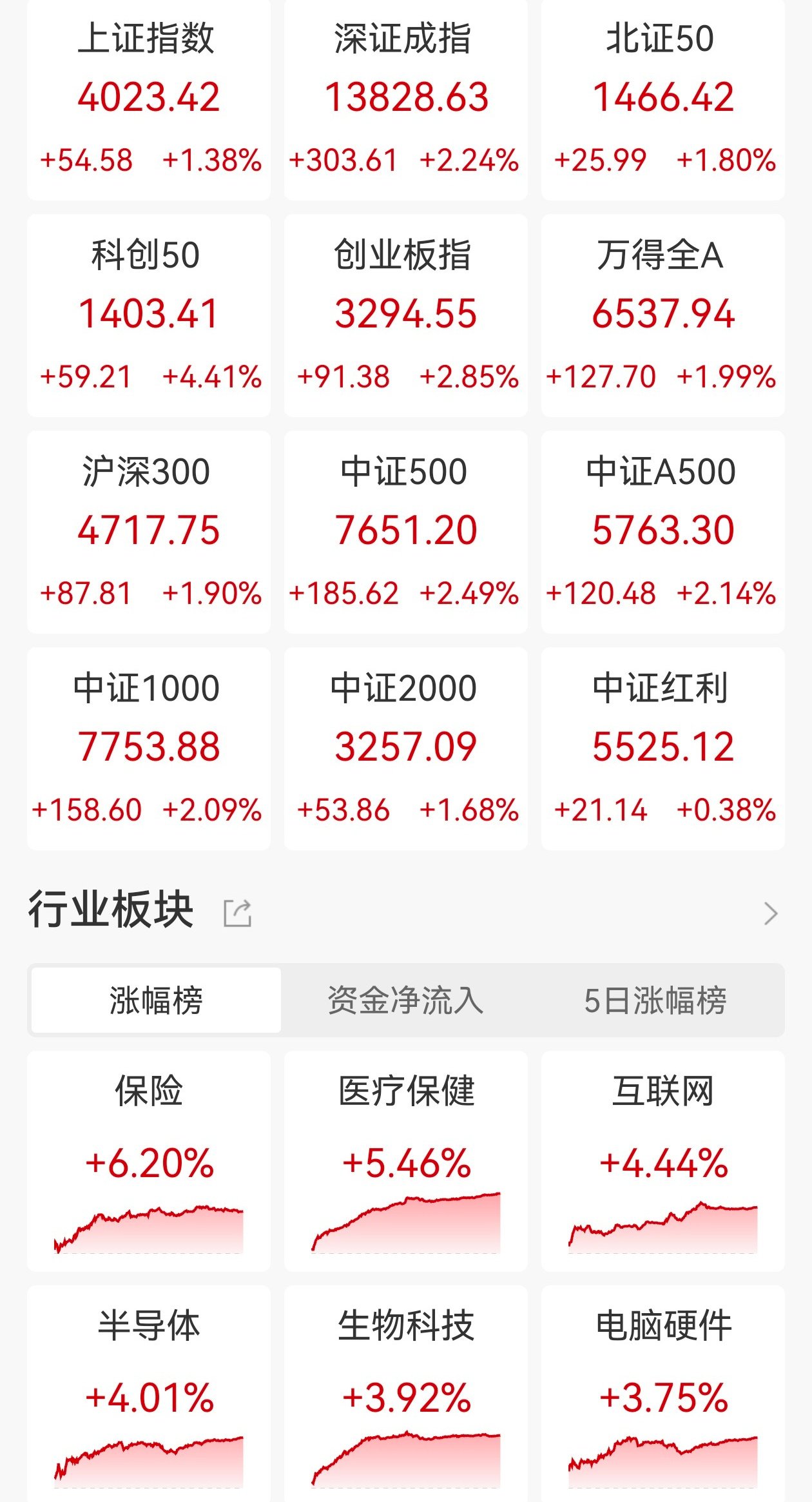
Market Performance - The A-share market opened positively on the first trading day of 2026, with all three major indices significantly rising. The Shanghai Composite Index (SSE) recorded a 12-day winning streak, returning to the 4000-point mark, closing at 4023 points, up 1.38%. The Shenzhen Component Index rose 2.24%, and the ChiNext Index increased by 2.85% [1] - The total market turnover reached 2.57 trillion yuan, an increase of 501.5 billion yuan compared to the previous trading day, with nearly 4200 stocks rising [1] Sector Performance - The brain-computer interface sector surged following Elon Musk's plan for large-scale production of brain-machine interface devices, leading to a wave of limit-up stocks including Daosheng Technology, Sanbo Brain Science, and Lepu Medical [1] - Insurance stocks experienced significant gains, with Xinhua Insurance rising over 8% [1] - The medical device sector also saw an uptick, with companies like Sainuo Medical hitting their daily limit [1] - AI chip and memory chip sectors rallied, with stocks such as Purun Co. and Hengshuo Co. reaching their daily limit [1] - Other sectors with notable gains included recombinant proteins, Kuaishou concepts, CRO, gaming, and Sora concepts [1] - Conversely, the Hainan and duty-free sectors declined, with Haikou Group and Hainan Development leading the losses. The tourism and hotel sector also fell, with Caesar Travel dropping nearly 7% [1] - The railway, highway, electric machinery, and airport sectors were among those with the largest declines [1] Fund Flow and Performance Rankings - The top sectors by net capital inflow over the past five days included insurance (+6.20%), healthcare (+5.46%), and internet (+4.44%) [2] - Other sectors with notable five-day gains included biotechnology (+3.92%), semiconductors (+4.01%), and computer hardware (+3.75%) [2]

摩尔线程涨2.04%,成交额9.54亿元,主力资金净流出8552.01万元
Xin Lang Cai Jing· 2026-01-05 03:12
Group 1 - The core viewpoint of the news is that Moer Technology's stock price has shown a slight increase of 2.04% this year, but has experienced a decline of 4.61% over the past five trading days [2] - As of January 5, the stock price reached 599.90 yuan per share, with a total market capitalization of 281.97 billion yuan [1] - The company reported a significant year-on-year revenue growth of 181.99% for the period from January to September 2025, amounting to 785 million yuan, while the net profit attributable to shareholders was a loss of 724 million yuan, reflecting a year-on-year increase of 18.71% [2] Group 2 - Moer Technology, established on June 11, 2020, is primarily engaged in the research, design, and sales of GPUs and related products [2] - The company's revenue composition includes 70.75% from clusters, 17.74% from graphics cards, 9.05% from all-in-one machines, 2.41% from other sources, and 0.05% from chips [2] - As of December 5, the number of shareholders increased to 39,200, a rise of 45515.12%, with an average of 748 circulating shares per shareholder [2]
寒武纪涨2.06%,成交额38.98亿元,主力资金净流入2691.77万元
Xin Lang Cai Jing· 2026-01-05 02:48
Group 1 - The core viewpoint of the news is that Cambricon Technologies has shown significant stock performance and financial growth, with a notable increase in revenue and net profit year-on-year [1][2]. - As of January 5, Cambricon's stock price increased by 2.06%, reaching 1383.50 yuan per share, with a total market capitalization of 583.40 billion yuan [1]. - The company has a strong presence in the semiconductor industry, focusing on AI core chip development, with 99.62% of its revenue coming from cloud products [1]. Group 2 - As of September 30, the number of shareholders for Cambricon increased by 52.13% to 62,000, while the average number of circulating shares per person decreased by 34.13% to 6,748 shares [2]. - For the period from January to September 2025, Cambricon achieved a revenue of 4.607 billion yuan, representing a year-on-year growth of 2386.38%, and a net profit of 1.605 billion yuan, up 321.49% year-on-year [2]. - The top ten circulating shareholders include Hong Kong Central Clearing Limited, which holds 12.0035 million shares, a decrease of 3.7005 million shares from the previous period [2].
