报行合一

Search documents
保险行业2025年中报综述:业绩平稳增长,戴维斯双击渐行渐近
2025-09-10 14:35
Summary of the Insurance Industry Conference Call Industry Overview - The insurance industry showed stable growth in the first half of 2025, with profits slightly increasing. All listed insurance companies, except for China Ping An, achieved positive growth, with total net assets increasing by 1.2% [1][2][22]. Key Points Financial Performance - The overall performance of the insurance industry in the first half of 2025 met expectations, confirming a recovery in profits. The net profit growth ranged from -8.8% for China Ping An to positive growth for other companies, with total net assets reaching 2.19 trillion yuan [2][22]. - New business value (NBV) showed strong momentum, with growth rates between 20% and 65%, primarily driven by accelerated sales through bank insurance channels and improved value rates [2][4]. Investment Performance - Under new accounting standards, investment performance became the dominant factor for profitability. Companies like Xinhua and PICC saw significant increases in the proportion of investment performance to pre-tax profits, while China Pacific and Ping An remained focused on insurance service performance [1][3]. - Net investment income for the five listed insurance companies increased by 6% year-on-year, totaling 285.2 billion yuan, with total investment income rising by 9% to 367.4 billion yuan [8][9]. Distribution Channels - The individual insurance agent channel continued to decline, with a 3.5% decrease in the number of agents. However, the average MVA (Market Value Added) per agent improved significantly [5]. - The bank insurance channel saw an increase in efficiency, with its share of total premiums rising by 11% to 110% year-on-year. The new single value rate in this channel ranged from 12% to 29% [5]. Property Insurance - The growth rate of original premium income in property insurance slowed down, but the comprehensive cost ratio improved significantly. The growth rate for auto insurance slowed, while new energy vehicle insurance maintained rapid growth, with Ping An and PICC reporting increases of 49.3% and 36%, respectively [6][7]. Asset Allocation - The allocation of assets among insurance companies showed a trend towards increasing OCI (Other Comprehensive Income) equity. The proportion of bond assets remained high, with the highest being China Pacific at 76.5% and the lowest being PICC at 49.7% [10][11][14]. - Stock and fund asset allocations saw double-digit growth for several companies, with Ping An leading in new stock proportions at 45% [12]. Future Outlook - The outlook for insurance stocks is positive, with expectations of recovery in valuations due to low interest rates and reduced costs. The potential for increased sales of rights-based products and the impact of economic recovery are also highlighted [22][23]. Recommendations - Focus on companies with low operating costs and valuations, such as China Pacific; those with significant equity returns like Xinhua; and those with good dividend yields and undervaluation like China Ping An and China Taiping [23].



深化改革进入“深水区” 上市险企个险渠道提质增效成主旋律
Jin Rong Shi Bao· 2025-09-10 07:35
Group 1 - The core viewpoint of the articles indicates that the individual insurance channel of listed life insurance companies is under pressure, with premium growth lagging behind the bank insurance channel, which has seen double-digit increases [1][2] - In the first half of the year, five major listed life insurance companies achieved a total premium income of 9,628.14 billion yuan, reflecting a year-on-year growth of 1.01% [1][2] - The individual insurance channel remains a crucial source of premium income, contributing over 70% to the total premium income of these companies [1] Group 2 - Except for China Ping An, all other four listed life insurance companies reported positive growth in individual insurance channel premium income, with China Life achieving 4,044.48 billion yuan (up 2.64%), Taikang Life at 1,373.8 billion yuan (up 0.9%), New China Life at 725.26 billion yuan (up 5.5%), and PICC Life at 354.14 billion yuan (up 3%) [2] - The growth in individual insurance premiums is primarily supported by renewal premiums, while new business premiums have declined for most companies, except for New China Life [2] Group 3 - The average monthly first-year commission income for Taikang Life's core sales force was 7,120 yuan, down 13.4% year-on-year, while Ping An Life's agents earned 9,898 yuan per person per month, a decrease of 17.3% [3] - The decline in agent activity and income is attributed to the implementation of regulatory requirements and product transformation, which are expected to stabilize in the future [3] Group 4 - Since the regulatory "cleaning up and improving quality" initiative began in 2019, the individual insurance channel has seen a significant reduction in personnel, dropping from a peak of 9.12 million to around 2 million [4] - Despite the reduction in personnel, the new business value in the individual insurance channel has shown significant improvement, with Ping An Life's new business value increasing by 17% year-on-year [4] Group 5 - The reduction in personnel has led to a noticeable improvement in the efficiency and quality of the individual insurance channel, driven by marketing system reforms and digital empowerment [5][6] - Taikang Life has optimized its team structure and enhanced its capabilities through digital initiatives, resulting in a 12.7% year-on-year increase in average monthly first-year premium per core salesperson [6] Group 6 - The ongoing transformation of the individual insurance channel is focused on professionalization and specialization, as indicated by the recent regulatory guidance aimed at upgrading the personal agency channel [7][8] - Long-term strategies emphasize improving the quality and productivity of agents to adapt to increasingly complex insurance products [7][8]


上市险企银保渠道迈向优质发展之路 从拼费用到拼实力
Jin Rong Shi Bao· 2025-09-10 07:28
Core Viewpoint - The mid-term performance reports from listed insurance companies indicate a significant increase in both premium scale and business value through the bancassurance channel, suggesting a revitalization of this channel after the strict implementation of the "reporting and operation integration" policy for two years [1][2]. Summary by Sections Premium Income and Business Value Growth - In the first half of the year, five listed life insurance companies achieved a total premium income of 2549.97 billion yuan through the bancassurance channel, representing a year-on-year growth of 46.9% [2]. - Specific contributions include: China Life at 724.44 billion yuan (up 45.7%), PICC Life at 531.04 billion yuan (up 24.1%), New China Life at 461.6 billion yuan (up 65.1%), Taikang Life at 416.6 billion yuan (up 82.6%), and Ping An at 415.97 billion yuan (up 37.5%) [2]. - The contribution of the bancassurance channel to the total premium income of these five companies increased from 14.2% to 19.3% year-on-year [2]. New Business Value and Key Performance Indicators - The bancassurance channel has become a crucial driver for the growth of new business value, with PICC Life reporting that nearly 60% of its premium income came from this channel, leading to a 71.7% year-on-year increase in new business value [2]. - Ping An achieved a new business value of 59.72 billion yuan, marking a significant year-on-year growth of 168.6% [2]. Long-term Premium Income and Strategic Importance - Key indicators for future premium income, such as the first-year premium income from long-term insurance, showed substantial growth, with China Life and New China Life reporting year-on-year increases of 112.4% and 150.3%, respectively [3]. - Executives from various companies emphasized the bancassurance channel's contribution to value, with statements highlighting its importance as a pillar for company value sources [3]. Regulatory Changes and Cost Structure - The implementation of the "reporting and operation integration" policy has led to a more rational fee structure in the bancassurance channel, with regulatory measures aimed at addressing long-standing issues of high costs and unreasonable fee structures [4]. - The regulatory changes have resulted in a unified standard for commissions on long-term premium products, which is expected to enhance the value of new business despite initial declines in new single premium income [5]. Expansion and Collaboration - The removal of restrictions on the number of insurance companies that can collaborate with a single bank branch has facilitated broader cooperation between leading insurance companies and banks, enhancing competitive advantages [6]. - Companies are focusing on optimizing product offerings and improving service quality to adapt to the new competitive landscape, with significant growth in bancassurance channel performance reported by several firms [6][7]. Future Outlook and Challenges - Companies are optimistic about the future of the bancassurance channel, with plans to enhance sustainable development capabilities and strengthen partnerships with key banks [7]. - Challenges remain, including the need for insurance companies to improve product design and service capabilities to meet the heightened expectations of bank customers regarding product profitability and value [7].
从“赔本赚吆喝”到“盈利破冰” 新能源车险迎关键转折
Jin Rong Shi Bao· 2025-09-10 06:16
Core Insights - The auto insurance business remains a cornerstone for the property insurance sector, with the top three insurers (PICC, Ping An, and Taikang) generating a total premium income of 306.2 billion yuan, accounting for over 60% of the industry [1][2] - The new energy vehicle (NEV) insurance sector is experiencing a turnaround, with several leading insurers achieving underwriting profitability, indicating a potential recovery for the industry [1][4] - The implementation of the "reporting and pricing together" policy has effectively curbed chaotic competition in the market, allowing insurers to focus more on risk management and service enhancement [3][7] Auto Insurance Performance - The top three property insurers reported a combined auto insurance premium income of 306.28 billion yuan in the first half of the year, representing 68% of the total auto insurance market [2] - Premium growth rates for PICC, Ping An, and Taikang were 3.4%, 3.6%, and 2.8% respectively, below the industry average growth rate of 4.5% [2] - The combined cost ratio for these insurers showed significant improvement, with PICC at 94.2% (down 2.2 percentage points), Ping An at 95.5% (down 2.6 percentage points), and Taikang at 95.3% (down 1.8 percentage points) [2][4] New Energy Vehicle Insurance Growth - The NEV insurance market has seen rapid growth, with premium income expected to rise from 24.6 billion yuan in 2020 to 140.9 billion yuan by 2024, reflecting a compound annual growth rate of 55% [4] - NEV insurance premiums are projected to reach approximately 480 billion yuan by 2030, making up over 40% of total auto insurance premiums [4] - Ping An reported insuring 5.75 million NEVs in the first half of the year, a 49.3% increase year-on-year, with premium income of 21.7 billion yuan, up 46.2% [4] Challenges and Strategies - Despite some insurers achieving profitability in NEV insurance, the overall industry still faces challenges, particularly in commercial vehicle insurance, which remains unprofitable [5][7] - The industry is focusing on risk reduction as a core strategy to improve the quality of NEV insurance operations, with initiatives aimed at lowering repair costs and enhancing service levels [7][8] - Insurers are collaborating with manufacturers to optimize vehicle designs and improve risk management through data utilization [8]


中国平安(601318):保险Ⅲ寿险NBVM延续增长 财险COR显著改善
Xin Lang Cai Jing· 2025-09-04 12:36
Core Insights - The company reported a net profit attributable to shareholders of 68.047 billion yuan for H1 2025, a year-on-year decrease of 8.8%, while the operating profit attributable to shareholders was 77.732 billion yuan, reflecting a year-on-year increase of 3.7% [1] - The new business value (NBV) for life and health insurance reached 22.335 billion yuan, marking a significant year-on-year increase of 39.8% [1] Group 1: Life and Health Insurance Business - The life and health insurance segment achieved an operating profit of 52.435 billion yuan in H1 2025, up 2.5% year-on-year [1] - New single premium decreased by 7.2% year-on-year, while the standard premium NBV increased by 9.0 percentage points to 30.5%, contributing to the 39.8% rise in NBV to 22.335 billion yuan [1] - The individual insurance channel's NBV grew by 17.0% year-on-year, with per capita NBV increasing by 21.6% [1] - The bancassurance channel's NBV reached 5.972 billion yuan, a substantial increase of 168.6% year-on-year, contributing 33.9% to the life insurance NBV [1] Group 2: Property and Casualty Insurance Business - The property and casualty insurance segment generated insurance service revenue of 165.661 billion yuan in H1 2025, a year-on-year increase of 2.3%, with auto insurance and non-auto insurance growing by 3.8% and declining by 0.6%, respectively [2] - The comprehensive cost ratio for property and casualty insurance improved by 2.6 percentage points to 95.2%, with the auto insurance comprehensive cost ratio also improving by 2.6 percentage points to 95.5% [2] - The company achieved underwriting profitability in the new energy vehicle insurance segment [2] Group 3: Investment Performance - The company's investment portfolio achieved a non-annualized comprehensive investment return of 3.1%, an increase of 0.3 percentage points year-on-year, attributed to a balanced asset allocation strategy and a focus on high-dividend equity assets [2] - The non-annualized net investment return was 1.8%, down 0.2 percentage points year-on-year, primarily due to the maturity of existing assets and declining yields on newly added fixed-income assets [2] - As of June 2025, the company's insurance fund investment portfolio exceeded 6.2 trillion yuan, reflecting an increase of 8.2% since the beginning of the year [2] Group 4: Investment Recommendation - The investment rating is maintained at Buy-A, with projected EPS for 2025-2027 at 7.85 yuan, 9.07 yuan, and 10.49 yuan, respectively [2] - The company is assigned a 0.8x P/EV for 2025, with a corresponding six-month target price of 66.87 yuan [2]
2025上半年寿险公司利润榜:平安、国寿、太保TOP3,投资↑新业务价值↑行业利润三连升...
13个精算师· 2025-09-04 12:23
Core Viewpoint - The life insurance industry in the first half of 2025 has shown significant profit growth, with 73 companies reporting a total net profit of 185.8 billion, a year-on-year increase of approximately 37 billion, or 25% [10][12][13]. Group 1: Profit Growth and Performance - 52 out of 73 life insurance companies reported profits, while 21 incurred losses, indicating a positive trend in profitability [1][22]. - The net profit of major companies such as Ping An and China Life has significantly contributed to the overall profit increase, with Ping An reporting a net profit of 50.6 billion and China Life 40.3 billion [2][24]. - The industry has experienced three consecutive years of profit growth, reaching a new high that surpasses the same period in 2019 [10][12]. Group 2: Investment and Business Value - The increase in equity investment has led to a rise in investment returns, with the average investment yield for 73 companies rising to 4.22%, up from 3.59% year-on-year [16][18]. - The total amount directly invested in stocks by insurance companies exceeded 3 trillion, marking an increase of approximately 1 trillion compared to the previous year [18]. - New business value has also seen substantial growth, particularly in the bancassurance channel, with companies like China Life and Xinhua Insurance reporting over 100% growth in new single premiums [31][35]. Group 3: Company Rankings and Market Dynamics - The top six life insurance companies have shown robust performance, with significant increases in both premium income and new business value [23][28]. - Tai Kang Life has seen a notable profit increase, attributed to the implementation of new accounting standards and improved investment returns [38][40]. - AIA's new business value rate remains high at 58.6%, reflecting its strong market position and effective agent model [41]. Group 4: Losses and Challenges for Smaller Companies - Despite the overall positive trend, 21 companies reported losses, with many being smaller firms struggling with high liability costs and investment volatility [22][43]. - Companies like Heng Tai Life and Guo Lian Life have faced significant challenges, with declining investment yields contributing to their financial difficulties [49][50]. - The continuous losses among smaller firms highlight the need for capital strengthening and improved operational efficiency to enhance solvency [47][48].
改道分红险、股市买买买 五大险企上半年谋“财路”
Xin Jing Bao· 2025-09-04 12:09
Core Viewpoint - The insurance industry in A-shares has shown significant growth in new business value through bank insurance channels in the first half of 2025, with a notable shift towards dividend insurance as a primary product, driven by regulatory changes and market conditions [1][5][7]. Financial Performance - Among the five listed insurance companies, four reported an increase in net profit, with New China Life Insurance leading at a growth rate of 33.5%, while China Ping An experienced a decline of 8.8% in net profit [2][3]. - The total dividend payout from four companies approached 30 billion yuan, with China Ping An contributing the highest at approximately 17.2 billion yuan [3]. Business Channel Trends - The bank insurance channel has seen a surge in business volume, with China Life's total premium from this channel reaching 72.44 billion yuan, a year-on-year increase of 45.7% [4][5]. - New business value from bank insurance channels has surpassed that of individual insurance channels for some companies, indicating a strategic shift in focus [4][6]. Product Development - Dividend insurance has emerged as a key product, with significant growth in new premium income, particularly in the individual insurance channel, where it now accounts for over 50% of new business [7][8]. - The low interest rate environment has contributed to the rise of dividend insurance, which offers both risk protection and potential profit sharing for policyholders [8][9]. Investment Strategies - Insurance companies have increased their stock market investments, with China Ping An's stock investment proportion rising to 10.5%, reflecting a broader industry trend towards equities [10][11]. - Despite the increase in stock investments, some companies reported a decline in overall investment returns, highlighting the challenges of matching asset and liability durations in a low-interest-rate environment [12]. Market Outlook - Executives from various insurance companies expressed optimism about the stock market's performance in the second half of 2025, citing reasonable valuations and potential investment opportunities in sectors like technology and consumer goods [13].
中国平安郭晓涛:“三差”对平安都是正贡献
券商中国· 2025-09-04 08:03
Core Viewpoint - China Ping An's management is satisfied with the mid-year report, showing a nearly 40% growth in new business value for life insurance and a 7.1% increase in original premium income for property insurance [1]. Group 1: Business Performance - In the first half of the year, life insurance new business value grew nearly 40%, while property insurance original premium income increased by 7.1% [1]. - The contribution of new business value from bancassurance and community channels exceeded one-third, indicating significant growth in these areas [6]. Group 2: Management Strategies - The company has not experienced any "cost difference loss," "interest difference loss," or "mortality difference loss," with all three contributing positively to its operations [2][4]. - The management strategy focuses on three main areas: enhancing sales value, improving return rates, and reducing expense ratios while ensuring claims are fully paid [2][4]. - The "Three Enhancements and Two Reductions" initiative aims to increase new business value, investment return rates, and product margins while lowering expense ratios and claims ratios [4][5]. Group 3: Technological Empowerment - The company emphasizes the use of AI to enhance all aspects of its operations, aiming for comprehensive intelligence across marketing, customer service, operations, and management [5]. - AI implementation is expected to improve customer acquisition efficiency, sales conversion rates, and operational efficiency, thereby optimizing costs [5]. Group 4: Future Outlook - The management has high expectations for the bancassurance and community channels in the coming year, anticipating continued robust growth [3][7]. - The agent workforce has seen a steady growth of 17%, and there are plans to expand partnerships with banks beyond Ping An Bank [7]. - The community financial channel, despite its smaller size, has experienced a remarkable growth rate of 160% and is expected to continue growing [7]. Group 5: Product Strategy Adjustments - The company is transitioning from traditional insurance to dividend insurance, with dividend insurance accounting for approximately 40% of individual insurance this year [8]. - Adjustments to product pricing rates are planned, with new limits set for various insurance products, and a total of 57 products will be discontinued while 24 new products are being prepared for launch [9].

盘点上市险企负债端:银保、分红险撑起增长,新能源车险进入盈利区间
第一财经· 2025-09-04 07:57
Core Viewpoint - The article highlights the significant improvement in the new business value and comprehensive cost ratio of listed insurance companies in China during the first half of the year, driven by the explosive growth of the bancassurance channel and a shift towards dividend insurance products [2]. Bancassurance Channel Explosion - The bancassurance channel saw a remarkable recovery, with new single premium income reaching 1,525.47 billion yuan, a year-on-year increase of 76.19% [4]. - Major players like New China Life and China Life reported over 100% growth in this channel, with increases of 150.3% and 111.1% respectively [4]. - The share of new single premium income from the bancassurance channel rose to 41.38%, up 13.24 percentage points year-on-year [5]. Improvement in New Business Value Rate - The new business value rate for the bancassurance channel improved, with companies like China Ping An seeing a 9.7 percentage point increase to 28.6% [6]. - The average contribution of the bancassurance channel to new business value among listed insurers rose to 38.9%, an increase of 8.4 percentage points year-on-year [6]. Shift to Dividend Insurance - Insurance companies have been transitioning from traditional products to dividend insurance since last year, with significant progress noted in the first half of this year [8]. - Companies like China Pacific and China Life have seen dividend insurance account for over 50% of their new single premium income [8]. - The overall proportion of dividend insurance in total premium income is expected to increase further as the industry pushes for this product type [9]. Profitability of New Energy Vehicle Insurance - The comprehensive cost ratio for property insurance companies improved, with reductions of 0.8 to 2.6 percentage points [11]. - New energy vehicle insurance has turned profitable, with China Ping An reporting a 46% increase in premium income and positive underwriting profits [12]. - China Pacific also reported that new energy vehicle insurance accounted for 19.8% of its auto insurance premiums, indicating a positive trend in profitability [12].

人保、太保、平安成本普降,新能源车险出海成新浪潮
2 1 Shi Ji Jing Ji Bao Dao· 2025-09-04 00:25
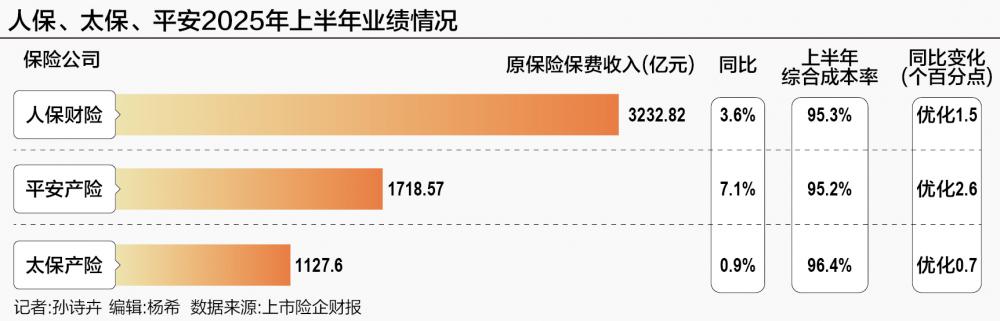
Core Viewpoint - The overall performance of listed insurance companies in China shows a positive trend in premium income and cost management, with a focus on the growth of new energy vehicle insurance and international expansion strategies [1][3][4]. Group 1: Premium Income and Market Share - The combined premium income of China Life Insurance, Ping An Property & Casualty, and China Pacific Property Insurance reached 607.9 billion yuan, accounting for 63% of the market share [1]. - China Life Insurance reported a premium income of 323.28 billion yuan, a year-on-year increase of 3.6% [1][2]. - Ping An Property & Casualty achieved a premium income of 171.86 billion yuan, with a growth rate of 7.1% [1][2]. - China Pacific Property Insurance's premium income was 112.76 billion yuan, reflecting a 0.9% increase year-on-year [1][2]. Group 2: Cost Management and Profitability - The comprehensive cost ratios (COR) for the three companies generally decreased, indicating improved underwriting profitability [1]. - China Life Insurance's COR was 95.3%, down 1.5 percentage points year-on-year, marking the best level in nearly a decade [1]. - Ping An's COR improved by 2.6 percentage points to 95.2%, showing the most significant improvement [1]. - The average COR for the listed insurance companies was 96.1%, a year-on-year improvement of 1.5 percentage points, driven by reduced disaster claims and enhanced cost control [1]. Group 3: New Energy Vehicle Insurance Growth - New energy vehicle insurance is experiencing significant growth, with China Pacific's premium income from this segment reaching 10.596 billion yuan, increasing its share of total vehicle insurance premiums from 14.1% to 19.8% [3]. - The profitability of new energy vehicle insurance is improving, with several companies reporting underwriting profits in this area [3][4]. - China Life Insurance's market share in new energy vehicle insurance is 34.2%, surpassing that of traditional fuel vehicles by 2.7 percentage points [4]. Group 4: International Expansion Strategies - China Life Insurance has initiated a three-step strategy for international development, focusing on Hong Kong, Asia, and global markets, with successful entries into Thailand and other Southeast Asian countries [5]. - China Pacific has also accelerated its international strategy, forming partnerships with major new energy vehicle manufacturers to support their overseas expansion [5]. Group 5: Non-Vehicle Insurance Performance - The non-vehicle insurance business showed varied performance among the three companies, with China Life Insurance's non-vehicle premium income growing by 3.8% to 179.22 billion yuan [6]. - Ping An's non-vehicle premium income increased by 13.8%, with significant growth in health, agricultural, and accident insurance [7]. - The upcoming "reporting and operation integration" policy is expected to positively impact the non-vehicle insurance sector, promoting rational competition and improving underwriting capabilities [8].