
数字技术

Search documents
2025年度中国互联网企业创新发展十大典型案例
Jing Ji Ri Bao· 2025-11-08 22:10
Group 1: Aviation Training Technology - The full-motion flight simulator visual system, developed by Tencent and Southern Airlines, represents a breakthrough in key aviation technology in China, completing a generational upgrade of the simulator visual system [1] - The system has achieved high-precision 3D reconstruction of over 200 airports globally, covering major international aviation hubs, providing efficient and safe training support for nearly 90,000 civil aviation pilots in China [1] Group 2: AI Safety Solutions - 360 has developed a large model security guard based on the "model-based modeling" concept, focusing on addressing AI's reliability, trustworthiness, controllability, and benevolence issues [2] - The solution includes a standardized and automated evaluation process, multi-dimensional verification of business model outputs, and dual protection on input and output sides, enabling "plug-and-play" security enhancements [2] Group 3: AI in Industry Solutions - iFLYTEK launched the Xinghuo cognitive large model, which possesses capabilities in text generation, language understanding, logical reasoning, and multimodal processing, continuously evolving from vast data and knowledge [3] - The model effectively addresses key challenges in complex scenarios across various vertical industries [3] Group 4: AI-Driven Business Solutions - Baidu's Huibo Star is the first AI full-stack digital human solution in the industry, leveraging generative AI technologies to empower live streaming, lead collection, and content broadcasting, helping businesses achieve low-threshold, round-the-clock live streaming [4] - The AI video generation platform allows users to quickly capture real-time trends and automatically generate video scripts, facilitating efficient digital human video creation [4] Group 5: Smart Supply Chain in Automotive Industry - JD's industrial solution for the automotive sector promotes the digital transformation of the supply chain, aiming to create a resilient and efficient automotive supply chain system [5] - The solution is expected to reduce supplier management costs by over 50% and improve supply chain response speed by 30% [5] Group 6: AI in Media Innovation - Kuaishou is expanding application scenarios around its AI technology, enhancing media production, advertising creativity, and gaming through collaborations [6] - The company has established a comprehensive AI ecosystem with a matrix of large models, injecting new momentum into smart media development [6] Group 7: Digital Cultural Promotion - Meitu has initiated a "Digital Communication Project for Chinese Traditional Culture," creating a "Guochao Pattern" brand that transforms traditional patterns into creative materials, enhancing young people's recognition and participation in traditional culture [8] - The project has achieved over 2 billion transmissions and created more than 100 sets of Guochao pattern materials, revitalizing traditional culture among the younger generation [8] Group 8: Smart Healthcare Ecosystem - Ant Group's digital healthcare business has served over 800 million users since its launch in 2014, collaborating with over 3,600 medical institutions to promote the digital upgrade of medical payments and health services [9] - The initiative aims to enhance the accessibility and convenience of public health management through a dual-driven approach of technology and ecosystem [9] Group 9: Autonomous Delivery Solutions - Meituan is focusing on breakthroughs in autonomous delivery technology and its commercialization, collaborating with Tsinghua University to establish a research center for intelligent driving in urban complex scenarios [10] - The initiative aims to improve delivery efficiency and user experience while reducing costs in urban logistics [10] Group 10: Humanistic AI Development - Xiaohongshu plans to upgrade its internal large model technology and application product team into a humanistic intelligence laboratory, inviting researchers with humanistic backgrounds to enhance AI with human wisdom and values [11] - The team aims to integrate humanities thinking with natural language processing to shape AI's personality and values, improving its empathy and value judgment capabilities in complex situations [11]





美中贸易全国委员会会长:中国优势是将数字技术转为应用
Zhong Guo Xin Wen Wang· 2025-11-07 13:46
美中贸易全国委员会会长:中国优势是将数字技术转为应用 中新社浙江乌镇11月7日电 (记者 刘亮)美中贸易全国委员会会长谭森7日在2025年世界互联网大会乌镇 峰会上指出,中国正着眼于用先进技术为传统产业赋能,优势在于能将数字技术转化为实际应用。 "从企业角度来看,中国最大的优势在于能将数字技术转化为实际应用,涵盖制造业、医疗保健、物流 和公共服务等领域。"谭森说,特别是人工智能时代,中国正着眼于用先进技术为传统产业赋能,为经 济增添价值。 谭森表示,其会员公司正积极参与到全球重要科技变革中,并从中看到深化合作的重大机遇。"我们希 望政府、企业和国际组织能携手合作,制定框架和措施,以促进长期稳定且可预测的政策。" 中新经纬版权所有,未经书面授权,任何单位及个人不得转载、摘编或以其它方式使用。 关注中新经纬微信公众号(微信搜索"中新经纬"或"jwview"),看更多精彩财经资讯。 编辑:王永乐 广告等商务合作,请点击这里 本文为转载内容,授权事宜请联系原著作权人 "通过与中国及全球利益相关方合作,能够营造增强投资信心、吸引人才的政策环境,最终实现负责任 和有包容性的技术发展。"谭森说,这恰恰反映当下商界的期望。从 ...
2025世界互联网大会观察:打造智慧参会新标杆
Zhong Guo Xin Wen Wang· 2025-11-07 12:12
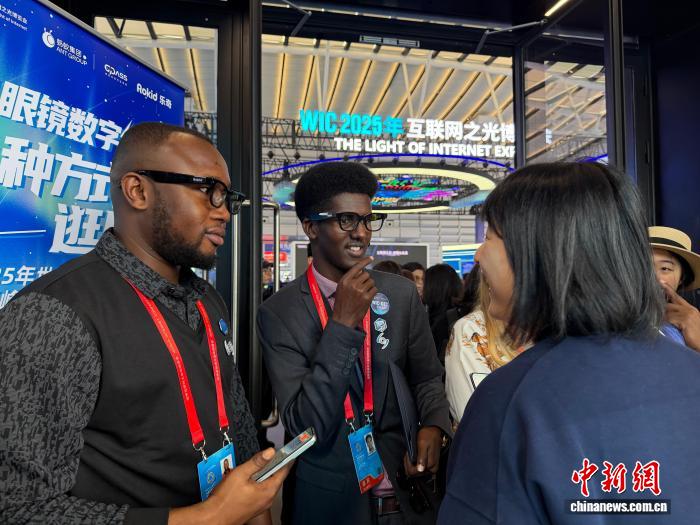
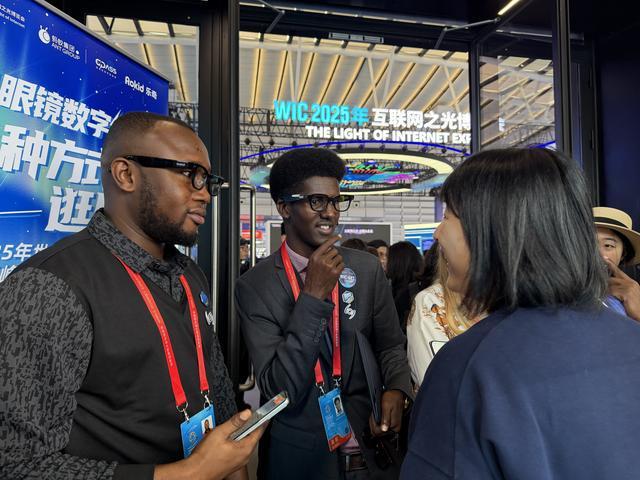
Core Insights - The 2025 World Internet Conference in Wuzhen showcased innovative technology and smart experiences, transforming the traditional conference model into a more interactive and engaging format [1][2]. Group 1: Technological Innovations - Attendees experienced AI glasses that provided immersive guided tours, utilizing gPass technology for a hands-free experience [1]. - The intelligent assistant "Tong Xiaowu" offered real-time navigation and information about the conference, integrating features from Gaode Navigation and Alipay's AI visual search [2]. - The conference highlighted the "Wenlan Chongguang" project, which used mixed reality technology to digitally reconstruct cultural heritage, allowing participants to interact with historical texts [2][4]. Group 2: Health and Community Engagement - The AQ joint health clinic, part of Ant Group's community service initiative, provided health consultations to attendees and local seniors, demonstrating a commitment to social responsibility [4][5]. - AI applications in health management were showcased, including tools for chronic disease management and remote health monitoring for the elderly [5]. Group 3: Broader Implications - The integration of various technologies at the conference redefined the experience of international events, emphasizing the potential of digital technology to enhance everyday life [5].

2025年世界互联网大会乌镇峰会开幕 李书磊出席开幕式并发表主旨讲话
Xin Hua She· 2025-11-07 08:29
Core Viewpoint - The 2025 World Internet Conference in Wuzhen emphasizes the importance of building a community with a shared future in cyberspace, as proposed by President Xi Jinping ten years ago, and outlines new opportunities for global internet development following the recent CPC Central Committee meeting [1][1][1] Group 1: Innovation and Development - The conference highlights the need to drive innovation in the digital economy and promote the widespread adoption of digital technologies and applications [1][1] - It stresses the importance of collaborative governance, respecting each country's internet sovereignty, development paths, and governance models to create a fair and reasonable governance system [1][1] Group 2: Security and Cultural Exchange - The event underscores the necessity of establishing common security as a foundation for dialogue and cooperation, aiming to create a peaceful and stable cyberspace [1][1] - It advocates for cultural exchange as a means to empower the inheritance and innovation of civilization through digital technology [1][1] Group 3: Conference Details - The theme of this year's conference is "Building an Open, Cooperative, Safe, and Inclusive Digital Future - Working Together to Build a Community with a Shared Future in Cyberspace," featuring 24 sub-forums on topics such as digital economy and the digital preservation of cultural heritage [1][1] - Over 1,600 guests from more than 130 countries and regions are participating in the conference [1][1]
探访2025乌镇峰会:当AI眼镜邂逅“桐小乌”,数字技术让古籍“活”起来
Huan Qiu Wang Zi Xun· 2025-11-06 11:42
Core Insights - The 2025 World Internet Conference in Wuzhen showcased a strong technological atmosphere and innovative experiences, highlighting the integration of AI and digital technology in enhancing participant engagement [1][4][9] Group 1: Technological Innovations - The conference featured AI glasses equipped with gPass technology, allowing participants to interact with the intelligent assistant "Tong Xiaowu" for navigation and information retrieval, transforming the traditional conference experience [1][3] - The "Wenlan Chongguang·Shuyun Liufang" project utilized mixed reality (MR) technology to digitally reconstruct cultural heritage, enabling participants to explore and interact with historical texts like the "Four Treasuries" [4][7] Group 2: Health and Community Engagement - The AQ Joint Blue Vest Health Clinic provided health services to attendees and local elderly residents, demonstrating a commitment to community health through AI applications [7][9] - The AI health applications included features like skin analysis and a 24-hour AI medical hotline, allowing for real-time health monitoring and support for elderly care [9] Group 3: AI Developments - Ant Group showcased its advancements in general artificial intelligence, including the full display of the Bailing model family, which encompasses language, reasoning, and multimodal capabilities, marking a significant step into the 2.0 phase [9] - The introduction of the Robbyant-R1 service robot demonstrated practical applications of AI in various sectors such as dining, exhibition guidance, and medical inquiries [9]
合肥云端创研工程科技有限公司成立 注册资本20万人民币
Sou Hu Cai Jing· 2025-11-05 02:13
Core Insights - Hefei Yunduan Chuangyan Engineering Technology Co., Ltd. has been established with a registered capital of 200,000 RMB [1] - The company is engaged in a wide range of services including technology services, engineering management, and manufacturing of construction-related machinery and materials [1] Company Overview - The legal representative of the company is Wang Mingchuan [1] - The business scope includes technology development, consulting, and transfer, as well as industrial engineering design services [1] - The company also focuses on the manufacturing of intelligent equipment for cultural venues and general applications of artificial intelligence [1] Industry Implications - The establishment of the company indicates a growing trend in the engineering and technology sectors, particularly in construction and digital services [1] - The diverse range of services offered suggests potential for innovation and development within the industry [1]
全球治理倡议有助于弥合南北发展差距
Ren Min Ri Bao Hai Wai Ban· 2025-11-03 03:41
Core Viewpoint - The global governance deficit is widening, and China's global governance initiative aims to uphold the core values and human ideals established 80 years ago by the United Nations, bridging the long-standing North-South development gap and injecting new momentum for fair cooperation and innovative development [1][2] Group 1 - The current global governance mechanisms are ineffective or unfair in addressing political, economic, military, and social turmoil, with wealthy countries holding disproportionate influence in international decision-making [1] - Developing countries, particularly in the Global South, face significant burdens due to inadequate representation in global governance, as exemplified by the climate change issue where developed nations have historically contributed to carbon emissions while pressuring developing nations [1] - China's global governance initiative emphasizes equal participation in international affairs for all countries, regardless of size or wealth, and aims to promote common development, thereby enhancing fairness in the global system [1] Group 2 - China calls for reforms in international financial institutions to address the persistent North-South gap and supports the legitimate development rights of emerging markets and developing countries amid disruptions caused by U.S. tariffs on global renewable energy markets [2] - The world is entering a new industrial revolution led by artificial intelligence and digital technology, with developing countries eager to leverage innovation for accelerated growth [2] - China's proposal to establish a World Artificial Intelligence Cooperation Organization aims to bridge the digital and intelligence divide, responding to the urgent needs of developing countries and inspiring international action towards the ideals enshrined in the UN Charter [2]
晶采观察丨前三季度多项数据表明 新质生产力加速成长
Yang Guang Wang· 2025-10-30 14:02
Core Insights - China has made significant progress in major engineering projects, including the upcoming launch of the Shenzhou 21 spacecraft and the launch of the world's largest electric cargo ship, indicating advancements in green shipping and smart vessel technology [2][3] - The concept of "new quality productivity" is crucial for China's economic future, emphasizing the need to balance the cultivation of new driving forces with the upgrading of old ones through technological innovation [2][4] - The high-tech and equipment manufacturing sectors have shown robust growth, with sales revenues increasing by 15.2% and 9% year-on-year, respectively, driven by the integration of artificial intelligence into traditional industries [2][3] Industry Performance - In the first three quarters, new quality productivity has become a key driver for stable industrial economic growth, supported by government policies that promote smart manufacturing and digital technology [4][5] - Specific regions like Henan and Jiangxi have reported strong growth in new energy vehicles and strategic emerging industries, with Jiangxi's fixed asset investments in these sectors increasing by 9.5%, 6.4%, and 10.9% respectively [3][4] - Retail sales of technology-related products have surged, with wearable smart device sales in Zhejiang growing by 105.6% and smart home appliances in Jiangsu increasing by 53.5% [3] Policy and Strategic Direction - The recent release of the 15th Five-Year Plan emphasizes the importance of high-level technological self-reliance and the development of new quality productivity as a strategic priority [4][5] - The plan highlights the need to build a modern industrial system, reinforcing the foundation of the real economy and maintaining a reasonable proportion of manufacturing [4]
超讯通信等在三明成立新公司
Mei Ri Jing Ji Xin Wen· 2025-10-30 03:59
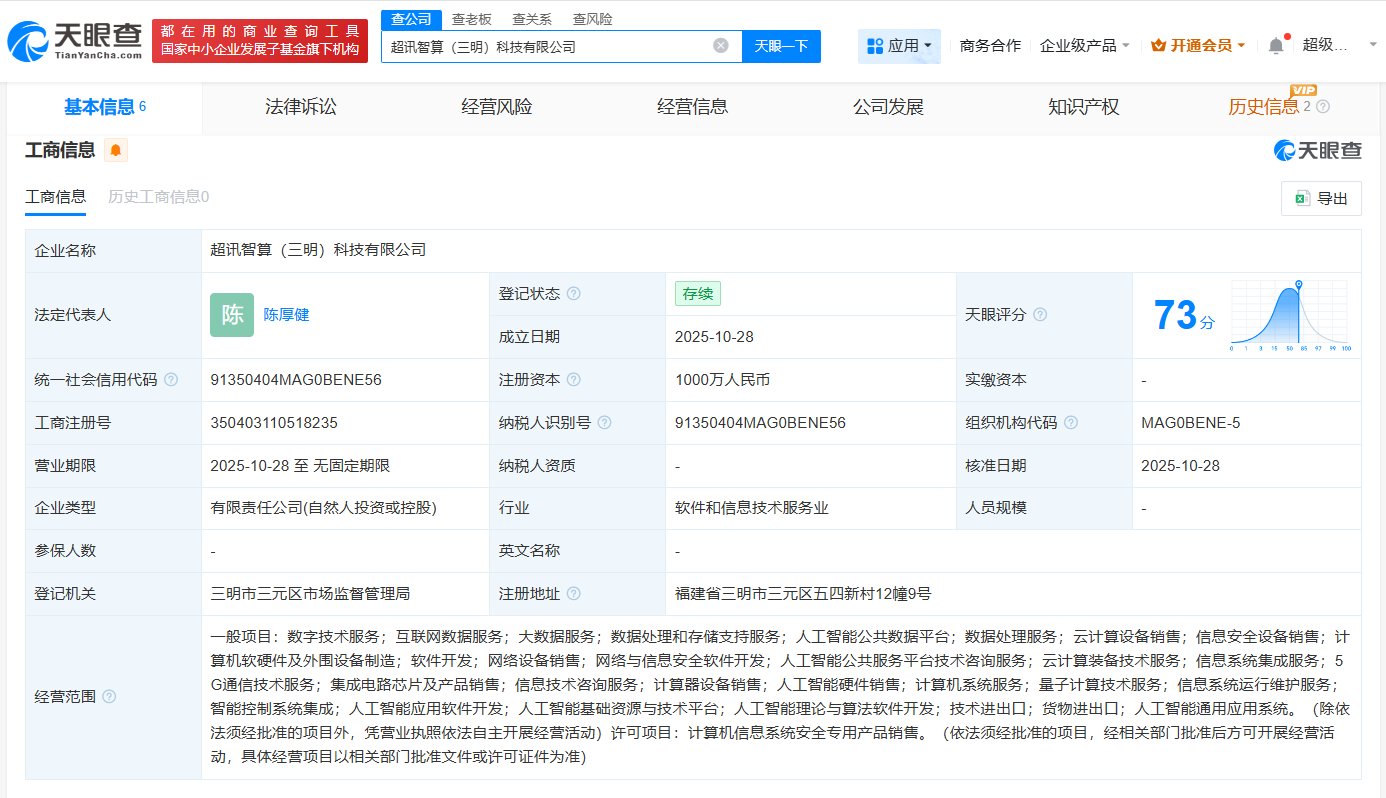
Core Insights - A new company, ChaoXun Intelligent Computing (Sanming) Technology Co., Ltd., has been established with a registered capital of 10 million RMB, focusing on digital technology services and artificial intelligence [1][2]. Company Information - The legal representative of the company is Chen Houjian, and it was registered with a capital of 10 million RMB [1][2]. - The company operates in various sectors including digital technology services, internet data services, big data services, data processing and storage support services, and artificial intelligence public data platforms [1][2]. - The shareholders of the company include ChaoXun Communication (603322), Guangzhou Yunshang Hongtu Investment Partnership (Limited Partnership), and Guangzhou Huahui Zhichuan Digital Information Technology Co., Ltd. [1][2]. Business Scope - The business scope includes digital technology services, internet data services, big data services, data processing and storage support services, and artificial intelligence public data platforms [1][2]. - Additional services encompass software development, network equipment sales, information technology consulting, and artificial intelligence hardware sales [2].

“数字技术活化千年古城”案例亮相联合国会议
Su Zhou Ri Bao· 2025-10-29 00:26
Core Insights - The "Digital Technology Revitalization of the Millennium Ancient City" case from Gusu District has been included in the 2025 edition of the "Shanghai Manual," showcasing China's experience in historical and cultural preservation at the World Cities Day Global Conference on Sustainable Urban Development [1] - The conference, co-hosted by UN-Habitat and the Shanghai Municipal Government, took place from October 26 to 27, 2023, and highlighted sustainable development cases from 242 cities globally, including 52 from China [1] Group 1 - The case constructs a closed-loop framework of "platform construction - protection and inheritance - revitalization and utilization," utilizing digital technology for the digital preservation, protection, maintenance, and display of cultural heritage [1] - Gusu District implemented the "Ancient City Cell Dissection Project" in December 2020, achieving over 95% household survey coverage of traditional residences, employing laser scanning and drones to create 3D models of cultural relics [2] - The "CIM+ Digital Twin Ancient City" platform was launched in October 2021, featuring multi-scale modeling with a resolution of 3 cm, integrating cross-departmental resources and supporting applications across 17 municipal and district departments with an average daily data call exceeding 20,000 times [2] Group 2 - The platform enables cross-departmental data sharing, enhancing the precision and efficiency of preservation efforts, and supports multi-temporal displays to aid planning and decision-making [2] - Gusu District has initiated the "Ancient City Protection and Renewal Partner Program," encouraging social capital participation in revitalization projects, such as transforming historical residences into boutique hotels and cultural museums [2] - Future plans include deepening the application of digital technology in health monitoring of ancient buildings, cultural tourism consumption, safety protection, and community elder care, aiming to extend the benefits of digital innovation to more residents and share the "Gusu experience" internationally [3]