
投资者保护

Search documents
深圳金融教育宣传周:全矩阵普及金融知识,筑牢投资者防护网
Nan Fang Du Shi Bao· 2025-09-18 08:13
Core Points - The 2025 Financial Education Promotion Week is officially launched from September 15 to 21, aiming to enhance public financial literacy through various activities organized by financial regulatory authorities and institutions [1] - In Shenzhen, local financial regulatory bodies and institutions are collaborating to create a comprehensive financial knowledge promotion matrix for citizens and market participants [1] Offline Activities - The CBD area in Futian has initiated financial education efforts by creating a platform for financial industry promotion and education, enhancing the business environment and public financial literacy [3] - The Southern Fund's investor education base participated in community events, focusing on themes like financial rights protection and risk prevention [3][5] Innovative Approaches - The education base has adopted a "cultural heritage + finance" model, combining traditional crafts with financial knowledge to make complex concepts more accessible and engaging for the public [5] - Interactive methods, such as creating figurines representing investment concepts, have proven to be popular and effective in raising financial awareness [5] Online Innovations - The Shenzhen Securities Regulatory Bureau has launched a series of engaging original short videos to expand the reach of financial education, addressing topics like ETF investment and financial fraud prevention [6][8] - These videos utilize humorous storytelling to balance professionalism and entertainment, making financial education more relatable [8] Industry Empowerment - A recent exchange meeting for investor education lecturers was held to strengthen the professional foundation of financial education services in Shenzhen, involving over 80 representatives from various financial institutions [11] - The Shenzhen Securities Association has established a lecturer expert pool to promote high-quality development in investor education [9] Long-term Mechanism - The series of activities in Shenzhen aims to create a robust synergy for financial knowledge dissemination and investor protection through a multi-faceted approach [11] - Future efforts will focus on deepening financial education innovation and building a sustainable financial education mechanism to enhance public financial literacy and promote rational investment behavior [12]


益智:上市公司取消季报?特朗普“特不靠谱”
Sou Hu Cai Jing· 2025-09-18 01:29
Core Viewpoint - The article discusses the implications of the "non-ST stock one yuan lightning delisting" mechanism, highlighting the unfairness faced by investors due to sudden delistings and lack of information disclosure, which exacerbates information asymmetry and investor losses [1][2][4]. Group 1: Investor Impact - Investors in non-ST companies faced significant losses due to sudden delistings without prior warning or adequate information, leading to a sense of betrayal and confusion [1][2]. - The absence of quarterly reports post-delisting has left investors in an information vacuum, making it difficult to assess the financial health of the companies they invested in [1][2]. - Many investors were unaware of the risks associated with delisting, as they had not signed agreements acknowledging such risks, resulting in unexpected liquidity issues [2][4]. Group 2: Regulatory Concerns - Regulatory bodies failed to announce penalties against major shareholders of delisted companies, allowing them to sell shares at a loss to unsuspecting investors [2][4]. - The lack of transparency and timely information from regulators has led to suspicions of collusion between major shareholders and regulatory personnel [2][4]. - The article emphasizes the need for stricter enforcement of disclosure regulations to protect investors and ensure accountability among listed companies [5][6]. Group 3: Information Disclosure System - The article critiques the suggestion by former President Trump to reduce earnings report frequency, arguing that it could worsen information asymmetry in the Chinese market, where quarterly disclosures are crucial for investor protection [4][6]. - It advocates for a differentiated disclosure system where compliant companies could benefit from reduced reporting frequency, while problematic companies would face increased scrutiny through more frequent disclosures [6][7]. - The need for timely and accurate information disclosure is underscored as essential for maintaining market fairness and protecting investors, particularly during delisting processes [5][6][7].

美国SEC允许上市公司要求通过仲裁解决股东争议
Zheng Quan Shi Bao Wang· 2025-09-18 00:14
Core Viewpoint - The SEC has overturned a long-standing policy allowing public companies to prohibit shareholders from initiating class action lawsuits, instead requiring arbitration for dispute resolution [1] Group 1: SEC Policy Change - The SEC's new policy aims to reduce compliance burdens for companies and make public listings more attractive, potentially reviving IPO activity [1] - SEC Chairman Paul Atkins emphasized that the change is intended to promote a more favorable environment for companies considering going public [1] Group 2: Investor Protection Concerns - The policy shift has raised concerns among Democratic lawmakers and investor advocacy groups, who argue it will weaken shareholder rights and undermine the advantages of U.S. capital markets [1] - Critics highlight that the high settlement amounts from class action lawsuits, projected to reach $3.7 billion in 2024, are more effective in compensating investors than SEC enforcement actions [1] Group 3: State Regulations - While Delaware currently prohibits the use of arbitration in federal securities claims, other states with more lenient stances may provide practical space for the SEC's new policy [1]
宁波市证券期货业协会联合多方开展2025年金融教育宣传周活动
Zheng Quan Ri Bao Wang· 2025-09-17 12:43
Group 1 - The event organized by the Ningbo Securities and Futures Industry Association aimed to promote financial education with the theme "Protecting Financial Rights to Enhance Quality of Life" [1] - Various interactive activities were conducted to enhance public awareness and ability to prevent risks, including exhibitions, games, and distribution of educational materials [1][2] - The event highlighted the dangers of illegal securities and futures activities through real-life case studies, helping investors improve their risk recognition and resistance skills [1] Group 2 - The association created a "Financial Market" to engage citizens, featuring various educational games and activities to disseminate anti-fraud knowledge [2] - Different companies participated with unique approaches, such as combining traditional crafts with fraud prevention education and using mascots to convey messages [2] - The association plans to continue diverse financial education initiatives to deepen and broaden outreach, aiming to foster a harmonious and healthy capital market environment [2]


金融教育宣传周|国新国证基金:基金投教进商圈 保障投资者金融权益
Xin Lang Ji Jin· 2025-09-17 08:04
Group 1 - The core event is the "2025 Financial Education Promotion Week" organized by Beijing Financial Regulatory Bureau, aiming to enhance public understanding of financial products and protect investors' rights [1][2] - The event features a "financial knowledge market" where various fund companies engage with the public through interactive activities, promoting financial literacy and rational investment [2][3] - The initiative represents a collaborative effort within the public fund industry to advance investor education and showcases the industry's responsible and professional image [2][3] Group 2 - The importance of investor protection is increasingly recognized as the asset management industry enters a new phase of high-quality development [3] - National New National Fund actively participates in events like the "Financial Knowledge Market" to fulfill social responsibilities and promote rational investment concepts [3] - The company plans to continue innovating investor protection methods and expanding channels to enhance financial literacy and contribute to the high-quality development of the public fund industry [3]
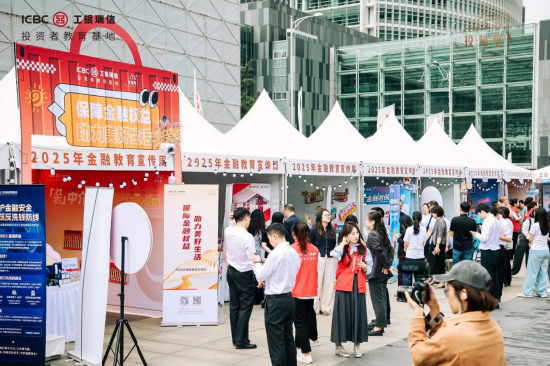
【2025年金融教育宣传周】投保同心,行业协同——多家基金机构走进工银瑞信《财富集装箱》防非主题展
Xin Lang Ji Jin· 2025-09-16 10:50
Group 1 - The "2025 Financial Education Promotion Week" is organized by the National Financial Regulatory Administration, the People's Bank of China, and the China Securities Regulatory Commission, taking place from September 15 to 21, 2025, featuring a "Financial Knowledge Market" for public engagement [1] - The event includes participation from various financial institutions such as ICBC Credit Suisse Fund, CICC Fund, and others, focusing on investor protection and collaborative development within the public fund industry [3] - The "Wealth Container" exhibition features interactive elements designed to educate the public on financial knowledge, including risk management and investor protection, showcasing the social responsibility of the public fund industry [5] Group 2 - The industry emphasizes the need for collective efforts in investor protection, aiming to enhance cooperation and leverage professional resources to build trust in the market and support the high-quality development of the public fund sector [7]
全面推动北京公募基金高质量发展 为加快建设金融强国贡献力量
Zhong Guo Zheng Quan Bao· 2025-09-15 22:33
Core Viewpoint - The public fund industry in China is entering a critical phase of deepening reform and improving quality and efficiency, focusing on enhancing investment capabilities, optimizing customer experience, and increasing investor trust [1][2][3] Group 1: Industry Development - The China Securities Regulatory Commission (CSRC) released the "Action Plan for Promoting High-Quality Development of Public Funds," marking a new development stage for the industry [2] - The public fund industry has over 30 trillion yuan in managed assets and more than 800 million investors, playing a vital role in serving the real economy and maintaining financial stability [3] - The industry faces challenges in operational philosophy, functionality, and governance, necessitating reforms to better align with national strategies [3] Group 2: Reform Initiatives - The action plan aims to address market and social concerns, encouraging institutions to focus on core business, optimize supply, and enhance value creation capabilities [3][4] - Beijing is positioned to lead by example in high-quality development due to its concentration of financial resources and institutions [4] Group 3: Business Innovation - The industry is encouraged to innovate and optimize business structures, including the introduction of floating fee rate products and the development of equity products [5][6] - In the first half of 2025, 73 new equity fund products were launched, totaling 41.5 billion yuan, with 1,106 equity funds under management amounting to 1.66 trillion yuan [6] Group 4: Investor Services - The focus is on enhancing the service system centered around investors, including the introduction of personal pension products and a comprehensive investor support system [6][7] - Digital transformation is being promoted to improve service efficiency and enhance investor experience [7] Group 5: Research and Investment Capabilities - The industry is urged to build a research and investment system that aligns with high-quality development, including the establishment of digital research platforms and integrated research teams [7] - Strengthening talent development and optimizing investment decision-making processes are key priorities [7] Group 6: Contribution to the Real Economy - The public fund industry is actively supporting national strategies, including technology innovation and green development, with 48 managed science and technology innovation funds totaling 173.236 billion yuan [8][9] - The industry is also involved in urban modernization projects through REITs, with 37 REITs issued, amounting to 1.03995 trillion yuan [9] Group 7: Investor Protection and Risk Management - Investor protection is prioritized, with ongoing fee reforms leading to significant savings for investors, totaling 7.2 billion yuan in 2024 [10] - A comprehensive risk management framework is being established to enhance regulatory oversight and prevent systemic risks [10]
强监管是对投资者最好保护
Bei Jing Shang Bao· 2025-09-15 16:14
Group 1 - The core viewpoint emphasizes a "zero tolerance" approach towards financial fraud and misconduct in the capital market, with strict penalties being imposed on companies like *ST Dongtong and Yili Clean Energy [1][2] - The regulatory environment is characterized by severe penalties, which serve as a deterrent against financial misconduct, thereby enhancing investor confidence and promoting the exit of poorly performing stocks from the A-share market [1][3] - The strong regulatory stance aims to protect investors by ensuring that companies adhere to ethical practices, thereby fostering a healthier market ecosystem [3] Group 2 - The regulatory framework is designed to hold all market participants accountable, with no exceptions for companies or individuals who violate market rules, as demonstrated by the case of Yili Clean Energy, which faced penalties even after delisting [2] - The comprehensive accountability system under the strong regulatory approach has led to a decrease in low-cost violations, resulting in a more stable market environment [3] - Enhanced governance among listed companies and increased diligence from intermediaries are expected outcomes of the stringent regulatory measures, ultimately benefiting investors through improved company performance and reduced risks [3]
证监会严打财务造假开出亿元罚单
Bei Jing Shang Bao· 2025-09-15 13:07
Core Viewpoint - The recent stringent regulatory measures by the China Securities Regulatory Commission (CSRC) against companies involved in financial fraud, such as *ST Dongtong and Yili Clean Energy, signal a "zero tolerance" approach to protect investors and enhance market integrity [1][2][3] Group 1: Regulatory Actions - The CSRC has imposed significant fines, often in the hundreds of millions, on companies for financial misconduct, indicating a strong regulatory stance [1][2] - The regulatory framework emphasizes severe penalties for financial fraud, market manipulation, and other illegal activities, aiming to deter such behaviors and protect investor interests [1][3] Group 2: Market Impact - The enforcement of strict regulations is expected to lead to a decline in low-quality stocks, as companies are discouraged from engaging in fraudulent activities [1][3] - A more robust regulatory environment enhances investor confidence, encouraging long-term investment and value-driven strategies [3] Group 3: Corporate Governance - Companies are increasingly focusing on improving governance standards and operational quality to regain investor trust and ensure compliance with regulations [3] - The responsibilities of intermediaries and corporate executives are being reinforced, promoting a culture of accountability and risk management [3]
【西街观察】强监管是对投资者最好的保护
Bei Jing Shang Bao· 2025-09-15 12:49
Group 1 - The core viewpoint emphasizes a "zero tolerance" approach towards financial fraud and misconduct in the capital market, with strict penalties being imposed on companies like *ST Dongtong and Yili Clean Energy [1][2] - The regulatory environment is characterized by severe penalties, including billion-level fines, which serve as a deterrent against financial misconduct and enhance investor protection [1][3] - Strong regulation is seen as essential for maintaining market confidence and ensuring the quality of listed companies, which directly impacts investor safety [1][3] Group 2 - The regulatory framework is designed to hold all entities accountable, with no exceptions for companies or individuals who violate market rules, as demonstrated by the case of Yili Clean Energy facing penalties even after delisting [2] - The comprehensive accountability system under strong regulation has led to a decrease in low-cost violations, fostering a healthier market ecosystem [3] - Enhanced governance among listed companies and increased diligence from intermediaries are expected outcomes of the stringent regulatory measures, ultimately benefiting investors through reduced risks and improved company performance [3]
