报行合一

Search documents
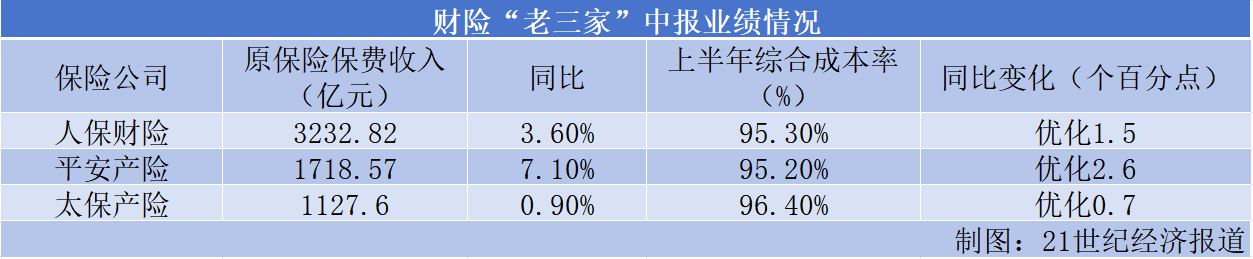
人保、太保、平安成本普降 新能源车险出海成新浪潮
2 1 Shi Ji Jing Ji Bao Dao· 2025-09-03 23:07
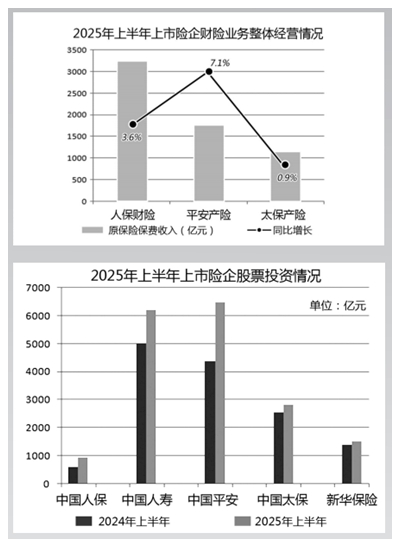
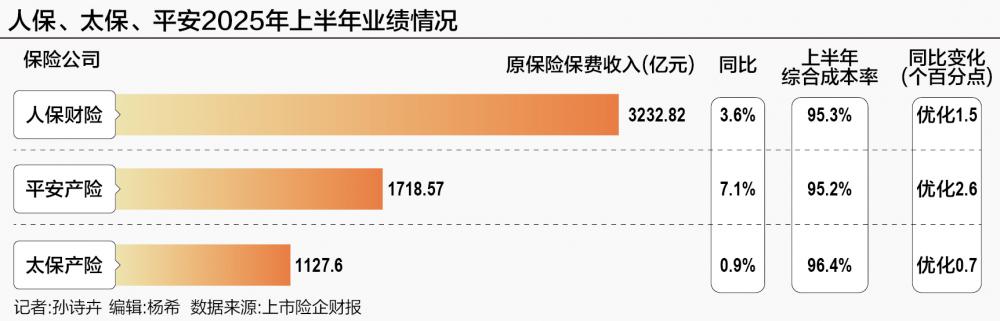
Core Viewpoint - The overall performance of listed insurance companies in China shows a positive trend in premium income and cost management, with a focus on the growth of new energy vehicle insurance and international expansion strategies [1][3][4]. Group 1: Premium Income and Market Share - The combined premium income of China Life Insurance, Ping An Property & Casualty, and China Pacific Property Insurance reached 607.9 billion yuan, accounting for 63% of the market share [1]. - China Life Insurance reported a premium income of 323.28 billion yuan, a year-on-year increase of 3.6% [1][2]. - Ping An Property & Casualty achieved a premium income of 171.86 billion yuan, with a year-on-year growth of 7.1% [1][2]. - China Pacific Property Insurance's premium income was 112.76 billion yuan, reflecting a 0.9% increase year-on-year [1][2]. Group 2: Cost Management and Profitability - The comprehensive cost ratios (COR) for the three companies generally decreased, indicating improved underwriting profitability [1]. - China Life Insurance's COR was 95.3%, down 1.5 percentage points year-on-year, marking the best level in nearly a decade [1]. - Ping An's COR improved by 2.6 percentage points to 95.2%, showing the most significant improvement [1]. - The average COR for the listed insurance companies was 96.1%, a year-on-year improvement of 1.5 percentage points, driven by reduced disaster claims and enhanced cost control [1]. Group 3: New Energy Vehicle Insurance Growth - New energy vehicle insurance is experiencing significant growth, with China Pacific's premium income from this segment reaching 10.596 billion yuan, increasing its share of total vehicle insurance premiums from 14.1% to 19.8% year-on-year [3][4]. - The profitability of new energy vehicle insurance is improving, with several companies reporting underwriting profits in this segment [3][4]. - China Life Insurance's share of new energy vehicle insurance in the domestic market is 34.2%, surpassing that of traditional fuel vehicles by 2.7 percentage points [4][5]. Group 4: International Expansion Strategies - China Life Insurance has initiated a three-step strategy for international development, focusing on Hong Kong and exploring other Asian markets, with successful entries into Thailand [5]. - China Pacific has also accelerated its international strategy, forming partnerships to support Chinese automakers in overseas markets [5]. - The export of Chinese new energy vehicles has surged, with 1.308 million units exported in the first seven months of the year, a year-on-year increase of 84.6% [4]. Group 5: Non-Motor Insurance Performance - Non-motor insurance business performance varied among the three companies, with China Life Insurance reporting a premium income of 179.22 billion yuan, up 3.8% year-on-year [6][7]. - China Pacific's non-motor insurance premium income decreased by 0.8% to 59.154 billion yuan, influenced by structural adjustments [6][7]. - Ping An's non-motor insurance premium income grew by 13.8% to 63.246 billion yuan, with significant growth in health and accident insurance [7]. Group 6: Regulatory Changes and Industry Outlook - The upcoming implementation of the "reporting and operation integration" policy is expected to shift the industry focus from scale competition to value cultivation [8]. - The new regulations aim to address issues such as high commission fees and receivable premium risks, which could enhance the underwriting capacity of the non-motor insurance sector [8]. - The policy is anticipated to positively impact the operating performance of non-motor insurance in 2025 and significantly improve it by 2026 [8].




今年上半年多家险企银保新业务价值同比翻倍 重新站上“C位” 银保渠道何以狂飙?
Mei Ri Jing Ji Xin Wen· 2025-09-03 19:24
Core Viewpoint - The insurance industry is transitioning from a focus on short-term and lump-sum products to a high-quality development era, driven by regulatory changes and a shift in product structure towards long-term and protection-oriented offerings [1][2][5]. Group 1: Industry Trends - The "reporting and banking integration" policy has led to a significant reduction in commissions, resulting in a high growth rate of new business value in the bancassurance channel in 2024 and 2025 [1][2]. - Major insurance companies reported substantial increases in new business value from bancassurance channels in the first half of 2025, with Ping An Life achieving 5.972 billion yuan, a 168.6% increase year-on-year, and China Pacific Life reaching 3.604 billion yuan, up 155.97% [1][3]. - The bancassurance channel is expected to maintain a core position in the industry, with a growing proportion of regular premium and protection products, which will drive premium growth and value enhancement [1][2]. Group 2: Company Performance - In the first half of 2025, New China Life's bancassurance channel achieved a first-year premium of 24.939 billion yuan, a 150.3% increase, with new business value contributing over 50% to the company's total new business value [2][3]. - Ping An Life's bancassurance channel reported new business premiums of 22.875 billion yuan, a 74.67% increase, with a significant contribution to the overall business value [3]. - China Pacific Life's bancassurance channel achieved a scale premium of 41.660 billion yuan, a growth of 82.6%, with new business value reaching 3.604 billion yuan, reflecting a robust performance [3]. Group 3: Market Potential - The bancassurance channel has significant growth potential, with only 3% to 5% of bank customers currently purchasing insurance, indicating a large untapped market [5][6]. - The demand for insurance products is evolving, with increasing needs for retirement and health protection, as well as a shift from single financial products to comprehensive life-cycle planning [5][6]. - The bancassurance model in mature markets shows that it can capture 60% to 70% of life insurance premiums, suggesting a strong potential for similar growth in China [4][5]. Group 4: Strategic Developments - The insurance industry is shifting from a fee-driven model to a value-driven approach, enhancing collaboration between banks and insurance companies to improve service and product offerings [7][8]. - Major companies are expanding their bancassurance networks and optimizing product strategies to enhance customer service and operational efficiency [9][10]. - The integration of digital solutions and customer journey enhancements is expected to drive further growth in the bancassurance sector [9].
今年上半年多家险企银保新业务价值同比翻倍 重新站上“C位”,银保渠道何以狂飙?
Mei Ri Jing Ji Xin Wen· 2025-09-03 19:22
Core Viewpoint - The insurance industry is transitioning from a focus on short-term and lump-sum sales to a high-quality development era, driven by regulatory changes and a shift in product structure towards long-term and protection-oriented products [1][2][5]. Group 1: Industry Trends - The "reporting and operation integration" policy has led to a significant reduction in commissions, resulting in a high growth rate of new business value in the bancassurance channel in 2024 and 2025 [1][2]. - Major insurance companies reported substantial increases in new business value from bancassurance channels in the first half of 2025, with Ping An Life at 5.972 billion yuan (up 168.6%), Taikang Life at 3.604 billion yuan (up 155.97%), and Xinhua Insurance at 3.267 billion yuan (up 137.08%) [1][3]. Group 2: Company Strategies - Xinhua Insurance's bancassurance channel achieved a first-year premium of 24.939 billion yuan (up 150.3%), with a focus on long-term products and a strategic emphasis on balancing scale and value [2][3]. - Ping An Life's bancassurance channel reported new business premiums of 22.875 billion yuan (up 74.67%), with a significant contribution from regular premium products [3]. - Taikang Life's bancassurance channel achieved a scale premium of 41.660 billion yuan (up 82.6%), with a new business value contribution of 3.604 billion yuan [3]. Group 3: Market Potential - The bancassurance channel has significant growth potential, with only 3% to 5% of bank customers currently purchasing insurance, indicating a large untapped market [6]. - The demand for insurance products is evolving, with increasing needs for health and retirement products driven by an aging population and diverse customer requirements [5][6]. Group 4: Collaboration and Service Enhancement - The bancassurance model is undergoing a transformation from a simple distribution model to a more integrated approach, focusing on customer needs and enhancing service capabilities [8][9]. - Major companies are expanding their bancassurance networks and improving collaboration with banks to enhance service delivery and customer experience [9][10].

“三差”对中国平安都是正贡献 靠服务打出差异化
Zheng Quan Shi Bao· 2025-09-03 18:21
Core Viewpoint - China Ping An's management is satisfied with the company's half-year performance, highlighting significant growth in new business value and premium income despite industry challenges [1][2]. Group 1: Business Performance - The new business value of life insurance grew nearly 40%, while property insurance premium income increased by 7.1% [1]. - The contribution of new business value from bancassurance and community channels exceeded one-third of the total [4]. Group 2: Strategic Initiatives - The company has not experienced "interest spread loss," "expense spread loss," or "mortality spread loss," indicating positive contributions from these areas [2]. - The strategy involves three steps: enhancing new business embedded value, improving investment return rates, and increasing the margin of new business value, while also reducing expense ratios and claims ratios [2][3]. Group 3: Technology and Innovation - The company is leveraging AI for comprehensive digital transformation, enhancing efficiency across marketing, customer service, operations, and management [3]. - The focus on technology aims to optimize the entire value chain, improving customer acquisition and operational efficiency [3]. Group 4: Channel Development - The agent team has shown a steady growth of 17%, with per capita new business value increasing by 21.6% [5]. - Community financial channels, although smaller, have experienced a remarkable growth rate of 160% and are expected to be a core growth driver by 2027 [5]. Group 5: Product Strategy - The company is transitioning from traditional insurance to participating insurance, with participating insurance accounting for 40% of individual insurance [7]. - Adjustments in product pricing are planned, with new product launches scheduled for September, including 24 main products [8].

“反内卷”初见成效,车险业务受益
Zheng Quan Shi Bao· 2025-09-03 12:29
Core Viewpoint - The property insurance industry has made initial progress in "anti-involution," leading to a significant decrease in comprehensive cost ratios among major listed insurance companies, particularly in auto insurance [1][3][4]. Group 1: Industry Performance - Major listed insurance companies reported substantial growth in underwriting profits in the first half of the year, with China Pacific Insurance, Ping An Insurance, and PICC achieving notable improvements [3]. - The comprehensive cost ratios for Ping An Insurance and PICC fell below 96%, marking a significant improvement in operational efficiency [3]. - Specifically, PICC achieved an underwriting profit of 11.699 billion yuan, a year-on-year increase of 53.5%, with a comprehensive cost ratio of 95.3%, the best level in a decade [3]. - Ping An Insurance reported an underwriting profit of 7.978 billion yuan, a year-on-year increase of 125.9%, with a comprehensive cost ratio of 95.2%, improving by 2.6 percentage points [3]. - China Pacific Insurance recorded an underwriting profit of 3.55 billion yuan, a year-on-year increase of 30.9%, with a comprehensive cost ratio of 96.3%, down by 0.8 percentage points [3]. Group 2: Cost Ratio Optimization - The optimization of comprehensive cost ratios is attributed to a decrease in expense ratios for PICC, while Ping An Insurance and China Pacific Insurance benefited from reductions in both claims and expense ratios [3][4]. - The implementation of the "reporting and execution" reform in auto insurance has been a key factor in reducing costs, ensuring that actual expense rates align with reported rates [4]. - The auto insurance comprehensive cost ratio for PICC was 94.2%, down 2.2 percentage points year-on-year, with an 18.2 percentage point decrease in expense ratios since the end of 2020 [4]. Group 3: Future Outlook - The non-auto insurance "reporting and execution" policy is expected to be implemented in the fourth quarter, which could positively impact the profitability of non-auto insurance by 2025 [5][6]. - The anticipated policy aims to establish fair and reasonable premium rates, enforce compliance with approved insurance terms, and ensure proper issuance of policies [5]. - If effectively implemented, the non-auto insurance "reporting and execution" policy will guide the industry back to its core functions, promoting rational competition and improving underwriting capabilities [6][7]. Group 4: Industry Transformation - The "anti-involution" trend is expected to create a more stable pricing basis for property insurance and foster rational market order [7]. - This shift will encourage insurance companies to focus on product development, service enhancement, and technological innovation rather than price competition [7]. - Long-term, the successful execution of the non-auto insurance policy will help the industry better assess risks and enhance its role as an economic stabilizer and social stabilizer, contributing to high-quality economic development [7].
“反内卷”初见成效!车险业务受益
证券时报· 2025-09-03 11:49
Core Viewpoint - The property insurance industry has made initial progress in "anti-involution," leading to improved business quality and underwriting profitability [1][3]. Group 1: Industry Performance - Major domestic property insurance companies have reported a significant decrease in comprehensive cost ratios, particularly in auto insurance [2][4]. - In the first half of the year, major insurers such as PICC, Ping An, and Taikang achieved substantial growth in underwriting profits, with PICC's underwriting profit reaching 11.699 billion yuan, a year-on-year increase of 53.5% [5]. - The comprehensive cost ratios for PICC and Ping An fell below 96%, marking a notable improvement in operational efficiency [5]. Group 2: Cost Ratio Optimization - The optimization of comprehensive cost ratios is attributed to a decrease in expense ratios for PICC and a dual reduction in both loss and expense ratios for Ping An and Taikang [5][6]. - Ping An's auto insurance comprehensive cost ratio improved to 95.5%, benefiting from refined expense management and the "reporting and execution" reform [6]. Group 3: Future Developments - The "reporting and execution" policy for non-auto insurance is expected to be implemented in the fourth quarter, which may positively impact the profitability of non-auto insurance by 2025 [9][10]. - The industry anticipates that effective implementation of the non-auto insurance "reporting and execution" policy will guide the sector back to its core insurance functions, promoting rational competition and improving underwriting capabilities [10][12]. Group 4: Long-term Implications - The ongoing "anti-involution" trend is expected to shift focus from price competition to product, service, and technological innovation, fostering high-quality development in the property insurance sector [12]. - The anticipated regulatory changes are likely to enhance the industry's ability to manage risks and contribute to economic stability and growth [12].
谁更赚钱?上市险企半年报透视:分红险转型初具成效,银保渠道“狂飙”
Xin Lang Cai Jing· 2025-09-03 11:21
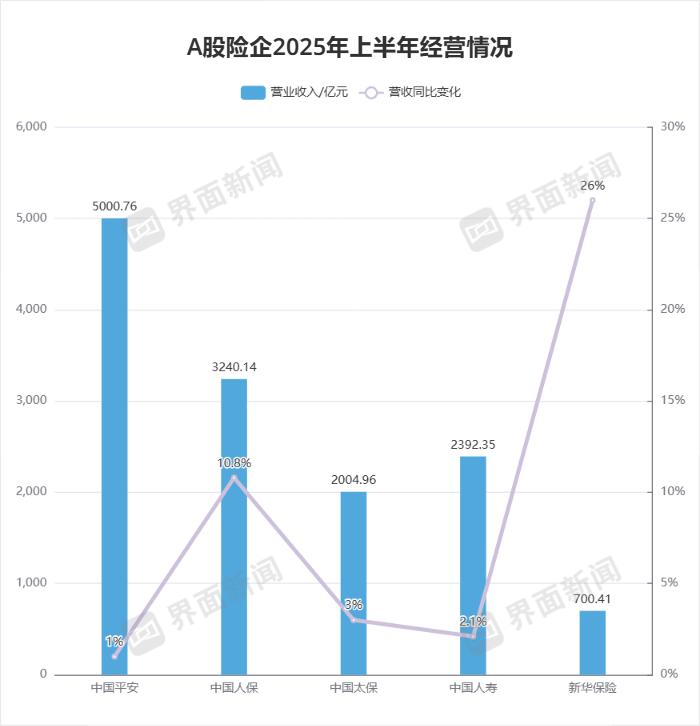
Core Viewpoint - The overall performance of A-share listed insurance companies in the first half of 2025 is stable, with revenue growth across the board, but varying business development trends among companies, with New China Life Insurance showing higher growth than its peers [1][3] Revenue Performance - China Ping An leads the industry with a revenue of 500.76 billion yuan, but its year-on-year growth is only 1% - China People's Insurance Company (CPIC) reported a revenue of 324.01 billion yuan, with a growth rate exceeding 10% - New China Life Insurance's revenue is approximately 70 billion yuan, with a year-on-year growth rate of 26% [1][3] Profitability Analysis - Except for China Ping An, all listed insurance companies experienced varying degrees of profit growth, with New China Life Insurance's net profit and net profit excluding non-recurring items both exceeding 33% - China Ping An's net profit declined by 8.8%, and net profit excluding non-recurring items slightly decreased by 0.9% due to capital market fluctuations and a one-time impact from the consolidation of Ping An Good Doctor [3][5] Embedded Value Growth - All listed insurance companies saw growth in embedded value in the first half of the year, with China Ping An and New China Life Insurance showing faster growth rates of 8.20% and 8.10%, respectively [7][8] New Business Value - New business value for the listed insurance companies grew significantly, with CPIC's new business value increasing by over 70% on a comparable basis - The silver insurance channel has positively contributed to the growth of new business value, with CPIC's new business value from this channel increasing by 168.6% [8][9] Dividend Insurance Transformation - The transformation towards dividend insurance has begun to show results, with CPIC's premium income from dividend insurance growing by 40.94% year-on-year, accounting for 12.79% of total life and health insurance premiums [10][12] Single Premium Growth - The growth in new single premiums in the first half of the year was better than the same period last year, with New China Life Insurance leading with a growth rate of 100.5%, while China Ping An saw a decline of 6.1% [12][15] Cost Ratio Improvement - The comprehensive cost ratio, a key indicator of property insurance companies' operational efficiency, improved for CPIC, China Ping An, and China Taiping, indicating enhanced underwriting profitability [17][19] Non-Car Insurance Performance - Non-car insurance profitability is gradually improving, with CPIC's comprehensive cost ratio at 97.0%, down 0.3 percentage points year-on-year, while health insurance achieved a turnaround to profitability [20][21]

“反内卷”初见成效!车险业务受益
券商中国· 2025-09-03 09:10
Core Viewpoint - The property insurance industry has made initial progress in "anti-involution" efforts, leading to improved business quality and underwriting profitability [1][3]. Group 1: Industry Performance - Major domestic property insurance companies have reported a significant decrease in comprehensive cost ratios, particularly in auto insurance [2]. - In the first half of the year, China Pacific Insurance, Ping An Property & Casualty, and People’s Insurance Company of China all achieved substantial growth in underwriting profits [4][5][6]. - Specifically, People’s Insurance Company reported an underwriting profit of 11.699 billion yuan, a year-on-year increase of 53.5%, with a comprehensive cost ratio of 95.3%, marking a 1.5 percentage point decrease [4]. - Ping An Property & Casualty achieved an underwriting profit of 7.978 billion yuan, a year-on-year increase of 125.9%, with a comprehensive cost ratio of 95.2%, improving by 2.6 percentage points [5]. - China Pacific Insurance reported an underwriting profit of 3.55 billion yuan, a year-on-year increase of 30.9%, with a comprehensive cost ratio of 96.3%, down by 0.8 percentage points [6]. Group 2: Cost Ratio Optimization - The optimization of comprehensive cost ratios is attributed to a decrease in expense ratios for People’s Insurance Company, while Ping An and China Pacific achieved reductions in both claims and expense ratios [6]. - The implementation of the "reporting and operation integration" reform in auto insurance has contributed to the cost ratio optimization, focusing on aligning actual expense rates with reported rates [6][7]. - People’s Insurance Company’s auto insurance comprehensive cost ratio was 94.2%, down 2.2 percentage points year-on-year, with an 18.2 percentage point decrease in expense ratio since the end of 2020 [7]. Group 3: Future Developments - The non-auto insurance "reporting and operation integration" policy is expected to be implemented in the fourth quarter, which could positively impact non-auto insurance profitability in 2025 and significantly improve it by 2026 [8][9]. - The policy aims to establish fair and adequate pricing principles, enforce compliance with approved insurance terms, and ensure proper issuance of policies and invoices [9]. - The industry anticipates that effective implementation of this policy will guide a return to the core functions of insurance, fostering rational competition and enhancing underwriting capabilities [9][10]. Group 4: Long-term Impact - The "anti-involution" trend across various industries is expected to create a more stable pricing basis for property insurance and promote rational market order [10]. - This shift will encourage insurance companies to focus on product, service, and technological innovation rather than price competition, leading to high-quality development [10]. - Long-term, the successful execution of the non-auto insurance "reporting and operation integration" policy will enhance the industry's ability to manage risks and contribute to economic stability [10].

财险老三家人保、太保、平安成本普降,新能源车险出海成新战场
2 1 Shi Ji Jing Ji Bao Dao· 2025-09-03 06:20
Group 1: Core Insights - The three major property insurance companies in China (PICC, Ping An, and Taiping) reported a total premium income of 607.9 billion yuan, capturing a market share of 63% [1][2] - PICC achieved a premium income of 323.28 billion yuan, a year-on-year increase of 3.6%; Taiping reported 112.76 billion yuan, up 0.9%; and Ping An reached 171.86 billion yuan, growing by 7.1% [1][2] - The overall combined ratio (COR) for these companies improved, with Ping An at 95.2% (down 2.6 percentage points), PICC at 95.3% (down 1.5 percentage points), and Taiping at 96.4% (down 0.7 percentage points) [1][2] Group 2: New Energy Vehicle Insurance - The new energy vehicle (NEV) insurance market is experiencing growth, with Taiping's NEV insurance premium income reaching 10.596 billion yuan, increasing its share of car insurance premiums from 14.1% to 19.8% [3][4] - NEV insurance is moving towards profitability, with several companies reporting improved underwriting results [3][4] - PICC's NEV insurance market share is 34.2%, exceeding that of fuel vehicles by 2.7 percentage points, indicating a strategic focus on this segment [4][5] Group 3: Non-Car Insurance Performance - PICC's non-car insurance premium income was 179.22 billion yuan, up 3.8%, with improvements in various segments [6] - Taiping's non-car insurance premium income decreased by 0.8% to 59.154 billion yuan, influenced by structural adjustments [6] - Ping An's non-car insurance premium income grew by 13.8% to 63.246 billion yuan, with significant growth in health and accident insurance [7] Group 4: Regulatory Changes and Industry Outlook - The upcoming "reporting and operation integration" policy aims to shift the industry focus from scale competition to value cultivation, addressing issues like high fees and premium collection risks [8] - The new regulations are expected to positively impact non-car insurance performance in 2025 and significantly improve results in 2026 [8]
承保盈利改善 多元业务齐发展
Jin Rong Shi Bao· 2025-09-03 00:50
Core Insights - The overall performance of listed property and casualty insurance companies shows steady growth in the first half of 2025, with improved underwriting profits and optimized combined cost ratios [1] Group 1: Financial Performance - In the first half of 2025, listed insurance companies achieved a total original insurance premium of 607.90 billion yuan, with a total underwriting profit of 23.23 billion yuan [1] - China Life Property Insurance reported original insurance premiums of 32.33 billion yuan, a year-on-year increase of 3.6%; Ping An Property Insurance reported 17.19 billion yuan, up 7.1%; and China Pacific Property Insurance reported 11.28 billion yuan, an increase of 0.9% [1] Group 2: Auto Insurance Business - The auto insurance sector is performing steadily, with significant growth in service income and premium revenue across major companies [2][4] - China Life Property Insurance's auto insurance service income reached 150.28 billion yuan, a year-on-year increase of 3.5%; Ping An Property Insurance's auto insurance premium income was 108.61 billion yuan, up 3.6%; and China Pacific Property Insurance's auto insurance premium income was 53.61 billion yuan, an increase of 2.8% [4] - The proportion of household car insurance business has increased, with China Life Property Insurance's household car insurance accounting for 73.4%, up 1% year-on-year [4] Group 3: Cost Management - Companies have effectively controlled auto insurance claims costs through online and precise risk management, with China Life Property Insurance's comprehensive expense ratio at 21.1%, down 4.1% year-on-year, and a combined cost ratio of 94.2%, down 2.2% [4] - Ping An Property Insurance's auto insurance combined cost ratio improved by 2.6% to 95.5%, while China Pacific Property Insurance's ratio decreased by 1.8% to 95.3% [4] Group 4: New Energy Vehicle Insurance - The new energy vehicle insurance business has seen rapid growth, with Ping An Property Insurance insuring 5.75 million new energy vehicles, a year-on-year increase of 49.3%, and generating premium income of 21.7 billion yuan, up 46.2% [5] - China Pacific Property Insurance reported premium income of 10.60 billion yuan from new energy vehicle insurance, accounting for 19.8% of its auto insurance premiums, and achieved underwriting profitability [5] Group 5: Non-Auto Insurance Business - Non-auto insurance business is experiencing rapid growth due to favorable policies and effective cost control measures [6] - In the first half of 2025, China Life Property Insurance's income from accident and health insurance reached 30.98 billion yuan, a year-on-year increase of 25.1% [6] - Ping An Property Insurance's health insurance premium income was 12.36 billion yuan, up 22.5%, and accident insurance premium income was 7.24 billion yuan, an increase of 25.6% [6] Group 6: Future Outlook - The implementation of the "reporting and operation integration" policy for non-auto insurance is expected to benefit insurance companies by enhancing their brand scale, service networks, and risk management capabilities [7] - The overall combined cost ratios for property and casualty insurance companies have decreased, with China Life Property Insurance at 95.3%, Ping An Property Insurance at 95.2%, and China Pacific Property Insurance at 96.3% [7] - The continuous optimization of business structures and the expansion of household car markets are anticipated to improve profitability in the property and casualty insurance sector [7]